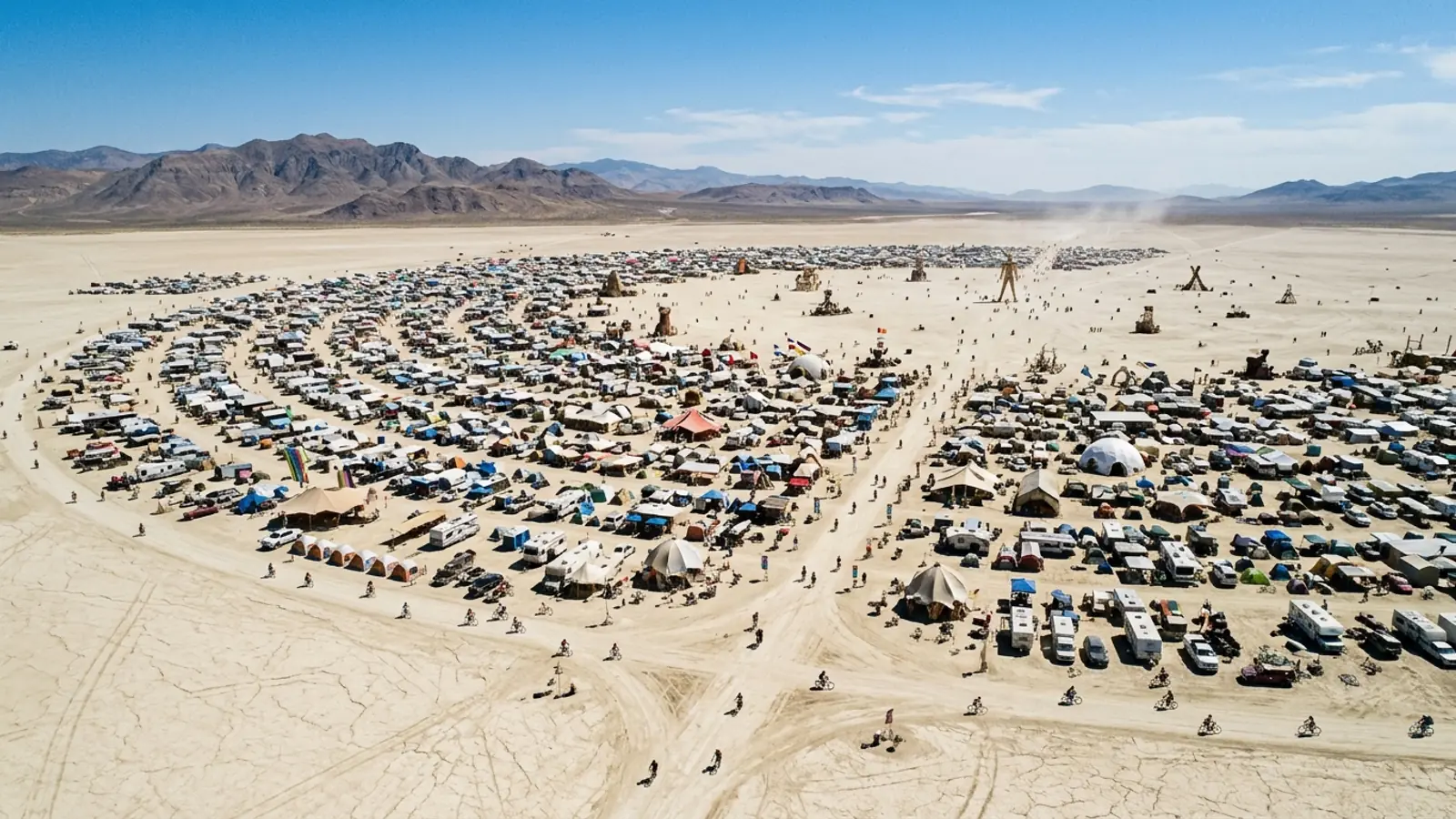
Every late summer, tens of thousands of participants gather on an ancient alkaline lakebed in northern Nevada to build Black Rock City, the temporary desert metropolis that hosts the Burning Man Festival. Unlike commercial music festivals or resort vacations, Burning Man provides no headliner concert schedule, no food courts, no hotel rooms, and no trash pickup. Attendees are active participants who haul in every drop of water, every meal, and every piece of shelter required to survive in the Black Rock Desert—and pack out every trace of waste when they leave.
Planning for Burning Man 2027 requires serious logistical preparation well before you step onto the playa. Temperatures in the Black Rock Desert regularly swing by 40°F or more between scorching afternoons and near-freezing nights, while sudden alkaline dust storms can reduce visibility to zero within seconds. Whether you are a first-time attendee from the United States or an international traveler flying into Nevada from the UK or Europe, this guide outlines the verified facts, official resources, packing requirements, and self-reliance strategies needed to prepare safely and responsibly.
What Is Burning Man Festival?
Organized by the nonprofit Burning Man Project (burningman.org), Burning Man is an annual week-long cultural and artistic gathering centered on community, radical self-expression, and decommodification. Rather than hiring commercial entertainment or booking stadium-style headliners, the event is co-created by its citizens—known as "Burners"—who design, fund, transport, and build the entire city's infrastructure, interactive art, and events themselves.
- Black Rock City: Built from scratch each year on a remote dry lakebed (the playa), Black Rock City is laid out in a giant concentric C-shaped semi-circle arranged like a clock face around a central open plaza containing "The Man." Radial streets run outward from the center, crossed by lettered concentric avenues.
- The Participation Model: There are no passive spectators at Burning Man. Every participant contributes to the city's life—whether by volunteering with event departments, hosting a workshop, serving coffee at a neighborhood camp, building an art piece, or keeping the desert spotless.
- Art Installations & Theme Camps: Hundreds of monumental, often interactive sculptures and mutated art vehicles ("Mutant Vehicles") populate the open playa. Surrounding them, registered Theme Camps create neighborhoods offering everything from bicycle repair and shade lounges to music sets, educational talks, and spontaneous performances.
The Ten Principles of Burning Man
Written by co-founder Larry Harvey in 2004 as a reflection of the community's ethos, the Ten Principles (burningman.org/about/10-principles/) guide life in Black Rock City:
- Radical Inclusion: Anyone may be a part of Burning Man. We welcome and respect the stranger, and no prerequisites exist for participation in our community.
- Gifting: Burning Man is devoted to acts of gift giving. The value of a gift is unconditional; gifting does not contemplate a return or an exchange for something of equal value.
- Decommodification: To preserve the spirit of gifting, the community seeks to create social environments unmediated by commercial sponsorships, transactions, or advertising. (In Black Rock City, nothing is bought or sold except ice and, historically, select beverages at Center Camp—verify current 2027 exceptions in the official Survival Guide).
- Radical Self-reliance: Burning Man encourages the individual to discover, exercise, and rely on their inner resources—including bringing all food, water, shelter, and survival gear needed for the desert.
- Radical Self-expression: Radical self-expression arises from the unique gifts of the individual. It is offered as a gift to others and should respect the rights and liberties of the recipient.
- Communal Effort: The community values creative cooperation and collaboration, striving to produce, promote, and protect social networks, public spaces, works of art, and methods of communication that support interaction.
- Civic Responsibility: Community members who organize events must assume responsibility for public welfare and endeavor to communicate civic responsibilities to participants, operating in accordance with local, state, and federal laws.
- Leaving No Trace: The community respects the environment and commits to leaving no physical trace of activities wherever it gathers, cleaning up after itself and leaving places in a better state than found.
- Participation: The community is committed to a radically participatory ethic, believing that transformative change can occur only through the medium of deeply personal participation.
- Immediacy: Immediate experience is the most important touchstone of value in the culture—overcoming barriers that stand between us and a recognition of our inner selves, the reality of those around us, participation in society, and contact with a natural world exceeding human powers.
Explore Popular Flight Corridors
Find direct vs connecting routes, airline schedules, and airport transfer tips.
When Is Burning Man 2027?
Official 2027 event dates, exact gate opening hours, and ticket sale schedules are currently awaiting official announcement by the Burning Man Project. Travelers should confirm all dates directly on burningman.org/event/ before purchasing non-refundable international flights or booking vehicle rentals.
- Traditional Scheduling Pattern (Historical Context): Historically, Burning Man takes place during the final week of August, concluding on the US Labor Day holiday (the first Monday in September). Based on the US calendar—where Labor Day falls on Monday, September 6, 2027—the traditional eight-day event window would run from Sunday, August 29 through Monday, September 6, 2027. However, do not treat these projected dates as guaranteed until published officially by Burning Man Project.
- Event Period vs. Travel Days: The official event period covers the eight days from gate opening through Exodus (departure). International and domestic travelers must budget at least 2 to 4 additional buffer days before and after the event for flying into Nevada, purchasing groceries and water, staging gear, navigating multi-hour entry/exit traffic queues, and cleaning dust-covered vehicles before returning rentals.
- Pre-Event Preparation Deadlines: Key milestones—including Burner Profile registration, Main Sale ticket registration, STEP (Secure Ticket Exchange Program) access, Burner Express Bus bookings, and Theme Camp placement applications—occur months in advance between winter and summer. Check tickets.burningman.org regularly for the 2027 timeline.
Where Is Burning Man Located?
Black Rock City is erected on federal public land managed by the Bureau of Land Management (BLM) (blm.gov) inside the Black Rock Desert in Pershing County, northwestern Nevada, USA.
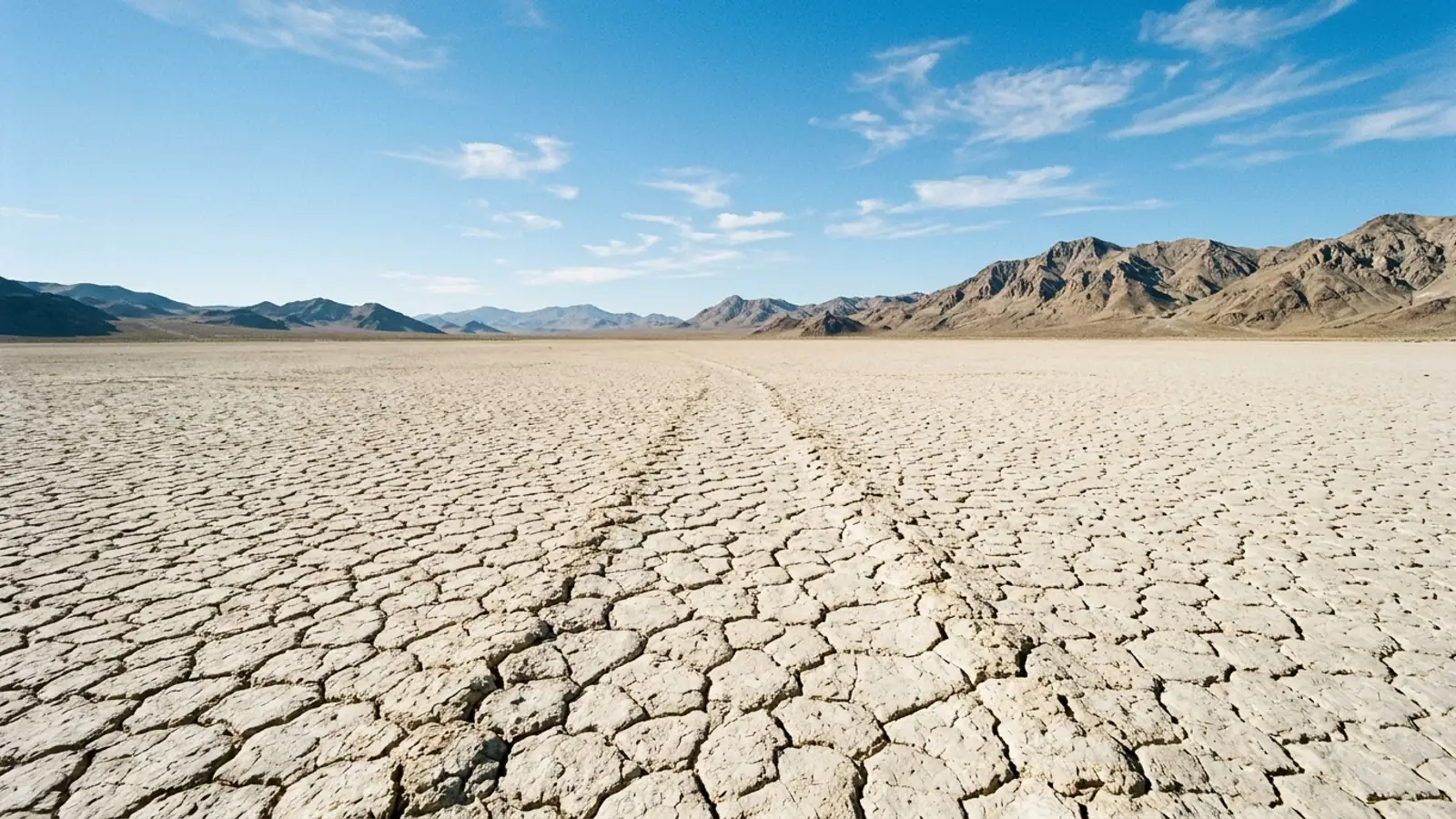
- Geographic Remoteness: The playa sits roughly 100 to 120 miles north-northeast of Reno, Nevada, just north of the small gateway towns of Gerlach and Empire. There are no permanent buildings, paved roads, electrical grids, water mains, or municipal services on the lakebed.
- Desert Access Conditions: Once you leave Interstate 80 east of Reno, travel continues along two-lane Nevada state highways (such as State Route 447) through rural high-desert terrain with limited fuel stations, minimal mobile phone coverage, and strict speed limits through small towns and tribal lands.
- Why Ordinary Navigation Fails: Standard smartphone GPS apps frequently fail or misroute drivers onto hazardous, unmaintained desert dirt tracks around the Black Rock Desert. Drivers must follow only official access routes (via I-80 and NV-447 through Wadsworth, Nixon, Empire, and Gerlach) and obey law enforcement signage, electronic highway boards, and live updates from the Nevada Department of Transportation (NDOT) and burningman.org/event/preparation/getting-there-and-back/.
- Location Reference: View Black Rock Desert, Nevada on Google Maps (use solely for broad geographic orientation, never for turn-by-turn off-road routing).
How to Get to Burning Man 2027
Flying to Reno-Tahoe International Airport (RNO)
Reno-Tahoe International Airport (RNO) (renoairport.com) is the primary commercial aviation gateway for Burning Man, located roughly 110 miles south of Black Rock City. (Travelers can compare flights into Reno-Tahoe International Airport to plan their travel routes early).
- Why Reno Is Standard: Reno offers major US airline connections (including American, Delta, United, Southwest, Alaska, and JetBlue), proximity to big-box grocery and camping supply stores, and direct access to the official Burner Express Bus airport pickup. International travelers from the UK and Europe typically clear US customs at a major hub (such as San Francisco, Los Angeles, Seattle, Denver, or Dallas) before connecting into RNO.
- Rental Car & RV Considerations: If you plan to rent a car, cargo van, or RV in Reno, book months in advance. Rental agencies strictly enforce cleaning fees for alkaline playa dust—which corrodes electronics and leaves white residue inside engines and upholstery—and some rental companies restrict off-road/playa driving in their contracts. Review rental agreements carefully and budget for thorough post-event detailing.
Driving From Reno to Black Rock City
- General Route: Drivers typically take Interstate 80 East from Reno to the Wadsworth/Pyramid Lake exit (Exit 43), continuing north on Nevada State Route 447 through Nixon, Empire, and Gerlach to the Black Rock City Gate Road entrance.
- Remote Road & Traffic Realities: SR 447 is predominantly a single-lane-each-way highway. During peak arrival (Gate opening weekend) and peak departure ("Exodus" on Sunday and Monday), traffic backups can stretch for many miles and take anywhere from 3 to 10+ hours to clear Gate Road or exit onto the highway. Never assume a normal two-hour highway drive during event weekends.
- Fuel & Vehicle Preparation: Fill your fuel tank completely in Reno or Fernley (and top off in Wadsworth or Gerlach if lines permit—do not rely solely on Gerlach stations during peak rushes). Check tire pressure, spare tires, coolant levels, wiper fluid, and engine air filters before departing Reno, as fine playa dust can clog air filters rapidly. Follow live traffic alerts at nvroads.com.
Flying to Other Nearby Airports
- Sacramento International Airport (SMF): Located roughly 135 miles southwest of Reno via Interstate 80 East over Donner Pass. SMF can be a practical backup if Reno flights or rental cars sell out, adding roughly 2.5+ hours of mountain highway driving to reach Reno before continuing north.
- San Francisco International Airport (SFO): Located ~220 miles southwest of Reno. Practical primarily for international travelers picking up an RV or camp gear in the Bay Area, or catching the official Burner Express Bus from San Francisco (if offered for 2027).
Burning Man Shuttle Services (Burner Express Bus)
The official Burner Express Bus (burnerexpress.burningman.org) is Burning Man's authorized shuttle program designed to reduce highway congestion and vehicle emissions.
- Confirmed vs. Pending 2027 Details: Exact 2027 operating dates, ticket fares, schedules, and pickup locations are awaiting official publication. Historically, Burner Express has operated routes from Reno-Tahoe International Airport (RNO) and San Francisco directly into Black Rock City's Depot, bypassing standard vehicle entry queues via dedicated bus lanes.
- Booking & Luggage Rules: Tickets must be purchased in advance online (riders must already hold a valid Burning Man event ticket). Buses enforce strict luggage allowances (historically two bags plus a carry-on, with optional add-on space for bicycles and pre-ordered water refills collected on-playa). Verify exact 2027 baggage limits and water add-on policies before packing.
Planning Travel Logistics?
Use FareWander tools to calculate flight times, luggage rules, and visa requirements.
Burning Man Tickets 2027 — What You Need to Know
All official ticket sales are managed exclusively through tickets.burningman.org and require creating an active Burner Profile prior to sale registration windows. Official 2027 ticket tiers, prices, and sale dates have not yet been announced.
- Why Tickets and Vehicle Passes Are Separate: Every individual entering Black Rock City requires a personal Event Ticket. In addition, any motor vehicle (car, truck, van, or RV) driving into Black Rock City requires a separate Vehicle Pass (historically limited to one vehicle pass per order). Arriving via Burner Express Bus eliminates the need for a Vehicle Pass.
- Ticket Tiers (Historical Context): Burning Man traditionally offers multiple price tiers—including standard Main Sale tickets, higher-priced steward/benefactor tiers that subsidize lower-income passes, and the Ticket Aid Program (reduced-price tickets for qualifying low-income applicants). Verify exact 2027 tiers and pricing on tickets.burningman.org.
- Official Resale & STEP: If you miss the primary sales, use only Burning Man's official Secure Ticket Exchange Program (STEP) or verified peer-to-peer face-value transfers linked through your Burner Profile.
- Avoiding Scams: Never buy tickets above face value or from unverified third-party scalping sites, social media resellers, or unauthorized "all-inclusive plug-and-play" tour packages. Tickets sold above face value are subject to voiding by Burning Man Project, leaving buyers stranded at the gate.
Where to Stay at Burning Man — Camping in Black Rock City
There are no hotels, cabins, or commercial accommodations in Black Rock City. Every participant camps on the flat alkali playa for the duration of their stay.
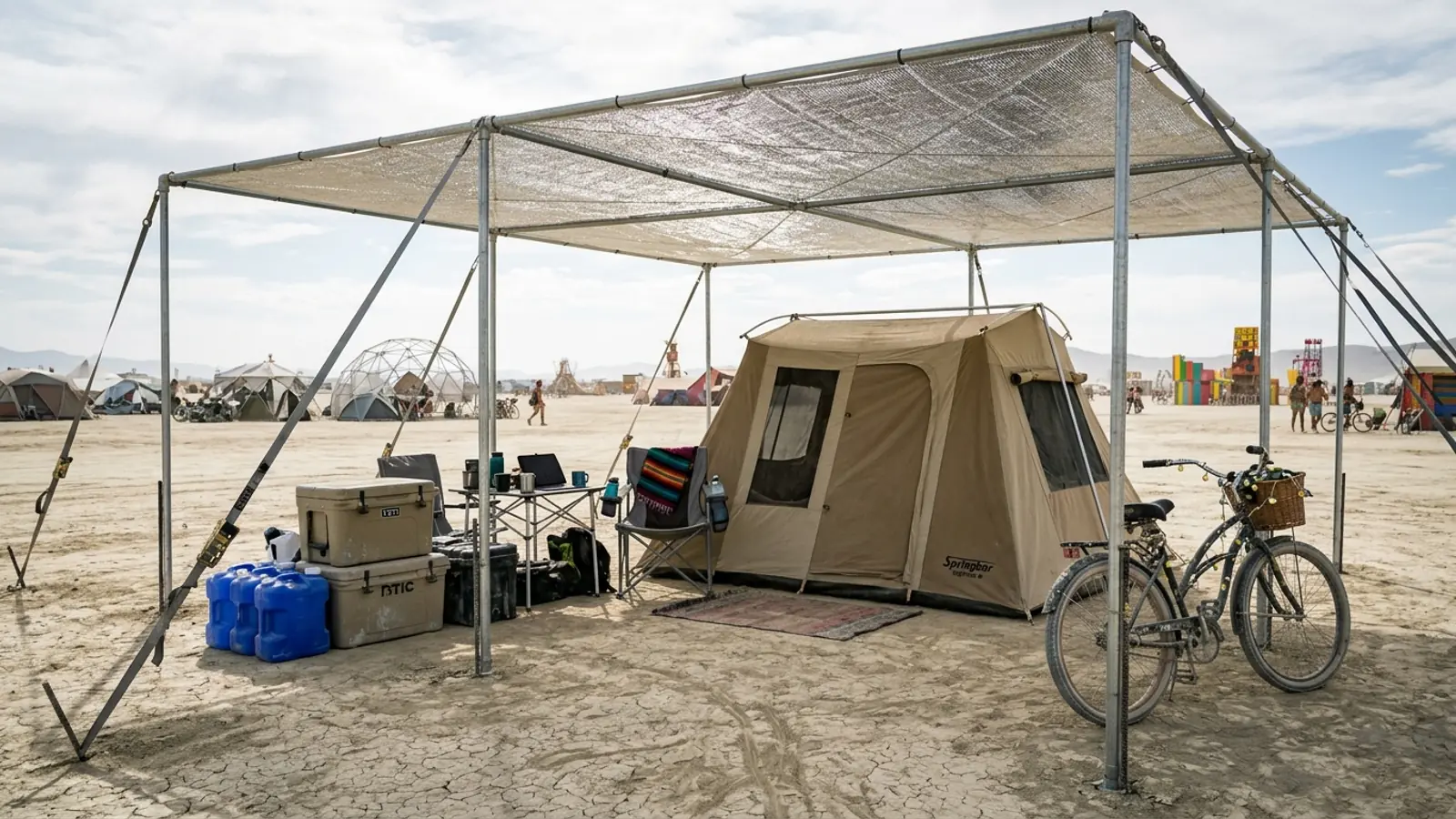
- Open (Unreserved) Camping: Solo travelers and small groups arriving without a placed camp can set up tents, shade structures, or RVs in designated open camping sectors (typically located along the outer lettered avenues—check the 2027 city map upon arrival at the Gate). Open camping is first-come, first-served; respect blue boundary flags marking reserved Theme Camps and fire lanes.
- Theme Camps & Placed Camps: Registered Theme Camps apply in advance for reserved real estate through Burning Man's Placement team in exchange for offering interactive experiences, art, or services to the city. Many Theme Camps welcome new members who contribute camp dues, build/strike labor, and shift duties—contact camps directly through regional Burner networks (regionals.burningman.org) months ahead, as space is never guaranteed.
- Tent Camping vs. RV Camping:
- Tent Camping: Most economical, but requires serious anchoring (heavy-duty lag screws/rebar) and an aluminet or heavy-duty shade canopy over the tent to keep daytime interior temperatures survivable.
- RV & Camper Van Camping: Provides insulated walls, a kitchen, and a shower/toilet, though generator exhaust rules, greywater tank capacity limits, and strict pump-out policies apply. RVs still require a standard Vehicle Pass (verify maximum vehicle length rules for 2027).
- Self-Reliance & Shared Facilities: Burning Man provides portable toilets (porto-potties) throughout the city, which are serviced regularly by contractors. However, there are no public showers, no electrical hookups, and no trash cans. Every camp manages its own power, water, greywater, and garbage.
Burning Man Packing List — Essential Things to Bring
Consult the current Burning Man Survival Guide before finalizing your gear list to verify prohibited items (such as firearms, fireworks, drones/UAVs without FAA/BRC authorization, glass bottles in high-traffic zones, and wood-burning fires directly on the playa surface). Note: Survival gear is not a substitute for professional medical care.
Shelter and Sleeping
- Dust-resistant tent (avoid tents with large unsealable mesh panels that cannot be zipped shut against dust)
- Heavy-duty anchoring: 12-inch to 18-inch lag screws with washers (installed using a cordless impact driver) or bent rebar stakes—standard tent pegs pull right out of playa dust in high winds
- Shade structure (e.g., Monkey Hut, EMT conduit canopy, or heavy-duty pop-up frame covered with breathable shade cloth/Aluminet)
- Cold-weather sleeping bag (rated to 20°F–30°F / -6°C to -1°C) and insulated sleeping pad or cot
- Sealed plastic storage bins with latching lids to keep clothing and bedding dust-free
Clothing
- Lightweight, breathable daytime clothing (cotton, linen, athletic wear) and sun-protective long sleeves
- Warm nighttime layers: insulated down or synthetic jacket, fleece sweater, thermal base layers, warm beanie, and gloves
- Broken-in, closed-toe boots or sturdy sneakers (alkaline playa dust dries out and cracks bare skin—known as "playa foot"—if you walk barefoot or in open sandals)
- Work gloves for staking down camp structures and handling equipment
Personal Protection
- Sealed, non-vented or foam-lined goggles (ski goggles or industrial safety goggles—sunglasses alone will not protect your eyes during a whiteout dust storm)
- Well-fitting particulate respirator masks (N95/KN95 or P100) suitable for fine alkaline dust (cloth bandanas alone do not filter microscopic playa dust; individuals with asthma or respiratory conditions should consult a physician before attending)
- Broad-spectrum sunscreen (SPF 30+), SPF lip balm, and saline nasal spray/eye drops
- Biodegradable body wipes, hand sanitizer, and single-ply toilet paper (for porto-potty visits)
- Personal first-aid kit (blister care, antiseptic, pain relievers, bandages, tweezers, and vinegar/lotions for neutralizing alkaline dust on skin)
Electronics and Navigation
- High-capacity portable power banks and solar panels (with dust covers for charging ports)
- Bright LED headlamp plus extra batteries
- Wearable LED lights or EL wire (mandatory for nighttime visibility so cyclists and art cars can see you)
- Offline downloaded maps and printed emergency contact/camp location cards (keep a laminated card with your camp address in your pocket)
Tools and Equipment
- Cordless impact driver (for lag screws), spare batteries, and socket adapters
- Heavy-duty duct tape, zip ties, paracord, and multi-tool
- Reusable water jugs/containers, collapsible wash basins, and funnels
- Heavy-duty contractor trash bags and sealable containers for separating recyclables, food waste, and greywater
Food and Water at Burning Man
Radical Self-Reliance begins with bringing enough food and water to sustain yourself independently from arrival through Exodus. There are no supermarkets, restaurants, or food vendors inside Black Rock City (aside from ice sales at Arctica—verify 2027 ice operating hours in the Survival Guide).
- Drinking Water Requirements: Per the official Burning Man Survival Guide, participants are advised to bring at least 1.5 to 2 gallons (approximately 5.7 to 7.5 liters) of water per person, per day for drinking, cooking, and basic hygiene. This guideline assumes standard late-summer desert heat and moderate physical activity—increase your supply if you exercise heavily, camp in hot weather, or anticipate Exodus traffic delays.
- Emergency Water Reserves: Always pack an extra 2 to 3 gallons per person of sealed emergency reserve water in your vehicle in case extreme weather or road closures delay departure.
- Water & Food Storage: Store water in sturdy, leak-proof 2.5-gallon to 7-gallon jugs (avoid thin single-use plastic gallon jugs that split easily in transit). Keep perishable food inside high-performance coolers using block ice (which melts far more slowly than cubed ice) and drain meltwater into greywater containers rather than onto the playa.
- Meal Preparation & Safety: Pack non-perishable, easy-to-prepare foods requiring minimal dishes—such as canned soups, precooked rice/grain pouches, tuna/chicken packets, nut butter, crackers, dried fruit, trail mix, and electrolyte powder packets. If using a propane camp stove, follow official fuel storage limits and never cook inside an enclosed tent due to carbon monoxide hazards.
Burning Man Weather — What to Expect in the Black Rock Desert
The Black Rock Desert sits at an elevation of roughly 3,900 feet in the rain shadow of the Sierra Nevada mountains, producing an arid high-desert climate with extreme daily swings.
- Daytime Heat vs. Nighttime Cold: Historical climate records from the National Weather Service Reno (weather.gov/rev) show late-August/early-September daytime highs frequently reaching 85°F to 100°F+ (29°C to 38°C+) under intense UV radiation, followed by overnight lows dropping into the 40s°F or high 30s°F (3°C to 9°C).
- High Winds & Dust Storms: Sudden afternoon and evening wind gusts exceeding 30 to 50+ mph are common, whipping the fine alkaline silt of the lakebed into dense whiteout dust storms that can last from a few minutes to several hours.
- Rain & Playa Surface Conditions: Although rare in late summer, passing desert thunderstorms can drench the lakebed. When wet, playa dust turns into thick, sticky clay mud that immobilizes vehicles, bicycles, and footwear. If rain occurs, stay put at your camp—driving or cycling on a wet playa damages the lakebed surface and strands vehicles until the sun dries the crust.
- Monitoring 2027 Forecasts: Long-range weather forecasts cannot be predicted months in advance. Monitor live forecasts via weather.gov, Gate Road radio (BMIR 94.5 FM—verify 2027 frequency upon arrival), and official Burning Man emergency alerts.
Dust Storms and Playa Safety
Whiteout dust storms are a defining reality of Black Rock City. Preparing properly turns a disorienting storm into a manageable event:
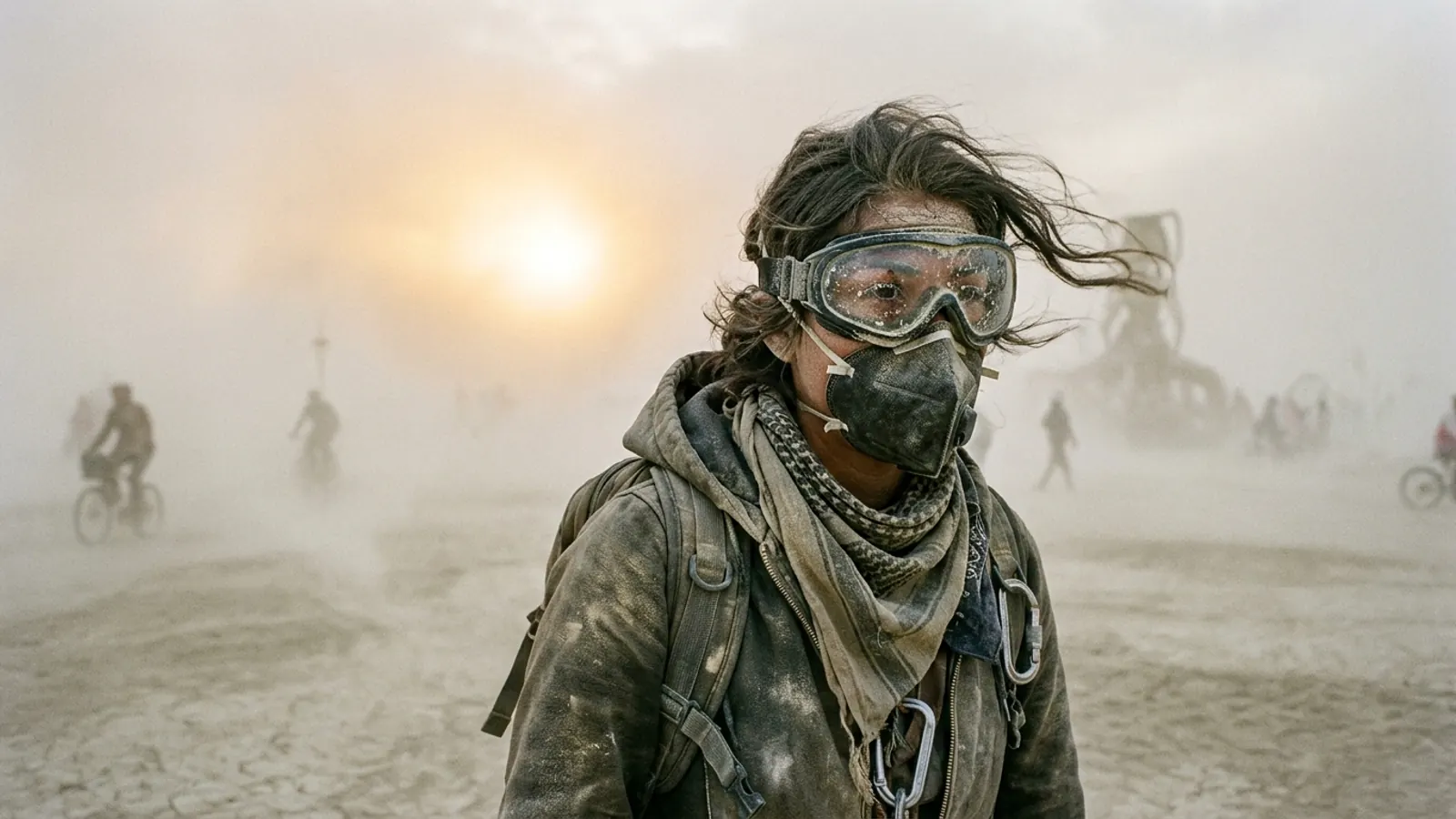
- Put On Goggles and Mask Immediately: At the first sign of an approaching dust wall, seal your goggles over your eyes and fit your N95/P100 respirator securely over your nose and mouth.
- Stop Moving & Shelter in Place: Never attempt to drive a vehicle or ride a bicycle rapidly through a whiteout where you cannot see 10 feet ahead—collisions with pedestrians, art installations, and guide wires are a serious hazard. Disembark your bike, turn on your lights, and shelter inside the nearest enclosed tent, structure, or art piece until visibility clears.
- Secure Camp & Supplies: Before leaving camp each day, zip tent doors completely, weight down loose items, and seal all water spigots and food containers so alkaline dust does not contaminate your supplies.
- Medical & Respiratory Precautions: Alkaline playa dust (pH ~9–10) irritates eyes, throat, and lungs. Anyone with asthma, COPD, cardiovascular conditions, or severe allergies should consult a qualified healthcare provider before deciding to attend.
Burning Man Transportation Inside Black Rock City
Once you park your vehicle at camp, driving personal motor vehicles inside Black Rock City is prohibited (except for pre-licensed Mutant Vehicles, authorized art support vehicles, and emergency/service fleets).
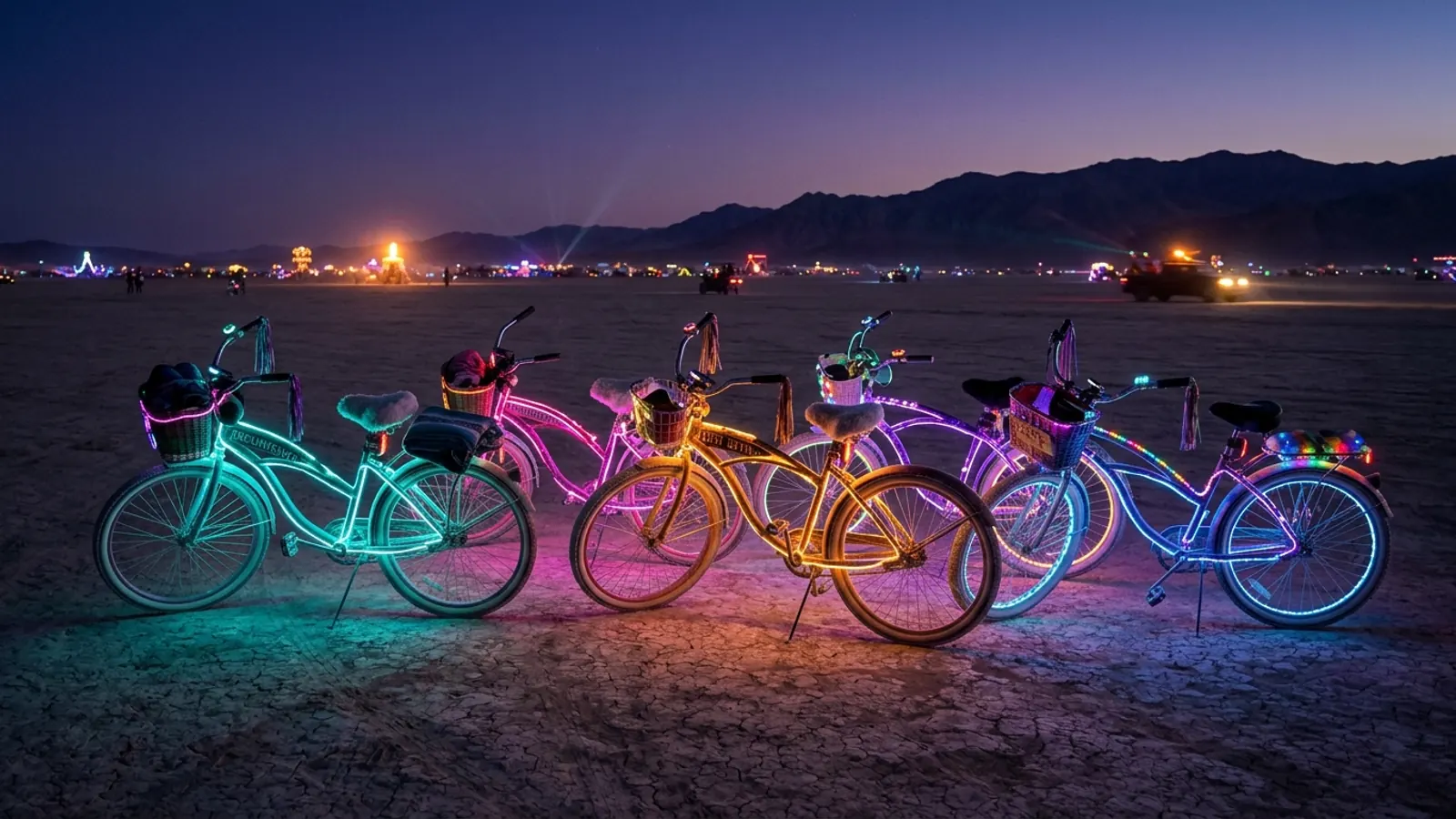
- Bicycles (Primary Transport): Black Rock City spans several miles across, making a sturdy, single-speed cruiser or mountain bike with wide tires (2.0 inches or wider—avoid skinny road-bike tires that sink in soft dust) the most practical way to get around.
- Bike Preparation & Night Lighting: Lubricate your bike chain with dry Teflon/wax lubricant (wet oil attracts dust and seizes chains). Equip your bike with a bright front headlight, rear red taillight, and wheel/frame LED lights so you are visible from 360 degrees at night. Bring a combination lock—dozens of cruiser bikes look identical in the dark.
- Walking: Ideal for exploring your immediate neighborhood or taking nighttime walks across the open playa, provided you wear bright personal illumination so cyclists and Mutant Vehicles can spot you easily.
- Accessibility: Burning Man's Mobility Camp and accessibility resources (burningman.org/event/preparation/playa-living/accessibility/) provide support and information for participants with disabilities, including guidelines for accessible Mutant Vehicles and camp placement.
Art, Music and Things to Experience at Burning Man
Because Burning Man's programming is participant-created, specific 2027 art installations, theme camp lineups, and music sets are not announced as a commercial festival bill and evolve right up until the event. However, several foundational traditions anchor the week:
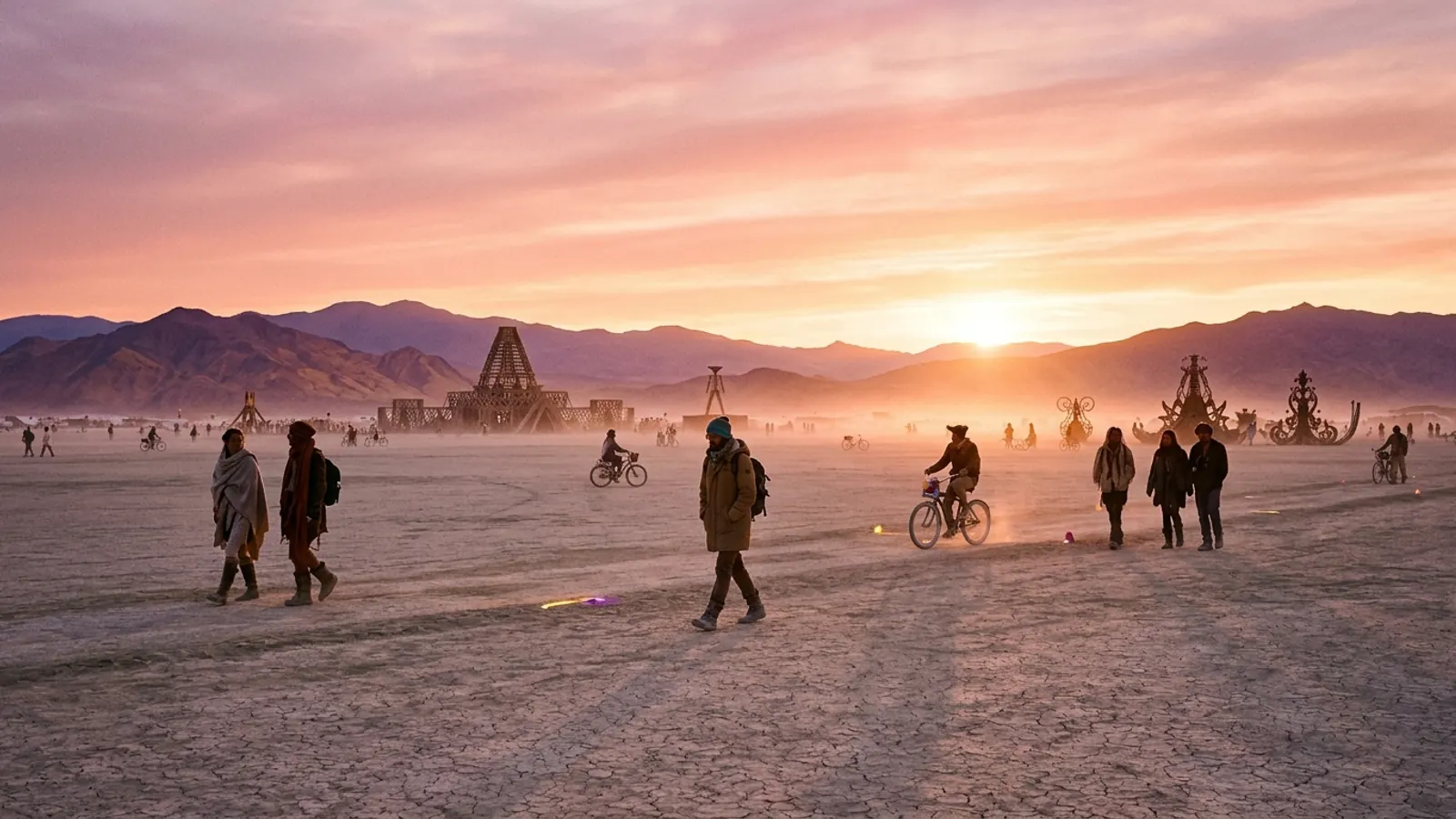
- Large-Scale Interactive Art: Scattered across the open playa are massive wooden, steel, and kinetic sculptures designed to be climbed, explored, and experienced at sunrise, sunset, and under starlight.
- Workshops, Talks & Performances: Daily event listings (published in the What Where When guide distributed at Gate—verify 2027 digital/print formats) feature hundreds of participant-hosted sessions ranging from yoga, welding, and astronomy talks to comedy, fire spinning, and acoustic concerts.
- Music & Sound Art: Sound camps—typically positioned along the outer 2:00 and 10:00 avenues—and mobile Mutant Vehicles host continuous electronic, live, and experimental sets across all hours, though schedules are decentralized and subject to spontaneous change.
- The Burn (The Man): Traditionally held on Saturday evening near the end of the event, the community gathers in a massive circle around the central plaza to watch the ceremonial burning of the wooden effigy known as The Man.
- The Temple Burn: Traditionally held on Sunday evening—the final night of the event—The Temple is a quiet, non-denominational sanctuary built each year where participants leave memorials, letters, and reflections for loved ones before the structure burns in complete silence.
Burning Man Rules and Ten Principles
While the Ten Principles represent cultural ideals rather than criminal statutes, Burning Man also enforces strict Event Policies and Federal/State Laws (burningman.org/event/preparation/playa-living/rules-and-regulations/) patrolled by Black Rock Rangers, BLM Law Enforcement, and Pershing County Sheriff's deputies:
- Consent & Personal Boundaries: Explicit, enthusiastic consent is required before photographing anyone, entering private camp spaces, or engaging in physical interaction.
- Respect for Art: Never climb on art installations marked "No Climbing," and never throw trash or unauthorized items into art burns.
- Fire & Fuel Safety: Open wood fires directly on the playa are prohibited; fire pits must be elevated in approved burn barrels/platforms, and all fuel must be stored in certified containers away from ignition sources.
- Zero Tolerance for Commerce: Vending, bartering, or advertising corporate brands on the playa violates decommodification policies and permit rules.
Leave No Trace — Environmental Responsibilities
Black Rock City is the largest Leave No Trace event in the world. Every participant is personally responsible for ensuring the playa returns to its natural state.
- What MOOP Means: MOOP stands for Matter Out Of Place—anything that was not originally part of the Black Rock Desert, including bottle caps, zip ties, wood splinters, glitter, feathers, cigarette butts, spilled greywater, and ash. (Avoid bringing loose feathers, sequins, glitter, or glass bottles, which easily become MOOP).
- Managing Greywater: Never dump dishwater, shower water, or melted cooler water onto the playa surface. Collect all greywater in sealed tanks or use an approved evaporation setup, and haul liquid greywater out to authorized RV dump stations in Gerlach, Wadsworth, or Reno.
- Daily & Final MOOP Sweeps: Perform a "MOOP sweep" of your campsite daily, and conduct a final grid-by-grid line sweep with your campmates after packing your vehicles—picking up every speck of debris before driving toward Exodus.
Medical Services, Emergencies and Personal Safety
Black Rock City operates temporary emergency and medical infrastructure supported by Emergency Services Department (ESD) volunteers, paramedics, and licensed medical personnel.
- Medical Stations: First-aid and medical stations operate 24 hours a day at key locations (historically near Center Camp and along the 3:00 and 9:00 plazas—check the 2027 city map upon arrival for exact coordinates). For urgent emergencies on the playa, contact a uniformed Black Rock Ranger or ESD responder immediately; do not attempt to drive yourself through pedestrian crowds.
- Heat Exhaustion & Dehydration: Watch for warning signs including headache, dizziness, dark urine, muscle cramps, confusion, or nausea. Rest in shade immediately, drink water with electrolytes, and seek medical care promptly if symptoms worsen.
- Medication & Personal Care: Bring a full supply of all prescription medications (plus extra days in case of travel delays), stored in temperature-regulated containers so extreme desert heat does not degrade insulin, inhalers, or other sensitive medications.
- Driver Fatigue: Never drive on SR 447 or I-80 while exhausted after Exodus. Pull over to rest or switch drivers if you feel drowsy—serious symptoms or injuries require immediate professional medical care.
How Much Does Burning Man 2027 Cost?
Burning Man is a significant financial commitment once you combine tickets, transportation, desert gear, and post-event cleaning. The table below provides a realistic planning framework in USD (checked against historical official ranges as of November 2026; all 2027 figures are estimates awaiting official 2027 pricing).
| Expense Category | Budget-Conscious Estimate (USD) | Mid-Range Estimate (USD) | Higher-Spend / RV Estimate (USD) | Planning Notes & Verification |
|---|---|---|---|---|
| Event Ticket (1 Person) | $225 – $575 (Ticket Aid / Lower Tier) | $575 – $750 (Standard Main Sale Tier) | $1,500 – $3,000+ (Benefactor / Steward Tiers) | 2027 prices unconfirmed. Verify exact tiers + NV Live Entertainment Tax & fees at tickets.burningman.org. |
| Vehicle Pass (Per Vehicle) | $0 (if using Burner Express Bus) | $150 – $200 (split among carpoolers) | $150 – $200 (1 pass per RV/vehicle) | 2027 price unconfirmed. Required for every motor vehicle entering BRC. |
| Flights / Airport Transfers | $250 – $500 (US domestic economy to RNO) | $450 – $850 (US cross-country or Burner Express) | $900 – $1,600+ (UK/Europe international economy to RNO) | Depends on origin city and booking lead time. |
| Rental Vehicle / RV + Fuel | $150 – $300 (Burner Express Bus round-trip) | $700 – $1,400 (SUV/minivan rental + fuel + car wash) | $3,500 – $6,500+ (RV rental + generator fuel + pump/cleaning) | Factor in mandatory playa dust cleaning fees ($250–$600+). |
| Camping & Shelter Gear | $300 – $600 (borrowing/buying basic tent & shade) | $600 – $1,200 (dust-proof tent, lag screws, shade canopy) | $1,000 – $2,000+ (upgraded Kodiak/shiftpod shelter & solar) | First-timers buying all gear from scratch spend toward the upper end. |
| Food, Water & Ice (8–9 Days) | $150 – $250 (bulk non-perishables & water jugs) | $250 – $400 (groceries, electrolytes, cooler ice) | $400 – $650 (specialty foods, camp meal plan, ice) | No commercial food vendors exist on-playa. |
| Clothing, Goggles, Masks & Bike | $150 – $300 (used cruiser bike, LED lights, goggles, N95s) | $300 – $550 (reliable cruiser bike, spare tubes, winter layers) | $550 – $1,000+ (fat-tire bike, custom LEDs, technical cold gear) | Never skimp on sealed goggles and N95/P100 masks. |
| Theme Camp Dues & Contingency | $200 – $400 (emergency buffer; $0 dues in open camp) | $400 – $900 (optional Theme Camp dues + contingency) | $800 – $2,000+ (established Theme Camp infrastructure dues) | Maintain at least $250–$400 in cash/card contingency for vehicle repairs or delays. |
Burning Man for First-Time Attendees
- Read the Official Survival Guide Cover to Cover: Download and read the current Survival Guide before buying gear. It contains critical rules on fire, sound, vehicles, and safety that override generic festival advice.
- Test Every Piece of Gear Before Leaving Home: Pitch your tent, assemble your shade canopy, test your cordless impact driver with lag screws, and check every LED light string in your yard or living room before packing.
- Pack for Function Over Fashion: Outfits matter far less than broken-in boots, sealed goggles, warm nighttime coats, and reliable hydration.
- Master the City Clock & Street Grid: Learn how Black Rock City's clock coordinates work (e.g., "4:30 & E") so you can navigate back to your camp at 3:00 AM without GPS.
- Avoid Over-Scheduling: Attempting to chase a strict timetable leads to frustration on the playa. Pick one or two anchor activities per day and leave plenty of room for spontaneous exploration, rest, and hydration.
- Common First-Timer Mistakes to Avoid: Bringing standard wire tent stakes instead of lag screws; forgetting warm winter layers for 4:00 AM; neglecting bicycle lights; packing single-use plastic water bottles that create mountains of trash; and scheduling a flight out of Reno on Monday afternoon without accounting for multi-hour Exodus traffic.
Is Burning Man Suitable for Everyone?
Burning Man is deeply rewarding for self-directed, adaptable travelers, but it is not suitable for every vacation style:
- Physical & Environmental Demands: Participants walk or cycle several miles daily in dry heat, high altitude (~3,900 ft), intense sun, sleep disruption, and alkaline dust.
- Zero Conventional Amenities: Travelers expecting air-conditioned hotel rooms, room service, reliable Wi-Fi, or quiet nights will struggle unless they carefully engineer an RV or specialized camp setup.
- Families & Travelers with Medical/Accessibility Needs: Families with children do attend Burning Man (including dedicated family-friendly neighborhoods like Kidsville—verify current 2027 camp participation), provided parents enforce strict sun, hydration, dust, and supervision protocols. Individuals with chronic respiratory, cardiac, or mobility conditions should consult a qualified physician and review Burning Man's official Accessibility Guide before committing to the journey.
Suggested Burning Man Preparation Timeline
Note: Because official 2027 dates and sale windows have not yet been published, use the sequence below as a general planning framework and plug in verified dates once released on burningman.org.
- 6 to 9 Months Before the Event: Read the Burning Man Survival Guide; decide between open camping, joining a Theme Camp, or taking the Burner Express Bus; create your Burner Profile; and research flights and cancellable Reno hotel/RV reservations.
- Official Ticket Registration & Sale Period: Register for the Main Sale (or Ticket Aid) through your Burner Profile during the exact announced window; purchase your Event Ticket and Vehicle Pass (or register for STEP if needed).
- 2 to 3 Months Before Departure: Finalize flights into Reno (RNO); book Burner Express Bus tickets (if not driving); purchase or source your tent, shade canopy, lag screws, cruiser bike, goggles, and N95/P100 masks.
- 2 to 4 Weeks Before Departure: Test-assemble your shelter and lighting; organize clothing into sealed dust-proof bins; finalize your food menu and water gallon calculations; and download offline maps and NDOT road alert tools.
- Final Week & Staging in Reno: Arrive in Reno at least 1 to 2 days before your planned Gate entry; buy drinking water, block ice, and perishable groceries; strip excess cardboard/plastic packaging from food so you don't haul unnecessary trash onto the playa; and fill your fuel tank.
- Arrival & Camp Setup: Follow official highway signage on NV-447; have your physical ticket and Vehicle Pass ready at the Gate; anchor your tent and shade structure immediately upon claiming your spot; and greet your neighbors.
- Departure (Exodus) & Cleanup: Conduct a thorough camp-wide MOOP sweep; load all trash and greywater into your vehicle; obey Gate Road speed limits (typically 5–10 mph on the playa); dispose of trash and greywater only at authorized transfer/dump stations (never in private business dumpsters); and wash/detail rental vehicles before returning them.
Frequently Asked Questions
Official 2027 dates have not yet been confirmed by the Burning Man Project. Historically, the event runs for eight days ending on US Labor Day—which would place the traditional window around August 29 – September 6, 2027—but travelers must verify official dates on burningman.org/event/ before booking travel.
Confirmed and Unconfirmed 2027 Event Details
Confirmed / Static Official Details:
- Location: Black Rock Desert, Pershing County, Nevada, USA (federal public land managed by the Bureau of Land Management).
- Organizer: Burning Man Project (nonprofit organization).
- Core Ethos & Policies: Governed by the Ten Principles, Radical Self-Reliance, Decommodification, and strict Leave No Trace (MOOP) federal permit standards.
- Official Water Guideline: 1.5 to 2 gallons (5.7 to 7.5 liters) per person, per day per the Burning Man Survival Guide.
- Primary Commercial Airport: Reno-Tahoe International Airport (RNO), accessed via I-80 East and NV-447.
Unconfirmed / Pending Official 2027 Announcement:
- Exact 2027 Event Dates & Gate Opening/Closing Hours (projected window of August 29 – September 6, 2027 follows the historical Labor Day pattern, but remains unconfirmed).
- 2027 Ticket Tiers, Exact Prices & Sale Dates (Main Sale, Ticket Aid, Steward/Benefactor tiers, and STEP timelines are unconfirmed).
- 2027 Vehicle Pass Pricing & Allocation Rules (unconfirmed).
- 2027 Burner Express Bus Routes, Fares, Luggage Limits & Schedules (unconfirmed).
- 2027 Annual Art Theme, Center Camp Beverage Policies, Ice (Arctica) Pricing & Placed Theme Camp Roster (unconfirmed).
Conclusion
Attending Burning Man 2027 in Black Rock City is one of the most demanding—and rewarding—travel experiences in North America. Success on the playa comes down to preparation: securing legitimate tickets through your Burner Profile, packing enough food, water, and cold-weather gear to remain completely self-reliant, preparing for sudden dust storms, and honoring Leave No Trace principles from arrival through Exodus. Before finalizing your itinerary, review the latest edition of the official Burning Man Survival Guide and monitor burningman.org for confirmed 2027 dates and operational updates.
Planning more adventures across the American West? Explore more destination guides, road trip itineraries, and travel planning resources on Farewander.