Every spring, more than 3,000 cherry trees along the Tidal Basin and across the National Mall burst into pale pink and white blossoms, turning Washington, DC into one of the most popular springtime destinations in the United States. The National Cherry Blossom Festival commemorates the 1912 gift of cherry trees from Mayor Yukio Ozaki of Tokyo to the people of the United States, celebrating enduring friendship between Japan and the U.S. alongside the arrival of Washington’s peak spring tourism season. Because the blossoms are living trees governed by late-winter temperatures rather than fixed calendar dates, organizing a 2027 trip requires understanding how the multi-week festival calendar differs from the brief botanical peak bloom window. This guide helps you plan every practical detail of a 2027 visit—from official festival dates and National Park Service bloom tracking to viewing locations, Tidal Basin construction rules, airport transit, neighborhood hotels, spring weather layers, and realistic trip budgets.
When Is the National Cherry Blossom Festival 2027?
- Official 2027 Festival Dates: Awaiting official confirmation on nationalcherryblossomfestival.org.
- Expected Spring Travel Window: Historically, the National Cherry Blossom Festival spans roughly four weeks from mid-March through mid-April (for context, recent editions have run from around March 20 through mid-April).
Travelers must distinguish between the festival dates and actual cherry blossom peak bloom:
- The Festival Calendar: The National Cherry Blossom Festival is a multi-week civic celebration featuring scheduled concerts, parades, kite flying, and cultural programming spread across several weekends. Because organizers must book venues, permits, and performers months in advance, the festival dates are fixed on the calendar well before spring arrives.
- Actual Peak Bloom: The blossoms themselves respond strictly to late-winter and early-spring temperatures. In warm years, the trees can reach peak bloom right as the festival opens—or even slightly before. In colder springs, peak bloom may not arrive until the final week of the festival.
- Individual Event Dates: Not every signature event occurs on the same weekend. The Opening Ceremony, Blossom Kite Festival, National Cherry Blossom Festival Parade, and Petalpalooza each take place on separate scheduled dates throughout the multi-week run. Always verify the 2027 calendar directly at nationalcherryblossomfestival.org before locking in non-refundable travel plans.
When Is Peak Cherry Blossom Bloom in Washington, DC in 2027?
- Official 2027 Peak Bloom Forecast: Not yet announced. The National Park Service (NPS) typically releases its initial annual peak bloom prediction in late February or early March, updating it regularly as flower buds develop.
How Peak Bloom Works
According to the National Park Service Cherry Blossom Watch, peak bloom is defined as the date when 70 percent of the Yoshino cherry blossoms (Prunus × yedoensis) surrounding the Tidal Basin are open.
Horticulturists track five distinct developmental stages leading up to peak bloom:
- Green buds
- Florets visible
- Extension of florets
- Peduncle elongation (stalks lengthen)
- Puffy white stage (blossoms emerge right before opening)
- Peak bloom (70% of blossoms open)
Historical Bloom Patterns vs. 2027 Forecasts
- Historical Context Only (Not a 2027 Prediction): Based on decades of NPS records, the average peak bloom date falls around April 3–4, with the vast majority of peak blooms occurring between the last week of March and the first week of April. Extreme historical outliers have ranged from as early as March 15 (1990) to as late as April 18 (1958).
- Weather Sensitivity: A sudden warm spell in March can accelerate bud opening by days, while a late-season frost, heavy rainstorm, or strong wind gusts can shorten the display after blossoms open.
- What Happens Before and After Peak Bloom: Arriving a few days before peak bloom still rewards visitors with puffy white buds, early-opening Kwanzan and Okame varieties, and magnolias. Arriving a few days after peak bloom offers "petal snow" drifting across the paths alongside late-blooming double-petaled Kwanzan cherry trees, which typically peak one to two weeks after the Yoshinos. Monitor live updates on the NPS Bloom Watch page.
Explore Popular Flight Corridors
Find direct vs connecting routes, airline schedules, and airport transfer tips.
Best Places to See Cherry Blossoms in Washington, DC
While the Tidal Basin is the centerpiece of Washington’s blossom display, several surrounding parks and monuments offer distinct viewpoints and crowd levels.
Tidal Basin
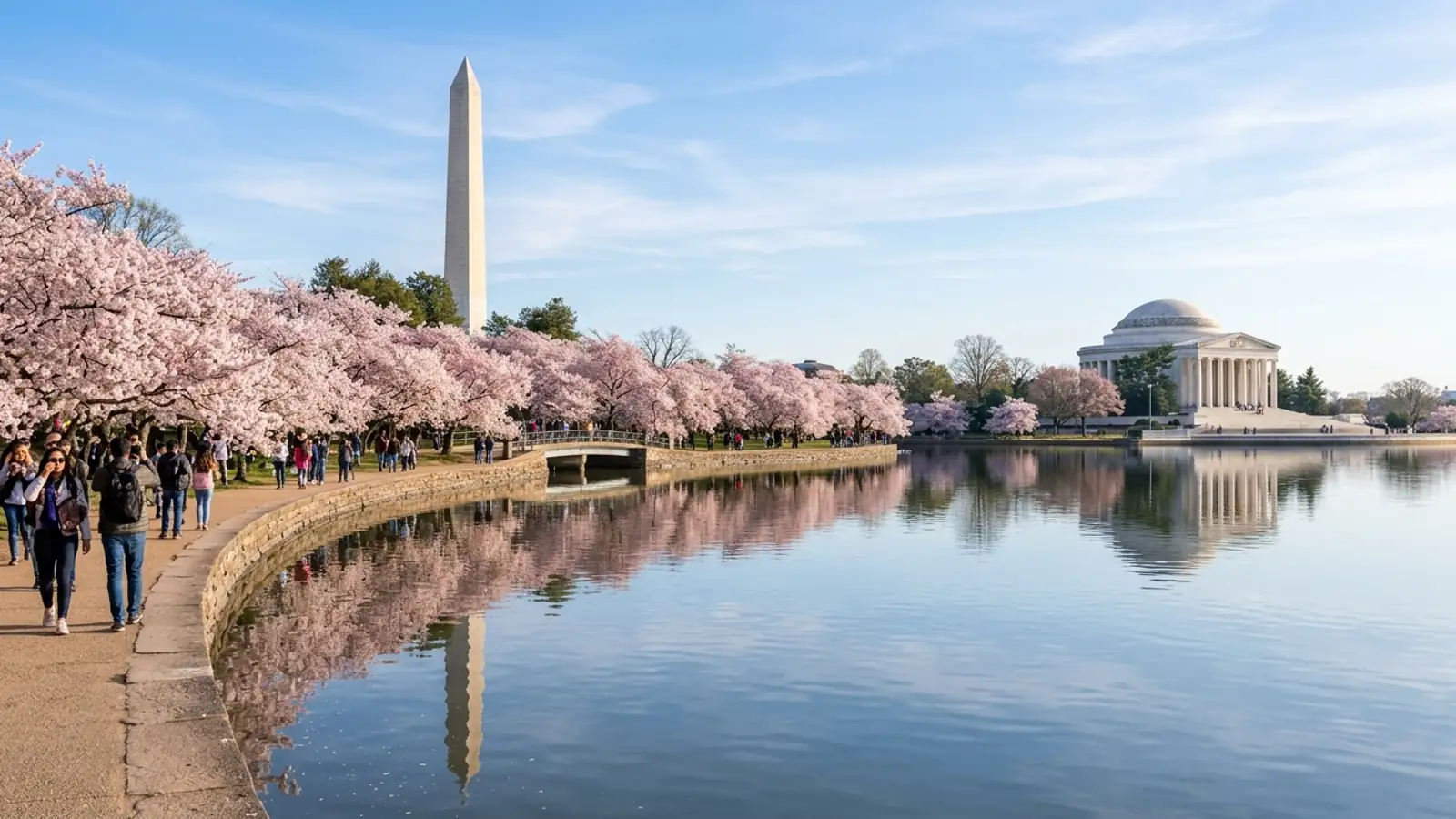
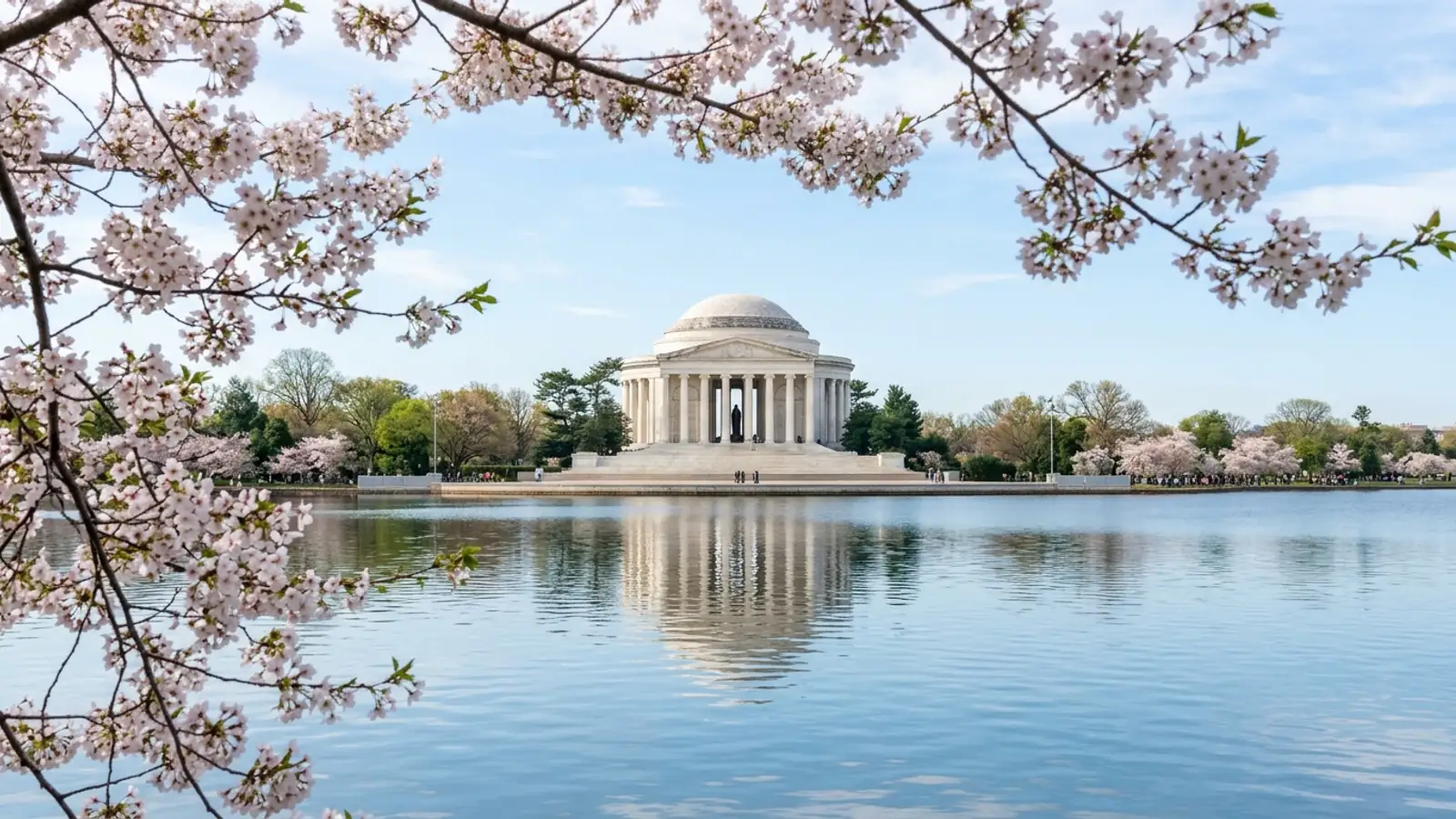
- Why Visit: Surrounded by the densest concentration of Yoshino cherry trees in the capital, the 107-acre Tidal Basin frames blossoms directly against the Jefferson Memorial, Martin Luther King, Jr. Memorial, and Washington Monument across calm water.
- Practical Visiting & Construction Notes: The loop path around the Tidal Basin is approximately 2 miles long. Note that the National Park Service has been conducting major multi-year seawall reconstruction and rehabilitation along sections of the Tidal Basin and West Potomac Park; temporary fencing, narrowed walkways, and detours around active work zones may remain in place during 2027. Check the NPS Tidal Basin Cherry Blossoms Visitor Guide for active trail closures before walking the full loop.
- Nearest Transit & Accessibility: Smithsonian Metro station (Orange, Blue, Silver lines) is the closest rail stop. The main paved perimeter paths are generally flat and wheelchair-accessible, though heavy crowds and construction detours can narrow passageways.
Jefferson Memorial
- Why Visit: Positioned on the southern shore of the Tidal Basin, the neoclassical marble rotunda provides the classic postcard backdrop framed by overhanging cherry branches.
- Practical Visiting: Climbing the front marble steps offers elevated panoramic views across the water toward the Washington Monument. Nearby attractions include the Tidal Basin Paddle Boats (seasonal) and the George Mason Memorial.
- Nearest Transit & Accessibility: Accessible via Smithsonian Metro station (walking across the Inlet Bridge or along Ohio Drive) or Metrobus routes serving East Basin Drive. An elevator on the lower level provides wheelchair access to the main chamber.
Martin Luther King, Jr. Memorial
- Why Visit: Situated on the northwestern shore of the Tidal Basin along West Basin Drive, this memorial sits directly along the primary blossom walking loop, pairing towering granite sculptures with dense clusters of Yoshino trees.
- Practical Visiting: An ideal midpoint stop when walking between the northern Tidal Basin welcome area and the Franklin Delano Roosevelt Memorial.
- Nearest Transit & Accessibility: Foggy Bottom–GWU (Orange, Blue, Silver lines) or Smithsonian Metro stations; paved, step-free plaza access throughout.
Franklin Delano Roosevelt Memorial
- Why Visit: Stretching along the southwestern edge of the Tidal Basin between the MLK Jr. Memorial and the Jefferson Memorial, this open-air series of four outdoor stone rooms features waterfalls, bronze sculptures, and mature cherry trees tucked along quieter garden alcoves.
- Practical Visiting: Because the memorial sits slightly set back from the immediate seawall edge, its pathways often feel less congested than the narrow waterfront boardwalks.
- Nearest Transit & Accessibility: Reached on foot via the Tidal Basin loop from Smithsonian Metro; fully wheelchair accessible with wide paved paths and accessible restrooms on-site.
East Potomac Park (Hains Point)
- Why Visit: Extending south of the Jefferson Memorial on a peninsula between the Washington Channel and the Potomac River, East Potomac Park features hundreds of cherry trees—including late-blooming Kwanzan varieties—lined along Ohio Drive.
- Practical Visiting: Far less crowded than the Tidal Basin, making it ideal for leisurely walking, jogging, or cycling on a flat loop road with waterfront breezes.
- Nearest Transit & Accessibility: Walk south from the Jefferson Memorial under the I-395 bridge, or take Capital Bikeshare; limited seasonal parking exists along Ohio Drive, though road closures often apply during peak weekends.
National Mall
- Why Visit: Smaller clusters of cherry trees surround the Washington Monument grounds and the paths near the Smithsonian Castle and National Museum of Asian Art (Enid A. Haupt Garden), allowing you to pair blossoms with museum hopping.
- Practical Visiting: Wide gravel and paved walkways make strolling easy even on busy afternoons.
- Nearest Transit & Accessibility: Smithsonian, Federal Triangle, or L’Enfant Plaza Metro stations; flat, accessible pathways across the Mall.
U.S. National Arboretum
- Why Visit: Located in Northeast Washington, DC, this 446-acre living museum operated by the U.S. Department of Agriculture showcases dozens of distinct cherry tree cultivars scattered across rolling hills and meadows—offering a peaceful, botanical-garden alternative without Tidal Basin bottlenecks.
- Practical Visiting: Admission is free, though hours are typically 8:00 AM to 5:00 PM. Verify seasonal hours and vehicle gate rules at usna.usda.gov.
- Nearest Transit & Accessibility: Not directly adjacent to a Metrorail station; reach via Metrobus routes (such as the B2 to Bladensburg Rd & R St NE, followed by a walk to the R Street pedestrian gate), rideshare, or car (free on-site parking available).
National Cherry Blossom Festival 2027 Events and Activities
All specific 2027 event dates, times, and locations are pending official confirmation by the National Cherry Blossom Festival organization. The overview below outlines the core signature events based on official festival programming so you know what to watch for on nationalcherryblossomfestival.org:
| Signature Event | 2027 Status | Typical Location & Format | Admission & Ticketing Notes |
|---|---|---|---|
| Opening Ceremony | Pending 2027 confirmation | Traditionally hosted at an indoor theater venue (such as Warner Theatre) featuring Japanese and American performing artists. | Typically free admission, but advance online ticket registration is required and distributes quickly. |
| Blossom Kite Festival | Pending 2027 confirmation | Traditionally held on the Washington Monument grounds on the National Mall with kite demonstrations, competitions, and family zones. | Free public outdoor event; no tickets required. |
| National Cherry Blossom Festival Parade | Pending 2027 confirmation | Traditionally marches along Constitution Avenue NW (between 7th and 17th Streets) with giant helium balloons, floats, marching bands, and performers. | Standing along most of Constitution Avenue is free; optional reserved grandstand seating requires paid tickets purchased via the official festival website. |
| Petalpalooza | Pending 2027 confirmation | Traditionally an all-day waterfront celebration at Capitol Riverfront / The Yards with live music stages, interactive art, beer gardens, and an evening fireworks display. | Free public admission; food, drinks, and select activities are pay-as-you-go. |
| Cultural Performances & Exhibitions | Pending 2027 confirmation | Hosted across the Tidal Basin welcome stage, National Museum of Asian Art (Freer and Sackler Galleries), and partner venues across DC. | Most Smithsonian exhibitions and outdoor Tidal Basin performances are free; check asia.si.edu for timed programs. |
| Cherry Picks & Seasonal Dining | Pending 2027 confirmation | Participating restaurants across DC, Maryland, and Virginia offer cherry- and spring-inspired menus and cocktails throughout the festival. | Regular restaurant dining prices apply; reservations strongly recommended. |
Best Time of Day to See Cherry Blossoms
Crowd conditions around the Tidal Basin fluctuate sharply by hour and day of the week, and no time slot guarantees an empty walkway—especially during peak bloom.
- Sunrise and Early Morning (6:00 AM – 8:30 AM): Offers the calmest water reflections on the Tidal Basin, soft directional light, and noticeably lighter foot traffic before tour buses and daytime commuters arrive.
- Weekdays vs. Weekends: Visiting Tuesday through Thursday morning provides a substantially easier walking experience than Saturdays or Sundays, when local residents and regional day-trippers converge on the National Mall.
- Golden Hour (Late Afternoon Before Sunset): Warm low-angle sunlight illuminates the pink blossoms against the Jefferson Memorial, though waterfront paths remain busy until dusk.
- Midday (11:00 AM – 3:30 PM): Expect peak pedestrian congestion, slow-moving walkways along narrow Tidal Basin paths, and harsh overhead sunlight that can wash out pale blossoms in photographs.
- Weather and Visibility: Overcast spring mornings often produce soft, even lighting ideal for close-up blossom portraits without harsh shadows, while windy afternoons can create choppy water reflections.
Planning Travel Logistics?
Use FareWander tools to calculate flight times, luggage rules, and visa requirements.
Cherry Blossom Photography Tips
- Smartphone Photography: Tap your screen on a foreground blossom cluster and slide the exposure meter slightly down so bright white petals do not overexpose against a bright sky. Use Portrait mode (2x or 3x telephoto lens if available) to separate individual flowers from busy background crowds.
- DSLR and Mirrorless Cameras: Pack both a wide-angle zoom (16–35mm or 24–70mm) to capture sweeping shoreline reflections with monuments and a telephoto lens (70–200mm) to compress layers of blossoms and isolate architectural details. A circular polarizer helps reduce glare on the Tidal Basin water.
- Sunrise and Reflections: Position yourself on the northern or western shore of the Tidal Basin at sunrise to capture the Jefferson Memorial bathed in warm morning light reflected in the water.
- Framing Around Memorials: Use low-hanging blossom branches along the top or edges of your frame as a natural border around the Washington Monument or Jefferson Memorial.
- Respect Park Rules and Protect the Trees: National Park Service regulations strictly prohibit climbing cherry trees, pulling down or breaking branches, picking blossoms, or stepping into fenced root zones to pose for photos. Soil compaction around shallow roots damages the historic trees—stay on designated paved or mulched paths at all times. Commercial photography and drone operation are strictly regulated or prohibited across the National Mall; verify rules at nps.gov/nama.
Where to Stay in Washington, DC for Cherry Blossom Season
Hotel occupancy across the Washington metropolitan area spikes during late March and early April, driving up nightly rates and triggering stricter cancellation windows. Booking four to six months in advance with a flexible or refundable rate allows you to lock in inventory while retaining the option to adjust if early spring bloom forecasts shift.
| Neighborhood / Area | Access to Tidal Basin & Transit | Hotel & Atmosphere Profile | Best Suited For |
|---|---|---|---|
| Downtown DC / Metro Center | 15–20 minute walk to the National Mall; direct hub for Red, Orange, Blue, and Silver Metro lines. | Full-service business and chain hotels; higher peak spring rates; central dining options. | First-time visitors and families prioritizing easy Metro access and walkability. |
| Penn Quarter / Chinatown | 15–20 minute walk to the National Mall; served by Gallery Place and Archives Metro stations. | Lively restaurant scene, steps from Smithsonian museums and Capital One Arena. | Couples and travelers combining cherry blossoms with museums and evening dining. |
| Foggy Bottom / West End | 15–20 minute walk south to the MLK Jr. Memorial and Tidal Basin; Foggy Bottom–GWU Metro station. | Upscale hotels and residential streets near Georgetown and the Kennedy Center. | Travelers wanting quick walking access to the western Tidal Basin without Downtown bustle. |
| Capitol Hill / Navy Yard | Easy Orange/Blue/Silver Line ride from Capitol South or Eastern Market; Navy Yard sits near Petalpalooza. | Historic rowhouse charm (Capitol Hill) or modern waterfront hotels (Navy Yard). | Families and repeat visitors seeking neighborhood restaurants or riverfront stays. |
| Dupont Circle | Red Line Metro to Metro Center (transfer to Orange/Blue/Silver to Smithsonian) or ~35-minute walk. | Boutique hotels, historic architecture, cafes, and tree-lined streets. | Couples and solo travelers who enjoy walkable neighborhood culture after sightseeing. |
| Georgetown | No direct Metrorail station; connect via Metrobus, DC Circulator alternatives, rideshare, or a 30–40 minute walk along the riverfront. | Cobblestone streets, waterfront dining, and luxury boutique hotels; commands premium rates. | Leisure travelers prioritizing historic charm, shopping, and waterfront ambiance. |
| Arlington, Virginia (Rosslyn, Crystal City, Pentagon City) | One to three stops across the Potomac River on the Blue, Orange, or Silver Metro lines to Smithsonian. | Often offers broader room inventory and slightly lower nightly rates than central DC hotels. | Budget-conscious travelers and families who want fast Metro access without downtown hotel premiums. |
How to Reach Washington, DC From Its Airports
Three major commercial airports serve Washington, DC. Do not assume taxi fares or highway travel times remain constant during peak cherry blossom weekends, when bridge and parkway traffic is heavy. Travelers can compare flights into Washington, DC airports to evaluate route availability and schedule differences across carriers.
From Ronald Reagan Washington National Airport (DCA)
- Location & Convenience: Situated just across the Potomac River in Arlington, Virginia, Reagan National Airport (DCA) is the closest airport to the Tidal Basin and downtown Washington.
- Metrorail Access: Both the Blue Line and Yellow Line stop directly at the airport’s elevated station connected to Terminal 2 via pedestrian walkways. Riding the Blue Line directly to Smithsonian or the Yellow Line to L’Enfant Plaza takes roughly 15 to 20 minutes under normal operating conditions.
- Taxi and Rideshare: Official taxi queues and designated rideshare pickup zones operate outside baggage claim. Vehicle trips into downtown DC can be quick off-peak, though George Washington Memorial Parkway and 14th Street Bridge congestion can slow daytime arrivals.
From Washington Dulles International Airport (IAD)
- Location & Convenience: Located in Dulles, Virginia, roughly 26 miles west of downtown DC, Washington Dulles International Airport (IAD) is the region’s primary hub for transatlantic and long-haul international flights.
- Silver Line Metro: The WMATA Silver Line connects directly from the Dulles Airport Metrorail station (linked to the main terminal by an indoor pedestrian tunnel with moving walkways) into downtown stations including Foggy Bottom–GWU, Farragut West, McPherson Square, Metro Center, and Smithsonian. Plan for roughly 50 to 60 minutes on the train to reach central DC.
- Taxi and Rideshare: Washington Flyer Taxis and app-based rideshares operate from the lower ground transportation level; highway travel via the Dulles Toll Road and I-66 varies significantly with rush-hour traffic.
From Baltimore/Washington International Thurgood Marshall Airport (BWI)
- Location & Convenience: Located roughly 30 miles northeast of Washington, DC in Maryland, BWI Marshall Airport (BWI) frequently offers competitive domestic and low-cost carrier fares.
- MARC and Amtrak Rail: Free airport shuttle buses run every 10–15 minutes from the terminal lower level to the BWI Rail Station, where MARC Penn Line commuter trains and Amtrak Northeast Corridor trains travel directly to Washington Union Station (typically 30 to 40 minutes by train, plus shuttle transfer time). Check timetables at mta.maryland.gov and amtrak.com, as MARC weekend frequencies are lower than weekday schedules.
- Taxi and Rideshare: Available outside baggage claim, though driving down I-95 or the Baltimore-Washington Parkway is substantially longer and more expensive than taking rail to Union Station.
Getting Around Washington, DC During Cherry Blossom Season
Public transportation and walking are far more efficient than driving near the National Mall during the festival.
- Metrorail: Operated by the Washington Metropolitan Area Transit Authority (WMATA), Metrorail is the fastest way to reach the blossoms. Smithsonian (Orange, Blue, Silver lines) is closest to the Tidal Basin, while Federal Triangle, L’Enfant Plaza, Archives, and Foggy Bottom–GWU provide easy alternative exits that help you bypass peak exit bottlenecks at Smithsonian station. Tap a SmarTrip card (physical or loaded in Apple Wallet/Google Wallet) at faregates.
- Metrobus: Useful for reaching neighborhoods without Metrorail stations, such as Georgetown or the U.S. National Arboretum, though downtown routes are subject to parade and event detours.
- Walking: Washington’s flat, grid-based monumental core is designed for pedestrians. Expect to walk 3 to 6 miles per day when combining the Tidal Basin loop with National Mall museums.
- Capital Bikeshare: Docking stations are positioned near the Tidal Basin, National Mall, and Metro stations, offering an efficient way to ride along East Potomac Park or between monuments—though walking your bike is required in congested pedestrian zones.
- Driving, Parking, and Road Closures: Public street parking near the Tidal Basin and National Mall is extremely limited, heavily time-restricted, and frequently closed during peak bloom weekends and signature events (such as the Parade and Blossom Kite Festival). Traffic gridlock along Independence Avenue, Constitution Avenue, and Ohio Drive makes driving and rideshare drop-offs directly at the Tidal Basin impractical. Check live transit alerts and weekend track work at wmata.com before heading out.
Washington, DC Weather in March and April
Spring weather in Washington, DC is famously changeable, often swinging between brisk winter mornings and mild sunny afternoons within the same day. Based on historical climate data from the National Weather Service Baltimore/Washington office:
- March Averages: Historical average daily highs hover around 55°F (13°C) while overnight lows average near 36°F (2°C), with occasional late-season frosts or chilly winds off the Potomac River.
- April Averages: Historical average daily highs climb to roughly 66°F (19°C) with overnight lows near 46°F (8°C).
- Precipitation and Wind: Spring brings passing rain showers and breezy conditions along the open waterfront of the Tidal Basin and East Potomac Park.
Note: Historical climate averages are a packing guide, not a confirmed 2027 weather forecast. Check the 7-day forecast on weather.gov during the week before departure and pack versatile layers:
- Breathable base layers paired with a sweater or fleece mid-layer
- A lightweight, wind- and water-resistant rain jacket or trench coat
- Broken-in, cushioned walking shoes capable of handling damp pavement and gravel paths
- A compact umbrella, sunglasses, and a light scarf or gloves for early-morning sunrise visits
How Much Does a National Cherry Blossom Festival Trip Cost?
Because live 2027 airfares and hotel room rates fluctuate continuously based on departure city, bloom forecasts, and booking lead time, use the USD budget-planning framework below (structured for two adults sharing one hotel room for 3 nights) to estimate total trip costs:
- Round-Trip Flights: Compare fares across all three regional airports (DCA, IAD, and BWI), factoring in seat selection and checked baggage fees.
- Accommodation (3 Nights, Shared): Peak spring bloom coincides with the highest hotel demand of the year in DC. Expect elevated nightly base rates plus Washington, DC’s 15.95% hotel occupancy tax (verify current municipal tax rates at booking). Staying in Arlington, Virginia along a Metro line often lowers nightly totals compared to Downtown DC.
- Airport Transportation: WMATA Metrorail fares from DCA or IAD are distance- and time-based (roughly $2.25–$6.75 per adult one-way as of WMATA’s published fare structure; verify current fares at wmata.com). MARC commuter rail from BWI to Union Station is a flat $8.00 one-way per adult (verified via mta.maryland.gov). Taxis and rideshares from IAD or BWI cost substantially more.
- Local Transportation: Allocate $15–$35 per person for a SmarTrip card loaded with Metrorail/Metrobus fares or a 1-day/3-day Unlimited Metro Pass, plus occasional rideshares.
- Food and Dining: Budget across casual museum cafes, food trucks near the National Mall, neighborhood counter-service spots, and sit-down dinners in Penn Quarter, Dupont Circle, or Georgetown.
- Attractions and Tours: Visiting the Tidal Basin, National Mall memorials, U.S. National Arboretum, and all Smithsonian museums is 100% free. Allocate funds only if booking optional paid experiences such as Monumental Night Bus Tours, Potomac river cruises, or reserved Parade grandstand seats.
- Emergency and Contingency Buffer: Set aside an extra 10%–15% for unexpected weather gear, extra rideshares during rain, or last-minute meal changes.
Best Things to Do in Washington, DC Beyond Cherry Blossoms
Pairing cherry blossom viewing with Washington’s world-class museums and monuments creates a well-rounded spring itinerary. Always confirm current operating hours and free timed-entry pass policies before visiting:
- Lincoln Memorial & Reflecting Pool: At the western end of the National Mall, the Lincoln Memorial overlooks the Reflecting Pool toward the Washington Monument—an easy 10-minute walk north from the MLK Jr. Memorial. Open 24 hours daily; free admission.
- Washington Monument: Offers panoramic 360-degree views over the Tidal Basin cherry blossoms from its 500-foot observation level. Free timed-entry tickets are required and released online via recreation.gov (30 days in advance and same-day morning releases).
- Smithsonian Museums: All Smithsonian Institution museums in Washington, DC offer free general admission. Highlights along the National Mall include the National Museum of Asian Art (featuring Japanese art exhibitions closely tied to the cherry blossom story), the National Museum of Natural History, the National Museum of American History, and the National Air and Space Museum (which requires free timed-entry passes via airandspace.si.edu).
- United States Capitol & Visitor Center: Located at the eastern end of the National Mall, the U.S. Capitol offers free guided tours booked in advance through visitthecapitol.gov or your Congressional representative’s office.
- Library of Congress (Thomas Jefferson Building): Directly across from the Capitol, its ornate Main Reading Room and Great Hall are free to enter with advance timed-entry passes from loc.gov/visit.
- National Gallery of Art: Situated on the north side of the National Mall between 3rd and 9th Streets NW, featuring European and American masterworks plus an outdoor Sculpture Garden; free admission, no timed passes typically required for general entry (nga.gov).
- United States Botanic Garden: Located at the foot of Capitol Hill, its indoor Conservatory showcases tropical, desert, and orchid collections—an ideal warm, dry retreat if spring rain arrives (usbg.gov).
- Georgetown Waterfront & C&O Canal: Stroll along Georgetown Waterfront Park beside the Potomac River and browse historic brick storefronts along M Street and Wisconsin Avenue.
Suggested 2-Day and 3-Day Cherry Blossom Itineraries
Note: The itineraries below are flexible trip-planning suggestions, not official 2027 event schedules. Adjust your days around confirmed 2027 festival events, live NPS bloom updates, and timed museum reservations.
Suggested 2-Day Washington, DC Cherry Blossom Itinerary
- Day 1: Tidal Basin, Iconic Memorials & National Mall
- Morning (7:00 AM – 10:00 AM): Arrive at the Tidal Basin via Smithsonian or Foggy Bottom Metro. Walk the shoreline loop past the Martin Luther King, Jr. Memorial, Franklin Delano Roosevelt Memorial, and Jefferson Memorial while morning light and crowds are at their best.
- Late Morning (10:30 AM – 12:30 PM): Walk north to the Lincoln Memorial and along the Reflecting Pool toward the Washington Monument (pre-book timed elevator passes if going up).
- Afternoon (1:30 PM – 5:00 PM): Grab lunch in Penn Quarter or at a Smithsonian cafe, then explore the National Museum of Asian Art and the National Museum of Natural History or National Gallery of Art.
- Evening: Dinner in Penn Quarter followed by an illuminated evening stroll past the Lincoln Memorial or Jefferson Memorial.
- Day 2: East Potomac Park or U.S. National Arboretum & Capitol Hill
- Morning (8:30 AM – 11:30 AM): For a quieter blossom experience, head to the U.S. National Arboretum (via rideshare or bus) or walk/bike the waterfront loop at East Potomac Park (Hains Point).
- Afternoon (12:30 PM – 4:30 PM): Lunch near Eastern Market on Capitol Hill, followed by pre-booked timed visits to the Library of Congress, the U.S. Capitol Visitor Center, and the U.S. Botanic Garden.
- Evening: Depart from DCA, IAD, or BWI—or enjoy a farewell dinner near the Capitol Riverfront / The Yards.
Suggested 3-Day Washington, DC Cherry Blossom Itinerary
- Day 1: Sunrise at the Tidal Basin & Monumental Core
- Early Morning: Sunrise photography and shoreline walk around the Tidal Basin, MLK Jr. Memorial, FDR Memorial, and Jefferson Memorial.
- Midday & Afternoon: Walk the National Mall from the Lincoln Memorial and Vietnam Veterans Memorial to the Washington Monument and World War II Memorial.
- Evening: Dinner in Dupont Circle or Downtown DC.
- Day 2: Smithsonian Museums & Official Festival Programming
- Morning: Visit the National Air and Space Museum (with free timed passes) or the National Museum of American History.
- Afternoon: Attend officially scheduled National Cherry Blossom Festival activities (such as the Blossom Kite Festival, Parade, or Tidal Basin stage performances, depending on confirmed 2027 dates) or explore the National Gallery of Art.
- Evening: Sunset walk along the Georgetown Waterfront and dinner in Georgetown.
- Day 3: U.S. National Arboretum, Capitol Hill & Departure
- Morning: Explore the cherry tree collections and National Capitol Columns at the U.S. National Arboretum.
- Afternoon: Visit the Library of Congress and U.S. Botanic Garden, collect luggage from your hotel, and take Metrorail or MARC to your departure airport.
Practical Travel Tips for Visiting the Cherry Blossom Festival
- Monitor NPS Peak Bloom Updates: Follow the National Park Service Cherry Blossom Watch closely in February and March so you know which tree varieties are blooming when you arrive.
- Book Accommodation Early with Flexible Terms: Reserve a refundable hotel room near a Metrorail station months ahead to avoid peak spring price spikes.
- Verify 2027 Event Schedules Before Traveling: Confirm exact dates and free ticket registrations for the Opening Ceremony, Parade, Blossom Kite Festival, and Petalpalooza on nationalcherryblossomfestival.org.
- Visit the Tidal Basin Early: Aim to arrive before 8:00 AM on weekdays for calmer paths and better lighting.
- Use Metrorail Over Cars: Avoid driving near the Tidal Basin; use alternative stations like Federal Triangle, L’Enfant Plaza, or Foggy Bottom if Smithsonian station is crowded.
- Wear Supportive Footwear: Expect several miles of walking on concrete, asphalt, and gravel pathways.
- Pack Water and Snacks: Food vendors around the Tidal Basin have long lines during peak bloom; carry a refillable water bottle and light snacks.
- Check the Weather Forecast 48 Hours Out: Pack removable layers, wind protection, and a compact umbrella for variable spring temperatures.
- Protect the Cherry Trees: Never climb trees, hang from limbs, pull branches down for photos, or step inside fenced root zones.
- Keep Parks Clean and Respect Memorials: Pack out all trash and maintain respectful behavior inside national memorials.
- Confirm Accessibility Arrangements: Check the NPS Accessibility Guide and official festival pages for ADA viewing zones and construction detours.
- Build Buffer Time Into Your Schedule: Allow extra time for security screenings at museums and slower pedestrian movement around the Tidal Basin.
Confirmed and Unconfirmed 2027 Event Information
| Item / Category | 2027 Verification Status | Editorial Handling in Article |
|---|---|---|
| 2027 Festival Start & End Dates | Unconfirmed / Pending Official Announcement | Explicitly labeled as awaiting confirmation on nationalcherryblossomfestival.org; typical mid-March to mid-April window noted as historical context. |
| 2027 Peak Bloom Forecast | Unconfirmed / Pending NPS Forecast | Explicitly noted that NPS releases its forecast in late February/early March; April 3–4 cited strictly as historical average and 70% Yoshino threshold explained per NPS rules. |
| Opening Ceremony 2027 | Unconfirmed / Pending Official Announcement | Labeled pending confirmation; free advance ticket registration pattern explained without inventing 2027 dates or performers. |
| National Cherry Blossom Festival Parade 2027 | Unconfirmed / Pending Official Announcement | Labeled pending confirmation; Constitution Avenue NW format and free standing vs. paid grandstand distinction explained. |
| Blossom Kite Festival 2027 | Unconfirmed / Pending Official Announcement | Labeled pending confirmation; Washington Monument grounds format noted as traditional context. |
| Petalpalooza 2027 | Unconfirmed / Pending Official Announcement | Labeled pending confirmation; Capitol Riverfront / The Yards format noted as traditional context. |
| Tidal Basin Seawall Construction | Confirmed Ongoing Multi-Year NPS Project | Flagged for readers with a direct link to nps.gov/nama/planyourvisit/cherry-blossoms.htm to check active walkway detours before visiting. |
| Airport Rail Links (DCA Blue/Yellow, IAD Silver, BWI MARC/Amtrak) | Confirmed Operational Infrastructure | Verified via WMATA, FlyReagan, FlyDulles, and BWI Airport; advised checking live wmata.com weekend alerts. |
Frequently Asked Questions
Official 2027 festival dates have not yet been announced on nationalcherryblossomfestival.org. Historically, the festival runs for approximately four weeks from mid-March through mid-April.
Conclusion
Experiencing the National Cherry Blossom Festival in Washington, DC rewards travelers who pair flexible planning with realistic expectations around nature’s timetable. Because cherry blossom peak bloom shifts from year to year with late-winter temperatures, checking official updates from the National Park Service and confirming 2027 event schedules on nationalcherryblossomfestival.org is the smartest way to anchor your itinerary. Lock in refundable Metro-accessible accommodations early, rely on Metrorail and walking rather than a car, and explore both the iconic Tidal Basin and quieter parks like the U.S. National Arboretum. Planning early spring trips? Also check out our St. Patrick’s Day in Chicago travel guide to discover more premier festival celebrations across the United States.
Planning more spring or city adventures across the United States? Explore Farewander’s destination guides and flight comparison resources to map out your next trip.