Every March, Chicago hosts one of the largest and most recognizable St. Patrick’s Day celebrations in the United States. Known globally for turning the Chicago River a vivid emerald green alongside a major downtown parade, neighborhood festivities, and cultural programming, St. Patrick’s Day in Chicago draws domestic and international travelers to Illinois at the transition from winter to spring. Because Chicago’s primary public events frequently take place on the Saturday surrounding March 17 rather than exclusively on the holiday itself, organizing flights, hotels, and transit around confirmed municipal schedules is essential. This guide covers everything you need to plan a 2027 trip to Chicago—including calendar details, river dyeing and parade logistics, viewing locations, airport transfers, neighborhood accommodations, weather preparation, and realistic budgeting.
When Is St. Patrick’s Day in Chicago 2027?
In 2027, St. Patrick’s Day falls on Wednesday, March 17, 2027.
Travelers planning a trip must distinguish between the national holiday date on the calendar and Chicago’s scheduled municipal celebrations:
- St. Patrick’s Day (Holiday Date): Wednesday, March 17, 2027. Traditional pub celebrations, cultural events, and Irish heritage programming occur across the city on this date.
- Chicago River Dyeing & Downtown Parade Date (2027 Status): 2027 details have not yet been officially announced. Historically, the Chicago Plumbers Local 130 river dyeing and the main downtown Chicago St. Patrick’s Day Parade are staged on the Saturday immediately preceding March 17 (which would be Saturday, March 13, 2027, if traditional scheduling is followed), though municipal organizers confirm exact dates and start times closer to the event.
Before booking non-refundable travel, check official schedule announcements on the Chicago St. Patrick’s Day Parade official website, Choose Chicago, and the City of Chicago.
Why Is Chicago Famous for St. Patrick’s Day?
Chicago’s St. Patrick’s Day reputation stems from more than a century and a half of Irish-American civic history combined with a unique urban tradition:
- Irish-American Heritage: Beginning in the 1830s and accelerating during the 1840s and 1850s, tens of thousands of Irish immigrants settled in Chicago, working on the Illinois and Michigan Canal, railroads, stockyards, and city infrastructure. Irish-American communities helped shape Chicago’s neighborhoods, labor unions, politics, and cultural institutions.
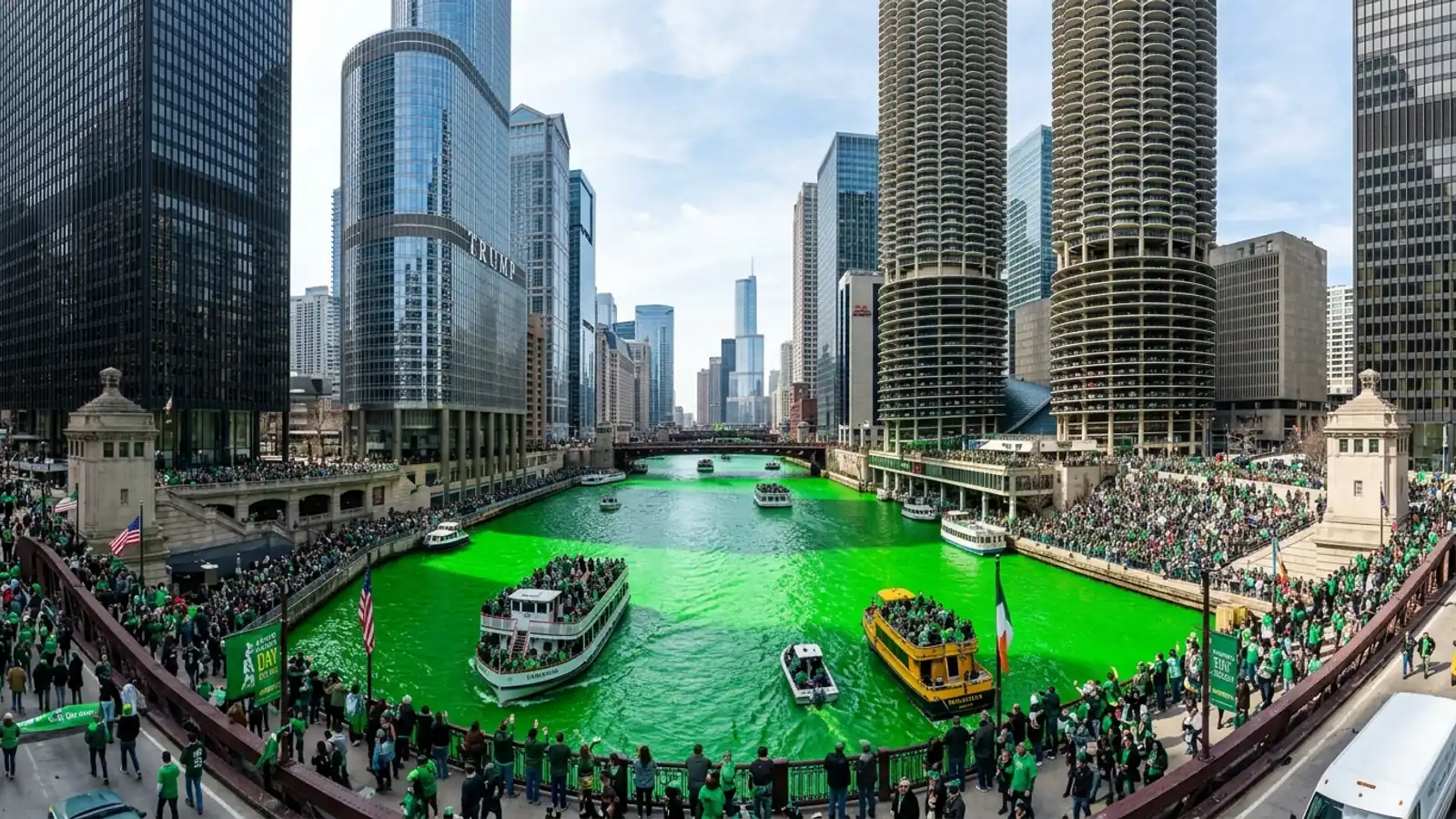
- The Chicago River Dyeing Tradition: Launched in 1962 by the Chicago Journeymen Plumbers Local Union 130—initially inspired by fluorescent dye used to trace plumbing discharges—the annual dyeing of the Main Branch of the Chicago River has become an iconic visual spectacle. Organizers use a vegetable-based, environmentally tested formula that turns the water bright green for several hours without harming aquatic life.
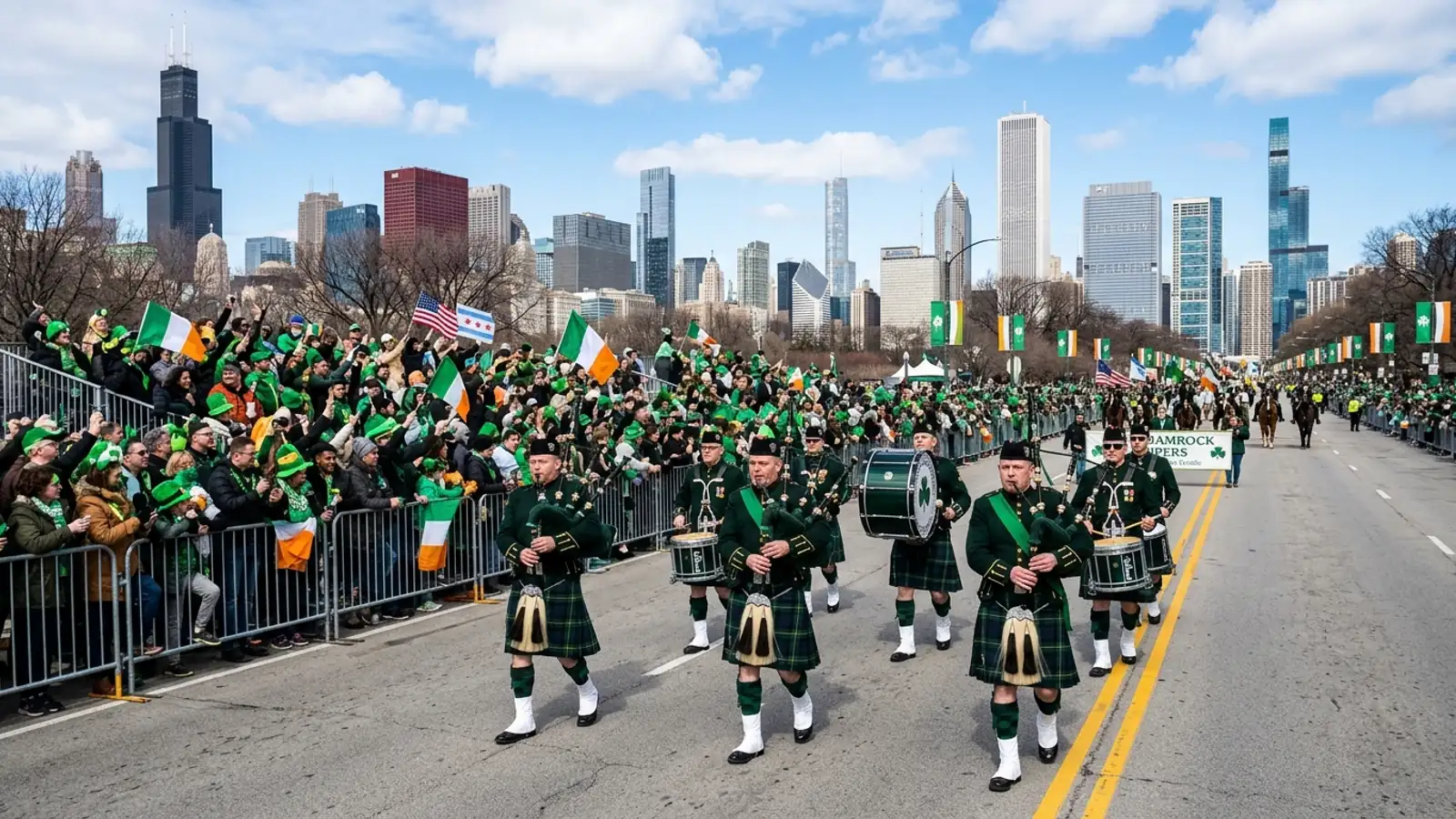
- Annual Downtown Parade: First organized in Chicago in the mid-19th century and formalized in its modern downtown iteration in the 1950s, the Chicago St. Patrick’s Day Parade brings marching bands, Irish step dancers, bagpipers, floats, and community organizations through the heart of the city.
- Citywide Celebrations & Tourism Impact: Alongside the downtown events, neighborhood parades (such as the South Side Irish Parade and Northwest Side Irish Parade—check individual organizer announcements for 2027 dates) and museum programs attract hundreds of thousands of visitors, making mid-March one of Chicago’s busiest early-spring tourism weekends.
Explore Popular Flight Corridors
Find direct vs connecting routes, airline schedules, and airport transfer tips.
Chicago River Dyeing 2027 — Everything Visitors Should Know
The dyeing of the Chicago River is the centerpiece of Chicago’s St. Patrick’s Day festivities, drawing massive crowds to downtown bridges and riverfront walkways.
- What the Tradition Involves: Boats operated by Chicago Plumbers Local 130 cruise along the Main Branch of the Chicago River, dispersing an orange-toned powder that reacts with the water to turn the river emerald green within minutes.
- Where the River Is Dyed: Historically, the dyeing takes place along the Main Branch of the Chicago River between State Street and Columbus Drive (stretching roughly from Marina City/Wabash Avenue past Michigan Avenue toward the Lakefront).
- Official 2027 Date and Time: 2027 details have not yet been officially announced. Historically, the river dyeing begins on Saturday morning around 9:00 AM or 10:00 AM Central Time, ahead of the downtown parade, with the brightest green color lasting roughly four to five hours before gradually fading. Confirm the exact 2027 start time via the Chicago St. Patrick’s Day Parade website and Choose Chicago.
- Publicly Accessible Viewing Areas: Spectators typically watch from upper-level sidewalks and bridges along Wacker Drive, Michigan Avenue, Wabash Avenue, State Street, and Columbus Drive. Exact bridge closures and pedestrian access points depend on annual City of Chicago public-safety arrangements.
- Reaching the River: Downtown Chicago is served by all Chicago Transit Authority (CTA) ‘L’ train lines (Red, Blue, Brown, Green, Orange, Pink, and Purple lines), with stations at State/Lake, Clark/Lake, Grand (Red Line), and Washington/Wabash within a short walk of the Main Branch.
- Crowd Conditions and Arrival Planning: Bridge sidewalks and upper-level railings fill well before the boats begin dispersing dye. Visitors hoping for a spot near a bridge railing typically arrive 60 to 90 minutes prior to the scheduled start time.
- Photography Tips: Elevated vantage points on bridges (such as Michigan Avenue, Wabash Avenue, and Columbus Drive) capture both the green water and surrounding skyscrapers. Overcast March skies often make the green hue appear more saturated than harsh midday glare.
- Safety and Riverfront Restrictions: For crowd safety, the City of Chicago routinely restricts access to portions of the lower Chicago Riverwalk and closes specific bridges to pedestrian loitering or vehicular traffic during the dyeing. Follow all Chicago Police Department barricades and signage; unobstructed views from any specific bridge cannot be guaranteed.
Chicago St. Patrick’s Day Parade 2027
The downtown Chicago St. Patrick’s Day Parade follows the river dyeing and showcases Irish culture, local unions, marching bands, and civic groups.
- Official 2027 Parade Date and Start Time: 2027 details have not yet been officially announced. Historically, the parade steps off on Saturday afternoon (typically around 12:00 PM or 12:15 PM Central Time) following the morning river dyeing. Check chicagostpatricksdayparade.org for official 2027 confirmation.
- Historical Parade Route: In recent years, the parade has marched northward along Columbus Drive through Grant Park, starting near Balbo Drive and concluding near Monroe Street (exact 2027 route boundaries await official City of Chicago permitting).
- Public Viewing Areas: Spectator viewing along Columbus Drive in Grant Park is free and open to the public along both sides of the street, subject to municipal barricades and security checkpoints.
- Accessibility: Grant Park pathways along Columbus Drive are paved and relatively flat, though heavy crowd density can make maneuvering wheelchairs or strollers challenging near the curb. Check the Chicago St. Patrick’s Day Parade official website and City of Chicago closer to March 2027 for designated ADA accessible viewing zones.
- Family Viewing Considerations: Viewing farther south near the parade starting area (closer to Balbo Drive) or along wider stretches of Grant Park lawn behind the sidewalk often provides slightly more breathing room for families with children than the northern end near Monroe Street.
- Crowd Expectations & Transportation: Expect dense crowds across Grant Park and the Loop. Multiple CTA ‘L’ stations—including Adams/Wabash, Monroe (Red and Blue lines), Jackson (Red and Blue lines), and Harold Washington Library-State/Van Buren—lie two to four blocks west of Columbus Drive.
- Road Closures: 2027 street closures have not yet been officially announced. Historically, Columbus Drive, Balbo Drive, Jackson Boulevard, Monroe Street, and adjacent Loop cross streets close to vehicular traffic on parade morning. Monitor Chicago.gov for official traffic advisories.
Best Places to Watch the Chicago River Dyeing
Because the Main Branch of the Chicago River runs east-west through a canyon of downtown towers, where you stand affects crowd density, sightlines, and ease of movement. Specific access points remain subject to annual City of Chicago safety protocols.
| Viewing Area | Viewing Opportunity & Perspective | Expected Crowd Level | Transit & Walking Access | Limitations & Photography Notes |
|---|---|---|---|---|
| Michigan Avenue Bridge (DuSable Bridge) | Iconic panoramic view looking west toward Marina City and east toward the lakefront. | Extremely high; fills earliest. | Short walk from Grand (Red Line) or State/Lake (‘L’). | Police frequently enforce moving pedestrian lanes on the bridge; stopping at railings may be restricted once full. |
| Wabash Avenue Bridge | Direct framing of the Marina City towers and Trump Tower reflected in the green water. | Very high. | Two blocks north of State/Lake (‘L’) station. | Narrower sidewalks than Michigan Avenue; arrive early for railing space. |
| State Street Bridge | Western edge of the main dyeing zone with classic downtown bridge trusses. | High. | Steps from State/Lake (‘L’) and Red Line exits. | Marks the western turnaround point for dye boats; slightly less congested than Michigan Avenue. |
| Columbus Drive Bridge | Eastern boundary of the dyeing zone with wider bridge walkways and easy transition to Grant Park. | Moderate to high. | 10-minute walk east from Loop ‘L’ stations via Randolph or Lake Streets. | Convenient if you are walking directly south to Columbus Drive for the parade afterward. |
| Upper Wacker Drive (South Bank) | Long, continuous elevated sidewalk running parallel to the river between State St and Columbus Dr. | High along railings, easier movement behind the front row. | Directly accessible from Loop ‘L’ stations and downtown hotels. | Lower Riverwalk access directly beneath Wacker Drive is frequently restricted or closed for safety during the dyeing. |
Planning Travel Logistics?
Use FareWander tools to calculate flight times, luggage rules, and visa requirements.
Best Places to Watch the Chicago St. Patrick’s Day Parade
When the parade takes place along its historical Columbus Drive corridor in Grant Park, spectators have several public viewing strategies:
- Southern Stretch (Balbo Drive to Jackson Boulevard): Positioned near the start of the route, this section allows families to see marching bands and dancers early in the procession. Open grassy areas in Grant Park behind the curb give children space to move without feeling hemmed in.
- Central Stretch (Jackson Boulevard to Adams Street): Located near Buckingham Fountain, this central area offers wide park setbacks and straightforward walking routes west to the Jackson and Adams/Wabash CTA stations.
- Northern Stretch (Adams Street to Monroe Street): Closest to Millennium Park, the Art Institute of Chicago, and Michigan Avenue restaurants, this section attracts the heaviest foot traffic and fills fastest.
Practical Viewing Guidance: Public viewing along the parade route is free, and there is no general-public reserved bleacher seating unless officially announced by parade organizers. Plan to arrive at least 45 to 60 minutes before step-off for front-row curb visibility, and note that portable restrooms are typically stationed inside Grant Park west of Columbus Drive.
Things to Do in Chicago During St. Patrick’s Day Weekend
Balancing outdoor festival events with indoor cultural landmarks helps make the most of unpredictable March weather. Always verify holiday hours before visiting, as special event street closures or museum schedules may affect access.
- Chicago Riverwalk: Stretching along the south bank of the Chicago River from Lake Street to the lakefront, this pedestrian promenade offers close-up views of Chicago’s architecture and bridges. Note that sections of the Riverwalk may close temporarily during the Saturday morning river dyeing—check Choose Chicago for access updates.
- Millennium Park: Located in the Loop along Michigan Avenue between Randolph and Monroe Streets (steps from Adams/Wabash and Washington/Wabash ‘L’ stations), Millennium Park is home to Cloud Gate (“The Bean”) and Crown Fountain. Entry is free, though perimeter security checks may apply during major downtown events.
- The Art Institute of Chicago: Situated at 111 S. Michigan Avenue bordering Grant Park, this world-renowned museum houses Impressionist, modern, and American masterworks—making it an ideal indoor retreat right next to the parade route. Advance timed tickets are strongly recommended via artic.edu.
- Navy Pier: Extending into Lake Michigan in Streeterville (accessible via CTA buses #29, #65, #66, or #124), Navy Pier features indoor gardens, dining, and the Centennial Wheel. General admission to the pier is free; individual rides and cruises require tickets.
- Chicago Architecture Center (CAC): Located at 111 E. Wacker Drive directly overlooking the Chicago River, the CAC offers interactive city scale models and guided river cruises or walking tours (seasonal river cruise schedules typically resume in March—book ahead at architecture.org).
- Museum Campus: Located just south of Grant Park along the lakefront (reachable via CTA #146 bus or Roosevelt ‘L’ station), Museum Campus houses the Field Museum, Shedd Aquarium, and Adler Planetarium. Advance reservations are advisable on busy March weekends.
- Magnificent Mile: Running along North Michigan Avenue from the Chicago River to Oak Street, this commercial corridor offers multi-level indoor shopping malls (such as Water Tower Place and The Shops at North Bridge) and dining, easily reached via the Red Line (Grand or Chicago stations).
- Irish American Heritage Center: Located on the Northwest Side at 4626 N. Knox Avenue (accessible via CTA Blue Line to Montrose or Metra Union Pacific Northwest Line to Mayfair), this cultural center hosts traditional Irish music, dance, genealogy exhibits, and seasonal St. Patrick’s Day programming. Check irish-american.org for 2027 event schedules.
Best Irish Pubs and Restaurants in Chicago
Chicago’s Irish pubs and neighborhood taverns are central to the March atmosphere, though many establishments operate on modified holiday rules—including early opening hours, cover charges, or ticketed entry packages—on parade Saturday and March 17. Enjoying the festival does not require drinking alcohol; most venues serve full menus of Irish-American comfort food, coffee, and non-alcoholic beverages.
- The Gage (Downtown / Loop): Located at 24 S. Michigan Avenue directly across from Millennium Park, this upscale gastropub serves refined tavern fare and hearty entrees steps from the parade route. Reservations are essential during St. Patrick’s Day weekend via thegagechicago.com.
- Elephant & Castle (Downtown / Loop): Situated at 111 W. Adams Street in the heart of the financial district, this British-Irish style pub offers traditional pub dishes and large group seating near Loop transit lines. Check elephantcastle.com for holiday hours.
- Fado Irish Pub (River North): Located at 100 W. Grand Avenue (near the Grand Red Line station), Fado is known for imported Irish pub interiors, traditional music sessions, and lively holiday festivities. Expect special event ticketing or early-entry requirements—verify details at fadoirishpub.com/chicago.
- Lizzie McNeill’s Irish Pub (Streeterville): Perched right along the north bank of the Chicago River at 400 N. McClurg Court, this neighborhood pub sits near the eastern end of the river dyeing zone. Visit lizziemcneills.com for seasonal schedule updates.
- Old Town Ale House (Old Town): A historic neighborhood institution at 219 W. North Avenue (near the Sedgwick Brown/Purple Line station), known for its jukebox, local artwork, and no-frills atmosphere. Note that seating is limited and cash-friendly policies often apply.
- Galway Arms (Lincoln Park): Located at 2442 N. Clark Street in Lincoln Park, this cozy Irish pub features snug wood-paneled rooms, fireplaces, and traditional Irish fare like shepherd’s pie and fish and chips. Check galwayarms.com for reservations and holiday hours.
Where to Stay in Chicago for St. Patrick’s Day
Booking accommodation early—ideally four to six months ahead—gives you wider room selection and more flexible cancellation terms before mid-March demand tightens inventory.
| Neighborhood | Proximity to River & Parade | Transit & Walking Convenience | Price & Crowd Profile | Best Suited For |
|---|---|---|---|---|
| The Loop | Immediate walking distance (5–10 mins) to both the Main Branch river bridges and Grant Park parade route. | Hub for all CTA ‘L’ lines and Metra terminals; virtually no need for taxis on event day. | Moderate to high weekend rates; quieter at night once offices close. | First-time visitors and families prioritizing minimal walking in cold weather. |
| River North | Directly north of the Chicago River; 5-minute walk to river dyeing bridges and 15–20 minutes to Grant Park. | Served by Red and Brown/Purple ‘L’ lines; dense concentration of restaurants and pubs. | Higher rates and lively late-night street noise during St. Patrick’s Day weekend. | Couples, solo travelers, and groups seeking vibrant dining and nightlife. |
| Streeterville | Steps from the eastern river dyeing bridges (Michigan Ave & Columbus Dr) and Navy Pier. | Walkable to the river and Magnificent Mile; served by CTA buses and nearby Red Line stations. | Mid-to-upper-tier full-service hotels; calmer evening atmosphere than River North. | Families and couples wanting waterfront access and major hotel amenities. |
| Magnificent Mile | 5- to 15-minute walk north of the Chicago River; 20–25 minutes to Grant Park. | Easy access to Red Line stops and Michigan Avenue buses (subject to parade detours). | Wide range of large hotels; busy daytime shopping crowds. | Shoppers and visitors pairing festival events with museum and retail sightseeing. |
| West Loop | ~1.5 miles west of Grant Park (10-minute ‘L’ ride or 25- to 30-minute walk). | Served by Green/Pink (‘L’) at Morgan and Blue Line at UIC-Halsted; famous Randolph Street dining. | Boutique and upscale hotels; avoids immediate parade street closures. | Food-focused travelers and repeat Chicago visitors. |
| South Loop | Borders the southern end of Grant Park (5- to 10-minute walk to the parade start at Balbo Drive). | Served by Red, Orange, and Green lines at Roosevelt; close to Museum Campus. | Often slightly more competitive weekend rates than River North or Magnificent Mile. | Budget-conscious travelers and families visiting Museum Campus and the parade. |
Booking Tip: Review hotel cancellation deadlines carefully—some downtown properties enforce stricter cancellation windows or minimum-stay requirements during major festival weekends.
How to Reach Chicago From Its Airports
Chicago is served by two major commercial airports, both directly connected to downtown via the Chicago Transit Authority (CTA) rail network. Travel times vary depending on time of day, weather, and event-related street closures. Travelers can compare flight routes into O’Hare and Midway to evaluate airline schedules and regional fare differences.
From O’Hare International Airport (ORD) to Downtown Chicago
Located roughly 17 miles northwest of the Loop, O’Hare International Airport handles the majority of international and long-haul domestic flights.
- CTA Blue Line: The 24-hour CTA Blue Line departs directly from the lower level of Terminal 2 (accessible via the Airport Transit System from all terminals, including Terminal 5) and runs straight into the Loop (Clark/Lake, Washington, Monroe, and Jackson stations). According to the CTA, typical rail travel time to downtown is approximately 40 to 45 minutes, unaffected by highway traffic.
- Taxi and Rideshare: Official taxi stands operate outside baggage claim at all terminals, while rideshare pickups (Uber/Lyft) use designated zones at Terminal 2 (Upper Level) and Terminal 5. Highway travel via I-190 and I-90 (Kennedy Expressway) can range from 30 minutes off-peak to over 75 minutes during rush hour or downtown event closures.
From Midway International Airport (MDW) to Downtown Chicago
Located roughly 10 miles southwest of the Loop, Midway International Airport is a major hub for domestic point-to-point carriers.
- CTA Orange Line: Connected to the terminal via an enclosed pedestrian walkway, the CTA Orange Line runs directly to the Loop elevated tracks (Harold Washington Library-State/Van Buren, Adams/Wabash, Washington/Wabash, State/Lake, and Clark/Lake). Typical rail travel time to downtown is approximately 25 to 30 minutes per CTA schedules.
- Taxi and Rideshare: Taxi stands and designated rideshare pickup areas are located on the lower level outside baggage claim. Driving via I-55 (Stevenson Expressway) typically takes 20 to 45 minutes depending on traffic and downtown road closures.
Getting Around Chicago During St. Patrick’s Day
Navigating downtown Chicago on parade day is significantly easier without a personal or rental car.
- CTA Trains (‘L’): The elevated and subway rail system is unaffected by surface street closures and provides the fastest travel between neighborhoods, airports, and downtown viewing zones. Purchase a reloadable Ventra card or tap a contactless credit/debit card or mobile wallet directly at turnstiles.
- CTA Buses: Numerous downtown bus routes—including lines along Michigan Avenue, State Street, Columbus Drive, and Wacker Drive—are rerouted around the river dyeing and parade perimeters. Check live bus detours at transitchicago.com/alerts.
- Metra Commuter Rail: Visitors staying in suburban Chicagoland can ride Metra trains directly into downtown terminals (Ogilvie Transportation Center, Union Station, Millennium Station, and LaSalle Street Station). Metra occasionally adjusts weekend train capacities or alcohol policies on St. Patrick’s Day—verify rules on metra.com before boarding.
- Walking: Downtown Chicago’s grid layout makes walking between River North, the Loop, Millennium Park, and Grant Park straightforward, though bridge closures during the river dyeing may require detouring one or two blocks west to cross the river.
- Taxis and Rideshares: Expect heavy congestion, surge pricing, and restricted drop-off zones near Wacker Drive, Michigan Avenue, and Grant Park during parade hours. If using a rideshare, set your pickup or drop-off pin several blocks west of State Street.
Chicago Weather in March — What Should You Wear?
Mid-March in Chicago is notoriously changeable, often blending late-winter chill with early signs of spring. Based on historical climate data from the National Weather Service Chicago office, average daily high temperatures in mid-March typically hover in the mid-40s°F (around 7°C–8°C), while morning lows frequently dip near or below freezing in the upper 20s°F to low 30s°F (-2°C to 0°C).
Because the actual 2027 weather forecast cannot be predicted months in advance, check the National Weather Service forecast within 48 hours of departure and pack versatile cold-weather gear:
- Layered Clothing: Start with a moisture-wicking thermal or long-sleeve base layer, add a warm sweater or fleece mid-layer, and top with an insulated outer jacket so you can adjust when moving between chilly streets and heated museums or restaurants.
- Wind- and Water-Resistant Outerwear: Gusts off Lake Michigan and wind tunnels along the Chicago River can make temperatures feel significantly colder than the thermometer reads.
- Cold-Weather Accessories: Pack insulated gloves, a warm knit hat or beanie, and a scarf—especially important when standing still along bridge railings or parade barricades for an hour or more.
- Comfortable, Weather-Resistant Footwear: Wear broken-in, waterproof walking shoes or boots with warm socks capable of handling miles of pavement and potential rain, slush, or late-season snow.
How Much Does a Chicago St. Patrick’s Day Trip Cost?
Because live 2027 airfares and hotel room rates fluctuate continuously based on departure city and booking timing, use the planning framework below (expressed in USD, assuming two adults sharing one standard hotel room for 3 nights) to structure your budget before booking:
- Flights: Compare round-trip economy fares into both O’Hare (ORD) and Midway (MDW), factoring in carry-on versus checked baggage fees.
- Hotels (3 Nights, Shared): Mid-March is peak early-spring festival demand in downtown Chicago. Expect higher nightly base rates plus Chicago’s combined state, county, and municipal hotel accommodations tax (roughly 17.4%). Booking refundable rates early protects against price spikes.
- Airport Transportation: CTA ‘L’ trains from O’Hare or Midway offer flat, predictable transit fares ($2.50–$5.00 per ride depending on direction, verified via transitchicago.com as of late 2026; subject to change), whereas taxis and rideshares cost substantially more during peak traffic.
- Local Transit: Unlimited 1-day or 3-day CTA Ventra passes provide cost-effective unlimited train and bus rides across the city.
- Food & Dining: Budget for a mix of casual Chicago staples (deep-dish pizza, Italian beef sandwiches, bakery breakfasts) and sit-down meals, plus potential cover charges or prix-fixe menus at popular Irish pubs on event days.
- Attractions & Optional Tours: Watching both the river dyeing and the downtown parade is completely free. Allocate funds for museum admissions (typically $25–$45 per adult depending on institution and residency) or architectural river cruises.
- Emergency & Contingency Buffer: Set aside an extra 10%–15% buffer for unexpected rideshares, cold-weather gear purchases, or last-minute itinerary changes.
Is Chicago St. Patrick’s Day Suitable for Families?
Yes—Chicago’s St. Patrick’s Day celebrations can be very enjoyable for families when planned thoughtfully:
- River Dyeing with Kids: Bridge railings get crowded quickly, making it hard for small children to see over adult spectators. Consider watching from a slightly less congested bridge (such as Columbus Drive or State Street) or viewing the green river later in the morning once initial crowds disperse, as the water stays green for hours.
- Parade Viewing with Children: Set up along the southern or central stretches of Grant Park (near Balbo Drive or Jackson Boulevard), where wide park lawns behind the sidewalk give kids space to sit or stretch without being pressed against metal barricades.
- Restrooms and Food Planning: Public restrooms inside Grant Park can develop long lines during the parade. Plan bathroom breaks at nearby hotels, museums, or cafes before heading to the curb, and pack snacks and water in a small daypack.
- Crowd and Stroller Logistics: Heavy sidewalk crowds around Michigan Avenue and the Loop make wide double strollers difficult to maneuver; a compact travel stroller or child carrier works best. Establish a clear physical meeting point in case anyone gets separated.
Suggested Chicago St. Patrick’s Day Itinerary
Disclaimer: This 3-day sample itinerary is a flexible planning framework, not an official event schedule. Because official 2027 dates and start times for the Chicago River dyeing and downtown parade have not yet been announced, adjust Day 2 activities once organizers confirm the 2027 timetable.
Day 1: Arrival & Downtown Exploration
- Morning / Early Afternoon: Arrive at O’Hare (ORD) or Midway (MDW) and take the CTA Blue or Orange Line directly into the Loop. Check into your hotel or store luggage.
- Afternoon: Walk through Millennium Park to see Cloud Gate and stroll along the upper bridges of the Chicago River to orient yourself with the river dyeing corridor.
- Evening: Enjoy dinner in the Loop or West Loop—book restaurant reservations well ahead to avoid long Friday night waits.
Day 2: River Dyeing, Parade & Cultural Sightseeing (Adjust to Confirmed 2027 Event Date)
- Morning: Dress in warm layers and walk to your chosen bridge along the Main Branch of the Chicago River (between State Street and Columbus Drive) 60 to 90 minutes before the officially announced river dyeing start time.
- Midday: Walk south into Grant Park along Columbus Drive to watch the Chicago St. Patrick’s Day Parade, grabbing lunch from nearby Loop cafes or food vendors.
- Afternoon: Warm up indoors at The Art Institute of Chicago right across Michigan Avenue from Grant Park, or visit the Chicago Architecture Center on East Wacker Drive.
- Evening: Have a relaxed dinner in Streeterville, South Loop, or Lincoln Park away from the busiest River North bar queues.
Day 3: Waterfront, Museums & Departure
- Morning: Take a morning walk along the Chicago Riverwalk (once standard access resumes) or head south to Museum Campus to explore the Shedd Aquarium or Field Museum.
- Afternoon: Browse the Magnificent Mile or stop at an Irish bakery/pub for a traditional lunch before picking up your luggage and taking the CTA ‘L’ back to O’Hare or Midway for your departure flight.
Travel Tips for Visiting Chicago During St. Patrick’s Day
- Book Accommodation Early: Downtown hotels near the Loop, River North, and Streeterville fill rapidly for St. Patrick’s Day weekend; lock in a refundable room months in advance.
- Verify Official Event Updates: Confirm the exact 2027 dates, start times, and bridge access rules on chicagostpatricksdayparade.org and chicago.gov during the week before your trip.
- Arrive Early for Prime Viewing: Plan to reach river bridges 60–90 minutes before the dyeing and Columbus Drive 45–60 minutes before the parade starts.
- Rely on CTA Trains Over Cars: Street closures and heavy downtown traffic make driving impractical; use CTA ‘L’ trains and walking for downtown movement.
- Monitor Live Transit Alerts: Check transitchicago.com/alerts for real-time bus reroutes or station advisories.
- Dress for Stationary Wind and Cold: Standing beside the river or in Grant Park feels colder than brisk walking—wear insulated layers, a hat, gloves, and waterproof footwear.
- Carry Valid Government ID: Bars, pubs, and ticketed St. Patrick’s Day venues strictly check physical passports or government-issued photo IDs for entry.
- Keep Valuables Secure: Carry phones, wallets, and transit cards in zippered inside jacket pockets or a secure crossbody bag in dense crowds.
- Designate a Group Meeting Spot: Cellular networks can slow down around Grant Park and the river bridges; agree on an unmistakable landmark (such as a hotel lobby or museum entrance) if separated.
- Confirm Attraction Holiday Hours: Check museum, river cruise, and restaurant hours ahead of time, as some businesses modify schedules on parade day and March 17.
- Build Buffer Time Into Transfers: Allow extra walking and transit time when crossing downtown bridges or heading back to ORD/MDW airports.
Confirmed and Unconfirmed 2027 Event Information
| Event Detail | 2027 Status | Verification & Planning Guidance |
|---|---|---|
| St. Patrick’s Day Calendar Date | Confirmed: Wednesday, March 17, 2027 | Fixed annual calendar date. |
| Chicago River Dyeing Date & Start Time | Unconfirmed (Pending Official Announcement) | Historically held the Saturday morning prior to March 17 (~9:00–10:00 AM CT); verify on chicagostpatricksdayparade.org. |
| Chicago St. Patrick’s Day Parade Date & Time | Unconfirmed (Pending Official Announcement) | Historically held the Saturday afternoon prior to March 17 (~12:00–12:15 PM CT); verify on chicagostpatricksdayparade.org. |
| 2027 Parade Route & River Bridge Closures | Unconfirmed (Pending Official Announcement) | Historically follows Columbus Drive (Balbo to Monroe) and dyes the Main Branch (State to Columbus); verify 2027 municipal permits on chicago.gov. |
| CTA Airport Rail Connections (Blue & Orange Lines) | Confirmed Infrastructure | O’Hare (Blue Line) and Midway (Orange Line) operate directly to downtown; check transitchicago.com for March 2027 weekend schedules and fares. |
Frequently Asked Questions
St. Patrick’s Day falls on Wednesday, March 17, 2027. However, Chicago’s major public events (such as the river dyeing and downtown parade) often take place on the surrounding weekend; 2027 event dates have not yet been officially announced.
Conclusion
Celebrating St. Patrick’s Day in Chicago in 2027 combines iconic waterfront spectacle, deep Irish-American cultural roots, and world-class urban museums—provided you plan around Chicago’s unique event calendar. Remember that while the holiday itself lands on Wednesday, March 17, 2027, the official 2027 dates and times for the Chicago River dyeing and downtown parade are still awaiting confirmation. Lock in refundable downtown lodging early, pack warm weather-resistant layers for March winds, rely on CTA ‘L’ trains to bypass street closures, and verify official schedules on chicagostpatricksdayparade.org and chicago.gov before you travel.
Planning more trips across the United States? Explore our destination guides and festival travel resources across Farewander to organize your next itinerary.