You booked a non-refundable flight weeks ago, but an urgent work conflict, family emergency, or unexpected change in schedule leaves you stranded at home. Meanwhile, a close friend, sibling, or colleague wants to take your spot on that very same flight. It sounds entirely sensible: the seat is paid for, the plane is flying anyway, so why not swap the passenger name and let someone else board? In commercial aviation, however, handing your boarding pass or reservation over to another person is rarely a simple matter of updating an online form. Whether you can change the name on your booking, pay a modification fee, or be forced to cancel the seat outright depends heavily on carrier policies, fare categories, and strict global ticketing regulations.
Quick Answer: Can You Change the Passenger Name on an Airline Ticket?
Whether you can change the passenger name on an airline ticket depends entirely on the operating airline and the specific ticket conditions attached to your fare.
- Name Correction vs. Passenger Replacement: Modifying an error in the original traveler's name (such as fixing a typo) is fundamentally different from swapping the traveler out for another person.
- Airline Discretion: A select group of point-to-point and low-cost carriers permit passenger substitution under defined conditions, whereas legacy full-service airlines generally prohibit changing the traveler entirely.
- Fees and Fare Differences: Where an airline does allow a passenger substitution, you will almost always pay a dedicated name-change fee, plus any applicable fare difference between your original ticket price and current market pricing.
- Booking Channel Rules: If you purchased through an Online Travel Agency (OTA) or a corporate booking tool, the agency—rather than the airline directly—may need to handle the initial modification request.
- Verify Before Paying: Where an airline does not permit passenger substitution, the only available route is typically to cancel the reservation under your fare rules (if eligible) and purchase a fresh ticket for the new traveler. Always verify your carrier's current ticket conditions before committing funds.
What Does "Changing the Passenger Name" Actually Mean?
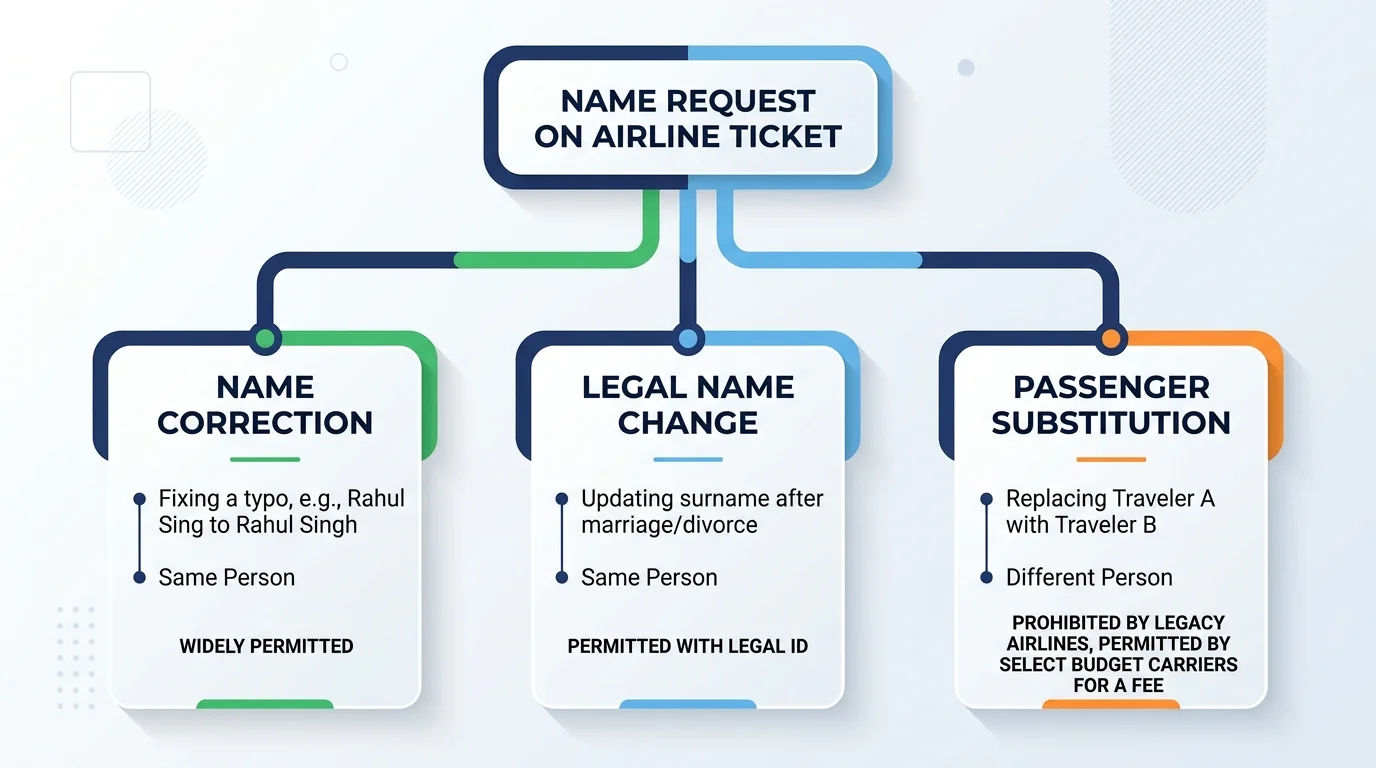 Determine your path: airlines handle clerical typo corrections differently than transferring a ticket to another person.
A common pitfall travelers encounter when contacting customer support is using the blanket phrase "name change". To an airline agent, that phrase can trigger completely different administrative workflows depending on the underlying context.
                                [Name Request]
                                      │
        ┌─────────────────────────────┼─────────────────────────────┐
        ▼                             ▼                             ▼
 [Name Correction]           [Legal Name Change]       [Passenger Substitution]
  Fixing a typo               Updating surname          Replacing Traveler A
  (Same Person)               (Same Person)             with Traveler B
1. Name Correction
A name correction resolves an administrative typo, spelling mistake, or formatting defect for the exact same passenger.
- Example: Changing "Rahul Sing" to "Rahul Singh". The traveler is the same individual, and the correction simply aligns the flight record with their legal travel document.
2. Legal Name Change
A legal name change reflects an official change in the traveler's legal identity occurring after the booking was ticketed.
- Example: A traveler updates their surname from "Sharma" to "Verma" following marriage or divorce. The physical traveler is still the same person, but formal government paperwork is required to update the reservation.
3. Passenger Substitution (Ticket Transfer)
A passenger substitution (or passenger name change) occurs when one traveler is replaced by an entirely different individual.
- Example: Changing "Rahul Singh" to "Amit Sharma". The original traveler no longer intends to fly, and a completely different person is taking the seat.
This distinction between the same person and a different person is the single most important legal and operational dividing line in airline ticketing.
Comparing Fares for Your Route?
Search live multi-airline schedules, spot discount windows, and baggage fee rules on FareWander.
Can You Transfer an Airline Ticket to Another Person?
Most airline tickets are strictly non-transferable. When an airline issues an electronic ticket, it creates an individual contract of carriage between the named passenger and the carrier. Under standard industry rules, that contracted right of transportation cannot be gifted, assigned, or sold to another traveler.
However, the commercial aviation market is diverse:
- Legacy Network Carriers: Airlines such as British Airways, Delta Air Lines, Emirates, Lufthansa, and Air India generally enforce strict non-transferability policies. If passenger A cannot travel, passenger A's ticket must either be cancelled (subject to fare conditions) or forfeited; it cannot be modified to carry passenger B.
- Low-Cost and Regional Carriers: A subset of point-to-point carriers (prominently including European low-cost operators such as easyJet, Ryanair, and Wizz Air) maintain commercial provisions allowing full passenger substitutions. These airlines treat passenger changes as an ancillary service, charging a dedicated passenger-name-change fee plus any fare difference between the original ticket and the live market fare.
- Corporate & Flexible Fares: Select specialized corporate contracts or fully flexible commercial fare products may offer ticket reassignment provisions, but standard consumer retail tickets rarely include this benefit.
Name Correction vs Passenger Name Change
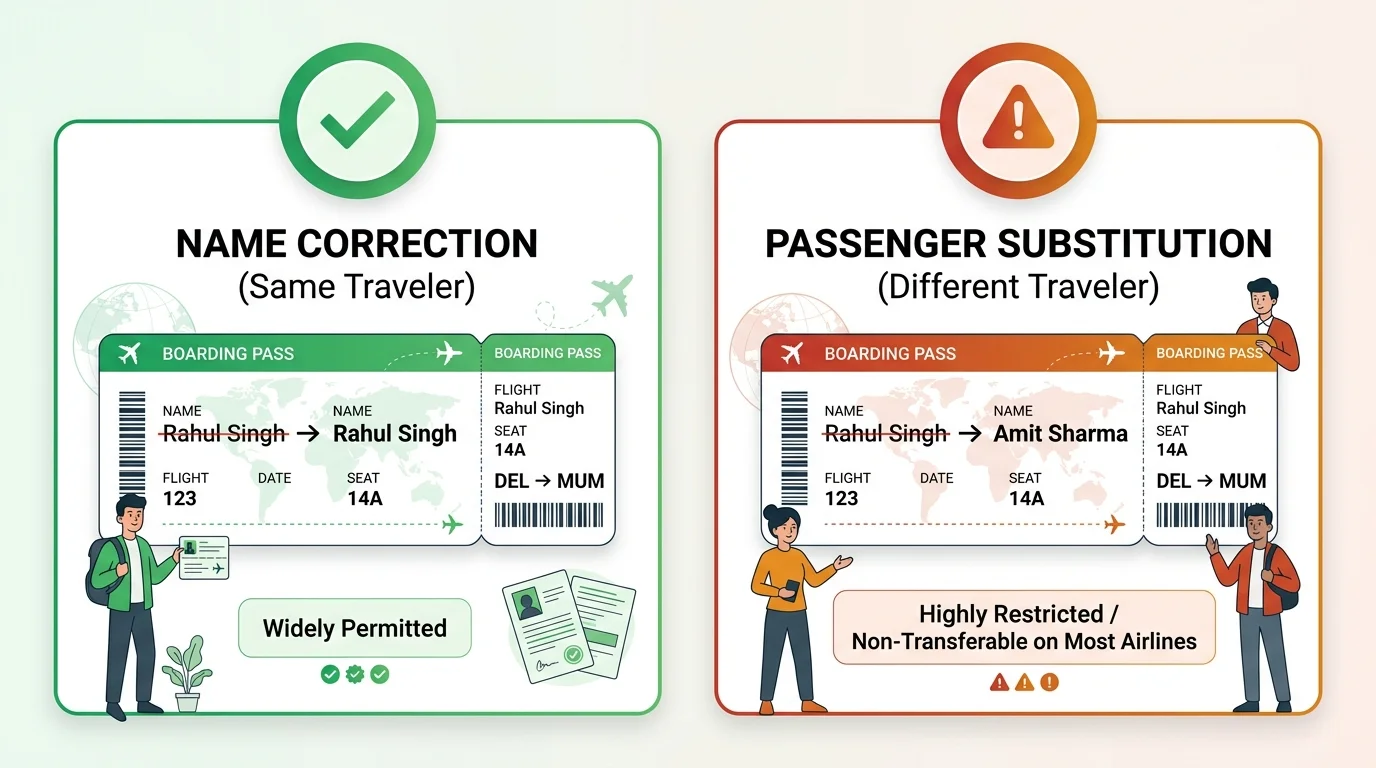 Replacing the ticketed traveler with another individual is considered a passenger substitution, which most legacy carriers prohibit.
The following matrix illustrates how airlines typically classify and handle different passenger naming requests:
| Situation | Same Traveler? | What It Means | Typical Question | Typical Airline Treatment |
|---|---|---|---|---|
| Typo in surname | Yes | Minor clerical correction | Can the airline fix the spelling? | Widely permitted; often free or for a modest fee depending on timing and carrier. |
| Missing middle name | Yes | System formatting / omission | Does the airline require an update? | Frequently accepted without formal reissue if first and last name match ID. |
| Legal name change | Yes | Legal identity update | What documentation is required? | Permitted upon submitting marriage certificates, court decrees, or updated passports. |
| Different passenger | No | Passenger substitution | Does the airline permit transfer? | Strictly prohibited by legacy airlines; permitted by select low-cost carriers for a fee. |
| Wrong passenger selected | Depends | Booking/profile error | Can the airline modify the passenger? | If ticketed, treated as substitution; within 24 hours, often handled via void/cancellation. |
(Note: "Typical treatment" reflects prevailing industry practices and does not represent an automatic universal guarantee for every carrier.)
Why Do Airlines Restrict Passenger Name Changes?
Airlines do not enforce non-transferability rules arbitrarily. These restrictions are grounded in practical technical, legal, and commercial systems:
- Passenger-Specific Ticketing: An airline ticket is an individualized electronic coupon tied to a verified passenger identity and specific flight segment. Reservation databases are structured around singular passenger records rather than open seating vouchers.
- Identity Verification & Security Screening: International civil aviation security protocols mandate that passenger manifests correspond directly to government watchlists, security vetting platforms, and advance passenger screening systems prior to departure.
- Immigration & Border Compliance: On cross-border flights, carriers transmit Advance Passenger Information (API) to destination border agencies. Discrepancies between ticketing manifests and border databases can lead to mandatory carrier fines and entry refusals.
- Check-In & Departure Systems: Once reservations enter airport operational control, altering core passenger records requires manual offloading, ticketing voids, and manifest rebuilding, introducing operational friction.
- Secondary Market & Fraud Prevention: Unrestricted passenger transfers would allow ticket brokers to speculate on discounted advance seats, purchase low-cost promotional inventory, and resell them closer to departure at inflated prices, disrupting airline revenue management controls.
Planning Travel Logistics?
Use FareWander tools to calculate flight times, luggage rules, and visa requirements.
When Can an Airline Allow a Passenger Name Change?
An airline may permit an actual passenger substitution or name replacement only under specific, qualified conditions:
- Explicit Carrier Policy: The airline's Conditions of Carriage specifically outline a commercial provision allowing passenger name changes.
- Eligible Fare Category: The ticket was purchased under a fare family that explicitly includes name substitution rights (often budget carriers or premium flexible corporate tickets).
- Applicable Booking Channels: The reservation was booked directly with the carrier or through an authorized integration partner that supports passenger reassignment.
- Strict Deadlines Met: The request is submitted well before the airline's operational cutoffs (typically several hours to days prior to scheduled departure).
- Payment of Associated Fees: The traveler pays the mandatory name-change fee along with any dynamic fare difference between the original fare and current seat inventory.
- Verification of Documents: Proper identification and documentation are provided for the replacement passenger to ensure regulatory compliance.
- Unused Ticket Coupons: Travel has not yet commenced, and no sectors within the ticket coupon have been utilized or restricted.
When Can You NOT Change the Passenger Name?
You will generally be unable to substitute a passenger under the following conditions:
- The Ticket Is Legally Non-Transferable: The carrier's standard tariff and contract of carriage prohibit passenger substitutions under all circumstances.
- Travel Has Commenced: If any leg of a multi-city or round-trip journey has already been flown, the remaining sectors are permanently locked to the traveling passenger.
- Check-In Has Closed: Once the flight reaches operational gate control or check-in windows have closed, reservation changes are typically blocked.
- Restricted Promotional Fares: Deeply discounted "Basic Economy" or promotional campaign fares often exclude all voluntary modifications, including name replacements.
- Codeshare or Multi-Airline Bookings: When an itinerary involves multiple operating carriers, ticketing synchronization often prevents passenger replacements from propagating across partner reservation engines.
- Expired Change Windows: The request is made after the carrier's published modification cutoff timeframe.
How Much Does It Cost to Change the Passenger Name?
If your airline permits passenger substitutions, the total expense is rarely a flat fee. The cost is calculated through a combination of individual pricing components:
- Passenger-Name Change Fee: A fixed administrative penalty levied by the carrier specifically for changing the primary traveler on the reservation.
- Fare Difference: The difference in price between the base airfare originally paid and the active market price of that same seat at the moment the name change is processed. Because airfares almost always increase as departure approaches, this is often the most expensive component.
- Ticket Reissue Charge: An administrative processing fee charged by some legacy carriers to void the original electronic ticket coupon and issue a brand-new 13-digit e-ticket.
- Agency / OTA Service Fee: If you booked through a third party (such as Expedia, Booking.com, or MakeMyTrip), the agency may assess its own customer service handling fee on top of airline penalties.
- New Ticket Cost: If the original airline prohibits passenger transfers, the cost to switch travelers is simply the full retail price of buying an entirely new ticket for the replacement passenger.
Is It Cheaper to Change the Name or Buy a New Ticket?
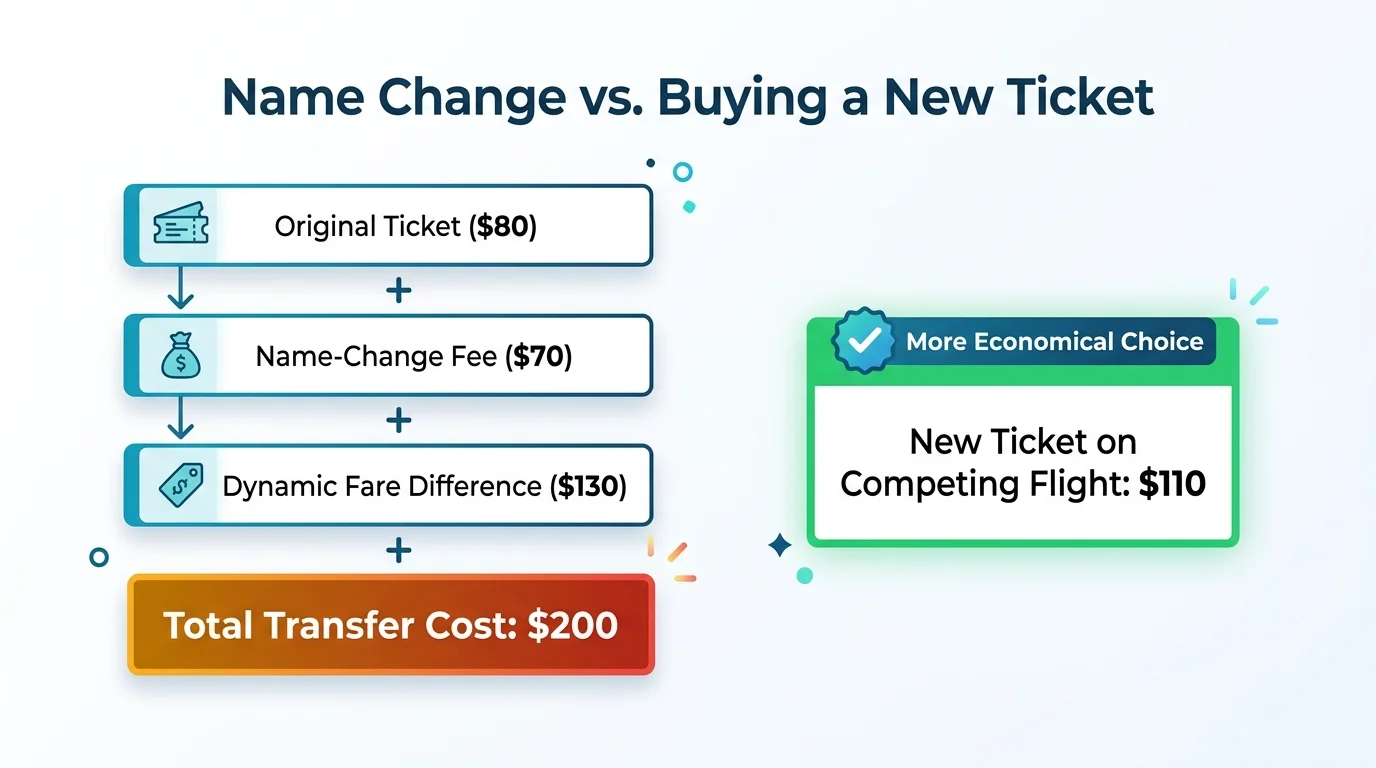 Always calculate the total cost: a name-change penalty combined with a dynamic fare difference can sometimes cost more than a fresh ticket.
Never assume that paying a name-change fee is automatically cheaper than purchasing a new booking. You should calculate the true financial comparison before authorizing any change:
Compare that figure against the current market price of buying a separate one-way or round-trip ticket for the new passenger, while checking whether the original ticket can be cancelled for partial travel credit or tax recovery.
A Hypothetical Comparison
Note: The following numbers are purely hypothetical to illustrate calculation mechanics and do not reflect any specific carrier's tariff.
Scenario A:
- Original ticket paid: $120
- Airline name-change fee: $65
- Current selling price of the flight: $140
- Dynamic fare difference: $20 ($140 current price minus $120 original price)
- Total to transfer existing ticket: $85
- Buying a fresh ticket on the same flight: $140
- Verdict: In this scenario, processing the name change saves $55.
Scenario B:
- Original ticket paid: $80
- Airline name-change fee: $70
- Current selling price of the flight: $210
- Dynamic fare difference: $130 ($210 current price minus $80 original price)
- Total to transfer existing ticket: $200
- Competing carrier's fare on an equivalent flight: $110
- Verdict: Paying the transfer penalty and fare difference costs $200, whereas booking a fresh flight on a competitor costs only $110. Cancelling the original ticket to reclaim statutory airport taxes and booking the new flight is substantially more economical.
How to Change the Passenger Name on an Airline Ticket
If you need to change or correct the passenger on a booking, follow these structured steps:
[1. Classify Request] ──> [2. Review Ticket Rules] ──> [3. Identify Booking Channel]
                                                                  │
                                ┌─────────────────────────────────┘
                                ▼
Direct Airline Booking? ──────────────> Contact Carrier Customer Support
                                │
                                ▼
OTA / Travel Agency Booking? ─────────> Contact Third-Party Agency Desk
                                │
                                ▼
     [4. Request Full Cost Breakdown: Name Fee + Fare Difference + Reissue]
                                │
                                ▼
     [5. Submit Valid IDs] ───> [6. Authorize] ───> [7. Verify New E-Ticket]
- Classify the Request: Determine whether you are fixing an error for the same person (name correction) or replacing the traveler entirely (passenger substitution).
- Review Current Ticket Conditions: Consult the fare rules and Conditions of Carriage of the operating airline to confirm if substitutions are allowed.
- Identify the Ticket Issuer: Determine whether the ticket was purchased directly from the airline website/app or via an Online Travel Agency (OTA) or travel agent.
- Contact the Issuing Entity: Reach out to the customer support team of the company that issued the booking.
- Ask Clear Policy Questions: State explicitly: "Does this ticket class permit a passenger name substitution, or is it strictly non-transferable?"
- Request an Itemized Quote: Ask for the complete out-of-pocket cost, including administrative fees, fare difference, and any agency surcharges.
- Ask About Reissue Requirements: Confirm whether the modification requires generating a new electronic ticket record or remarking the existing PNR.
- Provide Accurate Passenger Details: Supply the new passenger’s full legal name, date of birth, and travel document details exactly as shown on their passport or government ID.
- Authorize and Pay: Confirm the transaction only after reviewing the total price versus alternative flight options.
- Verify the Updated Confirmation: Log into the airline's "Manage Booking" tool and ensure the new traveler's name appears correctly across every flight sector.
Can You Change the Passenger Name Online?
Self-service digital changes depend entirely on the airline's technological infrastructure and commercial policy:
- Online Self-Service Portals: Certain low-cost airlines (such as easyJet or Ryanair) allow travelers to log into the "Manage Booking" or "My Trips" portal, select "Change Name," and input a new passenger's information after paying the published fee and fare difference online.
- Assisted Support Channels: For legacy network carriers and most traditional airlines, the online "Manage Booking" portal will only handle date, flight, or cabin modifications; the passenger name fields are permanently locked. Updating name details requires contacting reservations desks, ticket offices, or submitting offline verification requests.
- Agency Limitations: If your booking was made via an OTA, the airline website will routinely block online edits, instructing you to use the agency’s self-service portal or customer care line.
Can You Change the Passenger Name After Check-In?
Attempting to change the traveler after check-in has occurred introduces extreme operational complexity:
- Operational Control: When check-in opens and a boarding pass is generated, the reservation transitions from the carrier’s central ticketing database to the local airport departure control system (DCS).
- The "Offloading" Requirement: Before any data modification can occur, airport staff or support agents must manually reverse the check-in status (an operational procedure called "offloading").
- Time-Sensitive Restrictions: Offloading a passenger, recalculating fares, verifying identity documents, collecting payments, and reissuing a ticket takes time. If departure is approaching, airport agents generally do not have the operational capacity or contractual authority to execute passenger substitutions at the terminal desk.
Can You Change the Passenger Name After Booking Through an OTA?
If your ticket was issued by an Online Travel Agency (OTA) such as Expedia, Agoda, MakeMyTrip, or a corporate travel management desk, ticketing control rests with the agent:
- Ticketing Agency Ownership: The travel agency acts as the merchant of record that controls the electronic ticket coupons within the Global Distribution System (GDS). Airlines routinely decline to modify agency-issued tickets prior to departure day, directing travelers back to the issuing agent.
- Agency Terms Apply: Even if an airline's underlying fare rules permit passenger substitutions, the travel agency's own commercial terms may prohibit them or add independent administrative charges.
- Recommended Action: Always contact the original ticket issuer first to determine whether they can execute a passenger name change under the carrier's trade guidelines.
What If Someone Else Wants to Use My Flight Ticket?
If you cannot fly and another person wishes to travel in your place, this is classified as an attempted passenger substitution, not a minor name correction.
- No Direct Swapping: You cannot simply hand your boarding pass, printout, or mobile barcode to a friend. Airport security checkpoints and boarding gates verify the photo and legal name on government identification against the active flight manifest.
- Boarding Under Another Name Is Illegal: Attempting to travel under another person's name violates aviation security laws, results in denied boarding, and can trigger security detentions or statutory penalties.
- Contractual Steps: You must check whether your airline explicitly permits ticket transfers. If permitted, you must formally reassign the ticket through official airline or agency channels; if prohibited, you must cancel your booking and have the other person purchase their own seat.
Can I Change the Passenger Name After Booking With a Non-Refundable Ticket?
Non-refundable does not mean non-changeable.
Refundability and transferability are separate legal provisions:
- Refundability: Dictates whether you can surrender the ticket and receive your original funds returned to your payment method.
- Transferability: Dictates whether the contracted transportation right can be reassigned to a different passenger.
A ticket can be non-refundable yet transferable (as is the case with many budget airline standard fares that allow name changes for a fee). Conversely, a ticket can be non-refundable and completely non-transferable (the standard model for discounted legacy carrier tickets). The fare rules attached to your specific booking reference determine what is permitted.
Can I Change the Passenger Name on an International Flight?
International itineraries involve rigorous security screening and immigration checks:
- Advance Passenger Information (API): International regulations require airlines to transmit verified passenger passport data, nationality, and birth dates to foreign border and customs authorities well in advance of departure.
- Immigration Matching: The legal name on the electronic ticket must match the Machine-Readable Zone (MRZ) of the traveler’s passport.
- Substitution Feasibility: While the security process requires strict identity matching, the airline's underlying commercial fare rules still determine whether a passenger transfer is permitted. However, because international long-haul travel is dominated by legacy network carriers, international tickets are far less likely to permit passenger substitutions than short-haul domestic flights.
What Documents Might Be Required?
The documentation required by an airline depends strictly on whether your request represents a correction, a legal update, or a passenger transfer:
- Minor Typo Corrections: Often resolved without documentation or by presenting a scanned photo page of a valid passport or government-issued photo ID.
- Legal Name Updates: Typically requires formal legal documentation verifying the change of name, such as an official marriage certificate, divorce decree, court order, or newly issued passport.
- Passenger Substitutions: Where permitted, requires the full government photo ID or passport details of the new traveler to populate mandatory passenger records.
Not all airlines require exhaustive documentation for simple clerical errors, but official photo ID is standard across the industry for identity verification.
What Happens If the Name on the Ticket Is Wrong?
Traveling with an inaccurate name on your flight documentation introduces escalating operational risks depending on the nature of the mismatch:
- Minor Spelling Error (1–2 letters): A small typographical slip (such as "Jonathon" instead of "Jonathan") is frequently accommodated as an administrative correction by customer service desks. While it may occasionally cause automated kiosk check-in failures, it rarely prevents travel if resolved before departure.
- Major Name Mismatch: A substantial discrepancy (such as an entirely different surname or missing legal name) prevents automated document verification. Security screeners and gate agents will refer the passenger back to airline ticketing desks to investigate possible fraud or booking errors.
- Completely Different Passenger: Attempting to travel on a ticket issued to another human being will result in immediate denied boarding at security or immigration checkpoints.
What If I Entered the Wrong Passenger During Booking?
Entering the wrong traveler information during online checkout happens frequently when booking for family or colleagues. Take these steps immediately:
- Check Ticket Status: Determine whether the booking has been formally ticketed or remains in a pending reservation state.
- Review 24-Hour Grace Policies: If you booked directly with an airline in or departing regions like the United States, you may qualify under regulatory or customer-service policies to void or cancel the reservation for a full refund within 24 hours of booking, allowing you to rebook under the correct passenger name.
- Contact Customer Support Instantly: If the 24-hour window has expired, contact the ticketing airline or agency right away.
- Clarify the Mistake: Explain that you made a clerical entry error during checkout. Ask whether the ticket can be re-ticketed under the intended traveler's name or if cancellation and rebooking is required.
- Confirm Total Costs: Obtain an itemized quote of all fees and fare differences before agreeing to any modification.
Airline Passenger Name Change Rules Can Differ
The commercial airline sector does not share a single, unified name-change rulebook. Below is an objective comparison framework illustrating how different types of carriers approach passenger name adjustments based on their published conditions of carriage:
| Airline | Passenger Name Change Allowed? | General Conditions | Published Fee Structure | Verified Official Source |
|---|---|---|---|---|
| easyJet | Yes | Full passenger substitution permitted up to 2 hours before flight departure online or via customer service. | Tiered fee per passenger per flight, plus applicable fare difference between original and current ticket. | Official easyJet Fees and Charges / Terms & Conditions. |
| Ryanair | Yes | Passenger substitution permitted online up to 2 hours before scheduled departure; airport counter changes carry higher fees. | Fixed administrative name-change fee per passenger per booking, plus fare difference. | Official Ryanair General Terms and Conditions / Fee Table. |
| Wizz Air | Yes | Passenger transfer allowed online or via call center up to 3 hours prior to departure. | Flat name-change fee per flight per passenger, plus fare difference; free under specific bundled fare packages. | Official Wizz Air Conditions of Carriage / All Services & Fees. |
| British Airways | No (Corrections only) | Passenger substitution strictly prohibited; tickets non-transferable. Minor name corrections permitted to match passport. | No transfer permitted; corrections generally free for genuine typos with supporting passport. | Official British Airways Conditions of Carriage & Name Correction Guidelines. |
| Delta Air Lines | No (Corrections only) | Tickets are strictly non-transferable. Minor typos and legal name changes permitted for the original traveler. | No transfer permitted; minor corrections handled per policy; ticket reissue rules apply. | Official Delta Air Lines Ticket Transfer & Name Correction Policy. |
| Air India | No (Corrections only) | Non-transferable ticket contract. Administrative corrections allowed for same passenger with legal identification. | No transfer permitted; administrative correction fees apply depending on fare and channel. | Official Air India Citizen's Charter & Conditions of Carriage. |
(Note: Data verified against airline published tariffs and Conditions of Carriage as of September 2026. Rules, fees, and operational windows remain subject to dynamic airline schedule and commercial updates.)
What to Check Before Paying a Name Change Fee
Before paying an airline or agency to alter your ticket name, verify every item on this practical checklist:
- Correction vs. Substitution: Has the representative correctly categorized your request as a typo fix rather than an expensive passenger substitution?
- Transferability Rights: Does your ticket fare family legally allow passenger replacement under carrier rules?
- Itemized Fee Breakdown: Have you received a transparent quote for the name-change penalty, the ticket reissue charge, and the dynamic fare difference?
- Agency Surcharges: If booked via an OTA, are third-party service fees being added to the airline charges?
- New Ticket Comparison: Is purchasing a completely new ticket on the open market cheaper than paying the transfer fee plus fare difference?
- Cancellation Residuals: If you cancel the original ticket, can you salvage residual travel credit or reclaim third-party taxes?
- Check-In Status: If you checked in online, has the reservation been properly offloaded to allow ticketing edits?
- Departure Proximity: Do you have sufficient time before flight closure for the revised booking to sync with airport databases?
- Required IDs Ready: Do you possess the correct travel document details for the replacement traveler?
- Electronic Ticket Validation: Will the airline issue an updated 13-digit e-ticket receipt confirming the new passenger's name?
Common Mistakes to Avoid
- Confusing Name Correction with Passenger Transfer: Telling an airline agent "I want to change the name" when you only need to fix a misspelled surname can lead to incorrect denials or unnecessary cancellation advice.
- Assuming Every Airline Allows Transfers: Believing that an airline ticket can be freely handed to a friend or relative like a bus or concert ticket.
- Assuming Non-Refundable Means Non-Transferable: Assuming a cheap non-refundable ticket cannot be transferred on a budget carrier without checking its explicit fare rules.
- Purchasing a New Ticket Prematurely: Panicking over a minor booking error and buying a second expensive flight before checking if the airline will correct the original ticket for free.
- Waiting Until Arrival at the Airport: Postponing name changes until the departure terminal, where ticket counter staff have minimal time and higher in-person service fees.
- Expecting Airlines to Edit OTA Bookings: Calling the airline directly to modify a third-party agency booking, only to be redirected back to the agency.
- Authorizing Fees Without Seeing Total Costs: Paying a name-change fee without checking the dynamic fare difference, resulting in an unexpectedly large credit card charge.
- Failing to Verify the Reissued Confirmation: Assuming a phone agent's verbal assurance is sufficient without verifying the updated passenger name in the online "Manage Booking" system.
Frequently Asked Questions
You can correct typos and legal updates for the original passenger on most airlines, but substituting an entirely different traveler is prohibited by legacy network carriers and only allowed by select budget airlines.
Before paying any fees or assuming your booking is lost, confirm whether you are addressing a minor typo for the same traveler or trying to substitute an entirely new person. Check your specific carrier's ticket conditions, reach out directly to the issuing airline or travel agency, and request a comprehensive breakdown of all fees and fare differences before authorizing changes. Once your updated booking is confirmed, double-check that the new passenger's full legal name displays accurately on the revised electronic ticket to ensure a smooth, worry-free departure.