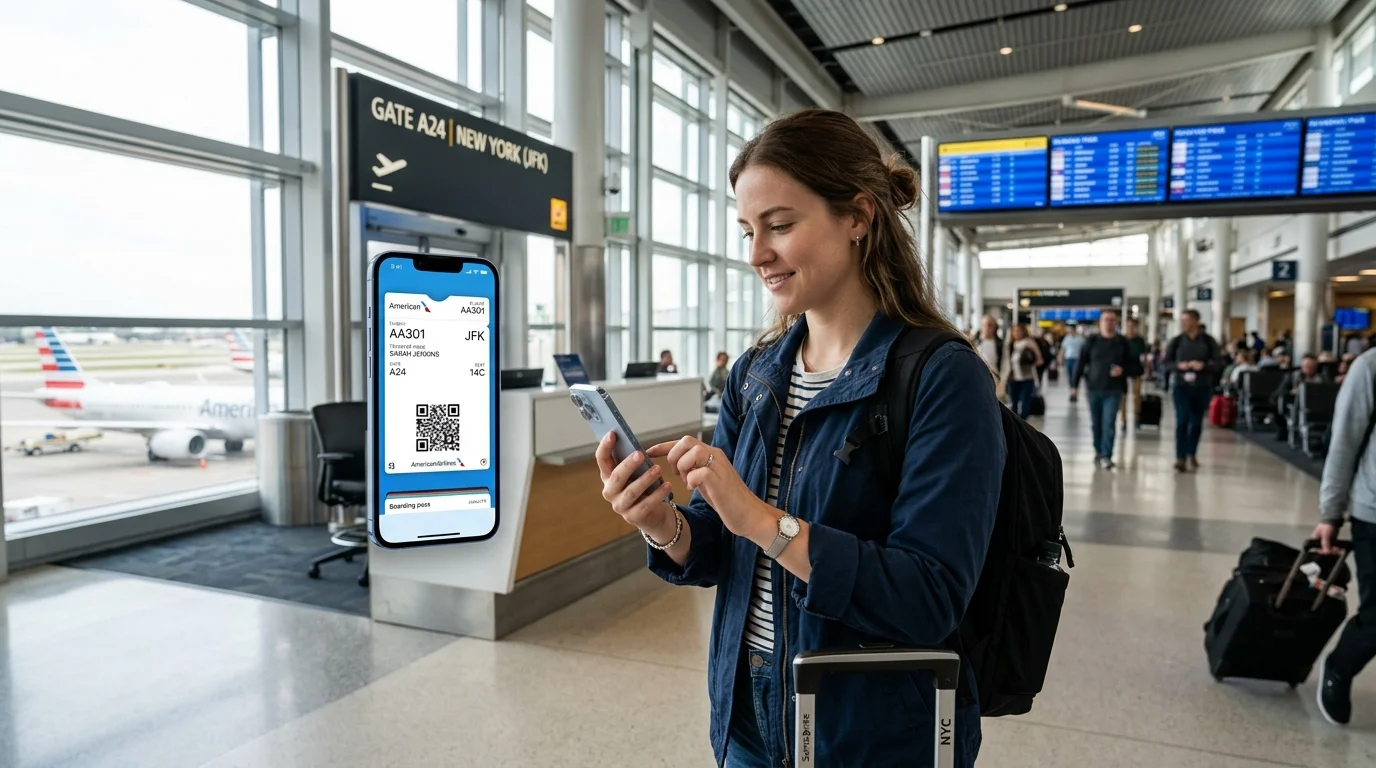
 Online check-in lets travelers secure boarding passes before reaching the airport.
You pull up to the departure drop-off curb forty-five minutes before your flight is scheduled to push back, confident there is still plenty of time to print a ticket and walk through security. Inside the terminal, the self-service kiosk flashes a red error screen, and the desk agent regretfully explains that check-in closed ten minutes ago. Your reservation receipt prominently displays the departure time, but departure is not the deadline that keeps you on the plane.
Every travel day, thousands of passengers forfeit their tickets because they confuse departure time with their personal arrival target. An airline check-in policy is an operational contract governing the exact cutoffs by which you must confirm your seat, hand over checked luggage, and present yourself at the boarding gate. Because online portals, airport desks, baggage belts, and boarding gates operate on separate, non-negotiable clocks, understanding how these deadlines interact is the most critical step in safeguarding your journey.
What Is Airline Check-In?
Airline check-in is the formal operational process by which a passenger confirms their presence on a scheduled flight, presents required travel documentation for inspection, allocates or verifies seating, checks hold luggage, and obtains an official boarding pass.
Holding an electronic ticket (e-ticket) or a booking confirmation confirms you have purchased passage, but it does not add you to the active passenger manifest. Check-in converts that ticket reservation into an active seat assignment and grants you the travel credentials required to clear airport security checkpoints and enter the aircraft.
Checking in and boarding the aircraft are two completely separate operational stages:
- Check-In: Verifies identity, registers checked luggage into the baggage-handling system, validates visas/passports, and issues the boarding pass.
- Boarding: Involves presenting that boarding pass and photo identification at the departure gate to physically step onto the aircraft. Completing check-in does not guarantee the plane will wait if you fail to reach the gate before boarding concludes.
How Does Airline Check-In Work?
The flight check-in process follows a strict operational sequence designed to balance passenger verification with complex aircraft weight-and-balance logistics:
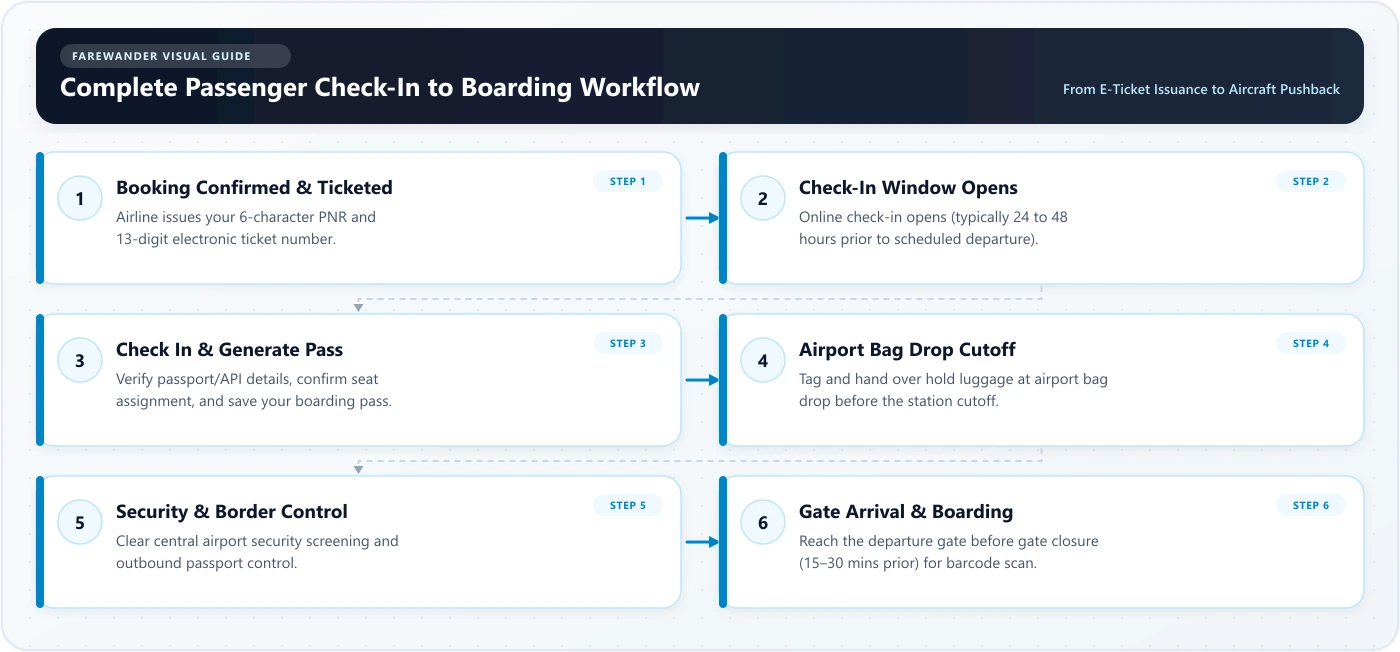
- Booking Confirmation: The passenger purchases an itinerary, generating an electronic ticket receipt and a six-character Passenger Name Record (PNR).
- Check-In Opens: The carrier opens its processing window via mobile app, website, or airport desks.
- Identity & Seat Confirmation: The passenger supplies mandatory identification details, confirms or selects available seating, and accepts the carrier's hazardous materials disclosures.
- Boarding Pass Issuance: The airline generates an optical 2D barcode credential—digitally via smartphone wallet/app or physically via thermal paper.
- Baggage Handover: If traveling with hold luggage, the passenger delivers suitcases to a baggage-drop desk or self-bag-drop unit before the published baggage cutoff.
- Security & Immigration: The passenger scans their boarding pass to access security screening and outbound passport control.
- Gate Boarding: Gate agents scan the boarding pass to confirm physical boarding.
- Gate Closure: Jet bridge doors lock strictly before the scheduled pushback time.
Comparing Fares for Your Route?
Search live multi-airline schedules, spot discount windows, and baggage fee rules on FareWander.
What Are the Different Ways to Check In for a Flight?
Commercial carriers offer multiple channels to complete check-in, though exact availability depends on the operating airline, departure airport infrastructure, and passenger documentation status:
- Online Web Check-In: Completed via a desktop or mobile browser on the airline's official site, allowing travelers to generate printable PDF passes or receive digital links.
- Mobile App Check-In: Executed through the carrier's official iOS or Android app, automatically generating offline mobile wallet boarding passes.
- Self-Service Airport Kiosks: Touch-screen terminals situated in the airport ticketing lobby where passengers scan passports or input PNR codes to print paper passes and adhesive luggage tags.
- Airport Counter Check-In: Staffed service desks where airline agents manually review physical travel documents, manage excess baggage, verify visas, and issue boarding passes.
What Is Online Check-In?
Online check-in is the digital confirmation of a passenger’s travel via the internet prior to arriving at the airport terminal.
To access online check-in, a traveler needs their six-character alphanumeric booking reference (PNR) or e-ticket number alongside the passenger's surname as it appears on the reservation. Digital portals allow travelers to enter advance passenger information (APIS), choose available seats, declare checked baggage quantities, and download boarding passes directly to their devices.
There is no universal online check-in opening window across the aviation industry. Opening timelines vary based on business models and route regulations:
- Full-service international carriers (e.g., British Airways, KLM, Air France) commonly open online portals 24 to 30 hours before departure.
- Regional and transatlantic carriers (e.g., Aer Lingus, Aegean Airlines) frequently open portals 48 hours prior for standard short-haul routes and 24 hours prior for long-haul transatlantic crossings.
- Some low-cost European carriers open digital check-in up to 30 or 60 days in advance for passengers who purchase reserved seating, while restricting passengers with unallocated seats to a 24- to 48-hour window.
How to Check In Online
While layout details differ across airline mobile apps and desktop portals, completing digital check-in generally follows this step-by-step procedure:
- Access the Official Platform: Navigate directly to the operating airline’s verified website or official mobile app. Never use unverified third-party search tools or paid intermediary check-in websites.
- Open the Check-In Tab: Locate the dedicated "Check-In" or "Manage Booking" portal on the homepage.
- Input Identification Data: Enter your six-character alphanumeric booking reference (PNR) and your surname.
- Review Itinerary: Confirm passenger names, flight numbers, departure dates, and connection cities.
- Submit Required Travel Details: Enter passport numbers, expiration dates, nationality, and destination address or visa details when traveling internationally.
- Seat Allocation: Select or modify your seating; pay any applicable ancillary seat fees if required by your fare rules.
- Declare Baggage: Specify the number of hold bags you plan to bring to pay lower digital rates rather than elevated airport counter fees.
- Finalize and Retrieve Boarding Pass: Save the mobile pass directly to Apple Wallet or Google Wallet, save an offline PDF copy, or print a physical sheet.
- Follow Airport Bag-Drop Directives: If traveling with hold luggage, locate your airline's dedicated bag-drop desk upon terminal arrival before the luggage cutoff shuts.
Planning Travel Logistics?
Use FareWander tools to calculate flight times, luggage rules, and visa requirements.
What Is Airport Check-In?
Airport check-in is the physical verification and processing conducted in person at the departure terminal.
At the airport, airline representatives or automated kiosks verify government-issued photo identification, confirm visa and entry documents, weigh and accept checked baggage, assign remaining seat inventories, and print physical thermal paper boarding passes.
Airport counter check-in remains essential when digital self-service cannot satisfy government regulatory mandates, when automated systems face outages, or when passengers require specialized ground assistance.
What Is the Difference Between Online Check-In and Airport Check-In?
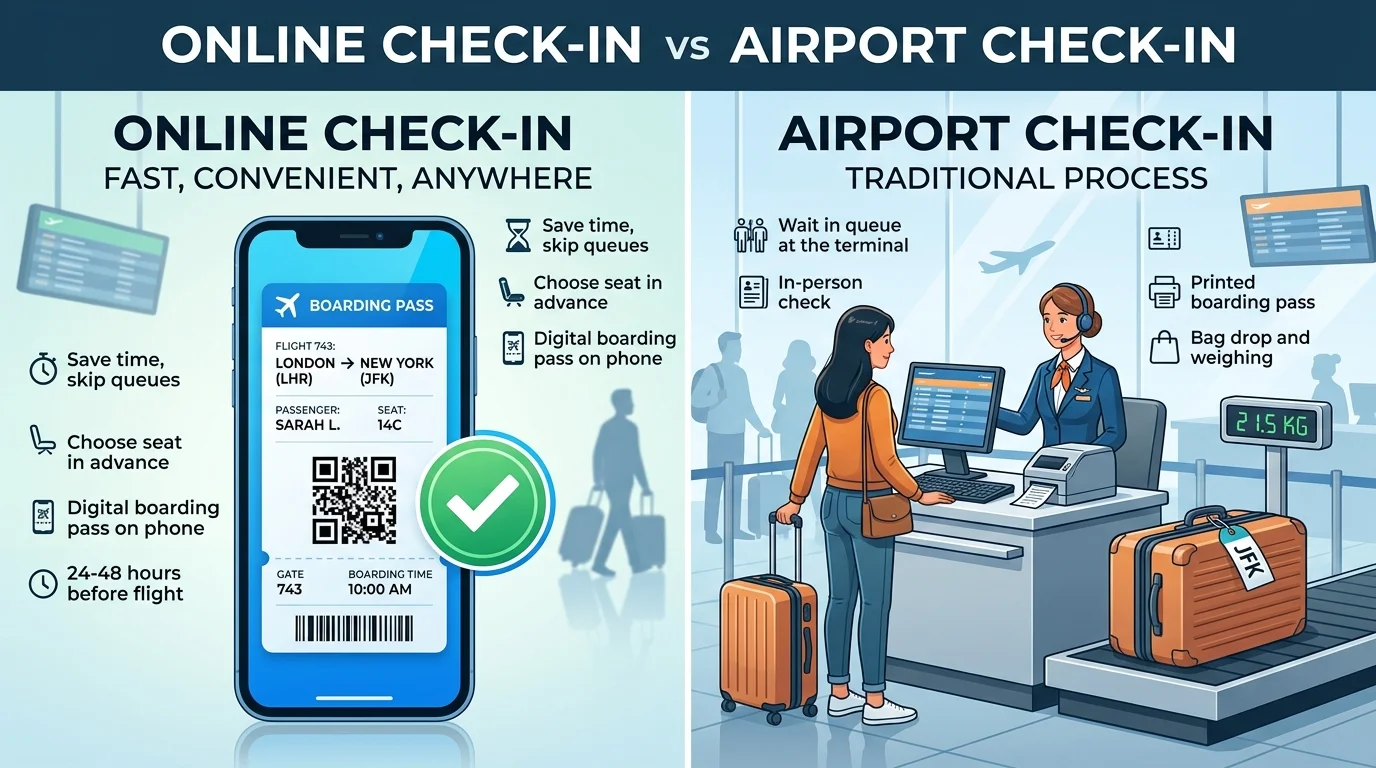 Choose between mobile check-in and staffed service desks based on your baggage and document requirements.
| Feature | Online Check-In | Airport Check-In |
|---|---|---|
| Location | Web browser or airline mobile app. | Departure terminal check-in hall. |
| Opening Window | Typically 24 to 48 hours prior (varies by carrier). | Typically 2 to 4 hours before departure. |
| Boarding Pass | Digital barcode in app/wallet or home-printed paper. | Thermal paper pass printed by kiosk or agent. |
| Seat Selection | Available from device; wider selection earlier on. | Subject to remaining seat inventory at arrival. |
| Checked Baggage | Must be taken to dedicated bag drop prior to cutoff. | Weighed, tagged, and accepted at the service counter. |
| Document Verification | Digital data entry; manual checks may still be flagged. | Physical inspection of visas, passports, and entry permits. |
| Special Assistance | Basic requests only; physical logistics cannot be resolved. | In-person staff dispatch for wheelchairs and mobility aids. |
| Applicable Fees | Free across global commercial carriers. | Free on legacy airlines; select budget carriers charge desk fees. |
Online check-in streamlines your departure, but it does not eliminate airport security, luggage acceptance cutoffs, or physical border controls.
When Does Online Check-In Open?
Airlines determine their own digital check-in schedules. No single universal opening hour applies across the industry:
- 24 Hours Prior: Standard among legacy US and transatlantic carriers (e.g., Delta Air Lines, United Airlines).
- 30 Hours Prior: Common among select European flag carriers like Air France and KLM.
- 48 Hours Prior: Standard practice for numerous international and European carriers (such as Aegean Airlines, Aer Lingus short-haul, and Air India domestic web check-in).
- Route-Specific Rules: A carrier may maintain a 48-hour window for regional routes but shorten transatlantic or US-bound routes to 24 hours to comply with security manifest transmission timelines.
- Codeshare Nuances: When your booking is marketed by one carrier but flown by another, online check-in windows are governed by the operating carrier's technical system.
When Does Online Check-In Close?
Online check-in closing cutoffs occur well before aircraft pushback to allow airline dispatchers to finalize passenger manifests, cargo weights, and seating trims.
- Domestic Flights: Online check-in typically closes 45 to 60 minutes prior to scheduled departure.
- International Flights: Online portals generally shut down 60 to 90 minutes prior to departure.
Once the digital window closes, the booking system automatically locks online processing. If you have not checked in digitally before this cutoff, you must immediately report to an airport service desk. Scheduled departure time is never your check-in deadline; waiting until 30 minutes before departure to log into an app guarantees a locked record.
How Early Should You Arrive at the Airport?
Airport arrival recommendations are practical planning guidelines designed to absorb variable security lines and terminal transit times, rather than statutory airline regulations.
Your arrival buffer must be calculated based on operational risk factors:
- Domestic vs. International: International flights require passport verification, customs declarations, and border control processing.
- Baggage Status: Traveling with checked luggage requires clearing the bag-drop line before the baggage cutoff closes.
- Airport Scale & Congestion: Navigating sprawling hubs (e.g., Delhi T3, London Heathrow, New York JFK) takes significantly longer than passing through regional airports.
- Travel Timing: Peak morning departure banks (6:00 AM – 8:30 AM) and holiday periods double checkpoint wait times.
General Planning Benchmarks:
- Domestic Travel: Plan to arrive 2 hours prior to scheduled departure (90 minutes if traveling with carry-on bags only and holding an active boarding pass).
- International Travel: Plan to arrive 3 hours prior to scheduled departure.
- Major Transfer Hubs & Peak Holidays: Plan to arrive 3.5 to 4 hours prior when departing major international hubs during peak seasonal rushes.
Always verify your carrier's published check-in and baggage-drop deadlines; these official cutoffs represent the legal minimums controlling your ticket validity.
What Is the Airline Check-In Deadline?
The airline check-in deadline is the absolute latest point in time by which a passenger must complete the check-in process or present themselves at the carrier's airport desk for processing.
This cutoff is fixed and non-negotiable. If you step up to an airport desk one minute after the published deadline has expired, the flight manifest will have transitioned to flight dispatch, permanently locking the agent out of the system. The check-in deadline is distinct from the baggage-drop cutoff, the boarding deadline, and the scheduled departure time.
Check-In Deadline vs Boarding Time vs Departure Time
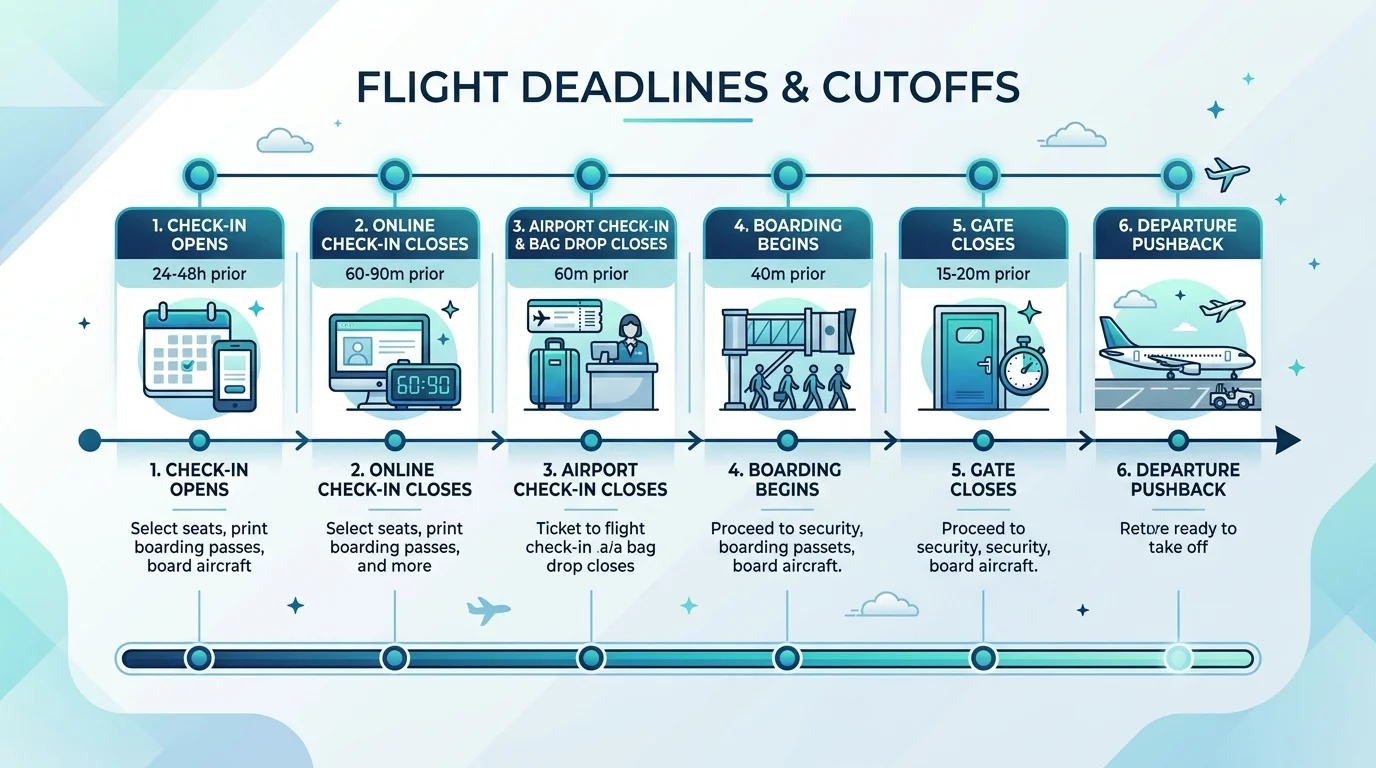 Flight milestones operate on distinct, non-negotiable operational clocks.
| Term | Operational Meaning | Typical Window |
|---|---|---|
| Check-In Deadline | The latest permitted time to complete check-in online or at a terminal desk. | 45–60 mins prior (domestic); 60–75 mins prior (international). |
| Baggage-Drop Deadline | The latest moment checked luggage can be scanned onto the sorting conveyor belts. | Commonly identical to or 10–15 mins earlier than desk check-in. |
| Boarding Time | The period when gate agents begin scanning boarding passes to load passengers. | Begins 30–50 mins prior to departure. |
| Gate Closing Time | The non-negotiable cutoff after which the jet bridge doors lock. | Strictly 15–25 mins prior to pushback. |
| Scheduled Departure | The exact time the aircraft releases brakes and pushes back from the gate. | The timestamp printed on your ticket; not an arrival cutoff. |
What Happens If You Miss the Check-In Deadline?
Missing the check-in deadline causes immediate administrative and financial disruptions:
- Refusal of Check-In: Desk staff cannot reopen closed flight rosters, and self-service kiosks will decline your PNR.
- Baggage Rejection: Luggage cannot be accepted or loaded onto the aircraft hold once the flight manifest is finalized.
- Classification as a No-Show: If you fail to check in or do not cancel before the cutoff passes, the automated booking engine marks your record as a "no-show".
- Loss of Ticket Value: On restrictive basic economy or promotional fares, no-show status results in the complete forfeiture of your base airfare.
- Cancellation of Downstream Flights: If you hold a multi-leg or round-trip booking, missing check-in on the outbound segment causes the reservation engine to automatically purge all onward and return flights under the sequential coupon rule.
- Rebooking Discretion: Depending on your fare conditions, airline representatives may offer same-day rebooking or standby on the next available flight upon payment of administrative penalties and dynamic fare differences. Complimentary rebooking is not guaranteed.
If you are running late, contact your carrier immediately before the check-in window closes. Modifying your ticket proactively prevents automated no-show penalties. For step-by-step guidance on recovering your itinerary, explore our resource on FareWander Airline No-Show Policy: Fees, Rules & Missed Flights.
What Happens If I Check In but Miss the Flight?
Checking in online confirms your intent to fly, but it does not compel an aircraft to hold its departure.
If you check in successfully but fail to reach the gate before the gate-closing cutoff:
- Offloaded Passenger & Bags: Gate staff will offload you from the flight manifest. Aviation security regulations strictly prohibit transporting unaccompanied luggage, meaning ground handlers must locate and unload your checked bags from the cargo hold before pushback.
- Gate No-Show Status: You are classified as a gate no-show, extinguishing your rights to involuntary delay compensation.
- Connecting Flights Voided: Subsequent connected flights on the same ticket will be cancelled unless you contact airline customer service immediately to reinstate the coupon file.
Do I Need to Check In Online If I Have Checked Baggage?
Checking in online is highly advantageous even when traveling with hold luggage, but it does not bypass physical airport baggage drop.
Completing digital check-in locks in your seat, registers your passenger details, and allows you to utilize dedicated, faster "Bag Drop" desks or automated self-service bag drop units at the terminal. However, your checked suitcases must still be weighed, tagged, and handed over to airline staff before the airline's published baggage-drop deadline. If you arrive with an online boarding pass but present your suitcase after the baggage desk closes, your bag will be rejected.
Can I Check In Online If I Only Have Carry-On Baggage?
When flying exclusively with carry-on luggage, online check-in offers maximum speed:
- Check in via the airline app 24 to 48 hours prior to departure.
- Save your digital boarding pass to your mobile wallet.
- Head directly to passenger security screening upon terminal arrival, bypassing the ticketing hall completely.
- Walk directly to the assigned boarding gate.
Important Exception: Certain international routes and specific destination countries mandate physical passport and visa inspections prior to security clearance. In these scenarios, digital check-in generates an informational slip instructing you to report to an airport desk for a manual document check before an active boarding pass can be released.
Why Can't I Check In Online?
Failing to complete digital check-in is common and rarely indicates a cancelled booking. Typical operational reasons include:
- Mandatory Document Verification: Your destination requires manual visa, return-ticket, or passport validity checks that must be conducted in person by counter staff.
- Window Timing: The digital check-in window has not yet opened, or it has already closed for operational balance.
- Operating Airline IT Disconnects: Your itinerary is a codeshare operated by a partner airline whose reservation system has not synced seat inventory.
- Special Assistance & Passenger Types: The booking contains lap infants, unaccompanied minors, service animals, or requested wheelchair/medical escort services.
- Booking Discrepancies: Unpaid seat fees, unconfirmed schedule modifications, or split PNR records requiring ticketing intervention.
- Secondary Security Screening: You have been selected for mandatory in-person security screening (such as the SSSS designation on US-bound itineraries).
If you encounter an online check-in error, take a screenshot of the message, verify your travel details, and arrive at the airport ticketing counter early to complete the process in person.
Can You Check In Online for International Flights?
Yes, many airlines support online check-in for international itineraries, allowing passengers to submit passport numbers, expiration dates, and visa details via their app or website.
However, digital check-in for international flights does not always produce an active boarding pass. Depending on the destination's border policies, the airline may issue a "Check-In Confirmation" or "Boarding Pass Required at Airport" barcode. In such cases, you must present your physical passport and required transit/entry visas at an airport check-in counter, where an agent will inspect the physical documents and print your active boarding pass.
Domestic vs International Airline Check-In
| Factor | Domestic Check-In | International Check-In |
|---|---|---|
| Online Check-In | Widely supported; instant digital boarding passes issued. | Available on many routes; may require in-person document validation. |
| Identification | Government photo ID (driver’s license, national ID). | Valid passport (frequently requiring 6 months remaining validity). |
| Entry Authorizations | Not applicable under domestic travel regulations. | Visas, e-Visas, or digital waivers (ESTA, eTA, ETA) required. |
| Border Immigration | None; proceed straight from security to gate. | Mandatory outbound border control/passport inspection checkpoints. |
| Desk Closing Times | Typically closes 45–60 minutes before departure. | Strictly closes 60–75 minutes before departure. |
| Recommended Buffer | Arrive 2 hours prior to scheduled departure. | Arrive 3 to 4 hours prior to scheduled departure. |
What Documents Do You Need for Airline Check-In?
Document requirements depend entirely on the itinerary and destination border mandates:
- Domestic Flights: Valid government-issued photo identity card (e.g., driver's license, national identity card, passport, military ID) and your six-character PNR or booking confirmation.
- International Flights: Valid physical passport with sufficient blank visa pages, required destination entry visas or approved electronic travel authorizations, outbound customs pre-declarations, and proof of onward/return travel where mandated by destination immigration laws.
- Medical / Accessibility Documentation: Doctor certificates or battery specification sheets if flying with personal portable oxygen concentrators or electric mobility devices.
Never pack identification documents, entry visas, or essential medications inside checked luggage; keep them in your personal item at all times.
Check-In for Infants and Children
Traveling with children introduces specific documentation and seating rules:
- Infants on Lap (Under Age 2): Most carriers restrict online check-in for lap infants due to aircraft oxygen mask configurations, which limit where infants can sit in each row. Parents generally must check in at an airport counter to present the infant's birth certificate or passport and collect a dedicated infant boarding pass.
- Child Fare (Seated): Children traveling in their own reserved seats can often be checked in online, provided they are linked to an adult reservation on the same PNR.
- Unaccompanied Minors: Children traveling alone without an adult companion cannot use digital check-in. A parent or legal guardian must accompany the child to the airport counter, present official identification, complete formal custody transfer documentation, and remain at the gate until the flight is airborne.
For full luggage allowances and seat rules, consult our guide on Infant & Child Airline Policies.
Check-In for Passengers Requiring Special Assistance
Passengers requesting accessibility support—such as airport wheelchair escorts, guide dog carriage, or mobility equipment transport—should review their check-in process carefully:
- Counter Reporting Mandate: While some airlines allow travelers requiring special assistance to check in online, airport staff must inspect personal mobility devices (verifying battery types for electric wheelchairs) and coordinate dedicated airport escorts.
- Recommended Buffer: Arrive at the airport at least 60 minutes earlier than standard arrival recommendations. Dedicated terminal assistance teams require time to dispatch personnel and transport travelers through security screening checkpoints.
- Medical Clearances: If traveling with medical devices or therapeutic oxygen, report directly to staffed desks to submit carrier-approved medical indemnity documentation.
Check-In for Connecting Flights
How check-in works on a multi-segment flight depends on whether your itinerary was issued as a single connected booking or as two separate, self-transferred tickets:
- Single-Ticket Connections: When your complete itinerary is issued under one booking reference (PNR), you benefit from through check-in. The origin airport counter or mobile app will issue boarding passes for all consecutive flight legs, and your checked bags will be tagged through to your final destination (subject to local customs entry regulations, such as clearing US customs at your first arrival port).
- Separate-Ticket Connections (Self-Transfer): If you purchased two flights independently, your check-in processes are completely unlinked. You must check in separately with each carrier, clear immigration at the transfer city, claim your luggage from the arrivals carousel, re-enter the public departure hall, and check in again at the second airline's desk before its cutoff closes.
For transit buffer advice, explore our detailed explainer on What Happens If You Miss a Connecting Flight? Single Ticket vs Separate Tickets.
Codeshare Flights and Check-In
A codeshare is a commercial agreement where one carrier markets and sells a flight under its own designator code, while a partner carrier physically operates the aircraft.
- Marketing Airline: The carrier that sells you the ticket and issues the confirmation (e.g., Delta selling a flight from New York to London).
- Operating Airline: The carrier that provides the aircraft, flight crew, and tarmac operations (e.g., Virgin Atlantic operating that aircraft).
Which Airline Handles Check-In?
- At the Airport: You must always check in at the operating carrier's physical counters and self-service kiosks. The operating carrier controls the aircraft manifest, gate staff, and boarding passes.
- Online Check-In: Start on the marketing carrier’s app or website. In many instances, the portal will provide the operating carrier's unique reservation locator code and redirect you to the operating airline’s check-in portal.
Always inspect your e-ticket receipt for the phrase "Operated by [Carrier]" before arriving at the terminal to ensure you head to the correct counter. Learn more in our guide on What Does "Operated By" Mean on a Flight Ticket?.
Can You Check In at the Airport After Online Check-In?
Yes. Completing online check-in does not bar you from seeking counter assistance at the terminal.
You can approach airport staff or use self-service kiosks after checking in online to:
- Hand over hold luggage at dedicated bag-drop desks.
- Print a physical thermal paper boarding pass if your phone battery is low.
- Present passports and entry visas for mandatory physical verification.
- Inquire about standby lists, operational seat adjustments, or cabin upgrades.
Can You Change Your Seat During Check-In?
Most airlines allow passengers to review and modify their seat assignments during the check-in workflow.
However, seat flexibility depends on fare rules and inventory:
- Basic/Light Fares: Many budget tickets assign random seats automatically; changing to an extra-legroom or aisle seat during check-in usually incurs an ancillary fee.
- Standard & Flexible Fares: Often include complimentary seat changes from remaining standard economy inventory during check-in.
- Fully Booked Flights: If a flight is heavily booked, available seat maps may appear locked, requiring airport gate agents to assign final seats immediately prior to boarding.
Can You Check In Without Choosing a Seat?
Yes. On carriers that charge for advance seat selection, you can check in without purchasing an assigned seat.
The airline's passenger service system will automatically assign you a seat at no charge from remaining cabin inventory when finalizing check-in. On select high-demand flights, an airline may issue an unassigned boarding pass labeled "Seat Assigned at Gate," directing you to the departure gate where agents finalize seat assignments based on aircraft trim requirements.
What Happens If Online Check-In Is Not Working?
If an airline's mobile app or website fails during your check-in attempt, follow these steps:
- Verify Your Data: Ensure you are entering the airline's official six-character PNR rather than a third-party travel agency booking number.
- Confirm Window Timing: Check whether the carrier's digital check-in window has opened.
- Capture Timestamped Proof: Take screenshots of the digital error message showing the time and date.
- Switch Channels: Attempt check-in on a mobile browser instead of the app, or vice versa.
- Head to the Airport Counter Early: Arrive at the airport ticketing lobby with ample time to check in at a staffed desk. If a verified technical outage prevented digital check-in, carriers that normally charge desk check-in fees will waive them.
What If My Boarding Pass Is Not Available?
Occasionally, completing digital check-in results in a confirmation screen without an active barcode or printable pass.
This occurs when:
- Destination border regulations require an airline agent to physically review your passport, visa, or health declarations before flight access is granted.
- The reservation requires manual seat assignment at the gate due to full loads.
- You have been selected for mandatory secondary airport security screening.
In this situation, bring your booking reference and passport directly to the airline's airport check-in counter, where staff will verify your paperwork and print a physical boarding pass at no cost.
Can You Check In at the Airport Without a Printed Ticket?
Yes. Commercial aviation operates on electronic tickets stored in airline passenger databases.
You do not need an old-fashioned paper flight ticket to check in at the airport. To check in at an airport counter or self-service kiosk, you only need to present:
- A valid government photo ID or passport.
- Your six-character booking reference (PNR) or digital e-ticket receipt displayed on a smartphone.
Common Airline Check-In Mistakes to Avoid
- Targeting Departure Time for Arrival: Treating the flight pushback time as your terminal arrival goal guarantees a missed check-in cutoff.
- Confusing Check-In with Boarding: Believing an online boarding pass allows you to reach the gate two minutes before departure; gates lock 15 to 20 minutes prior to pushback.
- Ignoring Separate Bag-Drop Deadlines: Arriving with a mobile pass after the baggage-drop desk has closed.
- Overlooking Document Rules: Failing to confirm destination passport validity rules (such as 6 months remaining validity) or required electronic visas.
- Assuming Online Check-In Eliminates Lines: Forgetting that security lines, immigration desks, and bag-drop queues still require substantial time.
- Heading to the Marketing Carrier's Desk: Standing in the wrong airline queue on codeshare itineraries rather than reporting to the operating airline.
- Using Unofficial Check-In Sites: Submitting private passport data into unverified third-party web forms rather than official carrier channels.
- Neglecting Airport Display Screens: Failing to monitor terminal monitors for last-minute gate changes after completing check-in.
Airline Check-In Checklist
Before Leaving Home
- Verify your airline’s exact check-in and baggage-drop closing deadlines.
- Complete online check-in via official app or website as early as permitted.
- Save boarding passes to your smartphone wallet and download an offline copy.
- Check departure terminal numbers and current airport road traffic conditions.
- Verify passport validity and print required visas or entry authorizations.
- Weigh hold luggage to avoid repacking at the terminal.
At the Airport
- Report to baggage drop before the published baggage cutoff if checking suitcases.
- Retain peel-off luggage claim barcode receipts after bag drop.
- Clear passenger security screening and outbound immigration checkpoints.
- Check terminal information screens to verify your departure gate assignment.
- Report to your departure gate at least 30 to 45 minutes before departure, well before the gate-closing cutoff.
Frequently Asked Questions
An airline check-in policy is the set of contractual rules, procedures, and strict cutoff times an airline uses to verify passenger travel eligibility, validate passports/visas, allocate seating, collect checked baggage, and issue boarding passes before a flight closes.
Air travel rewards disciplined preparation, and the most reliable habit you can build is separating your departure pushback time from your operational airport milestones. Airlines strictly enforce cutoff deadlines for digital check-in, baggage drop, and gate boarding because modern commercial airliners cannot depart safely or on schedule without finalized passenger manifests and verified cargo balances. Before leaving home, check your airline's official check-in window, verify whether your luggage drop closes earlier than the main desk, keep travel documents accessible in your carry-on bag, and ensure you clear terminal security with time to spare.