When you sit down to book a family trip with a baby or a young toddler, the standard checkout flow suddenly feels like a minefield of fine print. You find yourself wondering whether an infant sitting on your lap actually travels for free, whether your compact travel stroller can be wheeled right to the plane door, and what paperwork border control will demand if your child does not share your last name.
Aviation rules for minors are strictly divided by passenger age, aircraft cabin design, international borders, and operating carrier agreements. A policy that applies to a domestic hop on an Airbus A320 can be completely invalid on an overseas leg operated by a partner carrier. This guide breaks down the operational framework airlines use worldwide—covering fares, seating, cabin equipment, and documentation—so you can finalize your travel plans without airport surprises.
- •Lap Travel: 1 lap infant permitted per accompanying adult.
- •Ticket Mandate: Every baby requires an issued e-ticket, even if base fare is free.
- •International Lap Fare: Typically ~10% of adult base fare plus full taxes.
- •Separate Seat: Requires an aviation-approved, labeled car seat or harness.
- •Mandatory Dedicated Seat: Must occupy their own seat from 2nd birthday onward.
- •Turning 2 En Route: Cannot return as a lap infant if 2nd birthday passes during trip.
- •Documentation: Passports mandatory for all international travel regardless of age.
- •Baggage: Usually eligible for free gate-checked stroller and car seat.
1. Infant vs Child: What Is the Difference?
Airlines do not classify younger travelers by milestones like crawling or walking; ticketing engines run entirely on chronological age on the day of travel. Across the aviation industry, passengers are grouped into three distinct categories:
- Infant: Refers to a passenger from birth up to their second birthday (0 to 23 months). Under most carrier rules, an infant may travel either as a "lap infant" (held by an adult) or in their own ticketed seat using an approved child restraint system.
- Child: Generally covers travelers who have celebrated their second birthday up to an upper threshold defined by the airline—typically age 11, though some airlines extend child classifications up to age 14 or 15. A passenger who has reached their second birthday must occupy their own dedicated aircraft seat in the standard Economy Class cabin or premium cabins.
- Adult: For ticketing and safety purposes, passengers reaching a carrier’s adult threshold (commonly age 12 and above, though varying between 12 and 16 depending on the airline) are booked as standard adult passengers, paying adult fares and assuming full seating responsibilities.
Critical Age Rule: Age brackets apply to the date each individual flight segment is flown. If an infant turns two years old during a vacation, aviation safety regulations prohibit them from returning as a lap infant on the inbound journey. They must occupy their own seat for all segments flown after their second birthday.
| Passenger Type | Typical Airline Age Category | Dedicated Seat Requirement | General Fare Treatment |
|---|---|---|---|
| Infant (Lap) | Under 2 years (0–23 months) | No (held on adult lap) | Free domestically (many carriers); ~10% adult base fare + taxes internationally |
| Infant (Seated) | Under 2 years (0–23 months) | Yes (requires FAA/authority-approved car seat) | Child discount percentage or full adult fare depending on fare rules |
| Child | 2 years up to 11 years (varies up to 15) | Yes (mandatory individual seat) | Discounted child fare (25%–33% off base) or 100% adult fare |
| Adult | 12+ years (airline-specific) | Yes (mandatory individual seat) | Full standard adult fare |
2. Do Infants Need a Flight Ticket?
Yes. Every single individual on an aircraft manifest must possess an issued e-ticket, regardless of whether they occupy a seat or sit on a lap.
A frequent misunderstanding is assuming that because a domestic lap infant may travel without paying a base airfare, they do not need a reservation. If you arrive at an airport counter with an un-ticketed baby, you will not be issued a boarding pass. When checking in online or at the counter, the airline must associate the infant’s name and birth date with an accompanying adult’s Passenger Name Record (PNR).
On domestic itineraries, adding a lap infant may only incur zero-dollar base pricing, though nominal security fees or local passenger taxes can apply depending on the country. On international flights, "free infant travel" does not exist. International lap infants require an issued international infant ticket that incurs airline fuel surcharges, departure taxes, and a percentage of the accompanying adult’s fare.
Comparing Fares for Your Route?
Search live multi-airline schedules, spot discount windows, and baggage fee rules on FareWander.
3. Can a Baby Travel on a Parent's Lap?
Where permitted by the operating carrier and national aviation regulators, an infant under two years of age may travel on an adult’s lap. However, safety regulations and cabin architecture impose firm operational limits:
- One Lap Infant Per Adult: Aviation safety laws dictate that one adult passenger can only hold one lap infant. If a single parent travels with twins under age two, that parent cannot hold both babies; a second seat must be purchased for the second infant.
- Oxygen Mask Allocations: Commercial aircraft overhead panels (Passenger Service Units) contain a fixed number of supplemental oxygen masks per seat grouping—typically one extra mask per row (e.g., four masks for a three-seat row). Because of this design limitation, airlines restrict how many lap infants may sit in a single row section. If an adjacent passenger is already holding an infant, the reservation system will block another lap infant from booking that same row.
- Takeoff and Landing Restraint: Depending on the civil aviation authority, flight attendants will provide different safety instructions. In the European Union and the UK, flight attendants provide an extension loop belt ("belly belt") that loops through the adult's seat belt and secures around the infant for taxi, takeoff, turbulence, and landing. In the United States, the Federal Aviation Administration (FAA) prohibits supplementary loop belts due to load-transfer concerns, requiring the parent to hold the child securely in their arms.
4. When Does a Child Need Their Own Seat?
A child must occupy their own dedicated aircraft passenger seat the moment they celebrate their second birthday. No commercial airline allows a child aged two or older to travel as a lap passenger.
Even for infants under two, major aviation safety organizations—including the FAA, the National Transportation Safety Board (NTSB), and the International Civil Aviation Organization (ICAO)—strongly urge parents to secure infants in their own individual seats using an approved Child Restraint System (CRS). In severe clear-air turbulence or high-impact events, physical human grip is rarely sufficient to prevent an unrestrained lap infant from being thrown from a parent's arms.
5. Can You Book a Separate Seat for an Infant?
Yes. Parents can purchase an individual seat for an infant under two years old. When booking an infant with a dedicated seat, the parent must provide an approved hard-backed child safety seat (car seat) or an aviation-certified harness that secures into the airplane seat belt. When reading an aircraft seat map, choosing the optimal row and position is essential.
Booking a seat does not mean any infant gear can be used in any cabin position:
- The infant cannot sit unrestrained during taxi, takeoff, and landing; they must be strapped into the certified device.
- The car seat must fit the physical dimensions of the airline seat cushions (typically under 16 to 17.5 inches wide for economy class).
- The seat must be placed in a designated row (usually a window seat) to avoid blocking the evacuation path of aisle passengers in an emergency.
- Rear-facing and forward-facing installation rules must strictly follow the car seat manufacturer's instructions and airline cabin crew guidance.
Planning Travel Logistics?
Use FareWander tools to calculate flight times, luggage rules, and visa requirements.
6. Infant & Child Flight Ticket Prices
Airline pricing structures for younger passengers vary significantly between low-cost carriers, full-service legacy airlines, and route categories:
- Domestic Lap Infants: Often travel for zero base fare on full-service carriers, though government transportation taxes or segment fees may be billed. Some ultra-low-cost carriers charge a flat administrative infant handling fee per segment.
- International Lap Infants: Standard legacy carrier rules generally calculate international lap infant tickets at approximately 10% of the accompanying adult's base fare, plus 100% of all applicable government taxes, international arrival fees, and carrier-imposed surcharges.
- Infants with a Dedicated Seat: An infant occupying a separate seat is usually billed either a child discount fare (typically 75% to 80% of the adult base fare on participating international airlines) or the full 100% adult airfare.
- Child Fares (Ages 2–11): Many legacy international airlines offer published child fares that discount the base ticket by 10% to 33%. However, deeply discounted promotional fares, Basic Economy tickets, and low-cost carrier bookings generally charge children the exact same 100% base rate as adult passengers.
7. What Documents Does a Baby Need to Fly?
Documentation rules depend on whether the itinerary crosses domestic boundaries or sovereign international borders:
Domestic Travel
Requirements for domestic travel vary by national regulatory authority. In the United States, minors under 18 generally do not require government-issued photo ID for domestic TSA checkpoints, but airlines frequently require a certified birth certificate at the check-in desk to prove a lap infant is indeed under two years of age. In countries like India, official civil aviation guidelines mandate identity verification; parents must carry an infant’s birth certificate, government identification, or passport to clear terminal entry security.
International Travel
Every minor, from a two-day-old newborn to a teenager, must hold their own official government travel documents. Birth certificates are not accepted at international border control in place of a passport.
8. Does a Baby Need a Passport for International Flights?
Yes. A baby of any age must hold a valid passport for international flights.
There are no exemptions for infants at international immigration checkpoints. In addition to a valid passport, parents must verify:
- Passport Validity Rules: Many countries enforce a mandatory three-to-six-month remaining validity rule on passports beyond the date of intended departure.
- Visas and Electronic Travel Authorizations: If your destination or transit country requires an entry visa, ESTA (United States), eTA (Canada), or ETA (United Kingdom), a separate digital authorization must be applied for and approved under the infant's passport number prior to departure.
- Transit Visas: Connecting through an international hub can trigger transit visa requirements for children depending on citizenship, even if you never exit the airport transit lounge.
9. Can a Newborn Baby Fly?
Newborns can travel by air, but airlines enforce strict minimum-age thresholds for safety and liability purposes:
- Airline Minimum-Age Windows: The majority of commercial airlines require an infant to be at least 7 to 14 days old to travel. A few carriers permit travel at 48 hours of age, while others insist on a minimum of 7 days unless cleared in writing.
- Medical Clearance Requirements: If an infant is younger than the carrier's minimum threshold (often under 7 days) or was born prematurely or with medical complications, airlines require a formal medical clearance form (such as a MEDIF) signed by a certified physician confirming fitness to fly.
- Pediatric Medical Guidance: Independent of airline operational rules, pediatricians generally advise delaying non-essential air travel until an infant is at least 4 to 6 weeks old, allowing the baby’s immune system to develop and ensuring their lungs have adapted sufficiently to handle lower cabin oxygen pressures.
10. Bassinet / Baby Bassinet on Flights
Airlines operating wide-body aircraft on long-haul routes often provide onboard baby bassinets (sometimes referred to as skycots or carrycots) free of charge to parents traveling with young infants.
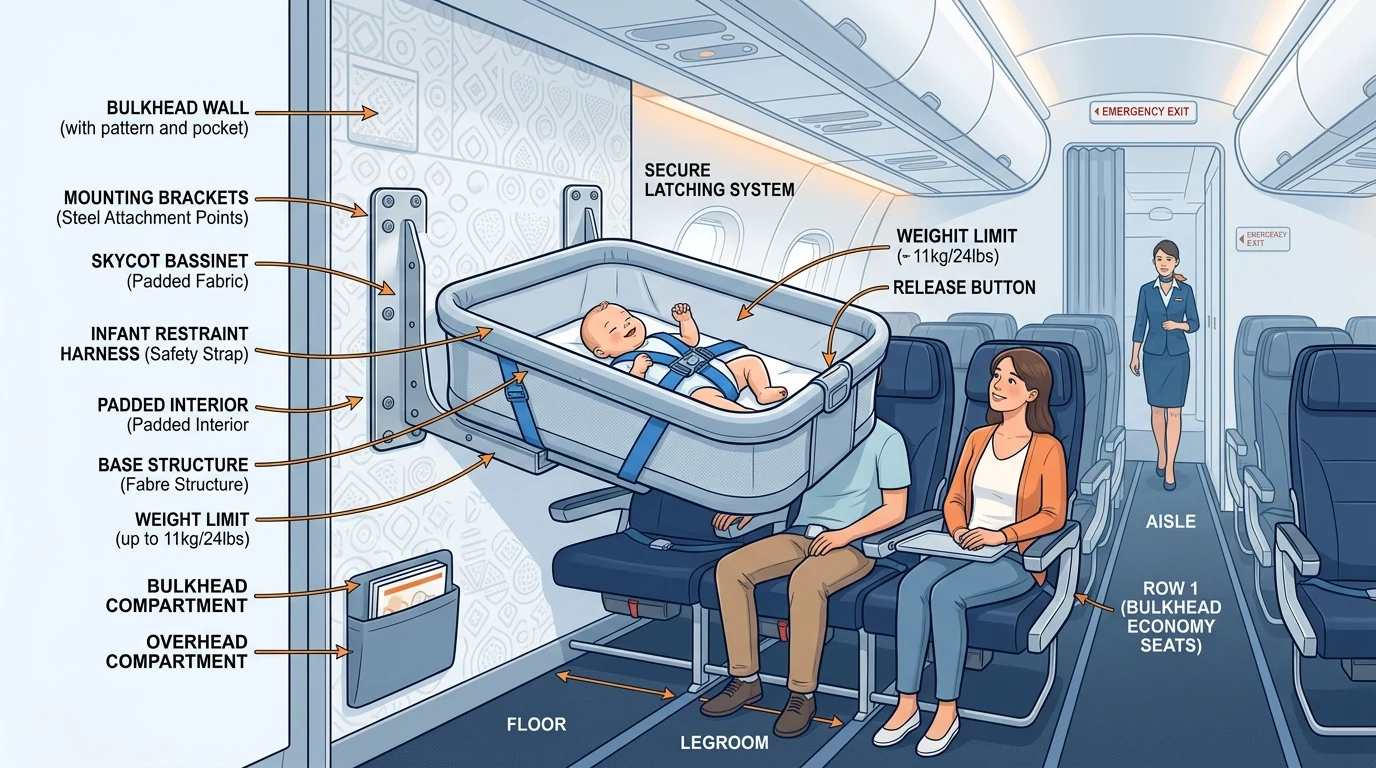
- Installation and Placement: Bassinets lock securely into dedicated brackets mounted on bulkhead walls (the solid partition separating cabin zones or galleys).
- Weight and Height Limits: Bassinet dimensions and weight limits are strictly enforced by carrier safety policies. Typical weight capacities range from 9 kg (20 lbs) to 11 kg (24 lbs), with maximum infant lengths capped around 70 to 75 cm (27 to 29.5 inches). If your baby exceeds these limits, crew will prohibit bassinet use.
- Reservation Process: Bassinets cannot simply be requested at the boarding gate. They must be requested well in advance through the airline’s reservations line or special services desk, accompanied by a reservation for the corresponding bulkhead seat.
- No Guarantee: Reserving a bassinet does not provide an absolute operational guarantee. Aircraft swaps, cabin reconfigurations, or operational seat reassignments can result in the loss of a bassinet-compatible seat.
- Turbulence Mandate: Whenever the captain illuminates the "Fasten Seatbelt" sign, the infant must be taken out of the bassinet and secured on the parent's lap or in an approved car seat for the duration of the turbulence.
11. Stroller Policy for Infants and Children
Airlines provide specialized handling for baby equipment, but handling procedures depend on the stroller's folded dimensions:
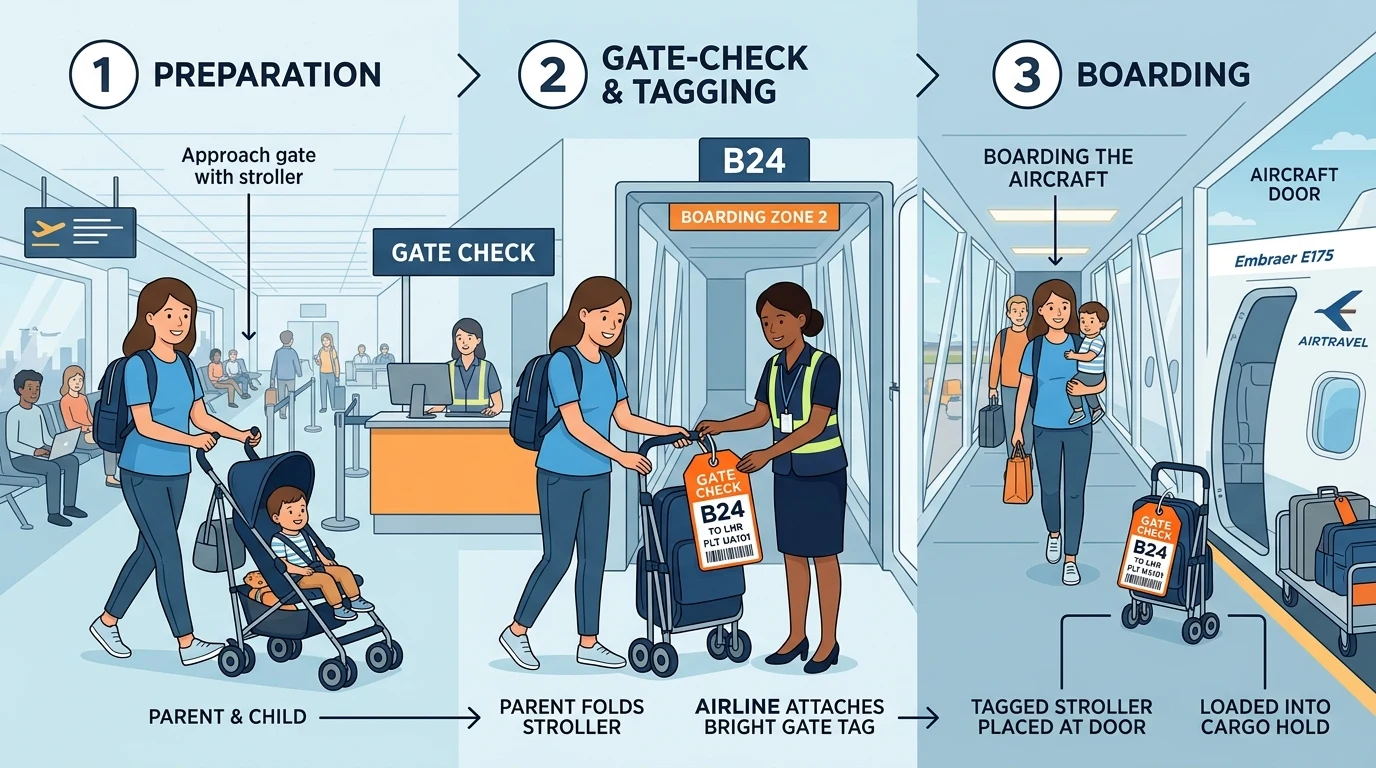
- Free Checked Stroller Allowance: Virtually all commercial airlines permit passengers traveling with an infant or young child to check one fully collapsible stroller or pushchair free of charge, over and above standard ticket baggage limits.
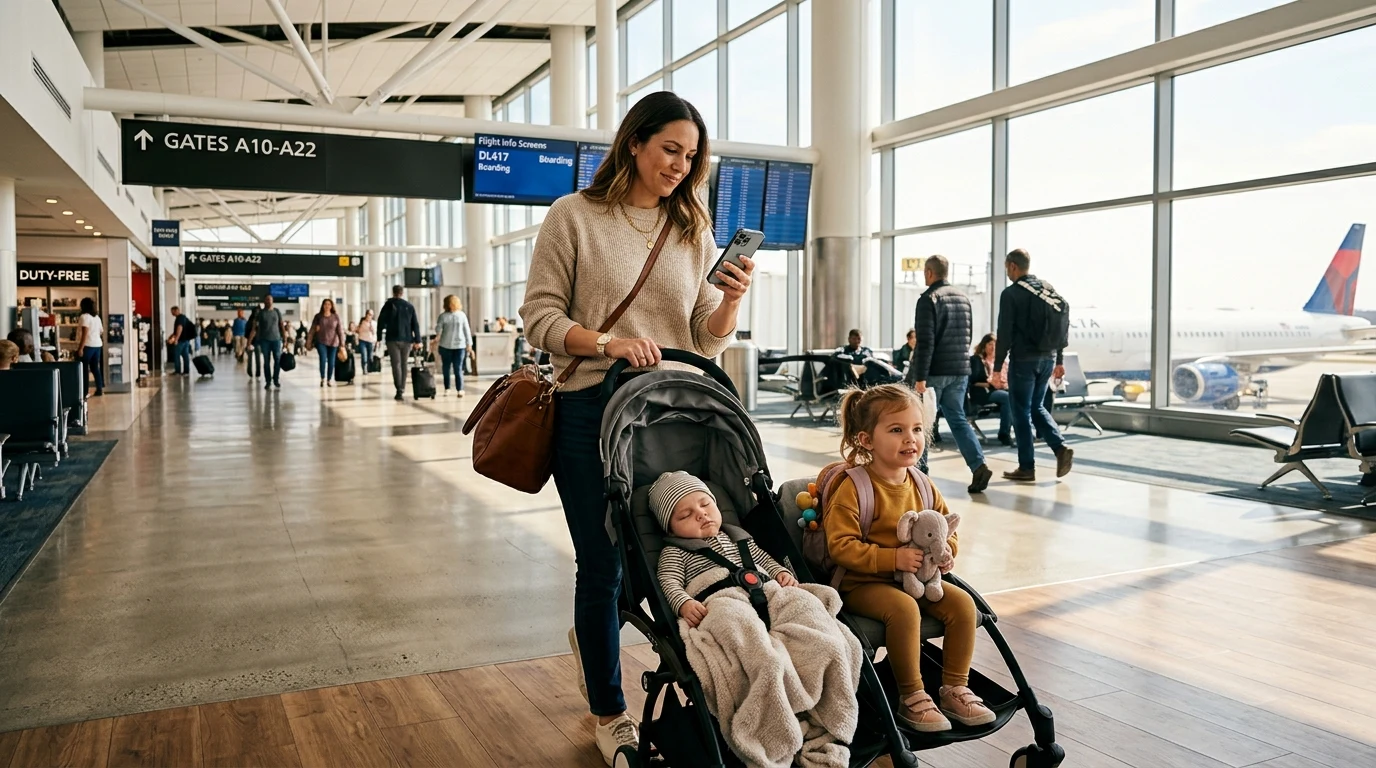
- Gate-Checking (Delivery at Aircraft Door): Most airlines allow parents to push their collapsible stroller through security and all the way to the aircraft boarding gate. At the gate, staff tag the stroller, and you leave it at the aircraft door or jet bridge before stepping onto the plane. Upon arrival at your destination, ramp personnel typically bring the stroller back up to the jet bridge door, though at certain airports local baggage rules force all gate-checked items to standard baggage claim carousels.
- Compact Strollers in Overhead Bins: Ultra-compact folding strollers (such as the Babyzen YOYO or similar models) that fold down to match standard IATA cabin baggage dimensions (e.g., 55 x 35 x 25 cm) may be carried directly into the cabin and stored in overhead lockers. However, this stroller will generally count toward the parent's personal carry-on baggage allowance.
12. Car Seats and Child Restraint Systems
Using an approved child restraint system (car seat) on board provides the highest level of physical safety for an infant or young child holding their own ticket. However, the seat must meet specific certification standards:
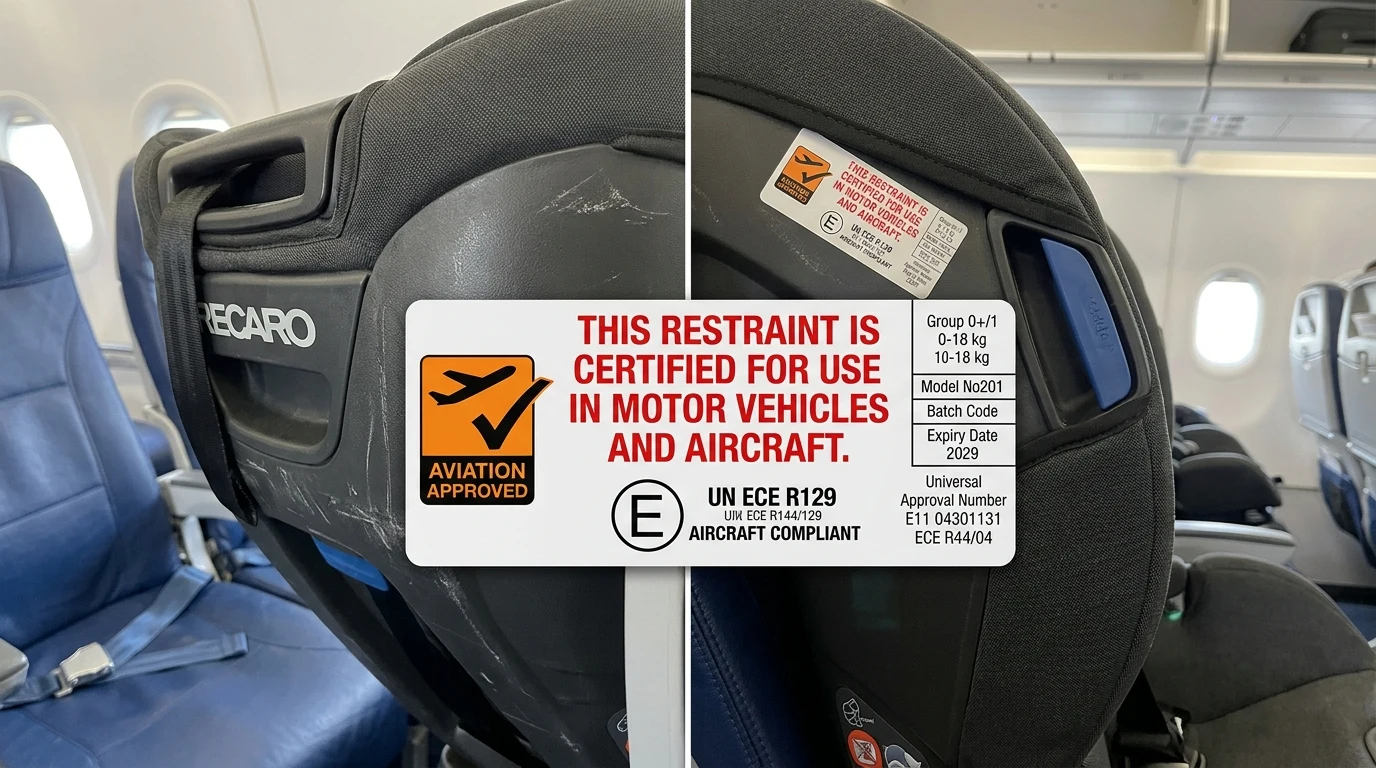
- Aviation Certification Labels: Flight attendants will inspect your car seat for an official certification sticker before allowing it to be strapped in. In the US, it must display text stating: "This restraint is certified for use in motor vehicles and aircraft" in red lettering. In Europe and internationally, seats must bear the ECE R44/04 or UN R129 (i-Size) approval label marked for aircraft use.
- Physical Seat Fit: Commercial economy seats typically offer between 16 and 18 inches of width. Bulky, wide car seats may not fit between fixed armrests.
- Seating Locations: Car seats are prohibited in emergency exit rows or the rows directly before or behind an exit row. They are usually restricted to window seats so they do not impede access to the aisle in an emergency evacuation.
- Alternative Restraints (CARES Harness): The FAA and numerous international aviation bodies have certified the AmSafe CARES child aviation restraint system—an engineered harness that wraps around the aircraft seat back and integrates with the lap belt for children weighing between 22 and 44 lbs (10 to 20 kg).
13. Diaper Bag and Infant Essentials
Packing for an infant requires separating airline cabin baggage rules from airport security screening procedures:
Airline Cabin Allowance
Most traditional carriers allow parents traveling with a lap infant to bring one dedicated diaper bag on board free of charge, in addition to the adult passenger's standard carry-on and personal item limits. On ultra-low-cost carriers, however, any diaper bag must fit within the restrictive dimensions of your purchased personal item or carry-on allowance.
Airport Security Exceptions
Aviation security administrations (such as the TSA in the United States, CATSA in Canada, and BCAS in India) exempt essential infant supplies from standard passenger screening caps:
- Pre-portioned baby formula, expressed breast milk, purified nursery water, and infant electrolyte drinks are permitted in quantities exceeding standard 100 ml (3.4 oz) liquid restrictions.
- You do not need to cram infant liquids into a single clear quart-sized bag.
- You must declare these items to security screeners at the start of the checkpoint, where they will undergo secondary testing (such as vapor scans or bottle exterior swabs).
- Gel ice packs, frozen cooler bricks, and thermal packs used to chill milk and food are permitted through security, though they must generally be frozen solid when presented.
14. Baby Food, Formula and Breast Milk on Flights
Cabin crew can assist with certain infant feeding needs, but aircraft galleys are not designed as commercial kitchens:
- Warming Bottles: Flight attendants cannot warm bottles in aircraft microwave ovens due to uneven heating risks and safety protocols. However, crew can provide a cup or bowl of hot galley water for you to submerge and warm your bottle.
- Refrigeration: Flight attendants are strictly prohibited from storing personal passenger baby food or expressed milk in onboard catering refrigerators due to aviation food safety regulations. Parents must carry their own insulated cooler bag with approved frozen gel packs to keep milk chilled during long-haul flights.
- Water Quality: Never use water from the airplane bathroom lavatory taps to mix baby formula or rinse bottles; lavatory water is non-potable. Always request bottled drinking water from the cabin crew for powdered formula preparation.
15. Infant and Child Baggage Allowance
Baggage allowances for children mirror their ticket status and fare class. Review your airline's comprehensive checked baggage allowance before heading to the airport:
| Equipment / Bag Type | Allowed Free for Lap Infant? | Allowed for Ticketed Child (Own Seat)? | Key Determinant |
|---|---|---|---|
| Collapsible Stroller | Yes (Virtually all airlines) | Yes (Up to specific age limits) | Checked at desk or gate-checked; must fold completely. |
| Certified Car Seat | Yes (As checked baggage) | Yes (In cabin or checked hold) | Cabin use requires an individual ticketed passenger seat. |
| Dedicated Diaper Bag | Yes (Most legacy carriers) | Replaced by standard carry-on | Low-cost carriers may count this toward adult baggage limits. |
| Checked Suitcase | Route-dependent (0 to 10 kg or 1 piece) | Full standard ticket allowance | Domestic flights rarely include infant checked bags; long-haul often permits 10 kg. |
16. Seating With Infants and Children
Keeping young children seated beside their parents is critical for both safety and emotional comfort. However, the legal mechanics of family seating vary by jurisdiction:
- Regulatory Mandates: In several regions, including the European Union (under EASA guidelines) and Canada (via the Canadian Transportation Agency), airlines are legally required to seat children under a specific age (typically under 12 or 14) adjacent to an accompanying adult at no extra charge. In the United States, Department of Transportation (DOT) policies urge carriers to guarantee fee-free family seating, with major carriers updating customer service commitments to prevent children from being isolated.
- Basic Economy Hazards: When purchasing highly restrictive Basic Economy tickets, automatic seat assignment engines scatter unassigned passengers across available middle seats. While airline gate agents and gate-control algorithms will work to seat a young child beside at least one parent, they are not obligated to seat the entire family together across an entire row. Always verify family seating policies during booking.
17. Can Children Sit in Emergency Exit Rows?
No. Aviation safety regulations universally ban children and infants from sitting in emergency exit rows.
Civil aviation authorities (such as the FAA, EASA, and DGCA) impose strict legal requirements on exit-row occupants. Passengers in these rows must be physically capable of lifting heavy emergency hatch doors (often weighing 30 to 50 lbs), comprehending complex emergency evacuation instructions, and assisting cabin crew during an egress. Most jurisdictions set a strict minimum age of 15 or 16 years old for exit-row seating. Furthermore, any adult traveling with a lap infant or supervising a minor is legally prohibited from occupying an exit row.
18. Traveling With One Parent
Border control agencies worldwide are highly vigilant regarding international child custody disputes and parental child abduction. When a minor travels internationally in the company of only one parent or a guardian, immigration officers routinely conduct secondary documentation checks:
- Child Travel Consent Letter: If a child is traveling internationally with one parent, the non-traveling parent should provide a signed, dated, and ideally notarized parental consent letter. The document should explicitly grant permission for the travel, list flight details, dates, and destination addresses, and include copies of the absent parent’s passport and contact phone numbers.
- Sole Custody and Legal Documentation: If a parent has sole legal custody, the father is not listed on the birth certificate, or the other parent is deceased, carry certified official records—such as a court custody decree, adoption order, or death certificate.
- Matching Surnames: If the accompanying parent’s surname differs from the child's surname on their passport, carry an unabridged birth certificate documenting the parent-child relationship to prevent delays at border control desks.
19. Unaccompanied Minor (UMNR) Policies
When children must travel without an adult guardian, airlines offer formal Unaccompanied Minor (UMNR) programs:
- Mandatory Age Ranges: UMNR service is typically mandatory for children aged 5 to 11 or 14 traveling alone. For teens aged 12 to 17, the program is generally optional. Children under 5 years of age are never permitted to fly alone under any commercial airline policy.
- Dedicated Escort Supervision: Airline personnel take custody of the child at airport check-in, escort them through security screening, supervise them in boarding lounges, seat them in monitored cabin sections, and escort them through customs at the destination.
- Strict Chain of Custody: The booking must list the specific identifying details of the designated adult dropping off the child and the designated adult picking them up. Both individuals must present government photo ID at the ticket counters.
- Routing Restrictions: Most airlines prohibit unaccompanied minors on itineraries involving overnight connections, transfers between different airports, or flights operated on codeshare partner aircraft.
20. Special Assistance for Infants and Children
Airlines and airport operators maintain structured accessibility services for families traveling with children who require physical or developmental accommodations:
- Family Boarding: Major carriers offer courtesy pre-boarding for families traveling with children aged two and younger, allowing parents extra time to stow carry-on luggage, fold strollers, and install certified car seats before the main boarding rush begins.
- Wheelchair and Mobility Equipment: Pediatric wheelchairs, adaptive strollers, and therapeutic mobility aids are transported free of charge and do not count toward checked luggage quotas.
- Neurodivergent Accommodations: Many international airports participate in the "Hidden Disabilities Sunflower" program, providing subtle lanyards to families traveling with autistic or sensory-sensitive children to alert airport security and flight crews to provide patience, quieter screening lanes, and minimal sensory disruptions.
21. Traveling With Twins or Multiple Infants
Flying with more than one infant requires careful structural coordination:
- Adult-to-Infant Ratios: Because one adult can only hold one lap infant, a single adult traveling alone with twins must purchase an individual seat for the second infant and secure them in an approved car seat. If neither infant has a purchased seat, two adults must travel.
- Row Allocation Limits: Because most single seat rows only feature one supplementary oxygen mask, two adults holding two lap infants cannot sit in the exact same three-seat block. They must sit across the aisle from each other or in adjacent rows ahead or behind.
- Bassinet Limitations: Aircraft bulkheads rarely feature adjacent twin bassinets; bulkheads typically feature two bassinet fittings separated across wide-body aisles, meaning parents may not be seated side by side.
22. International vs Domestic Infant & Child Rules
The operational differences between domestic and international family flights involve far more than flight duration:
| Factor | Domestic Flights | International Flights |
|---|---|---|
| Primary Identification | Birth certificate or school ID (if requested) | Valid government passport mandatory for all ages |
| Lap Infant Pricing | Often $0 base fare + minimal local taxes | ~10% adult base fare + surcharges and taxes |
| Visas and Clearances | None required | Visas, ESTA/eTA, or transit waivers mandatory |
| Baggage Allowances | Rare for lap infants; stroller free | Often 1 checked piece (10 kg) + stroller/car seat |
| Single-Parent Travel | Standard check-in | Notarized consent letters frequently inspected |
| Check-in Windows | 45–60 minute cutoffs | 60–75+ minute cutoffs; desk document check required |
23. Codeshare Flights With Infants or Children
When booking family travel through one airline that includes segments operated by an alliance or codeshare partner, policy confusion frequently arises. It is essential to understand what "operated by" means on a flight ticket:
- Marketing vs. Operating Carrier: The airline selling the ticket is the marketing carrier, while the airline whose aircraft and flight crew physically perform the flight is the operating carrier.
- Whose Rules Apply? Onboard safety rules, bassinet dimensions, car-seat approvals, and carry-on stroller dimensions are governed strictly by the operating carrier.
- Lap Infant Ticketing Desynchronization: An online travel agency or marketing carrier may easily attach a lap infant to their own flight segment, but failure to synchronize the infant record with the operating partner's reservation system can leave the infant off the operating manifest. Always call the operating airline directly to confirm your baby’s e-ticket number is visible in their system.
24. What Happens During Takeoff and Landing?
Taxi, takeoff, and landing represent the most critical phases of flight:
- Lap Child Positioning: Parents holding a lap infant must follow specific crew directions. You must not strap your adult seatbelt around both yourself and the child; in an abrupt deceleration, your body weight would crush the infant against the belt. The infant must either be held in an upright chest-to-chest hold or secured with a carrier-issued extension belt (where mandated outside the US).
- Cabin Pressure Changes: Infants cannot intentionally pop their ears during ascent and descent. Swallowing relieves pressure on the Eustachian tubes; offering a bottle, pacifier, or nursing during initial climb and final descent encourages swallowing and prevents middle-ear distress.
25. What If the Child Gets Sick Before the Flight?
If a child develops a sudden illness—such as a high fever, ear infection, or suspected contagious disease (chickenpox, measles, or hand-foot-and-mouth disease)—prior to departure, consult a physician immediately:
- Ear Infections and Barotrauma: Swollen Eustachian tubes from an ear infection or severe head cold prevent middle-ear pressure equalization, which can lead to extreme pain or tympanic membrane rupture during descent.
- Airline Medical Denials: Airline gate staff and cabin crew are legally empowered to deny boarding to any passenger displaying obvious symptoms of an active contagious condition.
- Medical Clearances: If recovering from recent surgery or an ear procedure, obtain a written "Fit to Fly" letter on clinic letterhead from your pediatrician stating the condition is non-contagious and safe for cabin altitude. Protect your financial outlay by securing comprehensive family travel insurance that covers pediatric trip cancellation.
26. What If the Child Has a Disability or Special Needs?
Families flying with children requiring medical, physical, or sensory accommodations should coordinate directly with the airline's accessibility desk at least 48 to 72 hours prior to travel:
- Approved Postural Supports: If your child requires specialized postural seating supports on board, verify whether the system is FAA-approved or accepted under carrier accessibility guidelines.
- Medical Equipment Power: Portable Oxygen Concentrators (POCs) and feeding pumps must be certified for aviation use. Airlines require battery reserves capable of powering the equipment for 150% of the maximum planned flight duration to account for tarmac delays.
27. Step-by-Step: How to Book a Flight With an Infant
- Verify Age on Flight Dates: Confirm your child will be under two years old on the departure date of every individual flight segment on the itinerary.
- Select the Correct Passenger Type: Choose either "Infant on Lap" or "Infant in Seat" in the initial search parameters. Never book an infant under an adult fare category.
- Input Names Exactly as on Identification: Type your child's given name and surname precisely as printed on their passport or birth certificate.
- Evaluate Aircraft Configuration: Review whether wide-body jets operate the route if an onboard bassinet is a priority.
- Add Bassinet Requests Immediately: Once the PNR is generated, contact airline customer reservations to request a bulkhead bassinet fixture.
- Review Baggage Allotments: Check your fare rules to determine whether checked luggage is included for the infant, or whether allowance is restricted to baby gear.
- Confirm Codeshare Segments: If traveling on partner airlines, obtain the operating carrier's PNR and reconfirm infant attachment.
- Recheck 48 Hours Prior: Confirm your seat assignments and verify that no schedule adjustments or aircraft swaps have displaced your family seating.
28. Airport Checklist for Parents
- Child’s valid passport (with 6+ months validity for international routes)
- Certified birth certificate (domestic flights and single-parent international travel)
- Approved entry visas, e-Visas, or ESTA/eTA confirmations
- Signed and notarized travel consent letter (if traveling without the other legal parent)
- Printed flight e-ticket receipt displaying the infant's 13-digit ticket number
- Compact, fully collapsible stroller or pushchair (with protective travel bag)
- Aviation-certified car seat or CARES restraint harness (if a seat was purchased)
- Declared infant liquids (formula, expressed milk, purified water) packed for easy inspection
- Minimum 24-hour supply of diapers, wipes, and change of clothes in cabin baggage
- Essential pediatric fever medications, teething aids, and pacifiers
29. Common Mistakes Parents Make
- Assuming Babies Fly Free Everywhere: Showing up for an international departure without purchasing an infant ticket leads to massive last-minute fare recalculations at the airport check-in desk.
- Traveling Internationally Without an Infant Passport: Assuming an infant can cross international borders on a parent’s passport or with a hospital birth record.
- Assuming Strollers Always Fit in Bins: Bringing standard, full-sized travel-system strollers to the gate expecting to carry them into the passenger cabin.
- Overlooking Operating Carrier Rules: Assuming that because an American or European carrier ticket was purchased, partner-operated regional legs will honor the same baggage and car-seat rules.
- Booking Bulkheads Without Checking Bassinet Limits: Assuming any baby under age two can use a bassinet, only to discover their child exceeds the airline's strict 9 kg to 11 kg weight threshold.
30. Realistic Illustrative Examples
Example 1: Domestic Journey with a 6-Month-Old Lap Infant
- Scenario: A parent flies domestically from Chicago to Denver on a mainline carrier with a 6-month-old.
- Action Required: The parent books the baby as a lap infant on the website, paying zero base fare. At the check-in desk, the agent requests the baby's state birth certificate to verify age under two. The parent gate-checks their folding stroller at the jet bridge and boards during family pre-boarding.
Example 2: International Family Vacation with a 2-Year-Old
- Scenario: Parents travel from New York to London with a child who celebrated their second birthday two weeks prior.
- Action Required: The child cannot travel as a lap infant. Parents must purchase a dedicated child-fare ticket with an assigned seat. The child requires a valid passport and an approved UK Electronic Travel Authorisation (ETA).
Example 3: Infant in an Individual Seat with a Car Seat
- Scenario: A mother travels on an 8-hour flight with an 11-month-old and purchases a separate seat for safety.
- Action Required: She brings an FAA-certified convertible car seat displaying the required aviation approval label. She assigns herself to an aisle seat and places the car seat in the window seat, ensuring the child's restraint does not impede emergency access.
Example 4: Gate-Checking a Multi-Piece Stroller
- Scenario: A family brings a heavy, two-piece stroller travel system to the boarding gate on an international connecting flight.
- Action Required: The gate agent informs the family that strollers weighing over 9 kg (20 lbs) cannot be gate-checked under company safety policy and must be checked into the cargo hold at the check-in lobby, requiring the parents to carry the child through airport terminals.
Example 5: International Travel with One Parent
- Scenario: A father travels alone with his 5-year-old daughter to visit relatives in South America, while the mother remains at home.
- Action Required: The father carries his daughter’s passport, her unabridged birth certificate showing both parents' names, and a signed, notarized travel consent letter from the mother granting explicit permission for the specific flight dates and destination country.
31. Quick Infant & Child Flight Checklist
- Before Booking: Confirm child's age category for all dates; choose lap infant vs. separate seat; compare child fare discounts; check passport expiration dates.
- After Booking: Call to request a bulkhead bassinet fixture (if eligible); reconfirm seat assignments so family members sit together; confirm operating carrier details on codeshare routes.
- Before Departure: Pack infant formula, expressed milk, and diaper supplies in carry-on bags; inspect car seat for aviation certification labels; confirm notarized consent paperwork if traveling as a single parent.
- At the Airport: Ensure plenty of buffer by arriving at the airport for an international flight at least three hours early; declare infant liquids to security screening personnel; secure gate-check tags for your collapsible stroller before boarding.
Frequently Asked Questions
Airlines classify passengers under two years of age (0 to 23 months) as infants. The age is measured on the date of travel for each individual flight segment.