Standing beside a baggage carousel as the conveyor belt grinds to a halt—leaving you staring at an empty rubber track—is an unsettling way to begin any trip. When everyone else has grabbed their suitcases and headed toward the arrivals exit, your immediate priority shifts from starting your vacation or returning home to establishing an official audit trail.
Airlines mishandle millions of bags globally each year, but the overwhelming majority are merely delayed on later flights rather than permanently lost. What you do in the next thirty minutes at the airport determines how quickly your bag is tracked, who pays for your emergency essentials, and whether your eventual claim is approved or denied.
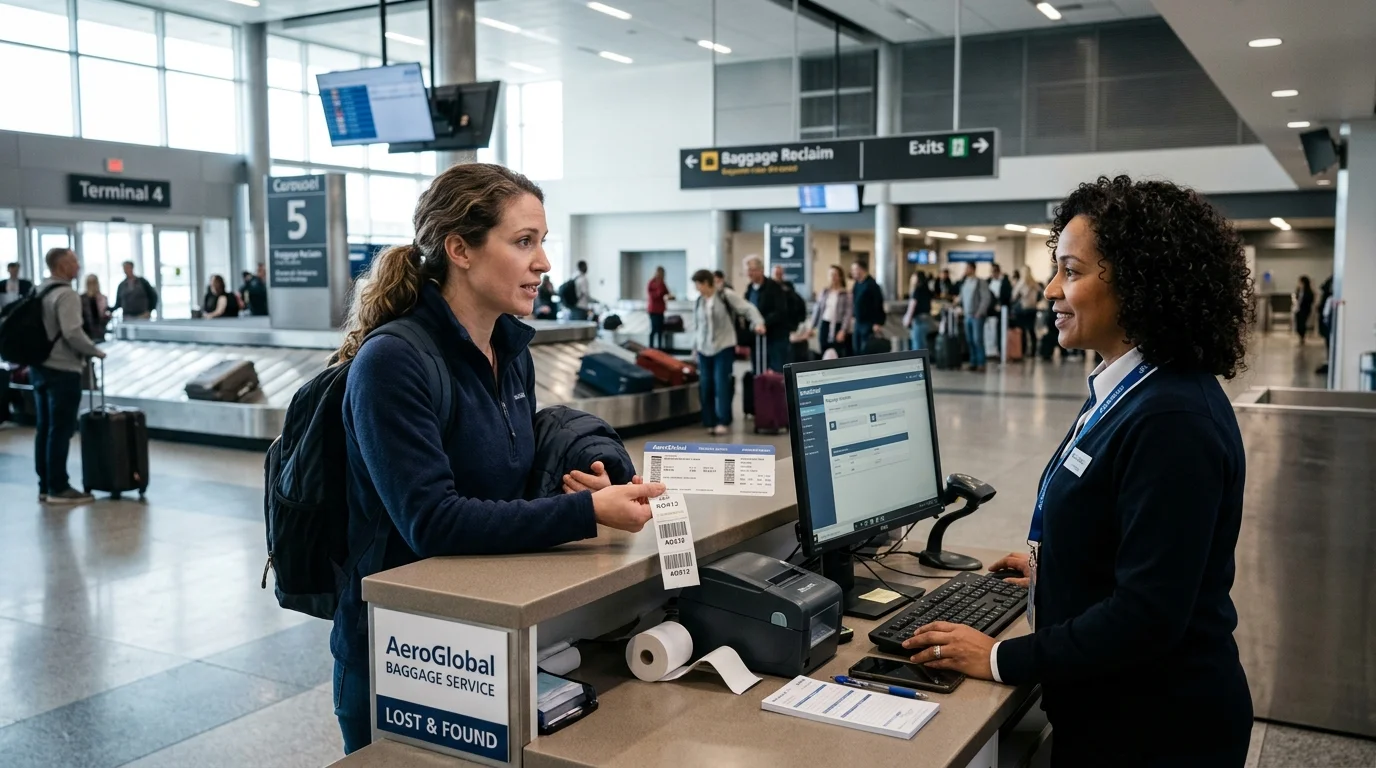 Standing inside the reclaim area and reporting a missing bag to the operating carrier's baggage service desk creates your legal audit trail.
What Should You Do If Your Baggage Doesn't Arrive?
If your suitcase fails to appear on the carousel, do not panic and, most importantly, do not exit the secure baggage hall. Leaving the customs or baggage claim area before filing a report complicates your claim significantly, as carriers can argue the luggage went missing after you left the terminal.
- Verify the Carousel and Flight Monitors: Ensure the flight number displayed above the belt matches your inbound flight. In large hub airports, flights arriving in rapid succession can split baggage across adjacent carousels or reassign belts mid-unloading. Double-check tracking your flight status on the airport monitors.
- Scan the Oversized and Bulky Baggage Area: Check the dedicated odd-size or out-of-gauge belt. Suitcases with heavy straps, duffel bags, rigid hard cases, or items with external tags are frequently diverted off standard belts by automated sorting systems.
- Inspect the Surrounding Baggage Floor: Occasionally, airport ground handlers clear unclaimed or early-arriving bags from the belt and stand them upright nearby to free up carousel capacity.
- Locate the Airline Baggage Service Desk: Walk directly to the operating carrier’s baggage service office, handling agent counter, or customer service desk located inside the baggage hall.
- Report the Missing Bag Immediately: Inform the representative that your luggage has not arrived. Present your physical baggage tag receipt (typically affixed to the back of your boarding pass or passport jacket at check-in).
- Complete an Official Irregularity Report: The agent will generate a formal report in the baggage system. Ensure every detail—your contact phone number, local physical delivery address, and precise bag description—is recorded accurately.
- Obtain Your Reference File Number: Secure a physical printout or digital confirmation containing your unique tracking code (often a 10-character alphanumeric reference).
- Clarify Interim Relief Policies: Inquire directly about the airline's emergency expense policy: whether they provide an immediate emergency amenity kit, a cash advance, or an authorization threshold for purchasing basic clothing and toiletries while you wait.
Delayed vs. Lost vs. Damaged Baggage
Airlines, ground handlers, and international treaties distinguish between different forms of mishandled baggage. Each category carries distinct legal definitions, reporting deadlines, and financial liability frameworks under standard airline baggage policy agreements.
| Problem | Official Aviation Definition | Immediate Passenger Action | Primary Rights & Liability Rules |
|---|---|---|---|
| Delayed Baggage | Checked luggage that did not arrive on your scheduled flight but is actively being traced and is expected to be recovered. | File an airport report immediately; obtain a Property Irregularity Report (PIR); retain essential purchase receipts. | Carrier reimburses reasonable, necessary interim expenses (toiletries, basic clothing) incurred during the delay. |
| Missing Baggage | Luggage whose physical whereabouts are temporarily unknown in the airline tracking system during early search efforts (usually the first 24–72 hours). | Provide a detailed description (make, color, exterior tags, internal contents); monitor digital tracing daily. | Traced under active operational protocols (e.g., WorldTracer); airline remains liable for necessary interim expenses. |
| Lost Baggage | Baggage that the carrier has officially acknowledged losing, or that has remained continuously missing for a legally defined period (typically 21 days under international law). | Transition the initial tracing file into a formal claim for total destruction/loss; provide itemized contents and value proof. | Carrier is liable for the depreciated value of the suitcase and its verified contents, up to statutory legal caps. |
| Damaged Baggage | Luggage that arrives on the belt with structural tears, broken handles, cracked shells, broken wheels, or damaged zippers. | Report damage before exiting customs; take clear photos; obtain a damage PIR or formal damage report. | Carrier evaluates repair, replacement, or cash depreciation. Excludes normal wear and tear, overpacking, and fragile items. |
| Pilfered / Missing Contents | Luggage that arrives intact or compromised, but with specific personal items missing from inside the compartment. | File an airport irregularity report and a local police report within 24 hours; document missing items with proof of ownership. | Subject to carrier liability rules; strictly excludes undeclared valuables, jewelry, electronics, and cash packed against policy rules. |
Comparing Fares for Your Route?
Search live multi-airline schedules, spot discount windows, and baggage fee rules on FareWander.
What Is a PIR and Why Do You Need It?
A Property Irregularity Report (PIR) is an official commercial aviation document generated when a passenger reports mishandled, delayed, lost, or damaged checked luggage at an airport.
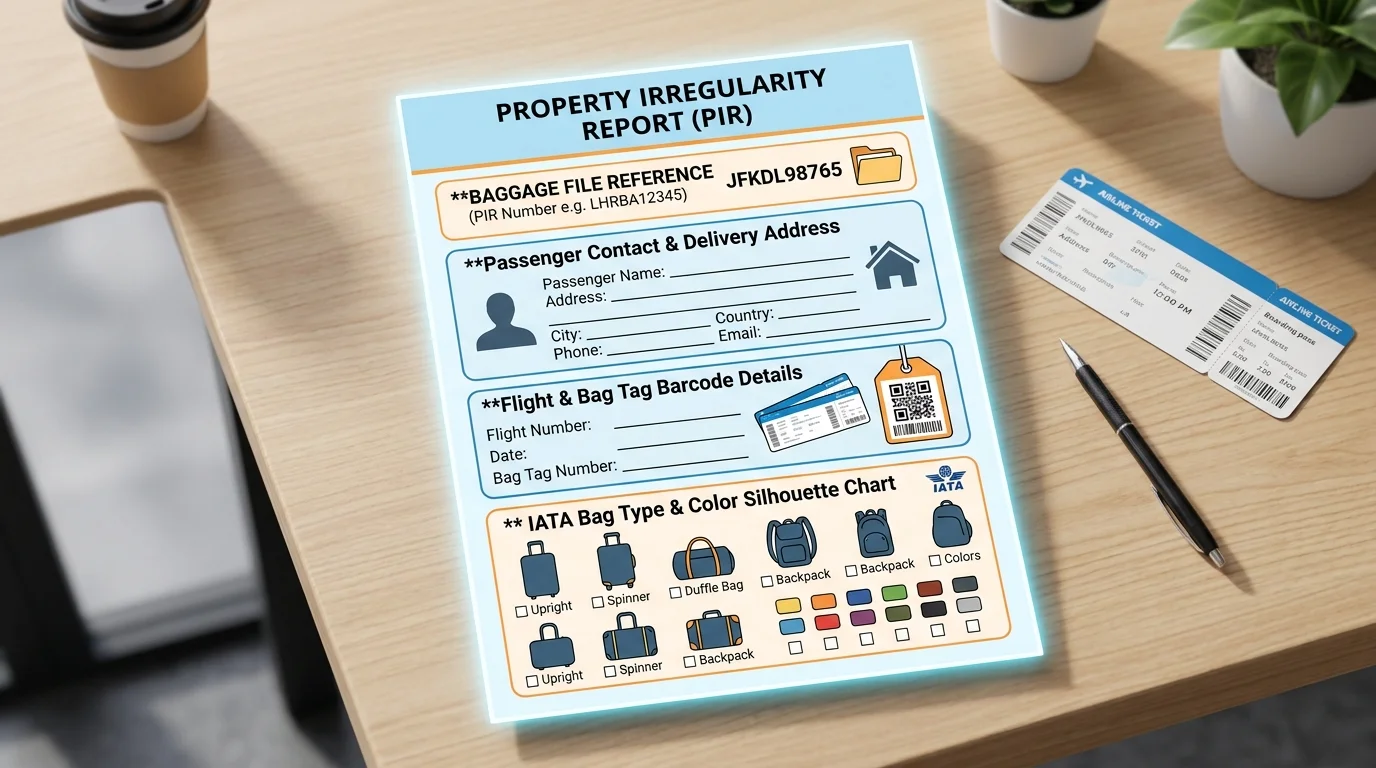 A sample Property Irregularity Report (PIR) highlighting the unique 10-character file reference, passenger delivery coordinates, and IATA bag silhouette matrix.
Where and Who Creates It
A PIR is created on-site at the arrival airport by the operating airline's baggage services agent or their appointed ground-handling representative (such as Swissport, Dnata, or Menzies Aviation).
What Information It Contains
The report records:
- Your personal contact information and physical delivery address.
- Inbound flight details and ticket number.
- Baggage tag barcode number and checked piece weight.
- Physical description of the luggage using standardized IATA luggage silhouette and color charts.
- A unique Baggage File Reference Number.
Understanding the Reference Number
A standard baggage tracing number typically consists of a five-letter airport and airline identifier followed by a five-digit sequence (for example, LHRBA12345 indicates London Heathrow, British Airways, file number 12345). This is completely distinct from your PNR booking reference or 13-digit e-ticket number.
[!IMPORTANT] The Critical Legal Distinction: A PIR is not a formal compensation claim. It is strictly an operational tracking document and internal acknowledgement of irregularity. Creating a PIR alerts the global tracing network that your bag is missing. If you incur expenses or if the bag is permanently lost, you must submit a separate, formal financial claim directly to the airline's customer relations or claims department within statutory legal deadlines.
Step-by-Step Lost or Delayed Baggage Claim Process
Navigating a luggage claim requires a structured approach from the carousel to final reimbursement.
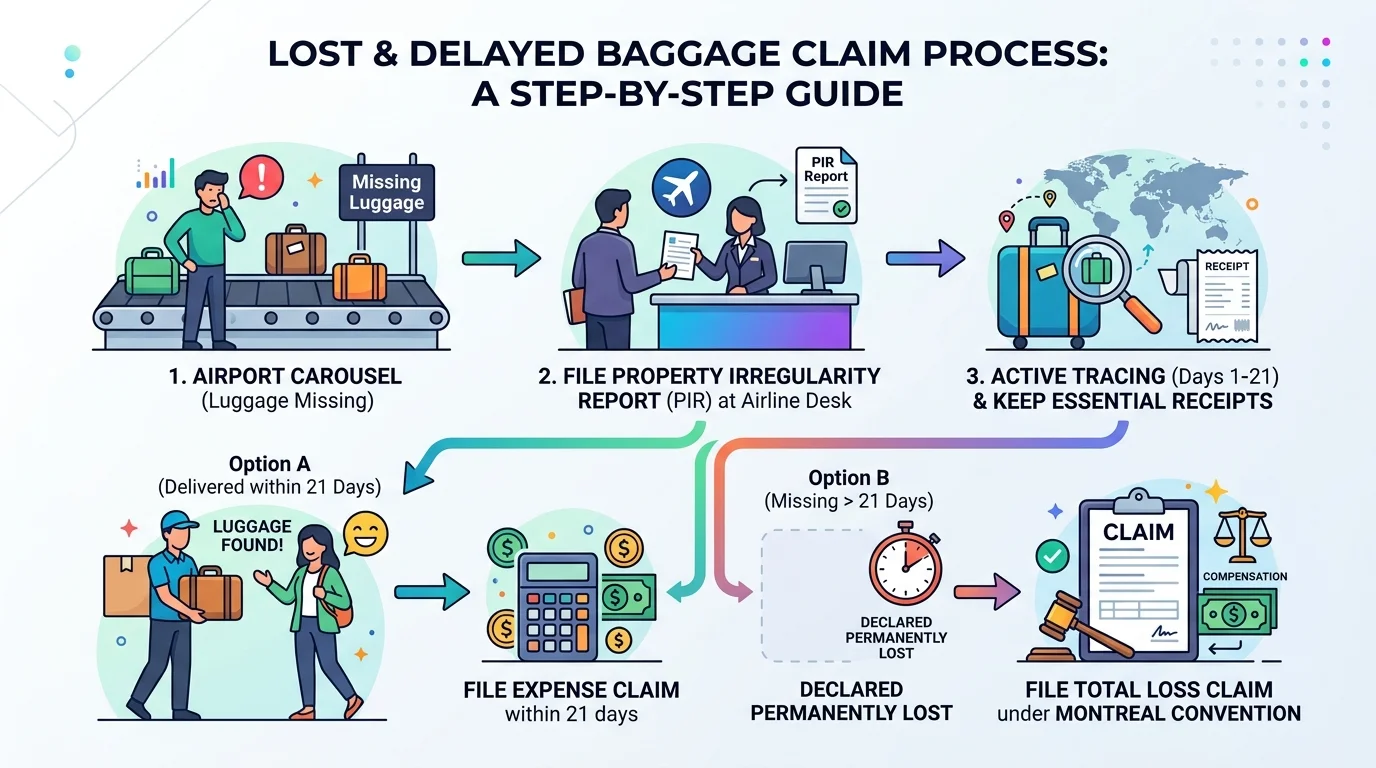 The complete lost and delayed baggage claim lifecycle: from airport PIR generation to active tracing and statutory compensation claims.
Step 1: Report the Baggage Problem at the Airport
Approach the baggage service desk in the reclaim hall immediately. Present your physical boarding pass, bag tag barcode stub, and passport or photo identification.
Step 2: Obtain the Physical PIR and Reference Number
Ensure the representative inputs your data into the system and provides a physical copy or SMS/email link containing your 10-character tracking code. Never leave the counter without this reference.
Step 3: Provide Accurate Contact and Delivery Details
Specify the exact physical address where you will be staying for the next 48 to 72 hours (hotel name, room reservation name, or residential street address). If you are moving between cities on an itinerary due to flight disruptions and rebooking, provide dates and addresses for each stop.
Step 4: Track the Baggage Online
Most international airlines link their tracking directly to WorldTracer—the global baggage tracing system operated by SITA and IATA. Use your PIR reference number and surname to track real-time scans on the airline’s dedicated baggage portal.
Step 5: Maintain a Communications Log
Keep a written record of every interaction. Note the dates, times, names of customer service representatives, and exact operational updates given via phone or desk interactions.
Step 6: Retain Receipts for Essential Expenses
If your bags are delayed away from home, purchase necessary personal hygiene items and essential clothing replacements. Retain original, itemized receipts showing every individual item purchased. Credit card summary slips are frequently rejected by claims adjusters.
Step 7: Follow Up Actively
If tracking shows no movement after 48 hours, contact the airline's central baggage services. Provide secondary identifiers: brands of clothing inside, shoes, book titles, or specific identifying features of the bag's interior.
Step 8: Submit the Formal Expense Claim
Once your luggage is delivered, submit an official reimbursement claim for your interim expenses directly via the airline’s website. Under the Montreal Convention, this must be filed in writing within 21 days of the date the bag was placed at your disposal.
Step 9: Transition to a Total Loss Claim (If Applicable)
If your bag has not been returned within 21 continuous days, it is legally deemed lost. Complete the airline's comprehensive baggage inventory claim form, listing every packed item, approximate purchase dates, and original purchase receipts or bank records where available.
Step 10: Escalate If Unresolved
If the airline rejects valid receipts, fails to respond within reasonable statutory windows, or arbitrarily caps your lawful rights, escalate the file to relevant civil aviation consumer bodies, your travel insurance provider, or small claims dispute mechanisms.
What Documents Do You Need for a Baggage Claim?
Airlines enforce rigorous document validation to prevent fraudulent claims. While exact document requirements vary by airline and route, you should assemble a digital portfolio containing:
- Boarding Passes and E-Ticket Receipt: Proves you completed the journey on ticketed sectors.
- Physical Baggage Tag Stubs: The barcode sticker showing bag weight and routing tags issued at check-in.
- Property Irregularity Report (PIR): The formal report number generated at the airport.
- Itemized Expense Receipts: Original merchant receipts showing individual toiletries, undergarments, and basic attire purchased during the delay.
- Delivery Confirmation Receipt: The signed courier delivery docket indicating the exact date and time the delayed luggage was returned to your physical possession.
- Photographs of the Luggage: Pre-travel photos showing the exterior condition, brand, and luggage tags help establish ownership.
- Itemized Inventory of Contents (for Lost Bags): A detailed list of all lost possessions, accompanying original purchase invoices, credit card statements, or replacement estimates.
- Government Photo ID or Passport Copy: Verifies the claimant matches the passenger manifest.
Planning Travel Logistics?
Use FareWander tools to calculate flight times, luggage rules, and visa requirements.
Can You Get Reimbursed for Delayed Baggage Expenses?
When checked luggage fails to arrive on your flight, you are often left with only the clothes on your back. Under international aviation treaties and domestic consumer regulations, airlines are liable for the financial damage resulting from the delay of baggage, which includes reimbursing reasonable and necessary out-of-pocket expenses.
However, "reimbursement" is not an automatic cash windfall, nor does it entitle a passenger to go on an unrestricted shopping spree.
The Concept of "Reasonableness"
Expenses must directly reflect your immediate needs based on the length of the delay and the nature of your trip. Buying basic toiletries, underwear, clean shirts, socks, and weather-appropriate outerwear (such as an emergency winter coat if arriving in sub-zero climates) is universally recognized as necessary. Purchasing designer luxury wear, high-end electronics, expensive colognes, or multiple outfits for a single-day delay will be rejected by claims evaluators.
Destination vs. Home Airport
If your luggage is delayed upon arriving at your home destination, airlines generally operate under the premise that you already have access to your wardrobe, personal hygiene supplies, and alternate belongings. Unless you can prove an unavoidable essential purchase (such as specialized work tools packed in hold luggage, or keys required to enter your home), claims for baggage delayed at your home airport are almost always denied.
Itemized Documentation Mandate
You must produce itemized receipts that clearly state every purchased product, price, and date. Bank balance screenshots or non-itemized credit card charge slips are almost never accepted as sole proof of expense.
Lost Baggage Compensation: What Are You Actually Entitled To?
Passengers routinely conflate expense reimbursement, statutory compensation, and insurance indemnification. Commercial aviation operates under strictly defined international legal liability frameworks.
The Montreal Convention Framework
For the vast majority of international flights, carrier liability for mishandled, delayed, or lost baggage is governed by the Montreal Convention of 1999.
- Liability Limits (SDRs): Carrier liability under the Montreal Convention is not measured in dollars or euros, but in Special Drawing Rights (SDR)—an international reserve asset defined by the International Monetary Fund (IMF). Under the regular five-year inflation reviews mandated by the treaty (adjusted by ICAO), carrier liability for baggage delay, damage, or loss is capped at a maximum of 1,288 SDR per passenger (approximately equivalent to $1,700–$1,750 USD, fluctuating with global exchange rates).
- Important Legal Nuance: The Montreal Convention limit is a maximum cap on liability, not an automatic, guaranteed payout. To receive compensation, you must prove the actual, depreciated financial loss incurred. If an airline permanently loses a suitcase containing clothing worth $600, you are legally entitled to $600 upon substantiation—not the 1,288 SDR maximum cap.
- Depreciation Policies: Airlines do not reimburse old items at "new replacement cost." Most carrier claims adjusters apply annual depreciation deductions (often 10% to 20% per year) against clothing and luggage based on the original purchase date, unless you hold separate travel insurance offering "new-for-old" replacement coverage.
- Excess Value Declaration: If you are checking personal items exceeding standard statutory limits (while avoiding excess baggage fees), you can make a "Special Declaration of Interest in Delivery at Destination" at the airport check-in desk prior to departure and pay a supplemental fee. This increases the carrier’s maximum liability limit to the declared value.
How Long Before Baggage Is Considered Lost?
Under Article 17 of the Montreal Convention, if the carrier admits the loss of checked baggage, or if checked baggage has not arrived at the expiration of 21 days after the date on which it ought to have arrived, the passenger is entitled to enforce against the airline their rights arising from the contract of carriage.
Hour 0: Flight Lands ────────► Luggage Missing (Operational Delay)
        │
Day 1 to 5: Primary Tracing ──► Local & Global WorldTracer Searches Active
        │
Day 6 to 20: Secondary Tracing ─► Central Baggage Services Handling Deep Tracing
        │
Day 21+: Legally Declared Lost ─► Passenger May File Complete Total Loss Claim
- Days 1–5 (Local Tracing): Ground handlers trace the bag between the departure airport, transit hubs, and arrival station. Most delayed bags (over 80%) are delivered within 48 to 72 hours.
- Days 6–20 (Secondary / Central Tracing): The file transfers from local airport agents to the airline’s central baggage tracing department. Detailed physical inventory questionnaires are processed to match unclaimed bags sitting in global hubs.
- Day 21 (Legal Threshold): The bag transitions from "delayed/missing" status to permanently lost. At this precise moment, you are legally entitled to submit your total loss claim for the luggage and its contents. Do not abandon your claim or stop communication while waiting for this 21-day mark to pass.
Domestic vs. International Lost Baggage Claims
A passenger's rights, filing windows, and financial remedies diverge significantly between domestic flights and international itineraries.
| Factor | Domestic Travel (e.g., US Domestic, India Domestic) | International Travel (Montreal Convention Routes) |
|---|---|---|
| Governing Framework | National transport regulations and airline domestic Conditions of Carriage. | Montreal Convention (1999) or Warsaw Convention (where applicable). |
| Liability Limit / Cap | Varies by country. E.g., US DOT mandates up to $3,800 USD per passenger for domestic flights; India DGCA sets domestic limits per kg or passenger norms. | Fixed international cap of 1,288 Special Drawing Rights (SDR) per passenger (approx. $1,700–$1,750 USD). |
| Mandatory Reporting | Usually requires on-site reporting within hours of arrival or prior to exiting the domestic baggage terminal. | On-site PIR strongly recommended; formal delay claims within 21 days of receiving bag; damage within 7 days. |
| Delay Expense Rules | Governed strictly by individual airline domestic customer service plans and national consumer rules. | Strict treaty liability for direct financial damage up to the statutory SDR cap. |
| Baggage Fee Refunds | Many jurisdictions (e.g., US DOT regulations) mandate a full refund of checked baggage fees if the bag is significantly delayed. | Baggage fee refund policies depend on operating airline conditions and local regulatory frameworks. |
| Escalation Path | National aviation consumer bodies (e.g., US DOT Aviation Consumer Protection Division, India AirSewa / DGCA). | Civil courts of competent jurisdiction designated under Montreal Convention Article 33; national consumer forums. |
What If Your Baggage Is Delayed on an International Flight?
Consider a realistic operational scenario: You fly from Delhi (DEL) to London Heathrow (LHR), and your suitcase is nowhere to be found on the Terminal 3 carousel.
- At London Heathrow: Head to the airline's arrival desk in the reclaim area before clearing UK Border Force customs. Complete the PIR with the handling agent, ensuring your UK hotel address and local contact number are correctly entered.
- Immediate Essentials: London is expensive; do not purchase luxury items. Head to a local department store or pharmacy to purchase bare necessities: basic toiletries, chargers, a change of underwear, and a clean outfit.
- Receipt Management: Retain every single physical till receipt showing the VAT breakdown and purchase timestamp.
- Active Tracking: Input your
LHRAA12345tracking code into the online tracking system twice daily. - Bag Return: The airline’s courier delivers the suitcase to your hotel concierge on Day 3. Inspect the bag on the spot and sign the delivery slip, recording the precise date and time.
- Filing the Claim: Within 21 days of delivery, visit the airline's online claims page. Upload the PIR copy, baggage tag stub, courier delivery receipt, and scanned copies of your clothing and toiletry receipts. Request reimbursement for direct damages under the Montreal Convention.
What If the Airline Delivers the Bag Later?
When a delayed bag is located, the airline will contact you via SMS, email, or telephone to coordinate delivery via a contracted third-party logistics courier.
- Delivery Costs: The airline is contractually responsible for delivering the recovered bag directly to the physical address specified in your file at no additional cost to you. You are not required to return to the airport to collect it unless you voluntarily choose to do so to expedite retrieval.
- Immediate Exterior Inspection: Before the delivery driver leaves, inspect the exterior of the suitcase thoroughly. Check handles, wheels, zippers, and hard-shell seams for transit damage.
- Verify Interior Contents: Open the bag immediately. Confirm that all packed items, electronics, and personal effects are present.
- Action If Damaged or Pilfered: If the bag has been crushed or items are missing, you must file an immediate secondary claim. Under the Montreal Convention, a formal written claim for baggage damage must be submitted within 7 days of delivery.
- Closing the File: Do not agree to formally sign off or close your baggage irregularity file until you have confirmed that the bag is physically in your possession, intact, and all outstanding emergency expense reimbursement claims have been formally accepted for processing by the airline.
What If Your Baggage Is Damaged?
Baggage damage is a legally distinct issue from delayed baggage, operating under tighter claim submission windows.
- Report Immediately: Whenever possible, present damaged luggage to the baggage service desk before exiting the airport terminal. The agent will inspect the damage and open a Damage Property Irregularity Report (DPR).
- Strict 7-Day Deadline: If damage is discovered after leaving the terminal, you have a strict legal deadline under international conventions: you must notify the carrier in writing within 7 calendar days of receiving the luggage. Missing the 7-day cutoff completely extinguishes your legal right to compensation.
- Photograph Everything: Capture clear, high-resolution photographs of the damaged area, the entire suitcase, the manufacturer brand label, and the airline luggage tag still attached to the handle.
- Exclusions and Fair Wear and Tear: Airlines expressly disclaim liability for normal operational wear and tear. This typically includes minor surface scuffs, small scratches, dirt stains, minor fabric abrasions, damage resulting from overpacking, and broken pull-zipper tabs. Structural damage—cracked shells, torn fabrics exposing contents, broken frame handles, or sheared wheels—is fully compensable.
What If Items Are Missing From the Bag?
Discovering that personal possessions have been pilfered from checked baggage requires prompt action:
- File an Official Airline Report: Report the pilferage immediately via the airline’s customer portal or desk. Note the exact weight recorded on your claim tag at check-in versus the weight upon delivery; a discrepancy provides clear evidence of missing contents.
- File a Police Report: Pilferage is a criminal theft. File a formal police report with the local airport police or municipal law enforcement within 24 hours to obtain an official crime reference number. Most airlines and travel insurance providers require a police report before assessing theft claims.
- Gather Proof of Value: Collect original purchase invoices, warranty certificates, or bank statements demonstrating ownership and value for every item reported stolen.
- Aviation Contract Exclusions: Be aware that standard airline Conditions of Carriage strictly prohibit packing high-value, fragile, or negotiable items in checked baggage. If you packed loose jewelry, high-end electronics, unsealed cash, negotiable securities, or luxury watches in the cargo hold, the airline will deny liability based on contractual exclusions.
What Should You Buy While Waiting for Your Baggage?
When your luggage is delayed, exercise practical judgment. Purchase only what you genuinely need to maintain health, comfort, and professional obligations during the outage period.
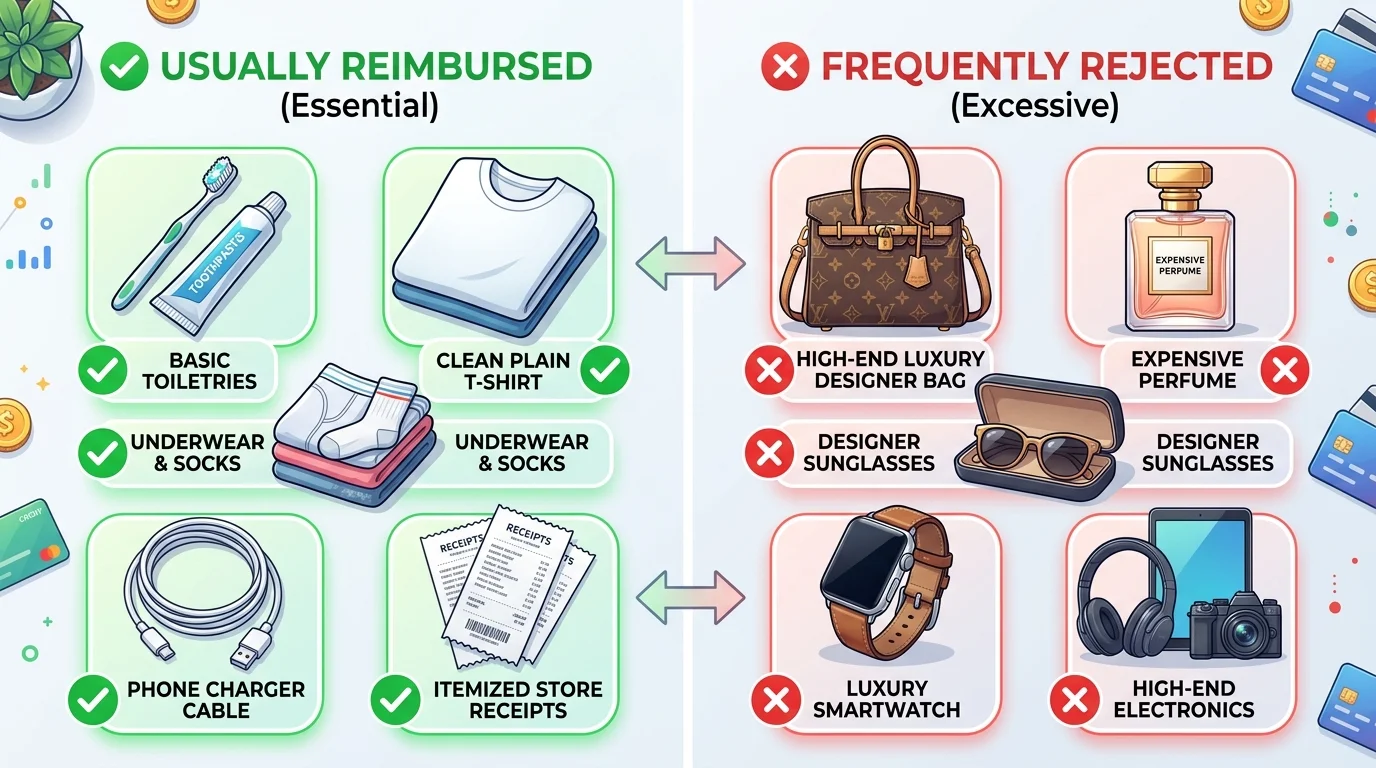 Comparison of reimbursable essential clothing and hygiene items versus non-reimbursable luxury purchases during a baggage delay.
| Category | Usually Reimbursed (Reasonable / Essential) | Frequently Rejected (Excessive / Discretionary) |
|---|---|---|
| Personal Hygiene | Basic toiletries (toothbrush, toothpaste, deodorant, shampoo, comb) | Luxury cosmetics, high-end skincare serums, expensive salon styling products |
| Health | Daily prescription medication emergency refills, lens solution | Elective vitamins, spa treatments, cosmetic enhancements |
| Undergarments | Necessary undergarments, undershirts, and socks | High-fashion designer lingerie, luxury silk nightwear |
| Clothing | Weather-appropriate basic clothing (e.g., standard shirt, trousers, weather coat) | High-end designer brand fashion, luxury evening gowns, tailored suits |
| Professional Attire | Essential business attire for documented scheduled corporate meetings | Multiple expensive suits, bespoke blazers, luxury leather goods |
| Electronics | Basic charging cable and standard plug adapter for your phone | Tablets, premium headphones, laptops, professional camera gear |
| Refreshments | Water, standard meal costs (if offered by carrier voucher) | Fine dining, alcoholic beverages, high-end minibar charges |
What NOT To Do After Your Baggage Goes Missing
Avoiding critical mistakes in the initial hours protects your financial recovery:
- ❌ Do not leave the airport without an official report: Exiting the arrivals hall without a PIR or written tracking receipt severely weakens your legal position.
- ❌ Do not discard your baggage tag receipts: The tiny barcode sticker attached to your boarding pass is your sole legal proof that the bag was accepted into airline custody.
- ❌ Do not throw away itemized store receipts: Claims adjusters reject credit card statements that lack an itemized breakdown of individual goods purchased.
- ❌ Do not buy luxury goods assuming full reimbursement: Treat every purchase as if you might have to pay for it yourself until approved.
- ❌ Do not miss the 21-day claim filing deadline: Delivering your receipts even one day past the 21-day mark after receiving your delayed bag legally voids your claim under international treaties.
- ❌ Do not rely on verbal telephone assurances: Always request written confirmation, ticket updates, or email notes from airline agents regarding compensation authorizations.
- ❌ Do not pack critical medication or valuables in checked luggage: Never check passports, cash, expensive cameras, laptops, or vital prescription medication.
Baggage Tracking Systems and WorldTracer
Modern commercial aviation relies heavily on automated scanning networks to track checked luggage from check-in belt to destination carousel.
WorldTracer Infrastructure
Developed jointly by SITA and IATA, WorldTracer is the global standard baggage tracking system utilized by hundreds of airlines and ground handling companies across thousands of airports worldwide.
How Tracing Functions
Every time your luggage moves through an airport transfer belt, sorting facility, container loading zone, or aircraft belly hold, its 10-digit IATA barcode is scanned. When a bag goes missing, WorldTracer matches your lost report (PIR) against its database of unclaimed, found, and rerouted bags (called "on-hand" baggage) using bag types, color codes, manufacturer marks, and routing tags.
Using Your Tracking Code
To monitor your file, navigate to your operating airline's baggage status page and enter your 10-character reference number (e.g., JFKDL98765) along with your last name. The dashboard displays the last confirmed physical scan, current routing instructions, and delivery transit updates.
What If the Airline Does Not Respond or Denies Your Claim?
When an airline ignores correspondence, delays processing past statutory response windows, or arbitrarily rejects legitimate, documented expense claims, escalate through formal regulatory channels:
Aviation Regulatory Bodies
- In India: Escalate your unresolved grievance to the Ministry of Civil Aviation’s AirSewa portal or lodge a formal complaint with the Directorate General of Civil Aviation (DGCA) under the Civil Aviation Requirements (CAR) governing passenger facilities.
- In the United States: File a formal consumer complaint with the U.S. Department of Transportation (DOT) Aviation Consumer Protection Division, which monitors unlawful claim denials and statutory baggage fee refund non-compliance.
- In the European Union / UK: Lodge a formal complaint with the designated National Enforcement Body (NEB) in the country where the disruption occurred, or utilize the UK Civil Aviation Authority (CAA) passenger complaints team.
Payment Card Dispute (Chargeback)
If you paid the airline checked baggage fees for a bag that was never delivered or severely delayed, request a chargeback from your credit card issuer for non-delivery of contracted services.
Small Claims Legal Action
Under Article 33 and Article 35 of the Montreal Convention, you have the legal right to file an action for damages in a small claims court within two years from the date of arrival at the destination.
Travel Insurance and Lost Baggage
Airline liability frameworks establish baseline legal rights, but comprehensive travel insurance provides critical secondary protection.
- Indemnity Coordination: Insurance operates on strict indemnity principles. You cannot receive double payment for the same expense from both the airline and your insurer. Insurers require proof of any reimbursement paid by the carrier before settling the balance of your out-of-pocket costs.
- Baggage Delay Stipends: Many premium travel insurance policies feature fixed-stipend baggage delay coverage (e.g., $200 for every continuous 12-hour delay, up to a $1,000 policy maximum). This provides predictable, quick out-of-pocket reimbursement without negotiating complex "reasonableness" arguments with airline adjusters.
- Higher Limits for Valuables: Standard airline liability caps out at ~1,288 SDRs, but comprehensive travel insurance plans can cover lost baggage limits up to $2,500–$5,000 USD, offering better protection for expensive clothing or gear (subject to individual item deductibles and sub-limits).
How to Reduce the Risk of Lost Baggage
While luggage mishandling is ultimately the carrier's operational failure, smart pre-flight habits reduce your risk:
- Remove Outdated Barcode Tags: Always peel off old bag tags and small barcode routing stickers from prior flights before checking your suitcase, as automated laser sorting belts can misread legacy barcodes.
- Photograph the Bag Exterior and Contents: Take a clear digital photo of the outside of your suitcase and open contents before closing the zippers at home.
- Insert Internal Contact Sheets: Place a sheet of paper inside your suitcase on top of your clothing displaying your full name, mobile number, email address, and flight itinerary. External luggage tags are easily torn off in automated conveyor chutes; internal identifiers allow handlers to identify the owner immediately.
- Deploy Digital Luggage Trackers: Place a Bluetooth personal tracking tag (such as an Apple AirTag, Samsung SmartTag, or Tile) inside your suitcase. While not a replacement for airline tracking, it provides independent visibility of your luggage's physical location.
- Adhere to Minimum Connection Times: Tight layovers under 60 minutes dramatically increase the probability that you will make your connection while your checked bag misses the transfer.
Real-Life Scenarios
Scenario 1: Bag Delayed for 24 Hours
- The Situation: A traveler flies from New York to Paris. Their bag misses the transfer and remains in New York.
- Actions Taken: The traveler files a PIR at Paris Charles de Gaulle (CDG). They purchase basic toiletries and a change of clothes totaling €95.
- Resolution: The bag is delivered to their hotel 26 hours later. The passenger submits an online claim with the PIR, courier receipt, and the €95 itemized store receipt. The airline reimburses the €95 full balance within three weeks.
Scenario 2: Bag Delayed for Five Days on a Multi-City Trip
- The Situation: A business traveler arrives in Frankfurt, but their bag is misrouted to Singapore. The traveler has scheduled corporate meetings across three days.
- Actions Taken: The traveler files a PIR, updating the file daily with their changing hotel addresses. They purchase a professional suit, dress shirt, shoes, and toiletries totaling €450, retaining all itemized receipts.
- Resolution: The carrier delivers the suitcase on Day 5. The airline reviews the submitted receipts alongside the itinerary, verifies that business attire was necessary for scheduled corporate meetings, and reimburses the full €450 claim.
Scenario 3: Bag Declared Permanently Lost
- The Situation: A traveler’s suitcase fails to appear in Toronto. Tracing updates show no physical scans for 21 days.
- Actions Taken: On Day 22, the passenger submits an official total loss claim. They provide an itemized spreadsheet detailing every garment, shoe pair, and personal item inside, supported by original online purchase receipts and credit card records totaling $2,100 CAD.
- Resolution: The airline applies standard depreciation formulas to older clothing items and pays the statutory maximum cap under the Montreal Convention (1,288 SDRs). The passenger files a secondary claim with their travel insurance provider to cover the remaining unpaid balance.
Scenario 4: Bag Arrives Damaged
- The Situation: A passenger receives their hardshell suitcase at the carousel with a severely cracked corner and a sheared-off wheel.
- Actions Taken: The passenger photographs the damage at the belt and walks straight to the airline baggage counter before exiting. The agent inspects the damage and issues a formal Damage Property Irregularity Report.
- Resolution: The airline determines the suitcase is irreparable and either provides an equivalent brand-new replacement suitcase from their stockroom or cuts a check for the depreciated value of the bag.
Quick Lost/Delayed Baggage Checklist
Use this scannable checklist if your checked bag does not appear:
- Double-check adjacent flight carousels and out-of-gauge/bulky baggage belts.
- Locate the airline baggage desk before passing through terminal customs.
- Present your physical boarding pass and baggage claim tag stubs.
- Complete a Property Irregularity Report (PIR) and obtain your 10-character file number.
- Verify that your local delivery address and mobile number are entered correctly.
- Inquire about the airline's daily emergency interim expense allowances.
- Track your luggage file online via WorldTracer using your reference code.
- Keep all original, itemized purchase receipts for essential clothing and toiletries.
- Inspect your luggage for damage or missing contents immediately upon courier delivery.
- Submit your formal expense reimbursement claim within 21 days of receiving the bag.
- Submit a formal total loss claim if the bag remains missing past 21 continuous days.
Frequently Asked Questions
Stay inside the reclaim area and report the missing luggage directly to the operating airline's baggage service desk before exiting through customs. File a Property Irregularity Report (PIR) and obtain a written copy containing your 10-character file tracking number.