Excess Baggage Fees: Overweight, Extra & Oversized Baggage Explained
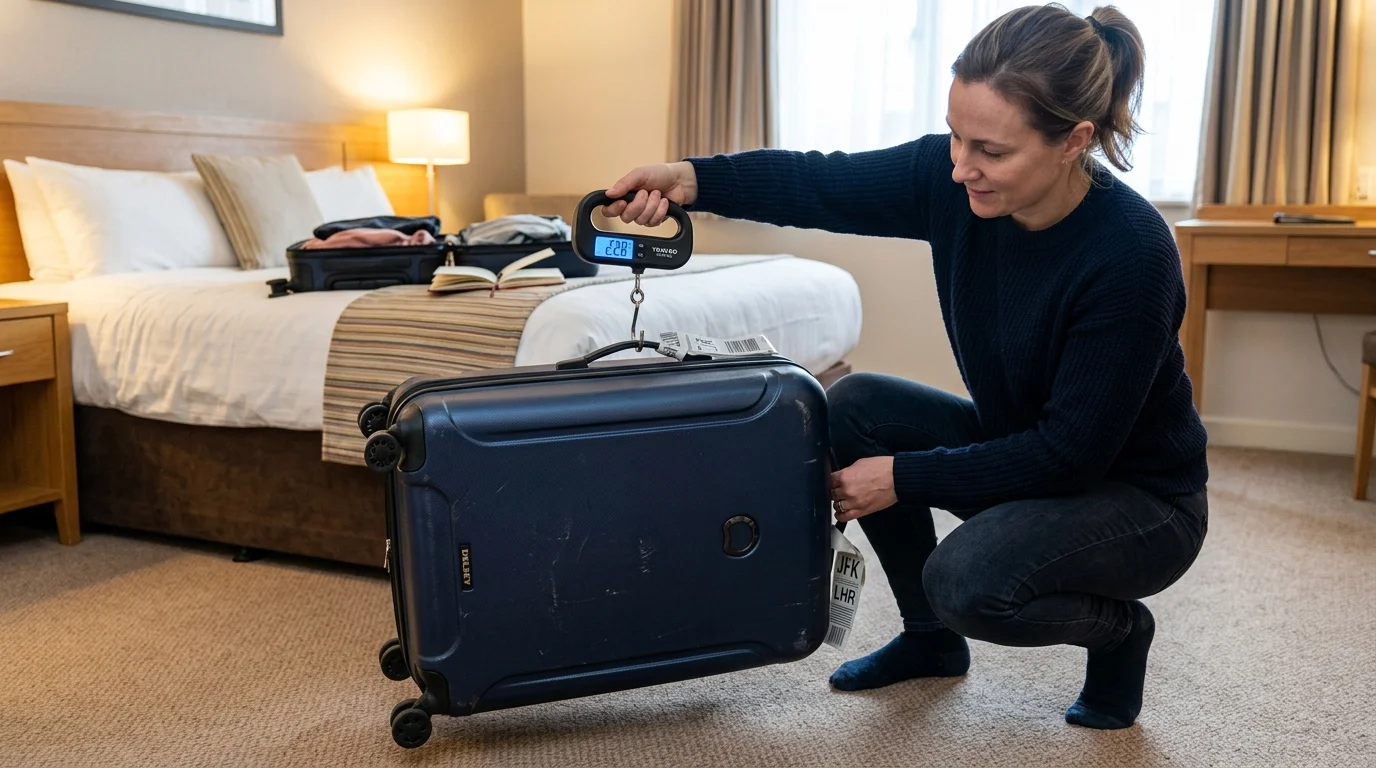 Checking your bag's weight before leaving home prevents unexpected check-in fees.
You heave your packed suitcase onto a digital bathroom scale the night before a long-haul flight, and the screen blinks 27 kilograms—four kilograms past the 23-kilogram threshold printed on your ticket confirmation. That single readout sets off a very specific kind of pre-travel panic: Do you start ripping open vacuum-sealed packing cubes, attempt to wedge thick winter jumpers into your carry-on, or simply accept whatever penalty awaits at the terminal? What happens next depends on whether your airline views those extra kilograms as standard overweight baggage, demands you purchase an entirely separate checked piece, or charges a steep flat penalty right at the check-in desk.
Quick Answer: Key Takeaways
- Excess baggage is any luggage that exceeds the free or included baggage allowance attached to your ticket. Airlines generally penalize this excess across three distinct categories:
- Overweight baggage: A bag that is within the piece allowance but heavier than the individual weight limit (e.g., 27 kg instead of 23 kg).
- Extra piece / Additional baggage: Bringing more physical bags than your fare allows (e.g., bringing two checked bags when your ticket includes one).
- Oversized baggage: A bag exceeding standard linear dimension thresholds (typically 158 linear centimeters / 62 inches).
- No universal fee: Costs vary based on your airline, route, fare class, cabin, whether you buy extra allowance online or at the airport, and whether the airline calculates charges per kilogram or per piece.
- Pre-booking savings: Buying additional baggage online in advance through the airline's website or app is almost universally 20% to 50% cheaper than paying walk-up rates at the airport desk.
- The 32 kg hard ceiling: No commercial passenger airline accepts any single bag over 32 kg (70 lbs) due to airport ramp-worker occupational safety laws.
What Is Excess Baggage?
In aviation terminology, excess baggage serves as an umbrella category for any personal property accepted for carriage in the aircraft hold that falls outside your ticket's included baggage allowance.
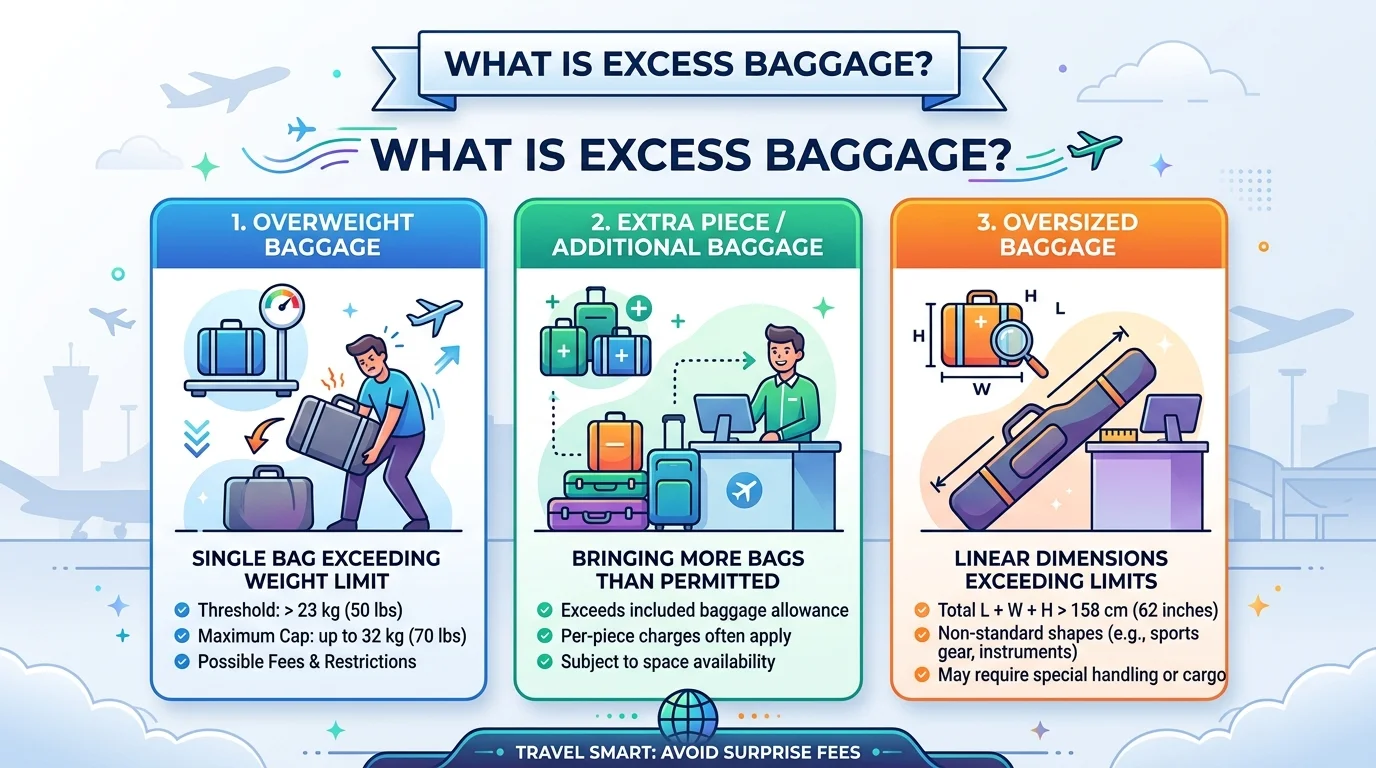 Excess baggage applies whenever weight, piece count, or dimensions exceed your ticket limits.
Many travelers conflate overweight bags with extra bags, but airlines view them as separate operational issues. Your ticket guarantees a contract of carriage for a defined amount of cargo—expressed either as a gross weight (Weight Concept) or a set number of containers with individual caps (Piece Concept). When you exceed these contract parameters, the airline incurs added fuel consumption, specialized handling, and operational constraints, which it offsets through excess baggage fees:
- Included baggage allowance: The exact quantity, weight, and dimensions of hold luggage covered by your baseline fare.
- Overweight baggage: A single piece of luggage that exceeds the maximum permissible weight for that bag tier.
- Extra piece: An additional suitcase or parcel beyond the numerical count allowed on your reservation.
- Oversized baggage: Luggage whose physical exterior dimensions surpass standard container or belt parameters, regardless of how light it is.
Comparing Fares for Your Route?
Search live multi-airline schedules, spot discount windows, and baggage fee rules on FareWander.
How Airline Baggage Allowance Works
Baggage allowances are never standard across the industry. When an airline issues an e-ticket, your baggage entitlement is derived from several structural factors:
- Fare family: Unbundled fares (such as Basic Economy vs Economy: What's the Difference?) typically exclude hold luggage entirely. Mid-tier and flexible economy fares usually bundle at least one checked bag.
- Route and market: Domestic routes frequently operate under stricter domestic baggage caps or completely unbundled models, whereas long-haul international routes often include hold bags as part of the baseline service.
- Cabin class: Premium cabins grant substantially higher weight allowances. While standard economy often limits bags to 23 kg, Business and First Class fares typically permit two or three bags up to 32 kg each.
- Frequent-flyer status: Elite status tiers across airline loyalty programs frequently award complimentary extra bags or additional weight allowances above the base fare rules.
For a comprehensive breakdown of carry-on and checked luggage regulations across global airlines, review our Airline Baggage Policy guide.
Weight Concept vs Piece Concept
International aviation operates under two foundational regulatory frameworks for checked luggage: the Weight Concept and the Piece Concept. Knowing which system governs your itinerary explains how any excess will be calculated.
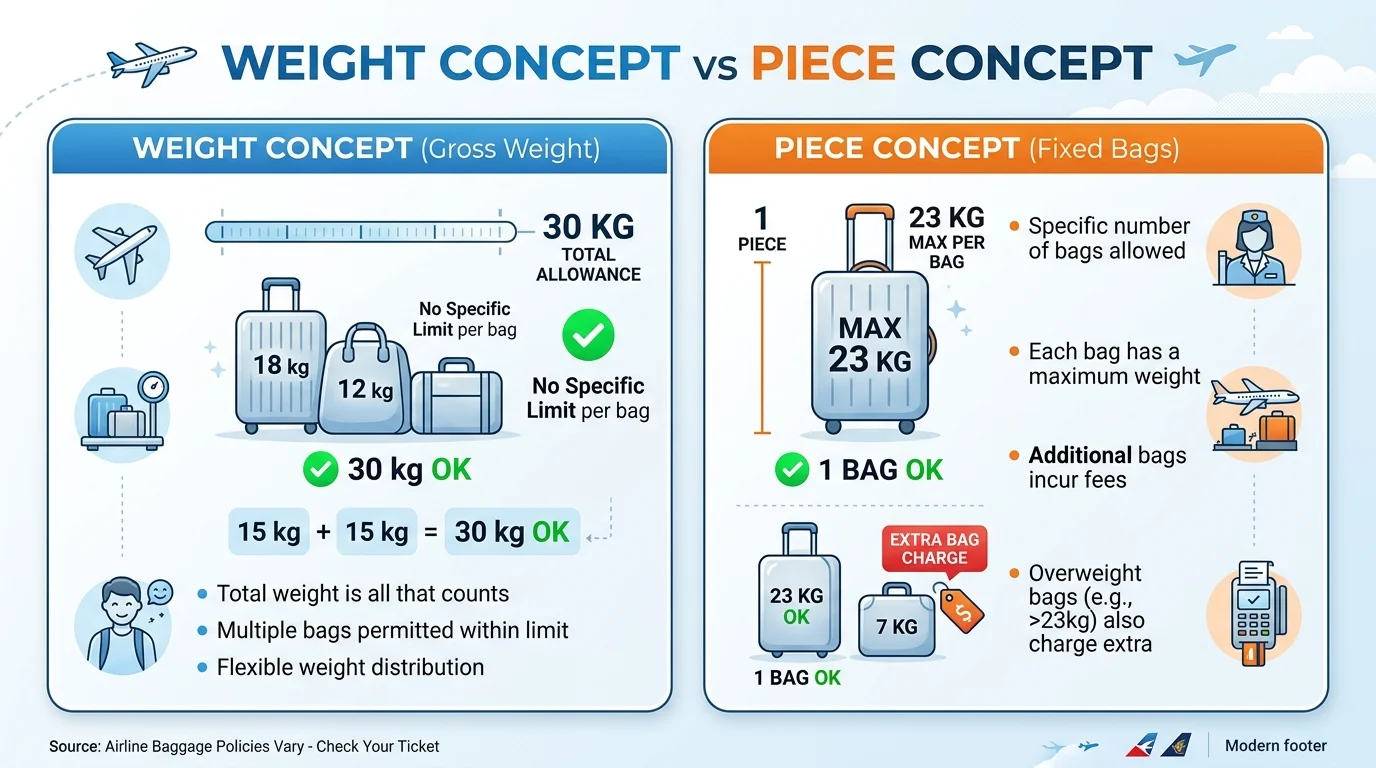 Whether your ticket uses the Weight or Piece Concept determines how excess fees are calculated.
| Concept | How It Works | Typical Application | Real-World Example |
|---|---|---|---|
| Weight Concept | Your allowance is a gross aggregate weight. You can bring one or multiple bags, provided the combined weight does not exceed the total limit. | Common on domestic flights within Asia, India, and regional routes across the Middle East and Africa. | A 30 kg allowance lets you check one 18 kg bag and one 12 kg bag without paying an extra-piece fee. |
| Piece Concept | Your allowance is defined by an exact number of bags, with each individual bag capped at a specific weight and size. | Standard for flights to, from, or within the Americas, transatlantic routes, and many European legacy carriers. | A "1 PC up to 23 kg" allowance means bringing a second 8 kg bag triggers a full extra-bag fee, not a partial weight fee. |
Overweight vs Extra Baggage vs Oversized Baggage
An individual piece of luggage can trigger more than one penalty depending on how the airline structures its fee schedule.
| Type | What It Means | Typical Pricing Structure | Primary Operational Impact |
|---|---|---|---|
| Overweight | Bag exceeds the single-bag weight limit (e.g., over 23 kg). | Flat overweight tier fee (e.g., 24–32 kg band) or fixed per-kg rate. | Ramp-agent health and safety; aircraft weight-and-balance trim. |
| Extra Piece | You have more bags than your fare allows. | Fixed per-piece charge, scaling upwards for 2nd, 3rd, or 4th bags. | Physical cargo hold volume and handling time. |
| Oversized | Linear dimensions ($L + W + H$) exceed standard limits (usually 158 cm / 62 in). | Fixed oversized surcharge; out-of-gauge handling fee. | Inability to clear automated airport baggage conveyers and sorting belts. |
| Combined Excess | A bag that is both overweight AND oversized, or an extra bag that is also overweight. | Dual-penalty billing: the airline applies the extra-piece fee plus the overweight/oversize fee. | Heavy operational friction; requires manual out-of-gauge routing. |
Planning Travel Logistics?
Use FareWander tools to calculate flight times, luggage rules, and visa requirements.
How Much Do Excess Baggage Fees Cost?
There is no single global excess baggage fee. Airline charges fluctuate dramatically depending on route distance, currency, when you pay, and the pricing structure in effect.
To see how fees diverge across carriers, routes, and cabins, review these verified official airline fee structures as of September 2026:
- IndiGo (Indian Domestic Routes): IndiGo operates under the Weight Concept for domestic flights, including a standard 15 kg checked baggage allowance on regular fares. Excess weight presented at airport check-in is charged at a standardized rate of ₹600 per kilogram. Passengers can pre-purchase excess weight blocks online (in increments of 5 kg, 10 kg, 15 kg, or 30 kg) at substantially discounted advance rates starting around ₹2,200 to ₹2,500 for a 5 kg block.
- Air India (Domestic vs International): On Indian domestic flights, Air India charges an airport excess baggage fee of approximately ₹600 per kilogram plus applicable taxes for weight beyond the ticketed allowance. For international flights operating under the Piece Concept (such as routes to the US or UK), an extra piece purchased at the airport costs upwards of $150 to $220 USD per bag depending on destination, while an overweight fee (moving a 23 kg bag to 32 kg) ranges from $75 to $100 USD.
- British Airways (Transatlantic Routes): British Airways uses the Piece Concept. For an economy passenger on a London Heathrow to New York JFK flight holding a standard allowance of 23 kg, checking an extra bag at the airport costs £75 / $100 USD, whereas purchasing it online in advance costs approximately £55 / $70 USD. If a bag exceeds 23 kg up to the 32 kg safety maximum, BA levies a flat heavy-bag surcharge of £65 / $100 USD at the airport counter.
- Emirates (Weight-Concept Routes): On itineraries where Emirates applies the Weight Concept (such as flights between Dubai, Europe, and Asia), excess weight purchased at the airport is calculated per kilogram based on geographic zones, ranging from $15 to $50 USD per kilogram. Advance purchases made online prior to departure receive tiered discounts between 15% and 35%.
Is Excess Baggage Charged Per Kg or Per Bag?
Airlines bill for excess using three primary pricing models:
1. The Per-Kilogram Model
Under this model, the check-in agent takes the gross weight of your bags, subtracts your ticketed allowance, and multiplies the remaining kilograms by a set route rate. If your ticket allows 20 kg, your bag weighs 25 kg, and the carrier charges $20 per kg, you pay exactly $100. This is the standard method for Asian, Middle Eastern, and Indian domestic flights.
2. The Per-Piece Model
Prevalent in the Americas and Europe, this model ignores the individual kilograms of excess unless the bag breaks an upper threshold. If you are permitted one checked bag up to 23 kg and you show up with two bags weighing 15 kg each, you do not pay for weight; you pay a flat second-bag fee for the additional piece.
3. The Tiered Weight-Band Model
Many carriers flying international routes combine both concepts. If your ticket allows one 23 kg bag and your bag weighs 27 kg, they do not multiply 4 kg by an hourly rate. Instead, they bill a flat overweight surcharge designed specifically for bags weighing between 23.1 kg and 32 kg.
What Happens If Your Checked Bag Is Over the Weight Limit?
When your suitcase lands on the check-in belt and exceeds your fare limit, the terminal agent will process the bag through several procedural checks:
[Bag Placed on Scale]
        │
        ├──> Within Allowance? ──────> Tagged & Sent to Cargo
        │
        └──> Exceeds Weight Limit?
                │
                ├── Option A: Repack / Redistribute weight into cabin/secondary bag
                ├── Option B: Pay applicable per-kg or flat overweight fee
                └── Over 32 kg? ───> Mandatory Rejection / Handed off to Cargo Service
- The Scale Alerts the Agent: The automated check-in terminal flags the overweight status.
- The Repack Offer: Agents will usually offer you the opportunity to step aside, open the suitcase, and transfer items into your cabin baggage or a secondary bag to drop the weight down.
- Assessment of Fees: If you cannot repack, the agent issues an excess baggage slip calculating the exact fee. You must pay this fee at the counter or customer service kiosk before your bag tag is printed.
- The Heavy Tag: If the bag is accepted between 23 kg and 32 kg, a fluorescent "HEAVY" tag is attached to warn ramp agents of injury risk.
- Absolute Rejection: If the scale exceeds the airline's hard limit (universally 32 kg on commercial passenger flights), the agent cannot legally accept the bag into the baggage handling system.
What Is the Maximum Weight for One Checked Bag?
It is critical not to confuse your ticketed allowance with the absolute maximum single-bag limit.
Your ticketed allowance might be 15 kg or 23 kg, meaning anything beyond that incurs a fee. However, the aviation industry strictly caps the gross weight of any individual checked piece at 32 kilograms (70 pounds).
This 32 kg limit is not an airline revenue policy; it is an international occupational health and safety regulation designed to protect baggage-handling personnel from severe musculoskeletal injury. Even if you are willing to pay an unlimited cash penalty, an airline agent will refuse to tag a standard suitcase weighing 33 kg. Any item weighing more than 32 kg must be split into separate luggage pieces, crated, or dispatched as commercial air cargo.
Can You Split Overweight Baggage Into Two Bags?
Splitting an overweight bag into two separate containers seems like a logical solution, but its financial viability depends entirely on whether your ticket operates under the Weight Concept or the Piece Concept:
- Under the Weight Concept: Splitting is often an effective strategy. If your ticket allows 30 kg, carrying one 15 kg suitcase and one 14 kg duffel bag uses 29 kg of your total weight allowance. As long as the cumulative weight remains under 30 kg, no fees apply.
- Under the Piece Concept: Splitting weight will frequently cost you more. If your ticket allows "1 Piece up to 23 kg" and you pack two bags weighing 14 kg each, you have not exceeded your weight ceiling (28 kg total), but you have brought an un-ticketed second piece. You will be billed a full extra-bag fee (often $75 to $150 USD), which is almost always more expensive than paying a moderate 5 kg overweight surcharge on a single bag.
Is It Cheaper to Buy Extra Baggage Before the Flight?
On almost all commercial airlines worldwide, purchasing extra baggage online in advance is significantly cheaper than paying at the airport check-in desk.
Airlines incentivize pre-booking because knowing the aircraft's cargo weight hours before departure enables precise flight planning, accurate fuel loading, and optimal belly-cargo monetization:
- Online via "Manage Booking": Most carriers offer advance excess baggage allowances through their website or mobile application up to 2 to 6 hours before scheduled departure. Discounts typically range between 20% and 50% compared to terminal counter rates.
- At the Airport Ticketing Counter: Arriving at the terminal without pre-booked allowance forces you to pay walk-up rates, which carry administrative handling premiums.
Important Note: Pre-purchased baggage is almost universally non-refundable. If you buy an extra 10 kg block online and end up not using it, the airline will not credit the difference back to your card.
Extra Baggage vs Overweight Baggage — Which Is Better?
When facing excess belongings, travelers must decide whether it is more cost-effective to check one heavy bag or two lighter bags.
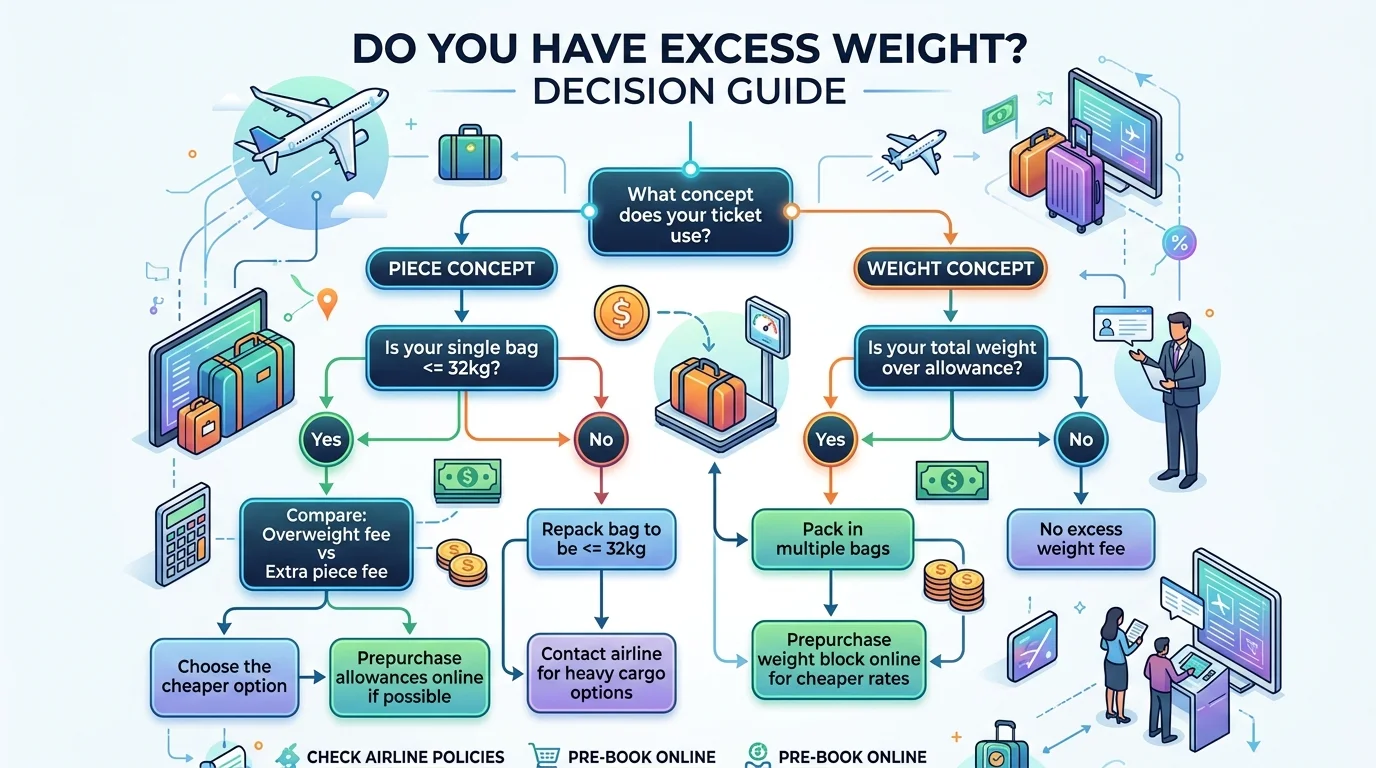 Compare the cost of an overweight band surcharge against an additional-piece fee before packing.
Use this decision framework before heading to the airport:
- Check your ticket concept: If your flight uses the Weight Concept, split items across two smaller bags to stay organized; number of pieces does not matter.
- Compare fee structures under the Piece Concept: An overweight fee (e.g., bringing a 23 kg bag to 28 kg) is often flat-rated at around $75 to $100 USD. Adding a brand-new second bag often costs between $100 and $150 USD. In this case, paying the overweight fee on one bag is cheaper.
- Account for physical safety caps: If your single bag weighs 33 kg, the decision is made for you: you must split it into two bags, because no commercial airline will load a 33 kg standard bag.
What Happens If Your Bag Is Oversized?
Airlines enforce dimensional boundaries alongside weight restrictions to ensure bags fit inside cargo containers (Unit Load Devices) and automated luggage belts.
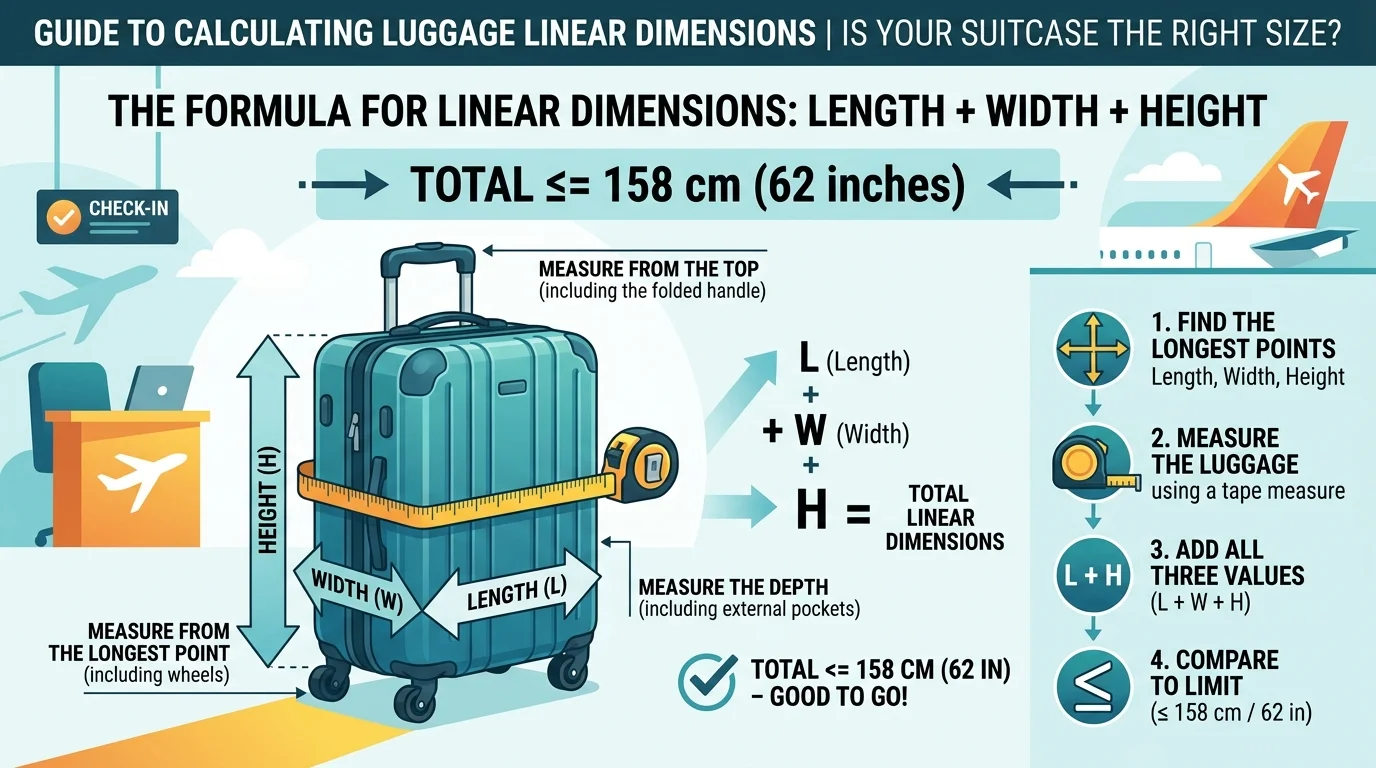 Linear dimensions equal length plus width plus height, including handles and wheels.
The Linear Measurement Standard
Baggage size is calculated using total linear dimensions:
$$\text{Linear Dimensions} = \text{Length} + \text{Width} + \text{Height}$$
(including wheels, handles, and external pockets).
- The 158-Centimeter Threshold: The standard industry limit for checked hold luggage is 158 linear centimeters (62 linear inches).
- Oversize Consequences: If your bag measures between 159 cm and 203 cm (80 inches), the carrier will levy an oversized baggage surcharge (frequently ranging from $100 to $200 USD). You will also be directed away from the standard check-in belts to drop the item at the terminal's Out-of-Gauge (OOG) / Bulky Baggage intake.
- Refusal: Bags exceeding 203 to 292 cm (depending on aircraft type and carrier) cannot be accepted as passenger checked luggage and must travel via cargo freight.
Domestic vs International Excess Baggage Fees
The rules and costs associated with excess baggage change dramatically depending on whether your flight is domestic or international.
| Factor | Domestic Flights | International Flights |
|---|---|---|
| Pricing Models | Frequently billed per kilogram (Asia/India) or flat low-tier piece fee (US/Europe). | Flat-rate piece fees, tiered weight-band surcharges, or regional per-kg rates. |
| Average Cost Profile | Lower baseline cost (e.g., ₹600/kg in India; $35–$45 per bag in the US). | Considerably higher penalties (e.g., $75–$200+ USD per extra bag or overweight tier). |
| Dominant System | Weight Concept is common across Asia/India; Piece Concept dominates US/Canada. | Piece Concept dominates long-haul west; Weight Concept spans Middle East/Asia routes. |
| Connecting Complications | Usually managed by a single carrier; straightforward rules. | Multiple partner airlines, customs clearances, and variable baggage policies. |
For a detailed analysis of connection types and layover buffers, check our comparison of Direct vs Nonstop vs Connecting Flights: What's the Difference?.
Airline-Specific Excess Baggage Rules
Because baggage rules are governed contractually by individual carriers, reviewing specific airline policies prevents costly airport assumptions:
IndiGo
- Allowance: 15 kg standard checked baggage on domestic flights; 20 kg to 30 kg on select international routes depending on fare type.
- Excess Policy: Domestic excess baggage at the airport is charged at ₹600 per kg. Advance pre-paid slabs (5 kg, 10 kg, 15 kg, 30 kg) provide significant cost reductions when booked via their website or app.
Air India
- Allowance: 15 kg for domestic Economy (Comfort/Flex tiers may offer higher allowances); 23 kg per piece (1 or 2 pieces depending on route) for international long-haul routes.
- Excess Policy: Domestic airport excess is ₹600/kg + taxes. International routes levy flat-rate piece or overweight charges (e.g., $100 to $200 USD for additional pieces on transatlantic/Europe sectors).
Emirates
- Allowance: Primarily operates on the Weight Concept (ranging from 20 kg to 35 kg for Economy depending on fare tier: Special, Saver, Flex, Flex Plus) except for itineraries to/from the Americas and Africa, which follow the Piece Concept (2 pieces up to 23 kg each).
- Excess Policy: Excess weight rates are calculated per kilogram based on global distance zones ($15 to $50/kg). Up to 35% discounts apply for advance purchases made online.
United Airlines
- Allowance: Operates strictly on the Piece Concept. Standard domestic economy excludes checked bags (first bag $35–$40 USD). International transatlantic routes generally include one 23 kg bag on standard economy fares.
- Excess Policy: Overweight bags between 23 kg and 32 kg incur an extra surcharge (typically $100 to $200 USD per bag depending on the route). Extra bags beyond the allowance scale upward ($100–$150 USD for a second bag; $200+ USD for a third bag).
How to Check Your Exact Baggage Allowance
Avoid relying on third-party memory or older trips. Follow these steps to verify your allowance:
- Locate your Booking Confirmation / E-Ticket: Open the PDF receipt generated after purchase.
- Find the Baggage Column: Search for the explicit code next to your flight segments:
0 PCorNIL: No checked baggage included (Carry-on only).1 PC: Exactly one checked piece included (usually capped at 23 kg).20 Kor30 K: Weight Concept applies; 20 kg or 30 kg total allowance.
- Log into "Manage Booking": Enter your 6-character PNR and passenger surname on the airline's official portal. (For help locating your reference, see What Is a PNR Number?). The system will show your exact allowances and current rates for adding luggage.
- Check Partner Airlines: If your flight includes a segment operated by a codeshare or interline partner, verify which carrier's baggage rules govern your ticket.
- Inspect the Special Baggage Page: If traveling with odd-sized luggage, verify specific gear policies.
How to Calculate Your Potential Excess Baggage
Before deciding how to pack, calculate your exposure using these three realistic scenarios:
Example 1: The Overweight Bag (Piece Concept)
- Ticket Allowance: 1 checked bag up to 23 kg.
- Actual Bag Weight: 27 kg.
- Baggage Status: 4 kg overweight.
- The Calculation: Under the Piece Concept, you will not pay for 4 individual kilograms. You will trigger the airline's flat 23 kg–32 kg heavy bag surcharge, which typically costs between $75 and $100 USD.
Example 2: The Extra Piece (Piece Concept)
- Ticket Allowance: 1 checked bag up to 23 kg.
- Actual Luggage: Two bags weighing 12 kg and 14 kg.
- Baggage Status: Total weight is 26 kg, but you are presenting two physical pieces.
- The Calculation: The first 12 kg bag clears your ticket allowance. The second 14 kg bag is billed as an Additional Checked Piece, costing roughly $75 to $150 USD, despite both bags being under 23 kg.
Example 3: The Oversized Bag
- Ticket Allowance: 1 checked bag up to 23 kg (maximum 158 linear cm).
- Actual Bag: Weight is 19 kg, but dimensions are $80\text{ cm} \times 55\text{ cm} \times 35\text{ cm} = 170\text{ linear cm}$.
- The Calculation: Even though the bag is 4 kg under the weight limit, it is 12 cm over the dimensional limit. The airline will charge a dedicated Oversized Baggage Fee ($100–$150 USD) and route it to the manual oversized intake belt.
Can Two Passengers Combine Their Baggage Allowance?
Baggage pooling—the practice of combining the individual allowances of multiple travelers traveling together—is permitted by some airlines, but heavily restricted by others:
- When it is generally allowed: Most full-service carriers and Indian domestic airlines permit pooling if both travelers are booked under the exact same booking reference (PNR) and present themselves at the check-in desk at the same physical time. For instance, if two passengers each have a 15 kg allowance, the airline may accept one suitcase weighing 20 kg and another weighing 10 kg without charging excess fees.
- The Inviolable Restriction: Pooling does not bypass the 32 kg single-bag safety limit. Two travelers with a 23 kg allowance each (46 kg total) cannot check a single bag weighing 35 kg. The heavy bag must still be split.
- Low-Cost Carrier Caveats: Several European and American budget carriers strictly prohibit pooling across piece-concept fares; each passenger must present their designated bag within their individual ticket limits.
What About Business Class or Frequent-Flyer Baggage Allowance?
Premium cabin tickets and elite frequent-flyer status significantly expand your baggage boundaries:
- Business and First Class: Most legacy carriers upgrade your baggage allowances automatically. While Economy allows one or two bags up to 23 kg, Business Class typically provides two to three bags with the weight ceiling raised to 32 kg (70 lbs) per piece at no extra cost.
- Frequent-Flyer Elite Status: Mid- and top-tier status holders within airline programs (or global alliances like Star Alliance, oneworld, and SkyTeam) usually receive complimentary baggage benefits. This generally manifests as either:
- An additional free piece under the Piece Concept (e.g., Star Alliance Gold extra piece).
- An extra 10 kg to 20 kg of gross allowance under the Weight Concept.
Never assume loyalty perks apply if you are traveling on deeply discounted Basic Economy tickets, as some airlines explicitly suppress elite baggage waivers on basic unbundled fares.
Excess Baggage on Connecting Flights
Connecting itineraries require extra diligence because multiple airlines and transfer regulations may come into play:
Single-Ticket Itineraries
If your connecting flights are booked under a single ticket, your baggage allowance is protected across all legs. In international travel, the allowance is generally dictated by the Most Significant Carrier (MSC)—an IATA Resolution 302 standard that assigns baggage policy to the carrier operating the longest geographical flight sector. On itineraries touching the United States or Canada, US DOT regulations dictate that the marketing carrier of the very first flight segment establishes the baggage rules for the entire journey. For layover buffer strategies, consult our guide on What Is a Layover? Complete Guide.
Separate Tickets (Self-Transfer)
If you book two separate tickets (e.g., Delhi to London on Air India, followed by a separate Ryanair flight to Dublin), there is zero policy coordination. Air India's generous international baggage allowance will not carry over to Ryanair. You must collect your luggage at London Heathrow, clear customs, transport it to the next flight, and pay whatever excess fees the second airline demands for bags exceeding their strict limits.
To understand codeshare ticketing rules across partner carriers, see our detailed guide on What Is a Codeshare Flight? How Codeshare Flights Work.
Sports Equipment, Musical Instruments & Special Baggage
Non-standard travel items do not always follow regular excess baggage guidelines:
- Sports Equipment (Golf Bags, Skis, Bicycles): Many full-service airlines accept golf bags or ski equipment as a standard checked piece, waiving minor oversize dimensions if the item is within the 23 kg weight cap. Conversely, bicycles and surfboards almost always incur special fixed handling fees ($50 to $150 USD) and require advance registration.
- Musical Instruments: Small instruments (violins, flutes) can often replace your cabin overhead bag if they fit within dimensions. Larger instruments (cellos, guitars) must either travel in a heavy-duty flight case in the cargo hold (subject to oversize/overweight rates) or you must purchase a dedicated adjacent passenger seat ("Cabin Baggage Seat").
- Mobility Devices and Strollers: Manual/electric wheelchairs, guide dogs, and infant strollers are universally exempt from excess baggage fees across all commercial carriers, provided they meet aviation safety and battery compliance rules.
What Happens If You Refuse to Pay the Excess Baggage Fee?
If you arrive at the check-in desk with luggage over your allowance and refuse to pay the assessed fee, the airline will not accept the baggage for carriage:
- Item Abandonment: Check-in staff cannot hold or store unpaid excess baggage at the counter.
- Repacking Under Pressure: You will be instructed to step out of the check-in queue to remove heavy items. Unless you can dispose of items, hand them to non-traveling companions, or fit them into your cabin allowance, the bags cannot be loaded onto the plane.
- Missed Departures: If repacking or payment disputes cause you to miss the flight's check-in deadline or baggage-drop cutoff time, the airline will mark you as a no-show, forfeiting your ticket value under standard fare rules. Learn more in our guide on Airline Check-In Policy.
Can Airlines Refuse Overweight or Oversized Baggage?
Yes. Airlines retain the contractual right under their Conditions of Carriage to reject luggage under specific operational scenarios:
- Bags Over 32 kg: Standard commercial baggage belts and ramp workers cannot handle single pieces exceeding 32 kg. These are rejected outright at the counter.
- Extreme Dimensions: Excessively long or bulky items that physically cannot negotiate the curvature of an aircraft cargo hold door or interior belly container will be declined.
- Aircraft Load Capacities: On regional, turboprop, or hot-and-high operational flights, strict weight-and-balance safety limits may prevent the airline from accepting excess bags, even if you are willing to pay the standard fee.
How to Avoid Excess Baggage Fees
Avoiding baggage penalties comes down to smart packing habits and understanding airline booking rules:
- Invest in a Digital Luggage Scale: Weigh your bags at home while packing. Bathroom scales are notoriously inaccurate when balancing wide suitcases; a handheld digital hanging scale costs very little and prevents terminal surprises.
- Measure the Exterior Dimensions: Measure length, width, and height, factoring in wheels and extended handles. Do not risk an oversize penalty on an overstuffed soft-shell bag.
- Pre-Purchase Extra Allowance Online: If you know your bags are heavy, buy additional allowance through the airline's website or app at least 24 hours prior to departure. You will save up to 50% compared to check-in counter prices.
- Wear Your Heaviest Gear: Board the aircraft wearing your heaviest boots, bulkiest winter coat, or heaviest knitwear. Use coat pockets to temporarily hold dense items like power banks or books during check-in.
- Pack Dense Valuables in Cabin Bags: Books, shoes, and toiletries quickly run up checked weight. Keep dense, permissible items in your approved carry-on allowance, provided you remain within the cabin weight limit.
- Compare Bundled Fares Upfront: When booking your flight, calculate whether purchasing a slightly higher fare tier (which bundles checked baggage) is cheaper than purchasing an unbundled Basic Economy ticket and adding luggage later.
Excess Baggage Checklist Before Going to the Airport
Review this checklist before leaving home to ensure your luggage clears check-in smoothly:
- Checked the exact baggage allowance printed on your current ticket confirmation.
- Identified whether your route operates under the Weight Concept or Piece Concept.
- Weighed every checked bag with a calibrated luggage scale.
- Verified that no individual bag exceeds the 32 kg absolute occupational safety cap.
- Measured the combined linear dimensions ($L + W + H \le 158\text{ cm}$).
- Pre-purchased extra baggage allowance online if bags exceed the limit.
- Checked airline-specific rules for sports gear, musical instruments, or bulky items.
- Verified baggage allowances across all airlines on multi-carrier or codeshare itineraries.
- Moved lithium-ion batteries, laptops, power banks, and valuables into your cabin luggage.
- Saved a digital copy of your prepaid baggage receipt on your smartphone.
Frequently Asked Questions
Excess baggage is any luggage that exceeds the free or included baggage weight, piece count, or dimension limits permitted by your airline ticket contract. Airlines levy additional surcharges to transport this extra cargo in the hold.
Conclusion
Handling excess luggage smoothly comes down to discovering the problem on your own floor rather than in front of an airport check-in agent. The minute you suspect your suitcase is edging past the allowance on your ticket, log into your reservation online and compare what the carrier charges for advance weight blocks against their published airport counter rates. Spending ten minutes rearranging items at home—or securing a discounted extra-bag allocation ahead of departure—spares you from repacking across a crowded terminal floor while watching the check-in clock run down.
Recommended Internal Guides
- Airline Baggage Policy: Cabin & Checked Baggage Rules Explained – Weight limits, bag drop cutoffs, and cabin baggage rules.
- Airline Check-In Policy: Online Check-In, Airport Desks & Cutoffs – Airport deadlines, bag-drop cutoffs, and boarding gate times.
- Basic Economy vs Economy: What's the Difference? – Understand fare classes and luggage inclusions.
- What Is a Codeshare Flight? How Codeshare Flights Work – Baggage policies when traveling with partner airlines.
- What Is a Layover? Complete Guide – Essential guide to baggage transfers during flight connections.