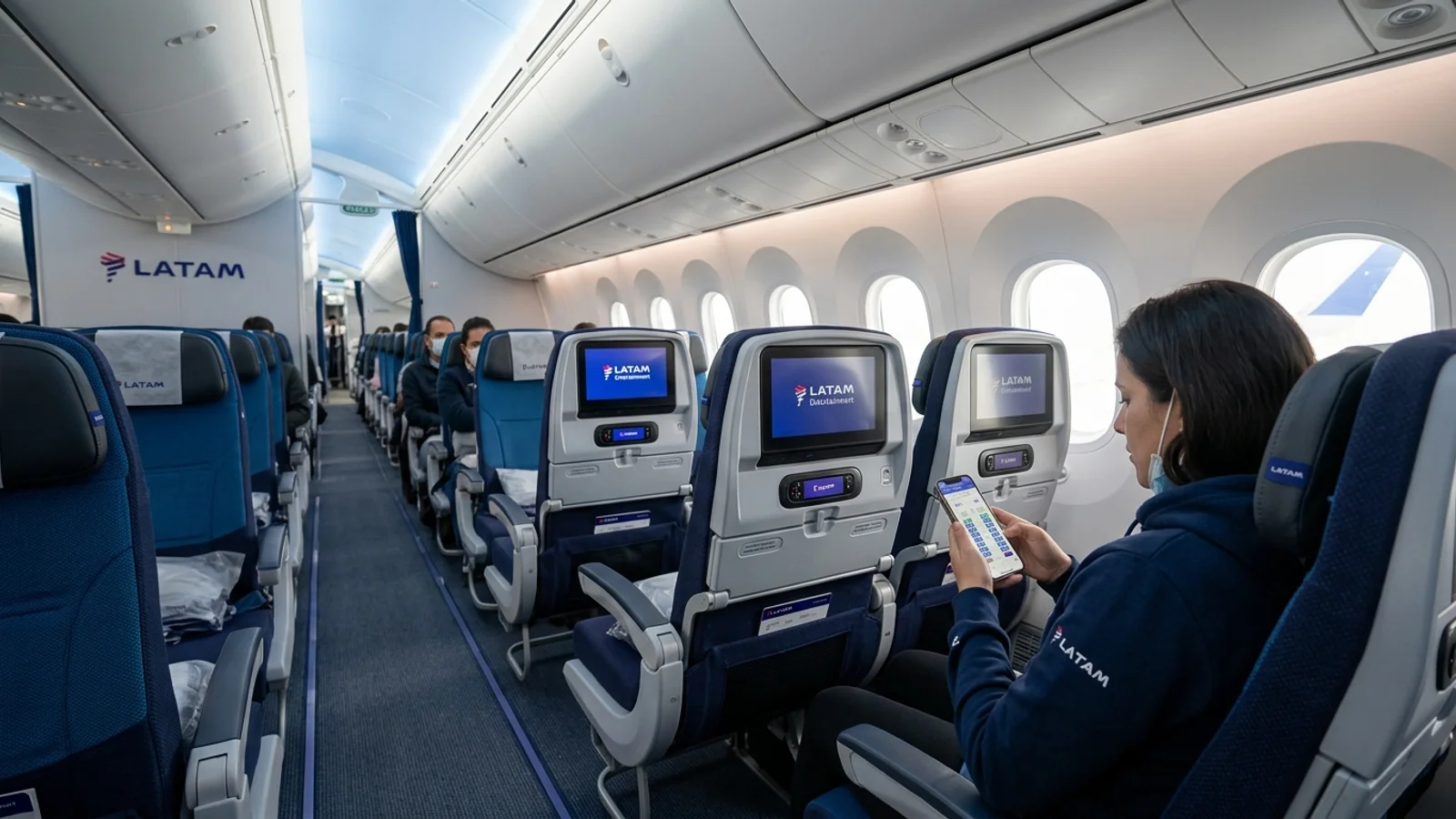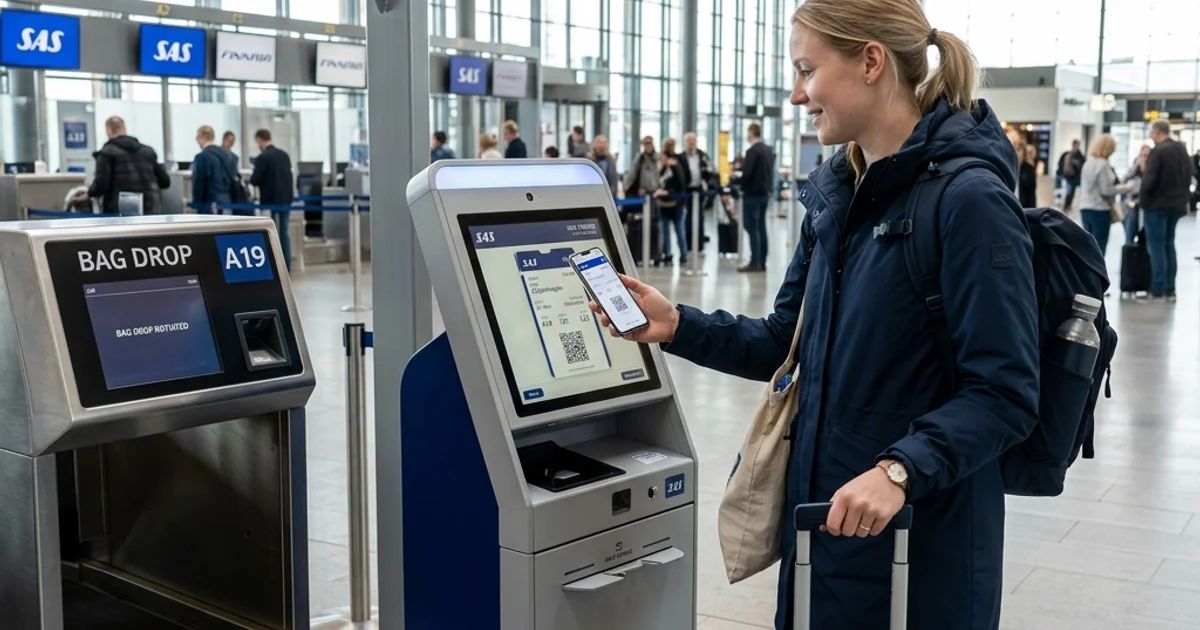
A codeshare flight is a flight operated by one airline but sold by another airline under a different flight number. That means the airline shown on your booking may not be the airline actually flying the aircraft.
Airlines use codeshare agreements to expand their global reach without having to physically fly to every destination themselves. By partnering with other carriers, an airline can offer a seamless ticket to a city it does not serve with its own aircraft. For travelers, this means you might buy a ticket through your preferred airline, but when you arrive at the airport, you will board a plane painted with a partner airline's logo and staffed by that partner's flight crew.
Understanding how a codeshare flight works is essential for a smooth journey. Knowing which airline actually operates your flight determines where you check in, whose baggage policies apply, and who is responsible if your flight is delayed or canceled.
- ✓ Is operated by one airline (the operating airline).
- ✓ May be sold under another airline's flight number (the marketing airline).
- ✓ Can appear under multiple airline flight numbers simultaneously on departure boards.
- ✓ Allows airlines to expand network reach through strategic commercial partnerships.
Marketing airline: The airline that sells and markets the flight under its own airline code and flight number.
Operating airline: The airline that physically provides the aircraft, flight crew, and executes the actual flight.
What Is a Codeshare Flight?
In beginner-friendly terms, a codeshare is a commercial partnership where two or more airlines share the exact same physical flight.
Imagine you want to buy a ticket from your local airport to a distant international city. Your favorite airline doesn't fly that route. Instead of forcing you to figure out how to book a second ticket on a foreign carrier, your favorite airline signs a "codeshare agreement" with an airline that does fly that route.
Your airline can now place its own flight number on that partner's flight and sell it directly to you on their website.
A Fictional Example:
Farewander Airlines (Airline A) sells a ticket for flight FW1234. However, the itinerary explicitly states: "Operated by Horizon Air Transport."
Therefore:
- Farewander Airlines (Airline A) = The marketing airline.
- Horizon Air Transport (Airline B) = The operating airline.
Multiple marketing airlines might sell seats on that exact same Horizon Air Transport physical flight, each using their own unique flight numbers.
What Does "Operated By" Mean on a Flight Ticket?
The phrase "Operated by" is the most important piece of information on a codeshare ticket. It identifies the airline responsible for physically operating that flight segment on the day of departure.
When your ticket says "Operated by [Airline Name]," it means that specific airline is providing:
- The Aircraft: You will step onto a plane featuring that airline's branding, seating configuration, and cabin interior.
- The Cabin Crew: The flight attendants serving you will be employed by the operating airline, wearing their uniforms.
- Flight Operations: The pilots flying the aircraft are employed by the operating airline.
- Onboard Service: The food, beverages, in-flight entertainment, and general hospitality will follow the operating carrier's standard setup, though specific premium arrangements occasionally vary depending on the depth of the partnership.
Even if you booked your itinerary, paid your money, and received a confirmation email entirely from the marketing airline, the "operated by" carrier dictates your physical experience in the sky.
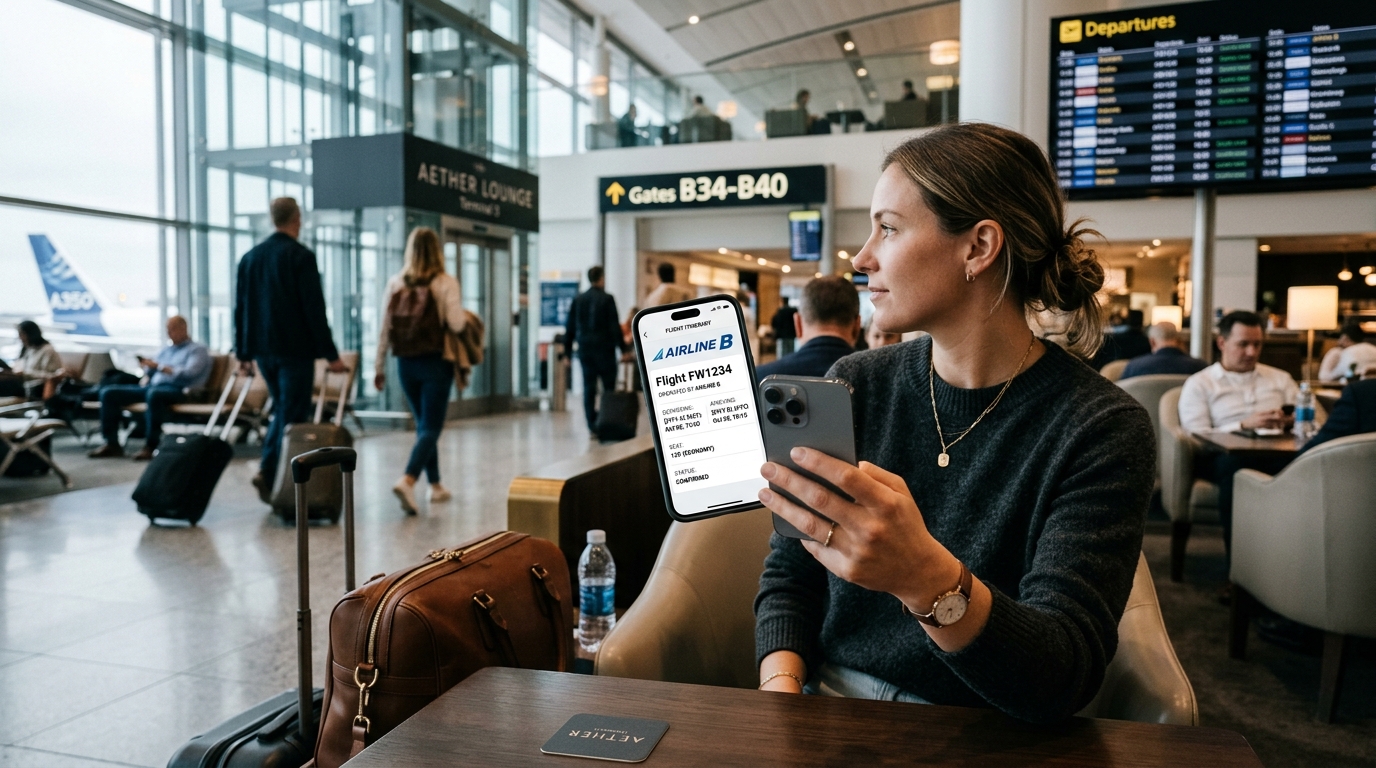 Always look for the "Operated by" text on your booking confirmation to know who is flying the plane.
Comparing Fares for Your Route?
Search live multi-airline schedules, spot discount windows, and baggage fee rules on FareWander.
Marketing Airline vs Operating Airline
Understanding the distinction between these two entities clarifies the entire codeshare process.
| Feature | Marketing Airline | Operating Airline |
|---|---|---|
| Primary Role | Markets, prices, and sells the flight to the passenger. | Physically operates the flight from takeoff to landing. |
| Flight Number | Attaches its own airline code and flight number to the route (e.g., AA1234). | Uses its own core flight number internally and for air traffic control. |
| Booking Channel | Sells the ticket through its website, app, or travel agents. | The flight occurs on their physical aircraft. |
| Loyalty Program | May provide frequent-flyer miles and elite benefits based on ticket rules. | Provides the actual cabin crew and pilots. |
| Responsibility | Retains ticketing responsibility and provides customer support for the booking. | Controls airport check-in, boarding, and onboard operational details. |
 The marketing airline sells the ticket, while the operating airline physically flies the aircraft.
It is a common misconception that the marketing airline has no responsibility to the passenger once the ticket is sold. If you need to change your dates or request a refund before the day of travel, you must contact the marketing/ticketing airline, not the operating airline.
How Do Codeshare Flights Work?
The process of implementing and selling a codeshare flight follows a specific commercial sequence:
- The Agreement: Two airlines legally establish a codeshare arrangement detailing how seats will be allocated and revenues shared.
- The Operation: The operating airline schedules and physically operates a flight between two cities (e.g., City X to City Y).
- The Marketing: The operating airline grants the marketing airline permission to sell seats on that flight under the marketing airline's own two-letter IATA code.
- The Flight Display: The exact same physical aircraft movement appears on departure boards under multiple flight numbers (e.g., Operating Flight B99, Marketing Flight A450, Marketing Flight C780).
- The Booking: Travelers can book this flight through either airline's website, depending on route availability and pricing.
- The Ticket: When the passenger receives their itinerary, aviation law requires the booking to clearly identify the operating carrier to the consumer.
By utilizing partner schedules, passengers can explore global flight routes seamlessly under a single booking portal.
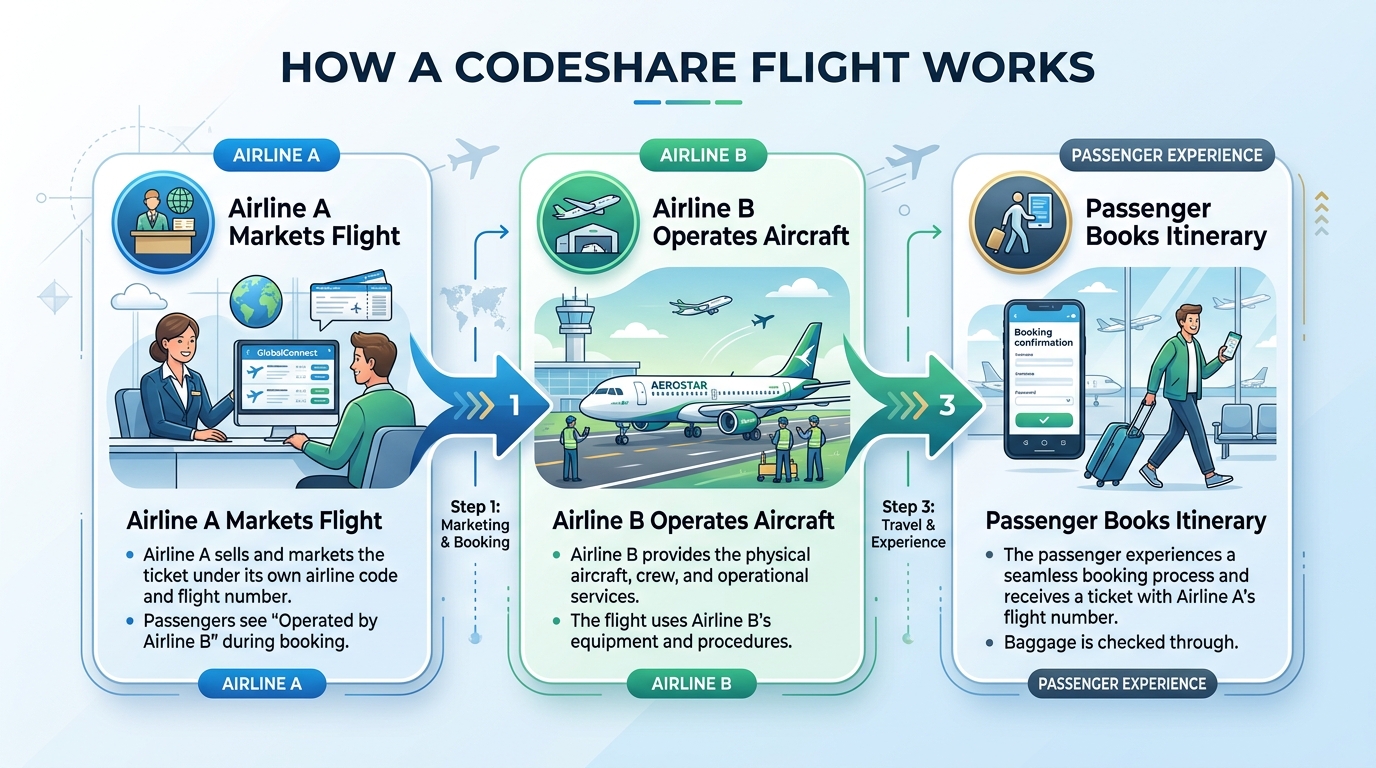 A single flight can be sold under multiple flight numbers by different partner airlines.
Why Do Airlines Use Codeshare Agreements?
Codeshares form the backbone of modern global aviation because they offer tremendous mutual benefits.
For Airlines:
- Network Expansion: Airlines can offer flights to destinations they do not physically serve.
- Better Connectivity: It allows carriers to build robust global networks without buying more aircraft.
- Feeder Traffic: A regional airline can feed passengers into a major international airline's global hub.
- Broader Schedules: Airlines can offer multiple departure times per day by combining their schedules with a partner's schedule.
- Partnership Opportunities: Deepens commercial ties, often leading to joint ventures and shared revenues.
For Travelers:
- More Itinerary Choices: Access to thousands of global destinations through a single booking portal.
- Easier Connections: Luggage can usually be checked through to the final destination without needing to be claimed and re-checked.
- Seamless Booking: The ability to book complex, multi-continent itineraries on a single ticket.
- Loyalty Benefits: Opportunities to earn frequent-flyer miles and utilize elite status perks across participating partner carriers.
While highly convenient, it is important to note that codeshares do not automatically provide cheaper airfare.
Planning Travel Logistics?
Use FareWander tools to calculate flight times, luggage rules, and visa requirements.
What Is the Difference Between a Codeshare and a Regular Flight?
The distinction lies entirely in whose name is on the ticket versus whose name is on the side of the airplane.
| Flight Type | Description |
|---|---|
| Regular Flight | The airline you buy the ticket from is the exact same airline that operates the physical flight. The flight number corresponds directly to the operating carrier. |
| Codeshare Flight | The airline you buy the ticket from is different from the airline operating the flight. The flight number shown to the customer belongs to the marketing airline. |
Understanding these arrangements helps travelers compare airline networks when choosing the best itinerary for their journey.
Codeshare vs Connecting Flight
These two terms are frequently confused, but they describe entirely different concepts.
- Codeshare: Describes the commercial and marketing arrangement between two airlines.
- Connecting flight: Describes an itinerary involving more than one flight segment, where reaching your final destination requires boarding two or more separate aircraft with different flight numbers.
A passenger's journey can be BOTH a codeshare and a connecting flight.
To understand how connecting flights work alongside codeshares, examine this example itinerary:
- Flight 1 (Connecting Leg 1): Marketed by Airline A, Operated by Airline B.
- Flight 2 (Connecting Leg 2): Marketed by Airline A, Operated by Airline C.
A codeshare does not automatically mean you have a connection. You can absolutely fly on a nonstop codeshare flight.
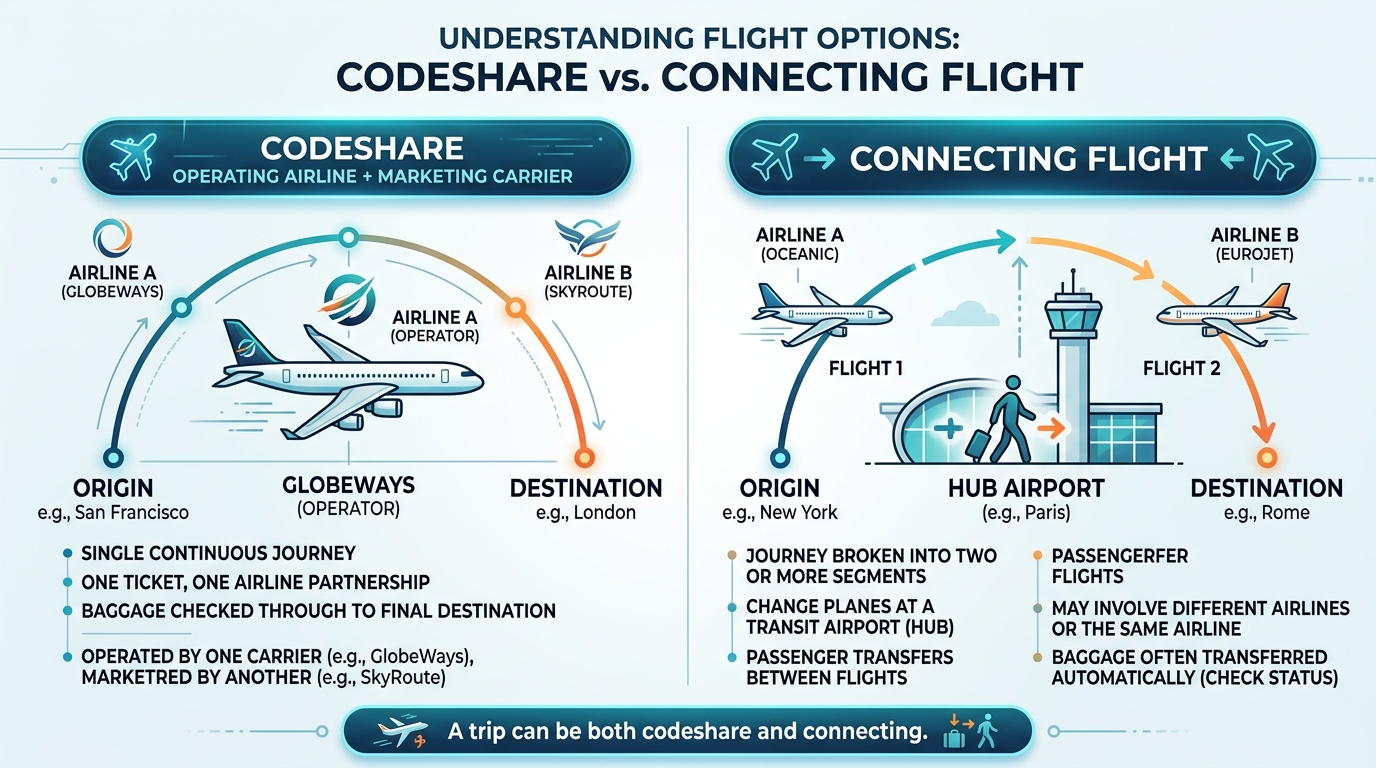 A codeshare refers to how a flight is sold, whereas a connecting flight refers to changing physical planes.
Codeshare vs Direct Flight
A codeshare flight can be nonstop, direct, or part of a connecting itinerary. Do not confuse the terminology:
- Codeshare: A flight sold by one airline and operated by another.
- Nonstop Flight: A flight that flies from your origin airport to your destination airport with zero intermediate stops.
- Direct Flight: An itinerary that operates between two cities under a single flight number, but it may make one or more intermediate stops along the route.
You could easily book a ticket that is marketed by Airline A, operated by Airline B, and makes a brief stop in a middle city without you changing planes. That would be a direct codeshare flight.
Codeshare vs Interline Agreement
While they sound similar, interline agreements and codeshare agreements are distinct levels of airline cooperation.
INTERLINE AGREEMENT:
A basic commercial agreement where airlines agree to recognize and connect transportation across each other's services. Interline agreements facilitate single-ticket booking and baggage transfers between two different airlines. However, if Airline A and Airline B only have an interline agreement, Airline A will sell you Airline B's flight under Airline B's flight number.
CODESHARE AGREEMENT:
A much deeper partnership. One airline actively markets a flight operated by another airline using its own flight number.
A relationship between two airlines can involve both interline and codeshare arrangements simultaneously. They are not mutually exclusive; rather, a codeshare is generally built on top of an existing interline foundation.
Codeshare vs Airline Alliance
Codeshare Agreement:
A specific, route-by-route commercial arrangement negotiated directly between two individual airlines.
Airline Alliance:
A broader strategic network partnership involving multiple airlines globally. The three major global alliances are Star Alliance, oneworld, and SkyTeam. Members of an alliance agree to coordinate schedules, recognize elite frequent-flyer status, and share airport lounges.
While airlines within the same alliance frequently codeshare with one another, you should not assume every alliance member has a codeshare relationship with every other member on every route. Furthermore, airlines frequently form codeshare agreements with airlines outside of their alliance if it benefits their network strategy.
How Can You Tell If a Flight Is a Codeshare?
Airline booking sites, travel agencies, and flight-search platforms are legally required to disclose the operating airline to the consumer before purchase. However, the exact phrasing can vary.
When reviewing your flight search results or booking confirmation, look carefully for these specific phrases underneath the primary flight number:
"Operated by [Airline Name]""Operating carrier: [Airline Name]""Flight operated by [Airline Name]""Marketing carrier: [Airline A] / Operating carrier: [Airline B]""Codeshare with [Airline Name]"
If you are using a third-party flight search platform, you may need to click on "Flight Details" or expand the itinerary view to see the operating carrier text.
Which Airline Do You Check In With on a Codeshare Flight?
This is the most common point of confusion for travelers at the airport.
In the vast majority of cases, the operating airline handles airport check-in for the flight. Because the operating airline provides the physical aircraft, it is their computer system that controls the seating map, the weight-and-balance calculations, and the generation of boarding passes.
However, the airline handling check-in can depend on:
- The specific operating airline
- The ticketing airline's digital integration
- The departure airport's terminal layout
- Whether the journey is part of a complex connecting itinerary
For example, if you are checking in online 24 hours before departure via the marketing airline's app, their system may seamlessly redirect you to the operating airline's portal.
Travelers should always follow the specific instructions shown on their booking confirmation. If you arrive at the airport and cannot check in via an automated kiosk, proceed directly to the desk of the operating airline. Before traveling, it helps to review your departure airport terminal guides to verify terminal layouts and check-in desk locations.
 For codeshare itineraries, you typically check in with the operating airline at the airport.
Who Handles Baggage on a Codeshare Flight?
Baggage rules on codeshare flights are notoriously complex and can depend on the operating airline, the marketing airline, the ticketing carrier, and the specific route.
Generally, in international aviation, the "Most Significant Carrier" (MSC) rule dictates baggage allowances. This usually means the baggage policy of the airline operating the longest or most significant geographical segment of your journey applies to the whole ticket. However, depending on consumer protection laws (like those from the US Department of Transportation), the baggage rules of the marketing carrier on the very first segment of the ticket might apply to the entire itinerary.
What you need to know:
- Carry-on: You are almost always subject to the physical size and weight limits of the operating airline, as they dictate what fits in the aircraft's overhead bins.
- Checked baggage allowance: Check the baggage allowance printed directly on your e-ticket receipt.
- Through-checking: If your flights are booked on a single ticket, your bags will generally be checked through to your final destination, even across partner airlines.
- Separate tickets: If you booked a codeshare flight on a separate ticket from your main journey, you cannot guarantee baggage will be checked through.
Always consult the relevant airline's official baggage policy page using your specific booking reference.
Can You Choose Your Seat on a Codeshare Flight?
Seat selection on codeshare flights can be a frustrating experience because the marketing airline's computer system must communicate with the operating airline's seating map.
Seat selection may be handled by:
- The operating airline's website (using a separate confirmation code).
- The marketing airline's website (if their IT systems are deeply integrated).
- Airport check-in only (if advance selection is not supported).
The rules vary wildly. A seat selected through the marketing airline may not always behave the same way as a seat purchased directly from the operating airline. For instance, extra-legroom seats might only be purchasable directly through the operating carrier.
To ensure your seat is confirmed, it is best practice to take the operating airline's record locator (usually a 6-digit alphanumeric code provided on your receipt) and plug it directly into the operating airline's website.
Which Airline Provides the Aircraft and Crew?
Normally, the operating carrier operates the physical aircraft and provides the flight crew. The marketing airline is merely the airline selling the ticket; they are not the airline flying the aircraft.
When you step aboard, you will find:
- The aircraft painted in the operating airline's livery.
- The pilots employed by the operating airline.
- The cabin crew employed by the operating airline.
- The onboard service (food, drink, entertainment) provisioned by the operating airline.
However, specific service arrangements can vary and should not be generalized across all agreements. In rare "wet lease" situations, an airline might supply an aircraft and crew to another airline, but standard commercial codeshares rely entirely on the operating carrier's standard physical product.
Will the Flight Number Be Different?
Yes, the exact same physical flight can be sold under entirely different flight numbers by different marketing airlines.
Fictional Example:
- Physical flight: Operating Airline (Skyways) Flight SK200.
- Customer A booking: Marketed by Partner Air as Flight PA8000.
- Customer B booking: Marketed by Global Air as Flight GA7100.
If Customer A, Customer B, and a customer who booked directly with Skyways all show up at the airport, they will all board the exact same physical aircraft. The airport departure screens will typically cycle through all three flight numbers (SK200, PA8000, GA7100) next to the destination to prevent confusion.
Do Codeshare Flights Earn Frequent-Flyer Miles?
Potentially, yes, but earning frequent-flyer miles, points, status credits, or elite qualifying dollars on a codeshare flight is not guaranteed.
It depends heavily on:
- The specific loyalty program's current rules.
- The marketing airline.
- The operating airline.
- The booking class (the single-letter code denoting your fare type, like Y, J, or Basic Economy).
Sometimes you earn miles based on the marketing airline's earning charts; other times, the earning is calculated based on the operating carrier's charts. Furthermore, heavily discounted economy tickets booked as a codeshare sometimes earn zero miles.
Travelers should always check their specific loyalty program's partner earning tables prior to booking to confirm eligibility.
Can You Use Airline Elite Benefits on a Codeshare?
If you hold elite status with a marketing airline, your ability to use those elite benefits (such as priority boarding or free checked bags) on a flight operated by a codeshare partner depends on the depth of their relationship.
Elite benefits may depend on:
- Alliance membership (e.g., Star Alliance Gold benefits usually apply across all member carriers).
- The specific bilateral agreement between the marketing and operating carrier.
- The ticket type.
- The departing airport's lounge availability.
Potential benefits like lounge access, priority check-in, priority boarding, and increased baggage allowance are frequently honored, but you must verify the loyalty program's current rules. Do not assume your marketing airline status automatically translates to VIP treatment on the operating airline.
What Happens If a Codeshare Flight Is Delayed?
Disruptions on codeshare itineraries require coordination. The answer to who helps you depends on who operates the flight, where the ticket was purchased, and whether the itinerary is on one single ticket.
If the flight is delayed on the day of travel, the operating airline is physically responsible for managing the disruption at the airport, handling the aircraft, and providing immediate passenger updates. However, the ticketing airline (the airline that issued the 13-digit ticket number) is responsible for the financial backend of rebooking you.
Practical advice if your flight is delayed:
- Check the flight status on both airlines' apps.
- Follow the operating airline's airport instructions for day-of-travel issues.
- Contact the airline that sold you the ticket if you need to be rebooked onto an entirely different day or routing.
- If connecting, check the status of your onward flight immediately.
- Ask airport staff about rebooking if you are at risk of a misconnection, but remember that airlines do not promise free rebooking onto competing carriers outside of their agreements.
What Happens If You Miss a Connecting Codeshare Flight?
The outcome of a missed connection hinges entirely on how the ticket was booked.
If flights are on one protected itinerary/ticket:
If your first flight is delayed and you miss your codeshare connection, the airline is generally obligated to rebook you on the next available flight to your destination, subject to fare rules and applicable passenger rights laws. Your baggage will also be managed by the airline during the rebooking process.
If flights are on separate tickets:
If you booked your flights independently (e.g., a ticket on Airline A, and a separate codeshare ticket on Airline B), you assume substantially more risk. A misconnection on separate tickets is considered a "no-show" by the second airline. They are not obligated to rebook you for free, you will be responsible for new ticket costs, and you assume all self-transfer risks regarding delayed baggage.
Are Codeshare Flights Safe?
Codeshare status itself does not mean a flight is unsafe.
Commercial aviation safety is rigorously regulated by applicable national aviation authorities (such as the FAA in the United States or EASA in Europe) and the operating carrier's own safety management systems. The fact that a different airline markets and sells the ticket has zero impact on how the aircraft is physically maintained or flown.
Before two major airlines enter into a codeshare agreement, they frequently conduct stringent safety audits of each other's operations (such as the IATA Operational Safety Audit) to ensure their passengers are flying on a safe, compliant airline.
Are Codeshare Flights More Expensive?
Not necessarily. The same physical flight can appear at different prices through different marketing channels.
Fares depend on:
- Inventory allocations between the partners.
- The specific fare class being sold.
- Market demand in the marketing airline's home country.
- Taxes, surcharges, and booking channel fees.
You should not blindly assume that booking directly with the operating airline is always cheaper. In some instances, the marketing airline may have a promotional sale or lower pricing inventory available for that exact same seat. Instead, recommend comparing the final fare, baggage inclusions, seat selection fees, and change/cancellation rules across both airlines' websites before purchasing, and applying proven strategies for finding cheap flights.
Advantages of Codeshare Flights
- More route options: Access to secondary cities around the globe.
- Easier connections: Baggage is usually checked through to the final destination.
- Broader schedules: More daily departure choices combining partner networks.
- Loyalty benefits: The potential to earn and burn miles across multiple carriers.
- Single-ticket itineraries: Legal protection during delays and misconnections.
- Better network coverage: Seamless travel utilizing the strengths of local carriers.
- Simpler booking: The ability to book complex global trips through one familiar website.
Disadvantages of Codeshare Flights
While highly beneficial, codeshares do come with possible drawbacks:
- Confusion about operating airline: Travelers may be surprised when they don't board their preferred airline.
- Different check-in processes: It can be confusing to figure out which app or desk to use.
- Different baggage rules: Carry-on sizes and checked weight limits may be stricter on the partner airline.
- Seat-selection differences: Advanced seating can be glitchy or require a fee across different IT systems.
- Loyalty-program restrictions: Elite upgrades are often much harder to clear on partner metal.
- Multiple airline policies: Navigating two sets of customer service rules.
- Disruption handling: Figuring out who to call when a flight is canceled can be frustrating.
What Should You Check Before Booking a Codeshare Flight?
Use this practical checklist before confirming your purchase:
- Who is the marketing airline?
- Who is the operating airline?
- What aircraft type will physically operate the flight?
- Which airline's app/desk do I use to check in?
- What is the specific baggage allowance for the operating carrier?
- Is advance seat selection available, and will it cost extra?
- What are the change and cancellation rules for this ticket?
- Will my frequent-flyer program award loyalty miles/points for this specific fare class?
- Is the entire itinerary booked on one single ticket?
- What happens if a connection is missed?
- Which airline should I contact during a major disruption?
- Are there any airport or terminal changes required during connections?
 Review your baggage limits and check-in procedures before heading to the airport.
How to Read "Operated By" on Your Booking
Reading your digital itinerary correctly prevents terminal confusion. Here is a conceptual example of what to look for:
In this example, Flight FW1234 is the marketing airline's code and number. However, the physical aircraft operation, the check-in desk, and the cabin crew are provided by Desert Airways.
Real-World Codeshare Example
Note: This partnership information is verified as of 31 August 2026.
A prominent real-world example of extensive codesharing is the joint venture partnership between Delta Air Lines and Air France, both founding members of the SkyTeam alliance.
If a traveler wants to fly from Atlanta (ATL) to Paris (CDG), they can go to the official Delta Air Lines website and search for a flight. They might select Flight DL8500.
However, beneath the flight number, the Delta website will clearly state: "Operated by Air France."
- The passenger pays Delta.
- The ticket has a Delta flight number.
- When the passenger arrives at the airport in Atlanta, they will walk up to a physical Air France aircraft.
- They will check their bags at the Air France desk and be served by Air France flight attendants.
This arrangement allows Delta to sell more tickets to Paris than they have physical planes to operate, while Air France benefits from Delta feeding passengers from all over the United States into Atlanta to fill up the Air France plane. (Arrangements can change; always review your specific booking).
Frequently Asked Questions
A codeshare flight is a commercial arrangement where one airline markets and sells seats on a flight that is physically operated by another partner airline.
Conclusion
At its core, a codeshare flight is a powerful marketing tool that allows airlines to seamlessly connect you to the world. It is primarily about how airlines market and sell flights, not about whether the flight is physically operated by that airline.
For the average traveler, the most important thing is to read the fine print. Always check who the marketing airline is, identify the operating airline, and confirm the specific rules regarding baggage, check-in, seat selection, and disruption procedures. As long as you know who is actually flying the plane, navigating a codeshare itinerary can be a highly convenient way to travel.