Finding cheap flights is not about discovering a hidden trick, booking at midnight, or trying to trick dynamic airline algorithms. Instead, the most reliable way to secure affordable airfare is by systematically comparing your options, keeping your schedule and routing flexible, calculating the total cost of travel, and knowing which trade-offs match your itinerary needs.
Airline ticket prices fluctuate dynamically in response to real-time seat inventory, passenger demand, route competition, and seasonal travel windows. Because no single tool or strategy guarantees the lowest fare on every route, saving money requires a structured comparison approach.
Whether you need to find cheap flights for domestic travel or international travel, this guide covers 15 practical strategies to help you evaluate real-world trade-offs, avoid hidden add-on costs, and find cheap flights online effectively.
1. Compare Flights Across Multiple Options
To find affordable flights, compare multiple airlines, departure windows, date combinations, and routing structures side by side rather than checking a single airline or website.
Airlines manage passenger pricing across different fare classes, meaning rates can vary significantly between carriers operating on identical routes. A broad search helps identify which carriers operate the route and whether legacy airlines or budget carriers provide the best overall value.
- 1 Direct Non-Stop vs 1-Stop Connecting Routes: Weigh time efficiency against layover fare discounts.
- 2 Primary Metropolitan Hubs vs Secondary Regional Airports: Check if regional hubs lower base fares.
- 3 Full-Service Bundled Fares vs Low-Cost Unbundled Fares: Calculate baggage and seat selection totals.
- 4 Single Round-Trip vs Two Separate One-Way Itineraries: Test split airline ticketing across directions.
Practical Example: A traveler searching for flights from London to Dubai might see a nonstop flight on a legacy carrier for $450 with checked luggage included, alongside a low-cost carrier base fare of $370. If the low-cost carrier charges $90 for luggage and airport check-in fees, the seemingly higher baseline ticket is actually the more affordable flight option.
You can compare route options side-by-side using the Farewander Flight Search.
2. Be Flexible With Your Travel Dates
Flexible travel dates remain one of the most effective levers when conducting a cheap flights search. Shifting your travel window by just 1 to 3 days often reveals different pricing tiers.
Airlines do not enforce universal "cheap days," but airfares follow passenger demand patterns. Mid-week departures (such as Tuesdays and Wednesdays) often see lower passenger volume on leisure routes than peak weekend slots (Fridays and Sundays).
- Fare Calendars: Use monthly or grid views to spot price dips across surrounding dates.
- Shoulder Seasons: Traveling during spring or autumn often yields better airfare than peak summer or end-of-year holiday periods.
- Avoid Assumption Traps: Never assume a specific weekday is always the cheapest; check the route's live availability calendar directly.

Comparing Fares for Your Route?
Search live multi-airline schedules, spot discount windows, and baggage fee rules on FareWander.
3. Check Nearby Airports
Metropolitan regions often have multiple commercial airports. Expanding your search to alternate arrival or departure airports can open up different carrier options and lower base fares.
However, you must evaluate the total door-to-door cost, not just the airfare. Secondary airports located farther from metropolitan centers may require expensive airport transfers, regional trains, highway tolls, or extended transit times.
| Scenario Factor | Primary Airport (e.g., JFK / LHR) | Secondary Regional Airport |
|---|---|---|
| Base Airfare | Higher ($350) | Lower ($280) |
| Ground Transit to City | $10 – $25 (Subway / Rail) | $70 – $100 (Long-distance shuttle / taxi) |
| Travel Time to City Center | 45–60 minutes | 90–150 minutes |
| Net Total Journey Cost | $360 – $375 | $350 – $380 |
Takeaway: A cheaper flight ticket to an alternative airport is only a bargain if ground transit costs and logistical delays do not cancel out your ticket savings. Explore terminal details in our Airports Directory.
4. Set Flight Price Alerts
Airfare pricing is dynamic, adjusting continuously based on seat availability and passenger demand. Setting up flight price alerts tracks these shifts automatically, sending an email or push notification when fares rise or fall for your target route.
Price alerts are monitoring tools rather than guarantees of future discounts. To use alerts effectively:
- Set a clear target budget for your trip.
- Track the route 2 to 5 months ahead for long-haul travel, or 1 to 3 months ahead for domestic trips.
- Book when an alert shows the fare has dropped into your target range, rather than waiting indefinitely for lower prices that may never arrive.
5. Compare the Total Cost, Not Just the Ticket Price
The lowest advertised base fare rarely represents the final cost of your trip. To make an accurate comparison, calculate all mandatory and optional charges across competing airlines before entering payment details.
The table below illustrates how two different airline fare structures compare in practice:
| Expense Component | Airline A (Full-Service Carrier) | Airline B (Low-Cost Carrier) |
|---|---|---|
| Base Ticket Price | $260 | $170 |
| Taxes & Carrier Surcharges | Included | Included |
| Carry-On Overhead Bag | Included (Free) | $40 (Paid add-on) |
| Checked Baggage (20–23 kg) | Included (Free) | $65 (Paid add-on) |
| Standard Seat Selection | Included (Free) | $20 (Paid add-on) |
| Airport Rail/Taxi to Center | $15 (Central Airport) | $45 (Secondary Hub) |
| Total Real Travel Expense | $275 | $340 |
Takeaway: Low advertised base fares can end up costing more once baggage, seating, and ground travel are factored in. Always evaluate the complete package.

Planning Travel Logistics?
Use FareWander tools to calculate flight times, luggage rules, and visa requirements.
6. Consider Connecting Flights
Direct and nonstop flights offer maximum speed, but connecting itineraries that include a brief layover are frequently priced lower on long-haul routes. Airlines use hub-and-spoke networks to discount connecting seats to maintain full passenger loads across their networks.
However, choosing a connecting route introduces trade-offs:
- Longer Journey Times: Layovers add hours to your total door-to-door transit time.
- Missed Connection Risks: Flight delays on the first leg can cause you to miss onward connections.
- Protected vs. Self-Transfer: Always distinguish between a single-ticket connection (where the airline is responsible for rebooking you during delays) and a self-transfer itinerary (where you hold separate tickets and take on the full financial risk of missed flights).
Learn more about managing transit times and baggage rules in our comprehensive guide to What Is a Layover? Complete Guide.
7. Compare Direct and Nonstop Flights With Connecting Options
Aviation terms are often misunderstood, leading travelers to book the wrong flight type.
- Nonstop Flight: Departs your origin and lands at your destination with zero intermediate stops.
- Direct Flight: Operates under a single flight number between two cities, but may make an intermediate landing for refueling, boarding, or maintenance without requiring a plane change.
- Connecting Flight: Requires landing at an intermediate airport, changing aircraft, and traveling under two or more distinct flight numbers.
Comparing these options requires balancing price against time and fatigue. A nonstop flight that costs $80 more may be well worth the price if it eliminates an 8-hour layover and late-night connection stress.
Read our full comparison guide on Direct vs Nonstop vs Connecting Flights: What's the Difference? to choose the best routing structure for your trip.
8. Consider One-Way and Round-Trip Combinations
While traditional round-trip tickets are standard, combining two separate one-way tickets on different airlines can sometimes produce lower total airfare or provide better departure times.
- Airline Mixing: Flying out with Airline A and returning with Airline B can take advantage of competing sales schedules.
- Airport Splitting: Departing from one regional airport and returning through another can unlock better rates in multi-airport cities.
Important Risk Warning: If you book two separate one-way tickets independently, they are distinct contracts. If your outbound flight is delayed or cancelled, the return carrier is under no legal obligation to refund or alter your return ticket without standard change fees.
9. Consider Budget Airlines Carefully
Low-cost carriers offer lower headline fares by unbundling their travel services. When you purchase a basic economy or budget ticket, you are generally paying only for the seat and a personal item that fits under the seat in front of you.
Budget airlines are effective options for short-haul trips, light packers, or weekend getaways. To determine if a low-cost carrier is genuinely cheaper:
- Review personal item and carry-on size limits.
- Check fees for checking luggage or carrying an overhead bag.
- Verify whether airport check-in requires a fee compared to free online/mobile check-in.
- Confirm the exact arrival airport location.
If you plan to travel with multiple checked bags and require specific seat assignments, a full-service legacy carrier may offer better total value.
10. Travel During Lower-Demand Periods When Possible
Airfare pricing is tied to passenger demand cycles. Understanding these cycles helps you identify seasonal windows with lower prices:
- Peak Season: Summer holidays, Thanksgiving, Christmas, New Year, and major destination festivals see elevated passenger volume and peak airfares.
- Shoulder Season: Periods immediately preceding or following peak seasons (e.g., April–May and September–October in Europe) generally feature moderate weather and balanced ticket prices.
- Off-Peak (Low) Season: Cold-weather months or intense summer heat periods in specific regions generally experience lower passenger traffic and competitive airline promotions.
Traveling during off-peak or shoulder windows can lower both your airfare and your local accommodation expenses.
11. Consider Early-Morning or Late-Night Flights
Flights scheduled during less popular travel hours often have lower demand and lower baseline prices.
- Dawn Departures: Early-morning flights (departing between 5:00 AM and 7:00 AM) often experience fewer air-traffic delays and lower pricing.
- Red-Eye Flights: Overnight flights departing late in the evening and landing early the following morning are frequently priced lower than daytime alternatives. They also save you the cost of a night's hotel stay while in transit.
The Logistics Check: Before booking an off-peak departure, ensure public transit or affordable rideshares will be operating at 4:00 AM to get you to the terminal, and verify what time you can check in to your hotel upon arrival.
12. Don't Assume Last-Minute Flights Are Always Cheaper
A common misconception among travelers is that airlines routinely slash ticket prices right before departure to fill empty seats. In modern commercial aviation, the opposite is usually true.
Airlines recognize that travelers booking within 7 to 14 days of departure are frequently business commuters, corporate professionals, or people responding to urgent family situations. Because these travelers have fixed schedules, carriers generally raise prices significantly during the final two weeks.
While occasional last-minute flight discounts occur on low-demand charter routes, you should not rely on last-minute price drops for important holidays or fixed-date vacations.
13. Check the Fare Rules Before Booking
A cheap flight ticket is not a bargain if unexpected change fees or cancellation penalties wipe out your savings. Always inspect the fare conditions before finalizing payment:
- Refundability: Basic economy and promotional fares are usually completely non-refundable.
- Change Fees: Confirm whether the airline allows free date changes (paying only the fare difference) or charges a separate change penalty.
- Baggage Inclusions: Check whether your ticket tier permits an overhead carry-on bag or strictly an under-seat personal item.
- Cancellation Credits: Confirm whether cancellations provide a reusable airline credit voucher or result in total fare forfeiture.
Review our detailed guide on the Airline Policy Directory to compare fare families across major domestic and international carriers.
14. Use Flexible Search Strategies
Optimizing your flight search is about casting a wide net across legitimate variables. Implement these flexible search habits:
- Search Broad Geographic Regions: If your destination is flexible, search by country or region to see which arrival hub has lower rates.
- Toggle Surrounding Dates: Test departing 2 days earlier or returning 2 days later.
- Mix Flight Classes for Long Trips: Consider booking Economy for a daytime outbound leg and Premium Economy for an overnight return leg to balance budget and rest.
- Avoid Misleading "Hacks": Steer clear of risky practices like "hidden-city ticketing" (skiplagging), which violate airline contract-of-carriage terms and risk ticket cancellation, frequent flyer account termination, or baggage forfeiture.
15. Know When to Book Instead of Waiting
Waiting indefinitely for a cheaper fare often backfires as remaining seat inventory sells out and prices climb. Use this decision framework to determine when to buy:
- Price is within target budget
- Travel dates are fixed
- Traveling during peak holiday season
- Few alternative flights operate on the route
- Fare includes needed luggage & seat allowances
- Travel dates are completely flexible
- Route has heavy multi-carrier competition
- Trip departure is 4 to 6 months away
- Current price is well above historic averages
For domestic travel, monitoring rates 1 to 3 months in advance provides a balanced booking window. For international long-haul flights, tracking prices 2 to 5 months before departure helps secure reasonable rates without paying late-booking premiums.

Flight Booking Myths You Should Ignore
The internet is full of outdated travel advice and pricing myths. The table below compares these common claims against how airline revenue systems actually operate:
| Common Travel Myth | Actual Aviation Reality |
|---|---|
| "Tuesday at midnight is always the cheapest time to book." | Myth. Airline algorithms update fares continuously in real time based on demand, inventory, and route competition. There is no single universal day or hour to book. |
| "Searching in Incognito mode lowers flight prices." | Myth. Airline pricing engines track seat inventory per fare bucket, not individual browser cookies. Price changes during searches occur because available seats in a low fare bucket sold out. |
| "Airlines increase fares because you searched multiple times." | Myth. Price updates are driven by overall market demand, fuel costs, and live seat purchases, not repeated searches from one computer. |
| "Last-minute flights are always cheaper." | Myth. Last-minute fares usually rise sharply within 14 days of departure to target corporate and urgent travel demand. |
| "The lowest base fare is always the cheapest option." | Myth. Low-cost carriers unbundle baggage, seat selection, and airport check-in fees, which can make the final trip cost higher than a bundled full-service ticket. |
| "One specific website always has the lowest airfare." | Myth. Fare inventory changes across distribution channels, airline websites, and travel platforms. No single aggregator guarantees the lowest price every time. |
| "Budget airlines are always cheaper after fees." | Myth. Once mandatory add-ons like checked luggage, carry-on bags, and airport transit are included, budget carriers can equal or exceed legacy carrier rates. |
How to Find Cheap Flights Step by Step
Follow this practical, 10-step process to find cheap airline tickets without overpaying:
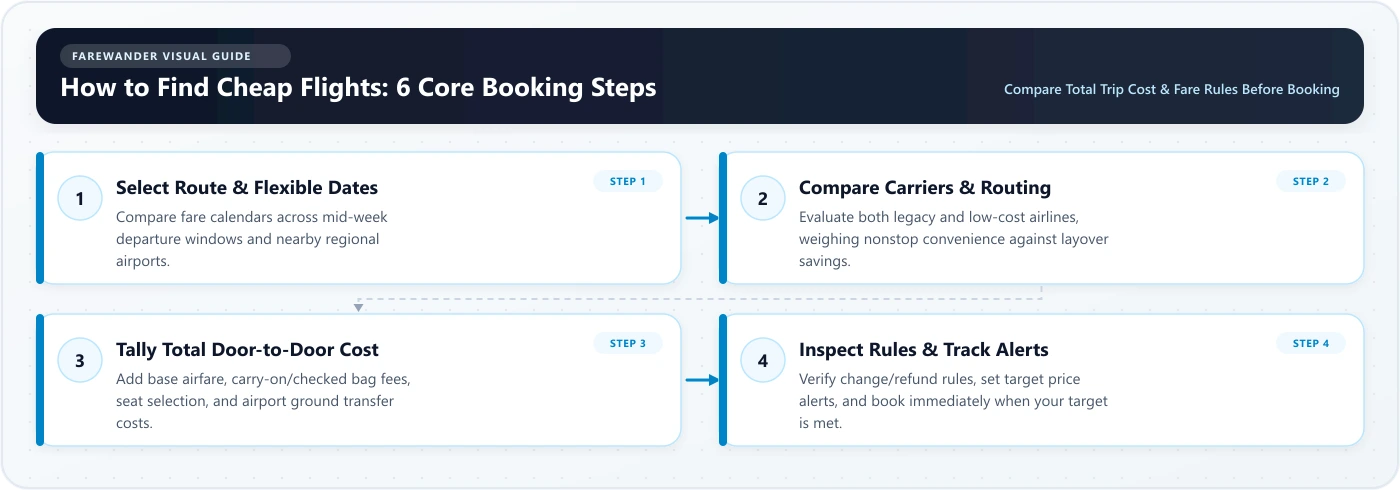
- Define your route and parameters: Identify your origin and primary destination.
- Explore flexible dates: Use fare calendar tools to identify lower-demand departure and return days.
- Check alternative regional airports: Compare primary and secondary departure and arrival hubs.
- Run a broad multi-carrier comparison: Review schedules across both legacy and budget carriers.
- Evaluate routing choices: Compare nonstop efficiency against connecting flight savings.
- Calculate the complete travel cost: Add base fare, baggage fees, seat fees, and ground transit expenses.
- Inspect ticket conditions: Confirm baggage allowances, refund eligibility, and flight change policies.
- Establish your target price: Decide on an acceptable price based on current market rates.
- Track fares with price alerts: Monitor pricing trends if your trip is several months away.
- Book when the fare meets your budget: Confirm your reservation directly when the price reaches your target rather than waiting for an uncertain drop.
How to Know If a Flight Is Actually a Good Deal
Evaluating whether a flight is a good deal requires looking beyond advertised discount percentages. A realistic fare evaluation depends on several key factors:
- Route Distance & Market Competition: Transatlantic routes with dozens of daily flights (such as New York to London) feature heavy carrier competition, keeping baseline rates lower per mile than monopolized regional routes.
- Seasonal Context: A $600 transatlantic summer ticket can be an exceptional deal during peak July travel, whereas that same price in February would be relatively high.
- Included Services: A ticket that includes 23 kg of checked luggage, seat selection, and free schedule changes carries substantially higher real value than a bare-bones basic economy seat.
- Itinerary Convenience: A nonstop flight that saves 7 hours of layover time and eliminates connection risks is often worth a reasonable premium over a multi-stop itinerary.
Compare similar itineraries side by side. If a flight fits your schedule, includes your baggage requirements, and sits comfortably within your travel budget, it is a good deal for your trip.
Common Mistakes When Looking for Cheap Flights
Avoid these common pitfalls when searching for airfare:
- Focusing strictly on base airfare: Ignoring baggage, seat assignments, and terminal transit costs.
- Booking risky tight connections: Selecting 35-minute layovers in massive international hubs, creating high missed-connection risks.
- Booking separate tickets blindly: Purchasing self-transfer itineraries without allowing a 3- to 4-hour connection buffer for baggage collection and re-checking.
- Overlooking airport locations: Landing at secondary airfields located 60 miles outside the destination without checking local transfer options or train schedules.
- Ignoring ticket change restrictions: Purchasing restrictive non-refundable tickets for trips with uncertain dates.
- Waiting too long for unrealistic discounts: Watching a fair price rise sharply while waiting for an unsubstantiated price drop.
- Failing to verify final checkout totals: Not reviewing the final breakdown before completing payment.
Author & Editorial Transparency
Authoritative Research & Industry Sources
- International Air Transport Association (IATA): Air Passenger Market Analysis & Economics Reports on airline yield management and seasonal load factors.
- U.S. Bureau of Transportation Statistics (BTS): Average Domestic Air Fares and Passenger Revenue per Available Seat-Mile (PRASM).
- Airlines for America (A4A): Commercial Airline Revenue Management & Dynamic Pricing Architecture.
- European Commission Mobility and Transport: Air Fares and Passenger Rights Regulation Studies.
Editorial & Regulatory Disclosure: Fares, airline seat inventory, baggage fees, and route policies are dynamic and subject to change by carriers without notice. FareWander operates as an independent travel information and comparison platform. We do not issue tickets, operate flights, or guarantee specific prices. Always confirm final pricing, fare conditions, and baggage rules on the booking provider's checkout screen prior to completing payment.