Basic Economy is usually a lower-priced, more restricted fare option within Economy travel, while a standard Economy fare generally includes more flexibility or benefits. But the exact difference depends on the airline.
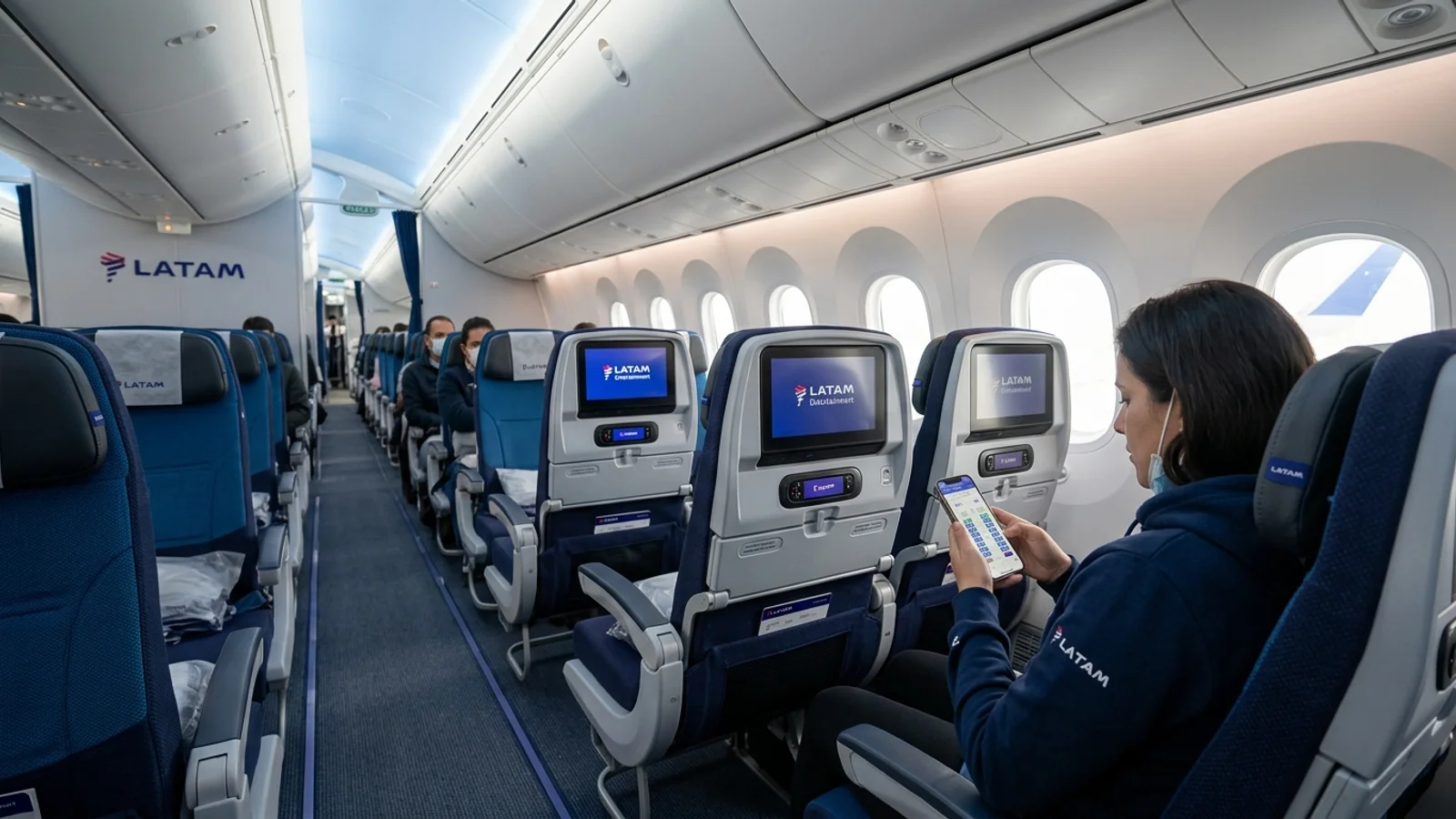
A common misconception is that Basic Economy is a completely different physical section of the airplane. In reality, both Basic Economy and standard Economy passengers are physically seated in the exact same Economy Class cabin. The difference lies entirely in the fare conditions and included benefits attached to your ticket. Fares are structured to unbundle non-essential services, charging base rates strictly for the seat while billing separately for checked bags, carry-on luggage, advance seat assignment, and onboard refreshments.
There is no universal definition of Basic Economy. While one airline might restrict carry-on bags and eliminate flight changes, another airline's Basic Economy ticket might include a carry-on and allow ticket modifications for a fee. Always compare the fare's actual inclusions rather than choosing based only on the "Basic" label.
- • Usually a lower base fare.
- • Comes with more strict ticket restrictions.
- • Fewer included benefits, depending on the airline.
- • May have restrictions on seat selection, baggage allowances, boarding priority, or ticket changes.
- • Usually a higher baseline fare.
- • Often offers more flexibility, such as easier ticket changes or cancellations.
- • Frequently includes standard seat selection and better baggage allowances.
- • Rules and naming conventions vary by airline.
What Is Basic Economy?
Basic Economy is generally a lower-priced Economy fare designed for travelers who need fewer included services or less flexibility. It caters to budget-conscious travelers and solo commuters seeking the lowest initial purchase price across all cabin tiers.
Basic Economy can have restrictions involving:
- Seat selection: often assigned at check-in
- Boarding: often boarding in the last group
- Carry-on baggage
- Checked baggage
- Flight changes
- Cancellation and refunds
- Upgrades
- Loyalty benefits and frequent-flyer miles
However, these restrictions differ significantly by airline. A Basic Economy ticket on an ultra-low-cost carrier operates under completely different rules than a Basic Economy ticket on a legacy international airline.
What Is Economy Class?
"Economy Class" is a physical cabin on an aircraft. It provides standard main cabin seating, basic transportation, and depending on the route, complimentary seatback entertainment and refreshments.
It is crucial to clarify that "Economy Class" and "Basic Economy" are not two different physical cabins. Basic Economy is simply a fare type within the Economy Class cabin.
Whether you book Basic Economy or Flexible Economy, you are walking down the same aisle and sitting in the same type of seat.
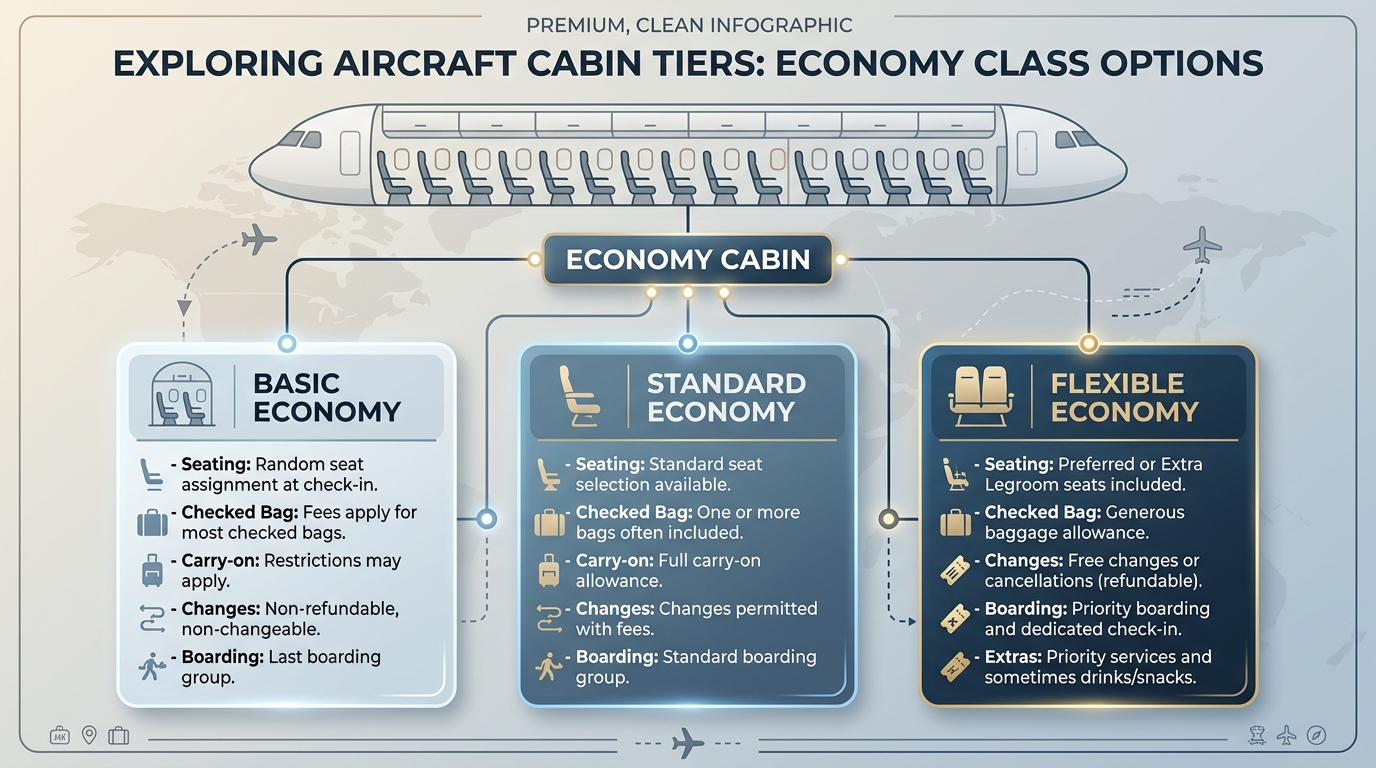 Basic Economy is a fare tier within the Economy cabin, not a separate physical section of the aircraft.
Comparing Fares for Your Route?
Search live multi-airline schedules, spot discount windows, and baggage fee rules on FareWander.
Is Basic Economy the Same as Economy Class?
Not exactly.
As mentioned, Economy Class refers to the cabin category on the plane. Basic Economy is a specific fare type or fare family that exists within that cabin. Airlines use fare families to bundle or unbundle services.
For example:
- Aircraft Cabin: Economy
- Available Fares: Basic Economy, Standard Economy, Fully Flexible Economy
Naming varies widely by airline. One carrier might call it "Basic Economy," another might call it "Light Fare," and another might call it "Saver."
Why Is Basic Economy Cheaper?
Basic fares can be cheaper because they offer fewer included benefits and greater restrictions. Airlines use revenue management systems to adjust ticket prices automatically based on variables like unbundled pricing models.
By offering a bare-bones fare, airlines can compete with low-cost carriers on price search engines. In return for the lower fare, the airline limits your flexibility, restricts your seat choices, alters your boarding priority, and charges separately for services like checked bags or overhead luggage space. It is a trade-off: you pay strictly for the seat to get from point A to point B.
Basic Economy vs Economy: At-a-Glance Comparison
Always check the fare conditions for your airline and itinerary, as these parameters are generalizations.
| Feature | Basic Economy | Standard Economy | Important Caveat |
|---|---|---|---|
| Base Fare | Lowest available | Usually higher | Price gap varies by route and demand. |
| Seat Selection | Often restricted or assigned at check-in | Usually included (standard seats) | Depends on airline/fare rules. |
| Carry-on Baggage | Varies widely (sometimes restricted) | Usually included | Depends entirely on the airline. |
| Checked Baggage | Rarely included (paid add-on) | Varies (often paid on domestic, included on international) | Baggage policies differ by airline and route. |
| Boarding Priority | Usually last boarding group | Standard boarding groups | Elite status or credit cards may override this. |
| Flight Changes | Often restricted or not allowed | Usually more flexible (fare difference applies) | Depends on the airline's current change policy. |
| Cancellation | Often non-refundable | Often partially refundable or offers travel credit | Depends on airline/fare. |
| Refunds | Usually limited to unused taxes | Varies by flexibility tier | Depends on local consumer-protection laws. |
| Upgrade Eligibility | Often restricted | Usually eligible | Varies by loyalty program. |
| Frequent-Flyer Earning | Varies (sometimes reduced or zero) | Standard earning rates | Depends on the marketing carrier. |
| Elite Benefits | Often restricted | Included | Depends on the specific loyalty program. |
| Total Flexibility | Low | Medium to High | Depends on the specific fare family chosen. |
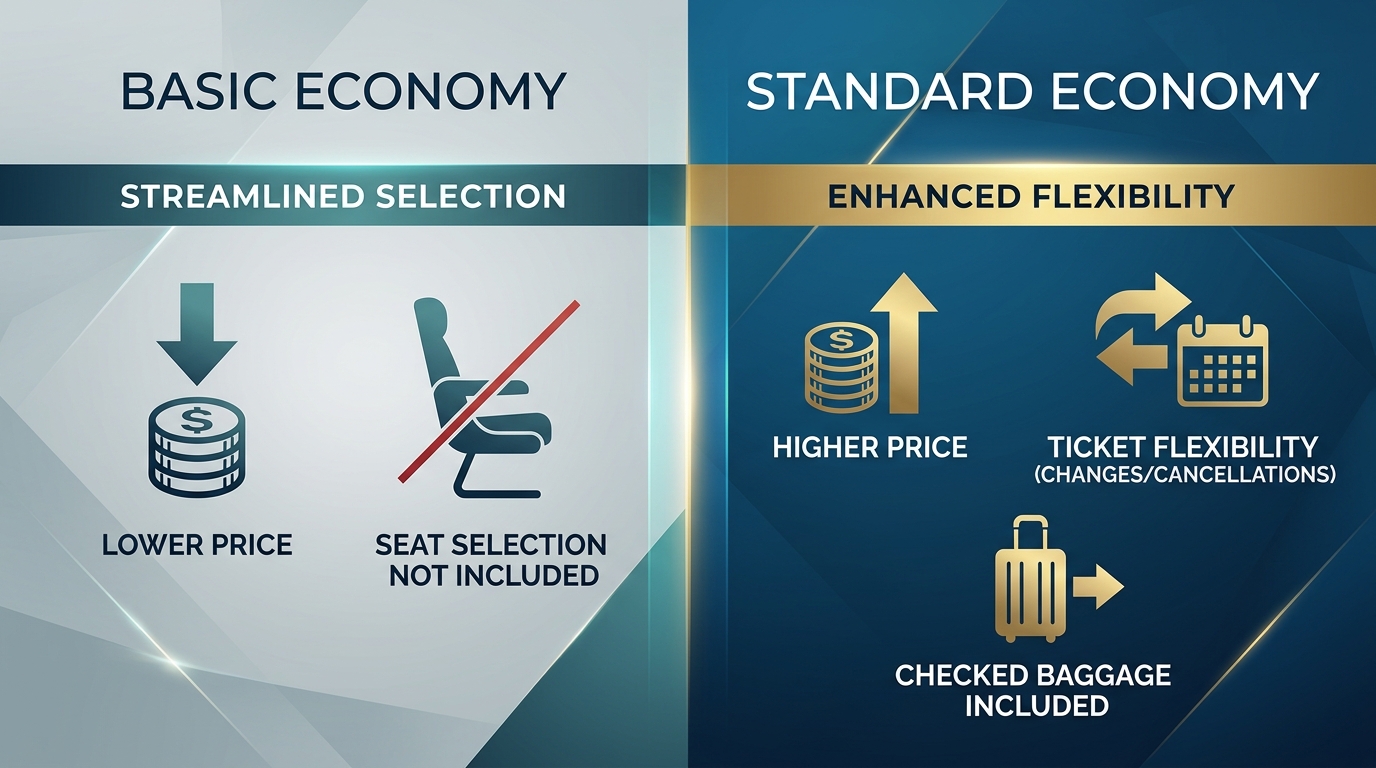 Comparing the standard inclusions and restrictions of Basic vs Standard Economy fares.
Planning Travel Logistics?
Use FareWander tools to calculate flight times, luggage rules, and visa requirements.
Basic Economy Baggage: Carry-On and Checked Bags
Baggage is the most critical factor when comparing Basic Economy vs Economy. Baggage rules vary widely by airline, ticket tier, aircraft type, and route distance.
Carry-On Baggage:
Never assume that Basic Economy universally excludes a carry-on bag. Conversely, never assume it universally includes one. Some major airlines allow a full-sized carry-on bag for Basic Economy passengers, while others strictly limit Basic Economy travelers to a single personal item that fits under the seat.
Checked Baggage:
Basic Economy tickets almost always exclude checked baggage, requiring a separate fee if luggage is added. Depending on the airline, standard Economy tickets may include a checked bag, especially on long-haul international routes.
Route-Specific Restrictions:
The exact same airline might allow a free carry-on for a Basic Economy ticket on a transatlantic flight, but ban the carry-on for a Basic Economy ticket on a short domestic flight.
 Baggage rules are a primary difference; always calculate bag fees before booking a Basic fare.
Seat Selection: Basic Economy vs Economy
Your ability to choose where you sit is a primary differentiator between these fare families.
Basic Economy may:
- Assign a seat automatically at check-in or at the gate.
- Restrict advance seat selection entirely.
- Charge additional fees if you wish to pick a seat.
- Provide very limited seat choices (e.g., only middle seats in the back).
Standard Economy may offer:
- More seat-selection options at the time of booking.
- Earlier seat selection without a fee.
- Access to preferred seating (though extra legroom seats usually still require an upgrade).
Seat rules differ significantly by airline. If you are traveling with a family and want guaranteed seats together, Basic Economy is often a risky choice.
 If sitting with travel companions is important, Basic Economy's random seat assignment may not be ideal.
Boarding Priority
Many airlines board Basic Economy passengers later or assign them to the final boarding group. This is closely tied to overhead bin space; if you board last, overhead bin space is often full, requiring you to gate-check your bags.
However, boarding groups can also depend on your frequent-flyer status, co-branded airline credit card benefits, or specific aircraft configurations. Elite members flying in Basic Economy can often bypass the last-group boarding penalty.
Can You Change a Basic Economy Ticket?
Basic Economy is designed to be highly restrictive for flight changes. Many airlines completely prohibit voluntary date, time, or route changes on Basic Economy tickets. Basic fares are often strictly non-changeable.
Standard Economy tickets, on the other hand, usually permit date or route changes upon payment of applicable modification fees plus any difference in airfare.
Airline fare rules can change. Always review the fare conditions shown during booking and the airline's current policy before payment.
Can You Cancel a Basic Economy Ticket?
Refundability and cancellation rules vary heavily. Basic fare types are usually non-refundable in the event of passenger-initiated cancellations, although unused airport taxes can generally be claimed back. If you cancel a Basic Economy ticket, you typically forfeit the fare value entirely.
Higher-tier standard Economy tickets often offer partial refunds or provide travel credits for future use.
(Note: In the U.S., the Department of Transportation enforces a 24-hour rule allowing passengers to cancel a booking made at least 7 days prior to departure within 24 hours of purchase for a full refund, regardless of whether it is Basic Economy. This is a government consumer-protection regulation, not an airline perk.)
Can You Upgrade From Basic Economy?
Upgrade options depend on the airline, fare type, loyalty status, route, and ticket conditions.
Some Basic Economy fares have strictly restricted upgrade eligibility, meaning you cannot use miles, cash, or elite status certificates to move to Premium Economy or Business Class. Other airlines may allow you to purchase a cash upgrade at check-in if space is available. Never book Basic Economy expecting an easy path to a premium seat.
Do Basic Economy Tickets Earn Miles and Points?
Mileage and points earning varies by airline, loyalty program, and fare type. While some airlines award full miles for Basic Economy tickets, others drastically reduce the earning rate (e.g., awarding only 50% of the miles flown). Certain legacy airlines award zero miles and zero elite-qualifying credits for Basic Economy fares. Check your official loyalty-program pages before booking if earning status is a priority.
Do You Get Elite Benefits With Basic Economy?
If you hold elite status in a frequent flyer program, your benefits—such as priority boarding, free checked bags, or lounge access—might be partially restricted or fully included when flying Basic Economy, depending entirely on the airline. Some carriers honor all elite benefits regardless of the fare class, while others actively suspend perks like complimentary upgrades when a basic fare is purchased.
Basic Economy vs Economy on Different Airlines
Airlines use drastically different fare structures. Below is a comparison of Basic Economy rules on major airlines.
Rules checked: 31 August 2026. Airline fare rules can change. Always review the official airline policies.
| Airline | Lowest Fare Name | Carry-On Rule | Seat Selection | Checked Baggage | Change/Cancellation | Important Restriction |
|---|---|---|---|---|---|---|
| Delta Air Lines | Basic Economy | Included | Assigned at check-in | Paid add-on | Non-changeable / Non-refundable | Does not earn SkyMiles or MQDs. |
| United Airlines | Basic Economy | NOT included (on most domestic) | Paid add-on | Paid add-on | Non-changeable | No Premier qualifying credit earned. |
| American Airlines | Basic Economy | Included | Paid add-on | Paid add-on | Permitted for a fee (for AAdvantage members) | Upgrades are heavily restricted. |
| British Airways | Basic | Included | Paid add-on | Paid add-on | Changeable for a fee | Seat allocated automatically at check-in. |
| Lufthansa | Economy Light | Included | Paid add-on | Paid add-on | Changeable for a fee | No refunds allowed on Light fares. |
| Copa Airlines | Basic Economy | Included | Assigned at check-in | Paid add-on | Non-changeable / Non-refundable | Unused government taxes may be refundable. |
| Hawaiian Airlines | Main Cabin Basic | Included | Standard seat included | Paid add-on | Non-changeable / Non-refundable | No changes allowed on transpacific routes. |
Note: International long-haul routes may have different inclusions than domestic or regional routes.
Basic Economy vs Economy for International Flights
International Basic Economy fares often look different than domestic ones. Due to intense competition, many legacy airlines have introduced Basic Economy on long-haul transoceanic flights.
On international routes, Basic Economy typically includes standard inflight meals and a carry-on bag, but still excludes checked baggage and advance seat selection. Because checked bags are essential for many international travelers, standard Economy tickets generally allow one checked bag (e.g., 23 kg).
If you are flying on a codeshare flight, be highly vigilant. Baggage and seat selection rules are dictated by a mix of marketing and operating carriers. To understand how partner airlines share routes, read Farewander's guide: What Is a Codeshare Flight? How Codeshare Flights Work.
Basic Economy vs Economy for Domestic Flights
Domestic airline fare structures often lean much heavier into unbundled pricing. In the U.S., Basic Economy is notoriously restrictive, with airlines like United banning full-sized carry-on bags. In India, domestic aviation is dominated by low-cost carriers (LCCs) like IndiGo or SpiceJet, which operate fundamentally unbundled models where checked bags (often limited to 15kg) might be included by government mandate, but seat selection and meals are always extra.
Do not assume U.S. or European Basic Economy rules apply to domestic flights in India or Asia.
Is Basic Economy Worth It?
To determine if Basic Economy is worth it, you must judge the fare based on the total value, not just the headline fare.
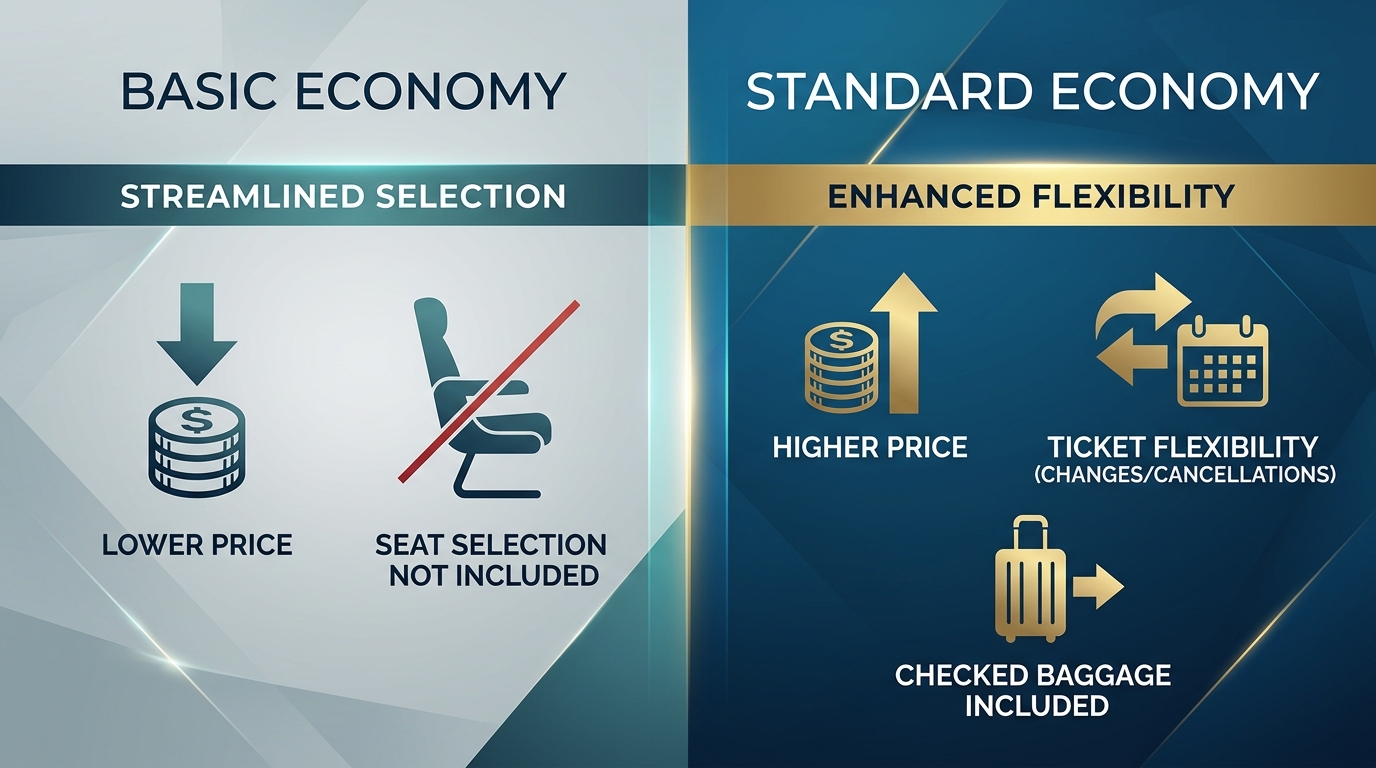 Weigh your flexibility and baggage needs against the headline fare price.
- ✓ Your travel dates are fixed.
- ✓ You need minimal flexibility.
- ✓ You travel light (e.g., just a personal item or backpack).
- ✓ You do not care where you sit or if you are separated from travel companions.
- ✓ The restrictions are acceptable to you.
- ✓ The total cost remains lower after any necessary add-ons.
- ✓ You want advance seat selection.
- ✓ You need flexibility to change your flight.
- ✓ You have checked baggage to bring.
- ✓ You want easier rebooking in case of personal emergencies.
- ✓ You value included loyalty benefits.
- ✓ The price difference between the two fares is small.
When Basic Economy Is NOT Worth It
Example 1: The Baggage Trap
A traveler books Basic Economy to save $30. However, they need to check a bag. The airline charges $40 each way for a checked bag on a Basic Economy ticket. The traveler ends up paying $50 more overall than if they had simply booked standard Economy, which included a checked bag.
Example 2: The Uncertain Schedule
A business traveler has a meeting that might end early or run late. They book Basic Economy. The meeting ends early, but because Basic Economy is strictly non-changeable, they are stuck at the airport for 6 hours and cannot pay the fare difference to hop on an earlier flight.
Example 3: The Family Vacation
A family of four books Basic Economy to save money. The airline randomly assigns seats at check-in. The parents are seated rows apart from their young children, causing immense stress during boarding.
How to Decide Between Basic Economy and Economy
Use this 5-step traveler decision framework before checking out:
- Check total price: Look at the base fare difference between Basic and Standard Economy.
- Check baggage: Review the specific carry-on and checked bag rules for both fare types.
- Check seat rules: Will you be charged to sit next to your travel partner?
- Check change/cancellation conditions: Can you afford to lose the entire value of the ticket if you get sick?
- Decide whether the savings justify restrictions: If the price gap is only $15, Standard Economy is almost always the safer bet.
Real trip cost = Ticket price + baggage fees + seat fees + required extras + potential change/cancellation cost risk.
Basic Economy Booking Checklist
Before finalizing your payment, run through this quick checklist:
- Is a carry-on included?
- Is a personal item included?
- Is checked baggage included?
- Are seats assigned automatically?
- Is seat selection available for a fee?
- What boarding group am I in?
- Are voluntary changes allowed?
- Is cancellation allowed?
- Can I get a refund or travel credit if I cancel?
- Am I eligible for upgrades?
- Will I earn frequent-flyer miles/points?
- Is the connection protected?
- Is the operating airline clearly identified?
- Is the final price confirmed?
 Always review fare conditions, boarding groups, and change policies prior to checkout.
Common Basic Economy Mistakes
- Looking only at the headline price: Ignoring the unbundled fees that inflate the final cost.
- Assuming a carry-on is included: Showing up to the gate with a roller bag and facing a $60 gate-check penalty.
- Assuming seats will be together: Airlines are under no obligation to seat Basic Economy passengers together unless dictated by local child-seating laws.
- Ignoring change restrictions: Assuming you can just pay a $50 change fee, only to discover the ticket is 100% "use it or lose it."
- Assuming miles work the same way: Missing out on elite status renewal because Basic Economy fares earned zero qualifying miles.
- Assuming all airlines use the same rules: Thinking Delta's Basic Economy rules apply to United.
- Assuming "Economy" automatically means flexible: Even standard Economy fares are rarely fully refundable.
Frequently Asked Questions
Basic Economy is a restricted fare option within the Economy Class cabin that offers a lower base price in exchange for fewer included services and strict ticket rules.
Conclusion
Basic Economy can be a smart choice when the strict restrictions perfectly fit your travel style. If you are flying for a quick weekend getaway, have fixed dates, and travel with just a backpack, the lower upfront cost is a great deal. But the lowest advertised fare is not automatically the best value. To avoid expensive airport surprises, calculate the total cost of your trip by comparing baggage fees, seat selection costs, flexibility requirements, cancellation terms, and boarding priority before deciding which ticket to book.