You are standing in your bedroom the night before a flight, watching the numbers on a portable scale settle on 24.5 kilograms, while your open carry-on sits packed to the brim next to two power banks, a toiletry kit, and your laptop. A familiar wave of uncertainty sets in: Does your ticket include an overhead roller or strictly an under-seat backpack? Will check-in staff overlook that extra 1.5 kilos, or will you face a steep penalty at the desk?
Modern airline baggage policies are deeply fragmented, meaning an allowance that worked seamlessly on one route or carrier last month could easily lead to an unexpected fee or a confiscated item tomorrow.
Understanding your baggage limits requires recognizing that three separate authorities govern your journey: airline tariff policies (weight, pieces, and dimensions), airport security screening (in-cabin flight safety and dangerous goods), and destination customs regulations (import legality and biosecurity). Keeping your packing compliant across all three ensures you move through check-in and security straight to your gate without delays.
What Is an Airline Baggage Policy?
An airline baggage policy is the formal contractual agreement between a carrier and a passenger defining what personal items can be transported, where they must be stowed, and what fees apply if specific parameters are exceeded.
Baggage policies are not uniform across the aviation industry. Commercial airlines configure allowances based on aircraft freight capacities, route distances, cabin classes, and revenue strategies. A legacy carrier flying a wide-body aircraft across the Atlantic operates with different cargo dynamics than a low-cost carrier operating an unbundled regional route. Consequently, your baggage entitlement is determined entirely by the explicit terms of your ticket rather than any universal standard.
Cabin Baggage vs Checked Baggage
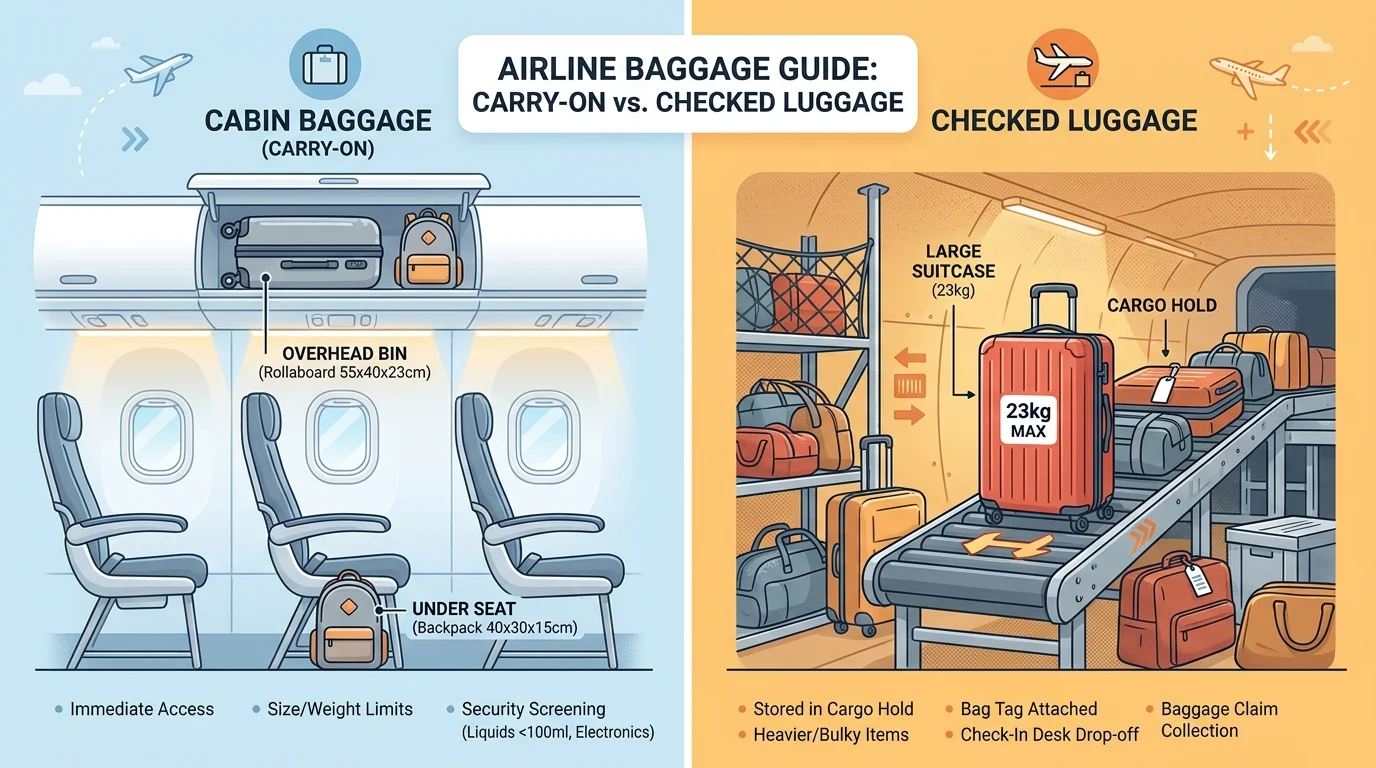
The foundational operational distinction in air travel is the separation between baggage carried into the passenger deck and baggage secured in the aircraft cargo hold.
| Feature | Cabin Baggage (Carry-On) | Checked Baggage (Hold Luggage) |
|---|---|---|
| Where it travels | Inside the passenger cabin (overhead bin or under the seat) | Lower cargo hold compartments |
| Passenger access | Fully accessible throughout the flight | Strictly inaccessible during transit |
| Size restrictions | Strict external limits to match cabin compartments | Standardized linear dimension limits (typically 158 cm / 62 in) |
| Weight restrictions | Typically 7 kg to 10 kg, or unweighted if lifted unassisted | Standard tiers of 15 kg, 23 kg, or 32 kg depending on fare and cabin |
| Security restrictions | Strict screening for liquids, sharp tools, and weapons | Strict screening against spare lithium cells and flammable gases |
| Typical contents | Electronics, medications, documents, and fragile valuables | Clothing, bulk footwear, full-sized toiletries, and sports gear |
Comparing Fares for Your Route?
Search live multi-airline schedules, spot discount windows, and baggage fee rules on FareWander.
What Is Cabin Baggage Allowance?
Your cabin baggage allowance represents the physical baggage permitted through the boarding gate into the aircraft cabin. This generally consists of either a single personal item or a combination of one overhead bag and one personal item.
Allowances vary according to the fare tier purchased. While full-service economy and premium cabins typically include an overhead roller bag and a personal item, unbundled Basic Economy or ultra-low-cost fares frequently limit the free allowance to an under-seat item only. Operating aircraft also influence practical cabin allowance; regional jets and turboprops with smaller overhead bins often require gate-checking carry-on bags regardless of ticket class.
Carry-On Luggage Dimensions
Airlines enforce linear boundaries on cabin bags to ensure items fit safely within enclosed bins without obstructing emergency egress.
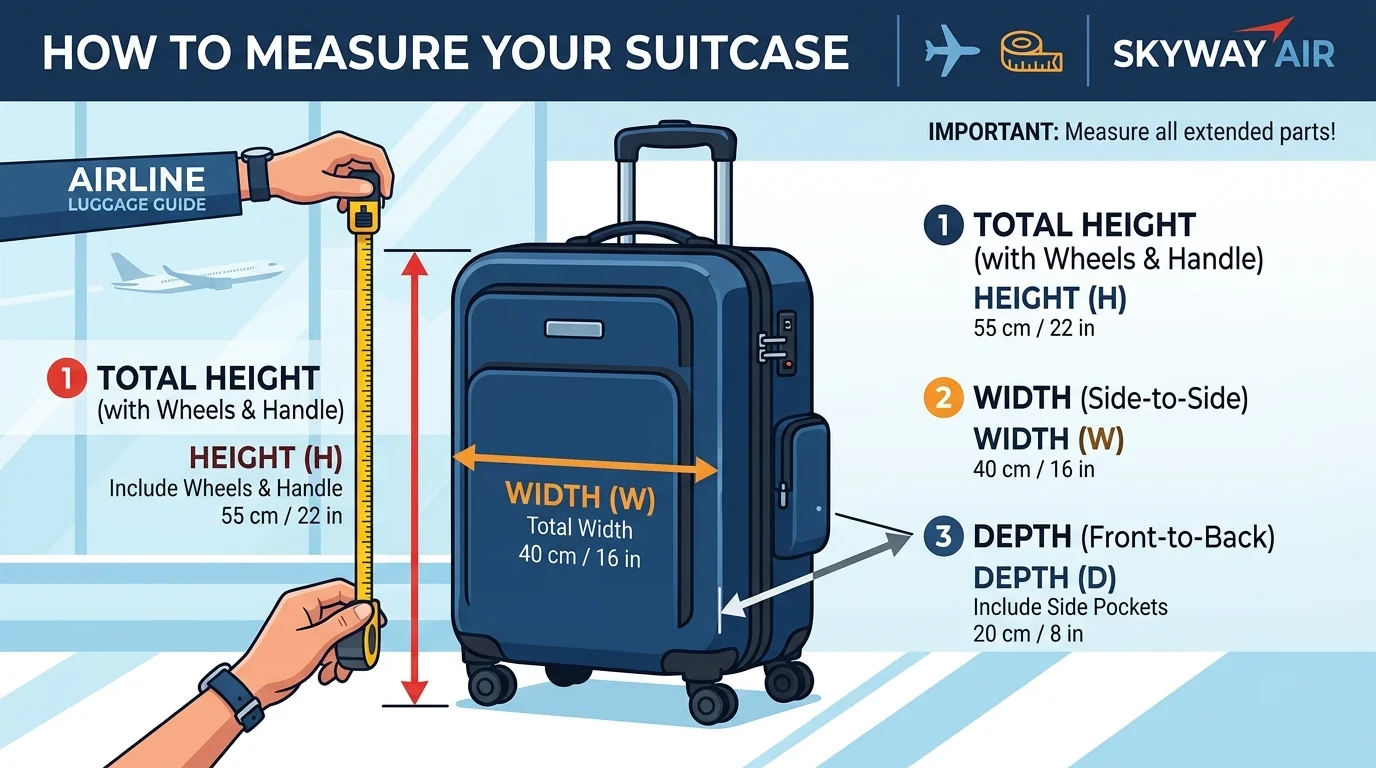
- Measuring Baggage: Dimensions are measured as Length × Width × Height ($L \times W \times H$). Measurements must include protruding wheels, rigid handles, side pockets, and external compression straps.
- Overhead Compartment Dimensions: A widely referenced baseline across legacy carriers is approximately 56 × 36 × 23 cm (22 × 14 × 9 inches). However, low-cost carriers frequently configure boarding sizers to narrower thresholds.
- Personal-Item Dimensions: An under-seat personal item generally averages around 40 × 30 × 15 cm to guarantee clearance below passenger seats.
Cabin Baggage Weight Limit
Carry-on weight limits are enforced to protect bin structural load limits and maintain cabin safety.
- Specific Carrier Thresholds: Several international airlines enforce a strict 7 kg or 8 kg cabin cap (such as Aegean Airlines), while others set the limit at 10 kg (such as Aer Lingus or Copa Airlines), or up to 25 lbs (11.3 kg, such as Hawaiian Airlines).
- Unweighted Cabin Allowances: Several major airlines (such as Delta and United on standard routes) do not impose an explicit weight limit for overhead bags, provided the passenger can hoist the bag into the bin unassisted.
- Weighing Procedures: Gate staff on budget and regional routes frequently weigh rollaboards on scales beside the boarding lane. Overweight bags are pulled from the gate and checked into the hold, incurring walk-up gate-check fees.
Planning Travel Logistics?
Use FareWander tools to calculate flight times, luggage rules, and visa requirements.
Personal Item vs Carry-On Bag
Understanding the operational distinction between an overhead carry-on and a personal item prevents boarding issues.
| Feature | Personal Item | Carry-On Bag |
|---|---|---|
| Target stowage | Under the seat in front of you | Overhead storage bin |
| Typical volume | 15 to 25 liters | 35 to 45 liters |
| Common formats | Small backpacks, laptop bags, briefcases, purses | Rolling suitcases, duffels, large travel backpacks |
| Basic fare inclusion | Almost universally included across all ticket tiers | Frequently excluded or monetized on basic/budget fares |
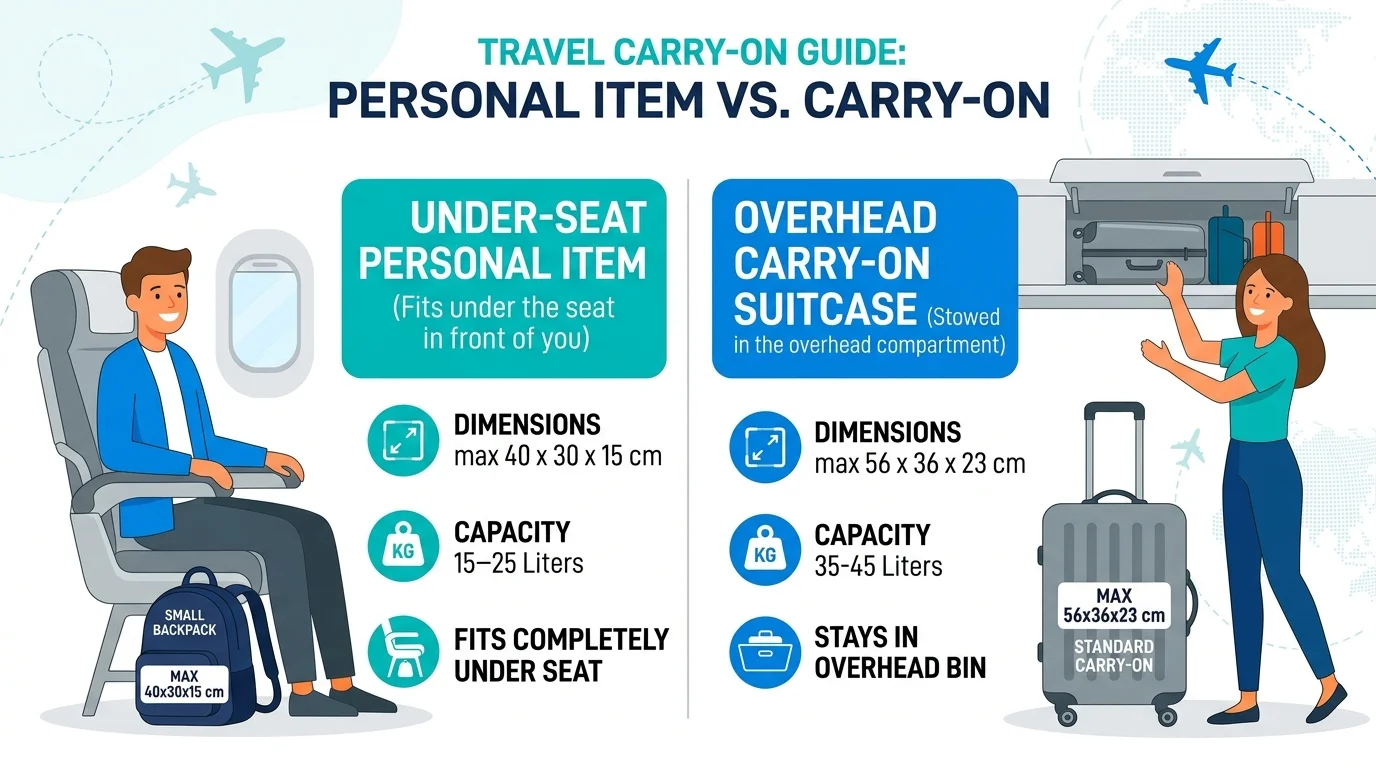
Airlines require personal items to sit entirely beneath the forward seat. If an overfilled backpack blocks footwell space or protrudes into the aisle, cabin crew will require it to be moved to an overhead bin or checked.
Free Baggage Allowance by Airline
A "free baggage allowance" refers to luggage entitlements bundled directly into the base purchase price of your ticket. Modern unbundled pricing models mean base ticket tiers do not guarantee free checked bags.
Verified airline baggage allowances across select operating carriers as of September 2026:
| Airline | Fare / Cabin Class | Cabin Allowance | Checked Allowance | Conditions |
|---|---|---|---|---|
| IndiGo | Domestic Economy | 1 Personal Item / Carry-on up to 7 kg | 15 kg (Weight Concept) | Standard domestic bookings; excess billed at ₹600/kg |
| British Airways | Standard Economy (Long-Haul) | 1 Cabin Bag (up to 23 kg) + 1 Personal Item | 1 Piece up to 23 kg | Excludes Basic / "Economy Light" unbundled fares |
| Air India | Domestic Economy | 1 Piece up to 7 kg + 1 Personal Item | 15 kg (Weight Concept) | Higher limits apply to Flex fares and international routes |
| Copa Airlines | Economy Classic | 1 Personal Item + 1 Carry-on (up to 10 kg) | 1 Piece up to 23 kg (158 cm max) | Basic Economy excludes free checked bags |
| Hawaiian Airlines | Main Cabin (Transpacific) | 1 Personal Item + 1 Carry-on (up to 25 lbs / 11.3 kg) | Paid add-on (Domestic US) / Included on select intl | Checked bags charged on standard interisland/mainland legs |
Checked Baggage Rules
Checked baggage is handed to airline agents at the departure terminal and transported in the cargo hold. Allowances define the permitted piece count, maximum gross weight per bag, and total linear dimensions.
Standard economy checked baggage is capped across most carriers at 23 kg (50 lbs) and 158 linear centimeters (62 linear inches). Baggage policies diverge based on whether an airline manages checked luggage under the Weight Concept or the Piece Concept.
Weight Concept vs Piece Concept
International commercial aviation relies on two distinct operational systems to calculate checked baggage:
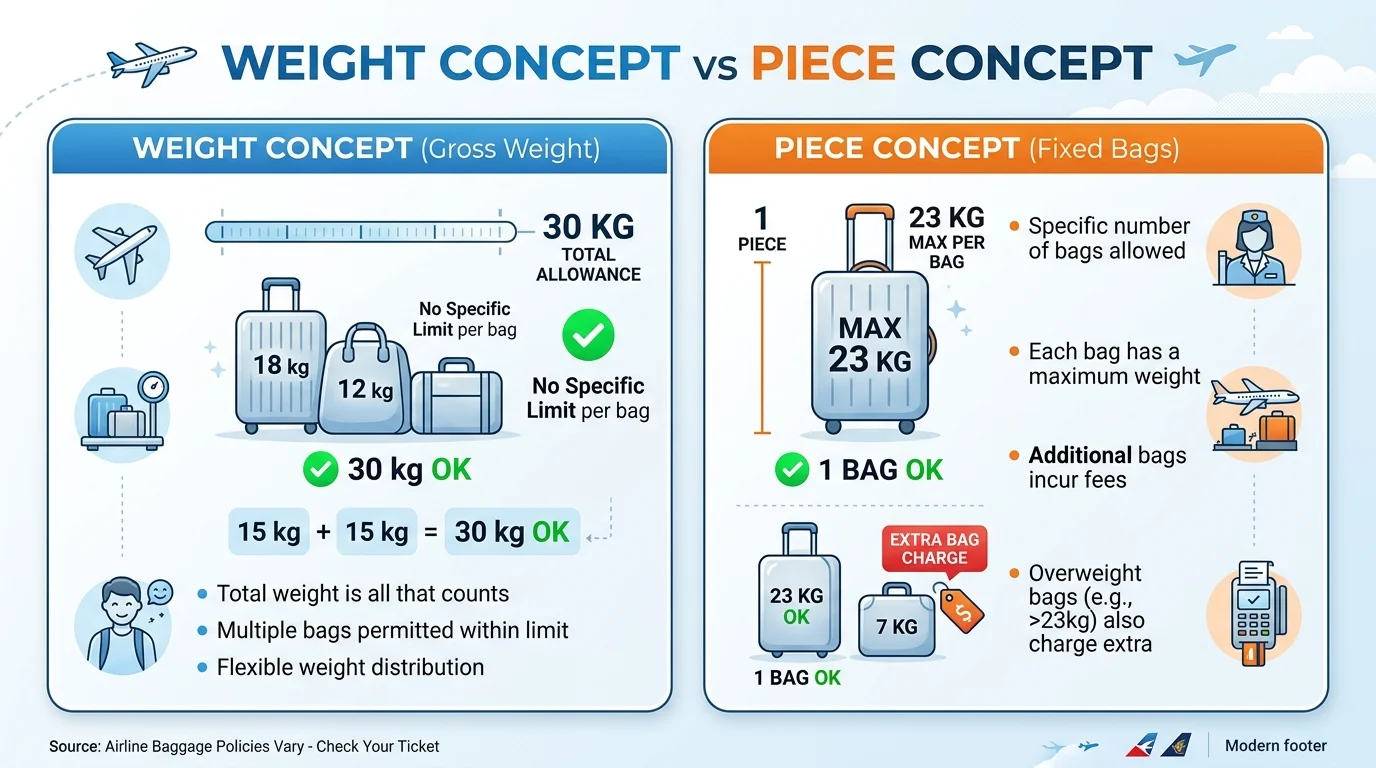
- The Weight Concept: The ticket grants a total aggregate weight (e.g., 20 kg, 30 kg). Passengers can distribute this weight across one or more bags, provided the combined scale weight does not exceed the limit. This system is common on domestic routes in India and Asia, and regional flights across the Middle East and Africa.
- The Piece Concept: The ticket grants a specific number of individual bags, with each bag subject to an individual weight limit and size cap (e.g., 1 bag up to 23 kg). This system is standard for flights touching the Americas, transatlantic routes, and many European international networks. Under this framework, checking two bags weighing 10 kg each against a 1-piece allowance incurs an extra-piece fee.
What Happens If Your Baggage Is Overweight?
If a checked bag exceeds your ticketed weight threshold, the automated scale will flag the item at check-in.
You will typically be given the option to step aside and repack items into secondary bags or cabin luggage to reduce the weight. If repacking is not possible, the agent assesses an overweight surcharge.
IMPORTANT SAFETY THRESHOLD (32 KG): Commercial airlines maintain a strict upper limit of 32 kg (70 lbs) for any single piece of passenger baggage. This cap is an international occupational health and safety standard to prevent musculoskeletal injury to ramp baggage handlers. Baggage exceeding 32 kg cannot be checked onto passenger aircraft, regardless of a passenger's willingness to pay excess fees, and must be shipped separately as commercial air cargo.
Airline Excess Baggage Fees
Excess baggage fees apply when baggage exceeds included fare parameters. For dedicated pricing breakdowns and airline fee schedules, consult our comprehensive guide to Excess Baggage: Fees & Weight Limits Explained.
These fees fall into distinct operational categories:
| Fee Classification | Operational Trigger | Billing Method |
|---|---|---|
| Overweight Fee | Bag weight exceeds the ticket tier (e.g., 24 kg to 32 kg) | Flat-rate surcharge band or fixed per-kg rate |
| Oversize Fee | External dimensions exceed 158 linear cm (up to 203 cm) | Flat out-of-gauge handling fee |
| Extra-Piece Fee | Physical bag count exceeds the ticketed piece allowance | Fixed charge per additional bag |
| Excess-Weight Fee | Gross aggregate weight exceeds the Weight Concept cap | Multiplied rate calculated per excess kilogram |
How Are Excess Baggage Fees Calculated?
Airlines do not share a single standardized formula for pricing excess baggage. Pricing is dynamic and determined by:
- Route distance, geographic zone, and operating market
- Fare category and class of travel
- The pricing model in use (per-kilogram rates vs flat piece bands)
- Payment channel (online advance purchase vs airport check-in desk)
On domestic routes operating under the Weight Concept (such as IndiGo or Air India in India), airport excess fees are charged at approximately ₹600 per kilogram plus applicable taxes. On transatlantic routes using the Piece Concept (such as British Airways or United), checking an additional piece at the airport typically ranges from $75 to $200+ USD depending on destination and routing.
Can You Pay Excess Baggage Online?
Most major commercial airlines allow passengers to pre-purchase additional baggage allowance through their official website or mobile app ("Manage Booking") prior to departure.
Pre-purchasing extra weight slabs or additional pieces online typically offers discounts of 20% to 50% compared to airport counter rates. However, advance baggage purchases are generally non-refundable once issued.
Oversized Baggage
A bag is categorized as oversized when its combined linear dimensions ($Length + Width + Height$, including handles and wheels) exceed standard airline thresholds, typically 158 linear centimeters (62 linear inches).
Oversized baggage cannot pass through standard airport automated conveyor and sorting systems. Passengers must check these items at dedicated Out-of-Gauge (OOG) or Bulky Baggage desks. Bags measuring larger than 203 cm to 292 cm are generally rejected for passenger check-in and must be booked through cargo freight services.
Special and Bulky Baggage
Non-standard travel equipment is subject to specialized airline acceptance procedures:
- Sports Equipment: Bicycles, golf bags, skis, and surfboards often require advance registration and may incur fixed equipment handling fees. Some carriers accept golf or ski bags as standard checked pieces if they stay within normal weight parameters.
- Musical Instruments: Small instruments (violins, flutes) can often replace a standard cabin bag if they meet overhead dimensions. Larger instruments (cellos, guitars) require a purchased adjacent passenger seat ("Cabin Seat Baggage") or must be packed in a certified hard flight case for hold transport.
- Mobility Equipment: Manual and electric wheelchairs and certified mobility devices are accepted free of charge across commercial carriers, subject to battery compliance and safety declarations.
What Can You Carry in Cabin Baggage?
Most standard personal effects can be packed in cabin baggage, provided they clear checkpoint safety and dangerous goods rules. For an exhaustive packing checklist, review our in-depth resource on What Can You Carry in Cabin Baggage?.
| Item | Generally Allowed? | Important Conditions |
|---|---|---|
| Clothing & Shoes | Yes | Packed within carry-on weight and dimension limits |
| Laptops & Tablets | Yes | Lithium devices belong in the cabin; accessible for screening |
| Smartphones & Cables | Yes | Must switch to airplane mode during flight operations |
| Power Banks | Cabin Only | Strictly prohibited in checked luggage; must be under 100 Wh |
| Prescription Medicine | Yes | Keep in original packaging; essential liquids are exempt from caps |
| Toiletries (Liquids/Gels) | Restricted | Standard checkpoints require containers $\le 100$ ml in 1 clear bag |
| Packaged Dry Snacks | Yes | Spreads/dips count as liquids; fresh foods face border customs bans |
| Baby Formula & Food | Yes | Medically exempt from liquid volume limits; declare at checkpoint |
Restricted Items in Cabin Luggage
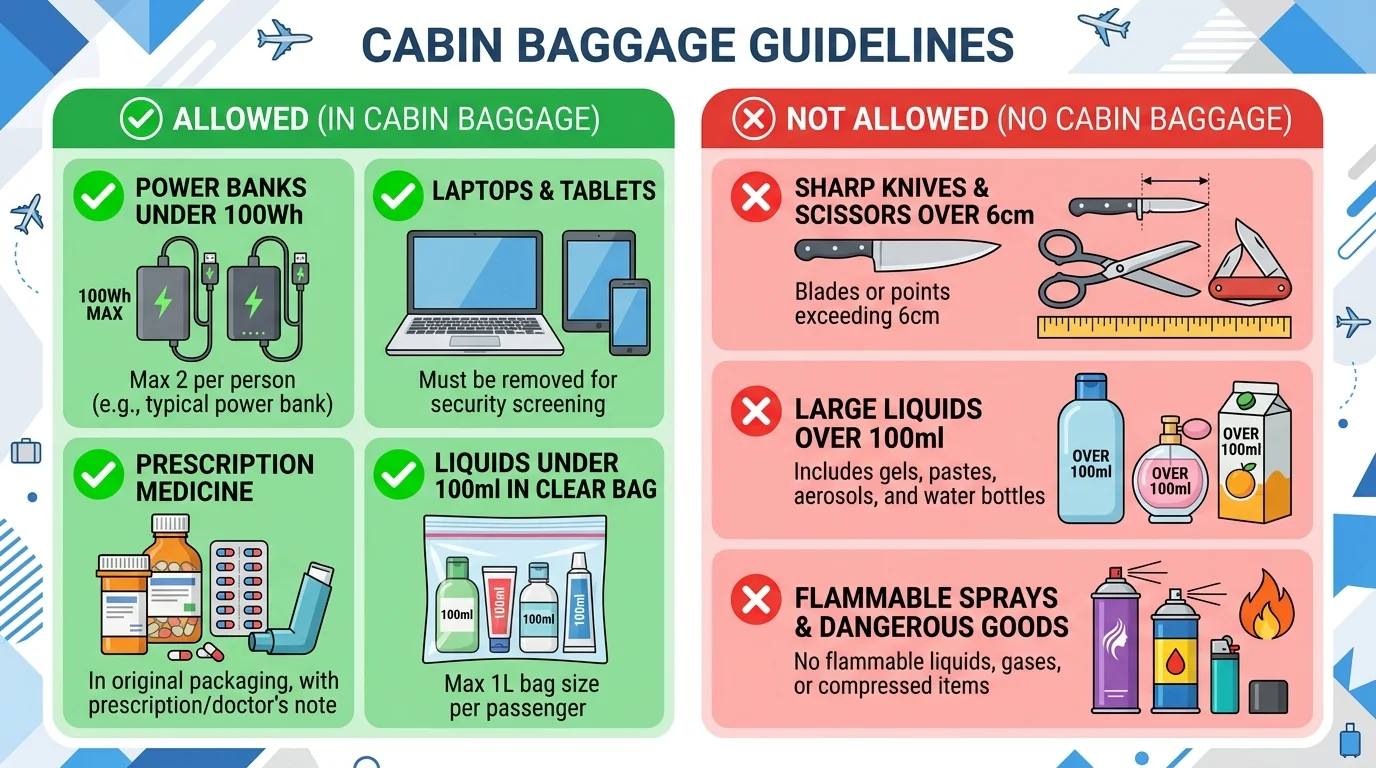
Aviation security frameworks (such as ICAO and national authorities like the TSA and BCAS) restrict or ban items that could compromise cabin safety:
- Liquids, Aerosols, and Gels (LAGs): Restricted to 100 ml (3.4 oz) containers at standard security checkpoints.
- Blades and Sharp Objects: Knives, box cutters, razor blades, and scissors with blades exceeding 6 cm (2.4 inches) from the pivot point are prohibited from cabin baggage.
- Blunt Tools and Impact Equipment: Baseball bats, cricket bats, golf clubs, and heavy mechanic tools are prohibited in the cabin.
- Chemical and Flammable Hazards: Lighter fluid, strike-anywhere matches, spray paints, bleach, and disabling sprays (mace/pepper spray) are strictly prohibited.
What Cannot Go in Checked Baggage?
Certain items present severe hazards in the aircraft cargo hold and are prohibited from checked luggage:
- Spare Lithium Batteries and Power Banks: Uninstalled lithium-ion cells and external battery packs present thermal runaway fire risks and must travel in cabin baggage only.
- E-Cigarettes and Vaporizers: Must remain in the cabin to prevent cargo hold fires from accidental activation.
- Loose Matches and Flammable Gaseous Items: Common butane safety lighters and safety matches must be carried on your physical person, not in checked bags.
- High-Value Items & Critical Documents: Passports, currency, luxury jewelry, and irreplaceable prescription drugs should never be checked into the hold due to carrier liability limits and transit delay risks.
Cabin Baggage vs Checked Baggage: Where Should You Pack It?
Determining where to pack specific items requires balancing security regulations against baggage safety.
| Travel Item | Cabin Baggage | Checked Baggage | Operational Reason |
|---|---|---|---|
| Laptops & Tablets | Yes (Recommended) | Discouraged | Risk of cargo transit crushing; lithium battery safety |
| Power Banks / Loose Cells | Mandatory | STRICTLY PROHIBITED | Fire suppression accessible only in passenger cabin |
| Essential Daily Medications | Yes (Recommended) | Strongly Discouraged | Prevents medical emergencies if checked bags are delayed |
| Liquids Exceeding 100 ml | Prohibited (Standard lanes) | Permitted | Must be sealed securely to prevent cargo leaks |
| Work Tools / Large Blades | Prohibited | Permitted | Security compliance; must be safely sheathed |
| Valuable Cash & Jewelry | Yes (Recommended) | Strongly Discouraged | Excluded from standard carrier loss liability limits |
Liquids in Cabin Baggage
Aviation security administrations enforce strict container rules on Liquids, Aerosols, and Gels (LAGs).
- The 100 ml Threshold: At standard security checkpoints worldwide, liquids must be housed in individual containers no larger than 100 ml (3.4 oz). All containers must fit inside a single, transparent, resealable 1-liter plastic bag.
- Container Capacity vs Remaining Volume: Security evaluation is based entirely on the printed capacity of the container, not the volume remaining inside. A 200 ml bottle holding 20 ml of lotion will be confiscated at standard checkpoints.
- Computed Tomography (CT) Scanner Rollouts: Several modern airport checkpoints equipped with advanced 3D CT scanners allow passengers to leave full-sized liquids in carry-on bags. However, travelers must pack according to standard 100 ml guidelines unless both departure and return transit airports have officially removed liquid limits.
Electronics, Power Banks and Batteries
Consumer tech devices operate on rechargeable lithium-ion cells, which are regulated by ICAO/IATA Dangerous Goods Regulations.
- Installed vs Spare Batteries: Batteries installed inside devices (laptops, phones) can travel in cabin luggage. Spare uninstalled batteries and power banks are strictly forbidden in checked baggage.
- Understanding Watt-Hours (Wh): Battery capacity is measured in Watt-hours. If your power bank displays milliamp-hours (mAh), calculate Watt-hours using the formula:
(For example, a 20,000 mAh power bank operating at a nominal 3.7V equals 74 Wh, falling safely below the baseline limit.)
- Capacity Limits: Batteries up to 100 Wh are permitted in cabin baggage without prior operator approval. Batteries between 101 Wh and 160 Wh require explicit airline authorization before carriage. Batteries exceeding 160 Wh are prohibited on commercial passenger aircraft.
Medicines and Medical Equipment
Essential pharmaceuticals and medical equipment are granted exemptions under aviation security rules:
- Liquid Medication Exemptions: Medically necessary liquid, gel, and aerosol pharmaceuticals are exempt from the standard 100 ml volume cap at airport security checkpoints. You must declare these items to screening personnel prior to inspection.
- Prescriptions and Documentation: Keep medicines in original pharmacy containers displaying your legal name and dosage instructions, accompanied by a physician’s letter.
- International Controlled Substances: Clearing airport security screening does not mean a medication is legally permitted into your destination country. Medications like codeine, ADHD stimulants, or medical cannabis are classified as controlled narcotics in several jurisdictions (e.g., Japan, UAE, Singapore). Always verify destination health ministry regulations prior to departure.
Food and Drinks
Bringing food on an aircraft involves two distinct jurisdictional checks:
- Airport Security Screening: Solid food items (nuts, sandwiches, biscuits, fruit) pass standard security X-rays. Spreadable or liquid foods (honey, peanut butter, yogurt, soups) are regulated as liquids and must remain under 100 ml. Empty reusable bottles can be carried through checkpoints and refilled airside.
- Destination Border Biosecurity: Destination customs authorities (such as US CBP or Australian Biosecurity) enforce strict import bans on fresh agricultural goods, raw fruit, vegetables, and uncured meats to prevent ecological contamination. Fresh produce must be consumed or discarded prior to reaching border customs.
Baby Items and Children's Baggage
Commercial airlines and security authorities provide allowances for passengers traveling with infants:
- Liquid Exemptions: Formula, expressed breast milk, distilled sterilization water, and baby food purees are exempt from 100 ml limits. Screeners will swab containers or conduct non-invasive bottle testing.
- Infant Baggage Allowances: Fully collapsible travel strollers matching cabin bag dimensions can often be stowed in overhead bins. Full-sized strollers and infant car seats are generally checked at the boarding gate free of charge across legacy and budget carriers.
For fleet-wide stroller dimensions and family seating rules, consult our dedicated guide to Infant & Child Airline Policies.
International Flight Baggage Restrictions
International baggage regulations involve customs, border biosecurity, and airport transit security rules.
There is no single global customs allowance. Items accepted at your departure airport can be confiscated upon arrival if they violate the destination's national border laws. Duty-free liquids exceeding 100 ml purchased airside must remain sealed inside an approved Security Tamper-Evident Bag (STEB) with the retail receipt visibly enclosed. If your international journey involves connecting flights, transit security checkpoints in your connection country may rescreen or confiscate duty-free liquids if regional transfer rules are not satisfied.
Domestic vs International Baggage Rules
Operating parameters differ markedly between domestic routes and international itineraries.
| Factor | Domestic Flights | International Flights |
|---|---|---|
| Baggage Allowance | Commonly unbundled; checked bags are frequently paid add-ons | Standard long-haul fares often bundle at least 1 checked bag |
| Dominant System | Weight Concept across Asia/India; Piece Concept in North America | Piece Concept on transatlantic/Americas; Weight Concept in Asia/Middle East |
| Security & Screening | Focuses strictly on civil aviation safety and dangerous goods | Focuses on dangerous goods, with transit security rescreening on transfers |
| Customs & Biosecurity | Minimal or no internal border customs screening | Mandatory customs declarations for currency, food, alcohol, and tobacco |
| Excess Baggage Fees | Lower base rates (e.g., ₹600/kg in India; $35–$45/bag in US) | Substantially higher penalties ($75–$200+ USD per extra piece or heavy band) |
Codeshare and Multiple-Airline Itineraries
When an itinerary involves multiple airlines, determining which baggage policy applies can be complex. For a full breakdown of how ticketing carriers interact with operating airlines, read What Is a Codeshare Flight? How Codeshare Flights Work.
- Marketing vs Operating Carrier: The marketing carrier sells the ticket (the flight code on your confirmation), while the operating carrier physically flies the aircraft.
- IATA Resolution 302 (Most Significant Carrier): For most international interline itineraries, baggage provisions are governed by the Most Significant Carrier (MSC)—typically the airline operating the first sector that crosses an international border or major IATA geographic sub-area.
- US DOT & Canadian Regulations: For itineraries that originate or terminate in the United States or Canada, government regulations dictate that the baggage allowance of the marketing carrier on the very first ticketed segment applies across the entire single-ticket journey.
- Separate Tickets: If you purchase two separate bookings on different airlines, no interline policy coordination exists. You must collect your bags, clear terminal customs, re-check your luggage, and satisfy the individual baggage limits of each carrier.
What Happens to Baggage During a Connecting Flight?
Handling procedures during transfers depend on ticket structure and routing:
- Single-Ticket Through-Checking: On a single booking reference, your checked baggage is usually through-checked to your final arrival airport. You do not need to collect bags at intermediate transfer points.
- Customs Clearance Exceptions: Several countries (such as the United States) require arriving international passengers to collect checked baggage at their first point of entry, clear customs, and re-deposit the luggage onto transit transfer belts, even on single-ticket bookings.
- Separate Ticket Transfers: On self-transfers booked on separate tickets, bags are never automatically transferred. You must exit airside, retrieve bags from the arrival carousel, and check them in at the next airline’s desk.
Baggage Rules for Basic Economy / Light Fares
Basic Economy and "Light" ticket tiers represent unbundled airline pricing models. While these tickets offer lower entry fares, they enforce distinct baggage restrictions:
- Checked Baggage Exclusion: Basic Economy tickets almost universally exclude complimentary checked baggage, charging standard or elevated add-on fees per bag.
- Overhead Bin Restrictions: Select carriers (such as United on domestic US routes) restrict Basic Economy passengers to a single personal item, prohibiting standard overhead carry-on bags unless an upgrade fee is paid. Conversely, carriers like Delta and American permit a standard overhead carry-on alongside a personal item on basic fares.
- Boarding Hierarchy: Basic Economy passengers are frequently assigned to final boarding groups, increasing the likelihood that overhead bin space will be filled before boarding.
To evaluate whether an unbundled fare is worth the restrictions, see our comparison guide on Basic Economy vs Economy: What's the Difference?.
Premium Economy, Business and First Class Baggage
Traveling in premium cabins provides expanded baggage allowances:
- Premium Economy: Typically bundles one to two checked bags with weight allowances matching standard economy (23 kg / 50 lbs), alongside priority check-in handling.
- Business Class: Frequently increases allowances to two or three checked bags and elevates the individual piece limit to 32 kg (70 lbs) per piece without incurring overweight penalties. Carry-on allowances are often expanded to two full pieces.
- First Class: Offers the highest baggage allocations, frequently permitting three checked bags up to 32 kg each, coupled with priority bag tagging for expedited delivery to arrival carousels.
Frequent Flyer / Elite Baggage Benefits
Frequent flyer status across major loyalty programs (such as Star Alliance, oneworld, or SkyTeam) often grants extra baggage allowances above baseline fare rules:
- Extra Piece Entitlements: Elite status holders commonly receive one additional complimentary checked bag under the Piece Concept.
- Weight Slabs: Under the Weight Concept, mid- and top-tier status members frequently receive an extra 10 kg to 20 kg of gross allowance.
- Basic Fare Exclusions: Several airlines explicitly restrict frequent flyer baggage waivers when flying on unbundled Basic Economy fares. Verify your program’s fare terms before relying on elite allowances.
Lost, Delayed or Damaged Baggage
If your checked luggage does not arrive at your destination carousel or is returned damaged, take immediate operational steps before leaving the terminal:
- File a Property Irregularity Report (PIR): Report the missing or damaged bag at the operating airline’s airport baggage service desk immediately. The PIR file reference number is mandatory for tracking and claims.
- Retain All Physical Documentation: Keep your physical baggage claim tags, paper boarding passes, and booking receipts.
- Emergency Expense Receipts: If luggage is delayed away from home, save all receipts for essential emergency purchases (toiletries, basic clothing) for reimbursement under Montreal Convention guidelines.
For step-by-step claim timelines and liability limits, read our complete guide on Lost/Delayed Baggage: Claim Process.
Baggage Claim and Receipts
At check-in, airline agents affix an adhesive barcode tag to your suitcase and provide a physical baggage claim receipt (often stuck to your passport cover or boarding pass). This receipt contains your unique ten-character alphanumeric bag tag number. Never discard this receipt until you have exited the arrival terminal with your luggage in hand, as it serves as your primary proof of custody during tracing.
What Should You Keep in Cabin Baggage?
Pack high-priority and fragile items in your cabin baggage to prevent loss or damage:
- Passports, visas, physical identification, and flight documents
- Critical daily prescription medications and medical equipment
- Laptops, tablets, cameras, and primary communication chargers
- Power banks and spare lithium batteries (required by safety regulations)
- High-value jewelry, luxury watches, and physical currency
- House keys, vehicle keys, and a change of essential clothing
What Should You Put in Checked Baggage?
Pack bulk items and items restricted from the cabin in your checked hold luggage:
- Routine clothing, shoes, and non-essential apparel
- Full-sized liquid toiletries and cosmetics exceeding 100 ml
- Blunt sports equipment, golf clubs, tennis rackets, and trekking poles
- Permitted tools, pocket knives, or grooming shears exceeding cabin limits
How to Measure Your Cabin Bag Correctly
Follow these steps to ensure your cabin bag complies with airline limits:
- Pack the bag fully: Luggage expands when loaded; measure your bag in its fully packed state.
- Measure exterior length, width, and height: Use a rigid tape measure to determine the dimensions.
- Include all protruding elements: Measure from the floor to the top of the handle, including spinner wheels and side pockets.
- Weigh with a digital hanging scale: Lift the bag with a luggage scale to confirm it falls below the airline's weight cap.
- Measure personal items separately: Ensure your under-seat bag fits within under-seat clearance dimensions.
How to Avoid Excess Baggage Fees
Avoiding excess baggage fees requires preparation before leaving for the airport:
- Check your specific e-ticket receipt: Never assume allowances based on previous flights. Check the explicit baggage codes (e.g., "0 PC", "1 PC", "20 K") on your confirmation.
- Weigh your luggage at home: Use a digital hanging luggage scale to confirm weights before departure.
- Pre-purchase additional weight online: If you exceed your allowance, purchase additional baggage online via the airline's Manage Booking portal to save up to 50% over counter rates.
- Wear heavy garments on board: Wear bulky jackets, boots, or heavy layers during boarding to reduce checked suitcase weight.
- Compare fare bundles upfront: When booking, calculate whether purchasing a Standard Economy fare that includes baggage is cheaper than adding luggage to a Basic Economy ticket.
Real-Life Hypothetical Examples
Example 1: The Heavy Cabin Bag
- Scenario: A traveler books an international economy ticket permitting an 8 kg cabin bag, but their packed rollaboard weighs 11 kg.
- Rule Applied: The airline gate agent enforces the cabin weight limit at the boarding lane.
- Resolution: The passenger is forced to gate-check the bag into the cargo hold, incurring a walk-up gate-baggage fee. Weighing the bag at home would have identified the 3 kg excess in advance.
Example 2: Overweight Checked Bag Under the Piece Concept
- Scenario: A flyer checks one suitcase weighing 27 kg against an allowance of 1 piece up to 23 kg on a transatlantic flight.
- Rule Applied: Under the Piece Concept, charges are billed by weight bands rather than individual kilograms.
- Resolution: The traveler pays a flat heavy-bag surcharge (covering the 23 kg to 32 kg tier). Splitting the contents into a second bag would have triggered a more expensive extra-piece fee.
Example 3: Personal Item Plus Overhead Suitcase on a Basic Fare
- Scenario: A passenger purchases a domestic Basic Economy ticket that restricts allowance strictly to an under-seat personal item, but brings a rolling suitcase to the gate.
- Rule Applied: The carrier monitors carry-on compliance during boarding group calls.
- Resolution: The suitcase is rejected for cabin boarding and sent to the hold for a walk-up gate handling charge. The flyer should have purchased overhead carry-on privileges online beforehand.
Example 4: Traveling Internationally with Fresh Fruit
- Scenario: A traveler packs fresh apples and a deli sandwich in their carry-on for an international flight.
- Rule Applied: Departure security permits solid food through X-ray screening, but arrival border biosecurity bans undeclared fresh produce.
- Resolution: The passenger consumes the food before customs or declares it upon landing to prevent biosecurity fines.
Example 5: Power Bank Packed in Checked Baggage
- Scenario: A passenger places a 15,000 mAh power bank into their checked suitcase.
- Rule Applied: Aviation dangerous goods regulations strictly prohibit spare lithium cells in cargo holds.
- Resolution: Automated baggage X-rays flag the battery, leading to security opening the suitcase, confiscating the power bank, and delaying the bag. The battery must be packed in cabin baggage.
Example 6: Connecting Flight with Two Partner Airlines
- Scenario: A traveler flies from Mumbai to Frankfurt on an international carrier (2-piece allowance), connecting onto a regional European partner on a single ticket.
- Rule Applied: Under IATA Resolution 302, the Most Significant Carrier’s baggage allowance governs the itinerary.
- Resolution: The original 2-piece allowance is protected on the connecting regional flight.
Complete Baggage Packing Checklist
Before Packing
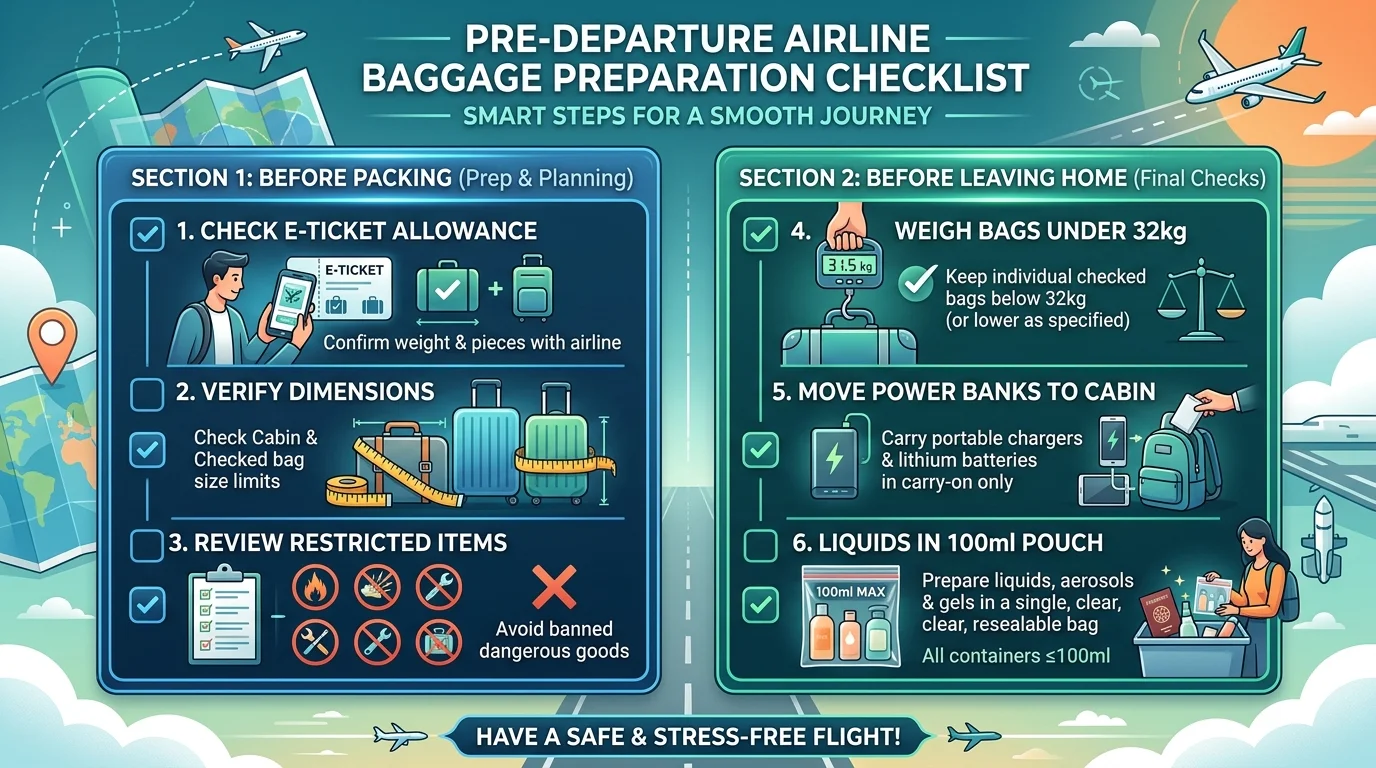
- Review the baggage allowance printed on your specific e-ticket receipt
- Verify your fare conditions (Basic Economy vs Standard Economy)
- Check the airline's cabin baggage linear dimensions ($L \times W \times H$)
- Check maximum cabin weight allowances
- Check under-seat personal-item clearance dimensions
- Confirm checked baggage piece limits and weight tiers
- Review published excess baggage charges and pre-purchase options
- Review restricted and dangerous goods policies
- Verify airport security liquid restrictions for your route
- Check destination border customs and agricultural import bans
Before Leaving Home
- Weigh your packed cabin bag with a digital luggage scale
- Weigh your packed checked bags (ensure no single bag exceeds 32 kg)
- Measure exterior carry-on dimensions, including handles and wheels
- Pack passports, boarding documents, and identification in your personal item
- Move power banks, e-cigarettes, and loose batteries into cabin baggage
- Pack essential daily medicines and prescription copies in the cabin
- Ensure all cabin liquids are in $\le 100$ ml containers inside a clear 1-liter bag
- Take an exterior photo of your checked suitcase and save your booking reference
Common Airline Baggage Mistakes
- Assuming All Airlines Use Identical Rules: Assuming that an allowance on one airline applies to another carrier or aircraft type.
- Checking Weight but Ignoring Dimensions: Bringing a lightweight bag that exceeds the linear dimensions of the airline's sizer bins.
- Ignoring Personal-Item Restrictions: Packing an oversized personal item that cannot fit beneath forward seating.
- Confusing Cabin and Checked Baggage: Packing restricted dangerous goods (like power banks) in checked luggage or large liquids in carry-ons.
- Assuming Checked Luggage Is Always Free: Overlooking unbundled Basic Economy terms that exclude checked baggage.
- Paying Walk-Up Airport Fees: Failing to pre-purchase necessary excess baggage online at advance discount rates.
- Overlooking Operating Carriers on Codeshares: Checking baggage rules only for the marketing carrier rather than the airline operating the flight.
- Splitting Bags Under the Piece Concept: Splitting weight into two bags on a 1-piece allowance, inadvertently triggering an extra-bag fee.
Quick Baggage Rules Summary
- Cabin Baggage: Standard allowance covers one overhead bag (typically 56 × 36 × 23 cm, 7–10 kg where weighted) plus one personal item. Basic fares may restrict access to personal items only.
- Personal Item: Must fit under the seat in front of you (approx. 40 × 30 × 15 cm).
- Checked Baggage: Standard economy pieces are capped at 23 kg (50 lbs) and 158 linear cm. Governed either by total weight (Weight Concept) or individual bag count (Piece Concept).
- Excess Baggage: Applies to overweight, oversized, or extra pieces. Online pre-purchases generally offer 20% to 50% savings over airport desk fees. Absolute single-bag safety cap is universally 32 kg.
- Restricted Items: Power banks and loose lithium batteries are cabin-only. Liquids at standard checkpoints are capped at 100 ml containers in a 1-liter clear pouch.
- International Travel: Compliance requires clearing airline limits, airport security screening, and destination customs/biosecurity import rules.
Managing airline baggage comes down to confirming your specific ticket conditions before you pack. Rather than relying on assumptions or previous trips, open your e-ticket receipt, check the exact baggage allowances printed on the reservation, and verify whether your route follows the Weight Concept or Piece Concept. A few minutes spent measuring your carry-on, weighing your bags on a home scale, and checking your airline's current baggage terms ensures you head to the terminal confident that your luggage will clear check-in and security without unnecessary fees or delays.
Frequently Asked Questions
An airline baggage policy is a set of contractual rules defining how much luggage a passenger can bring, including size, weight, piece allowances, excess fees, and safety restrictions.