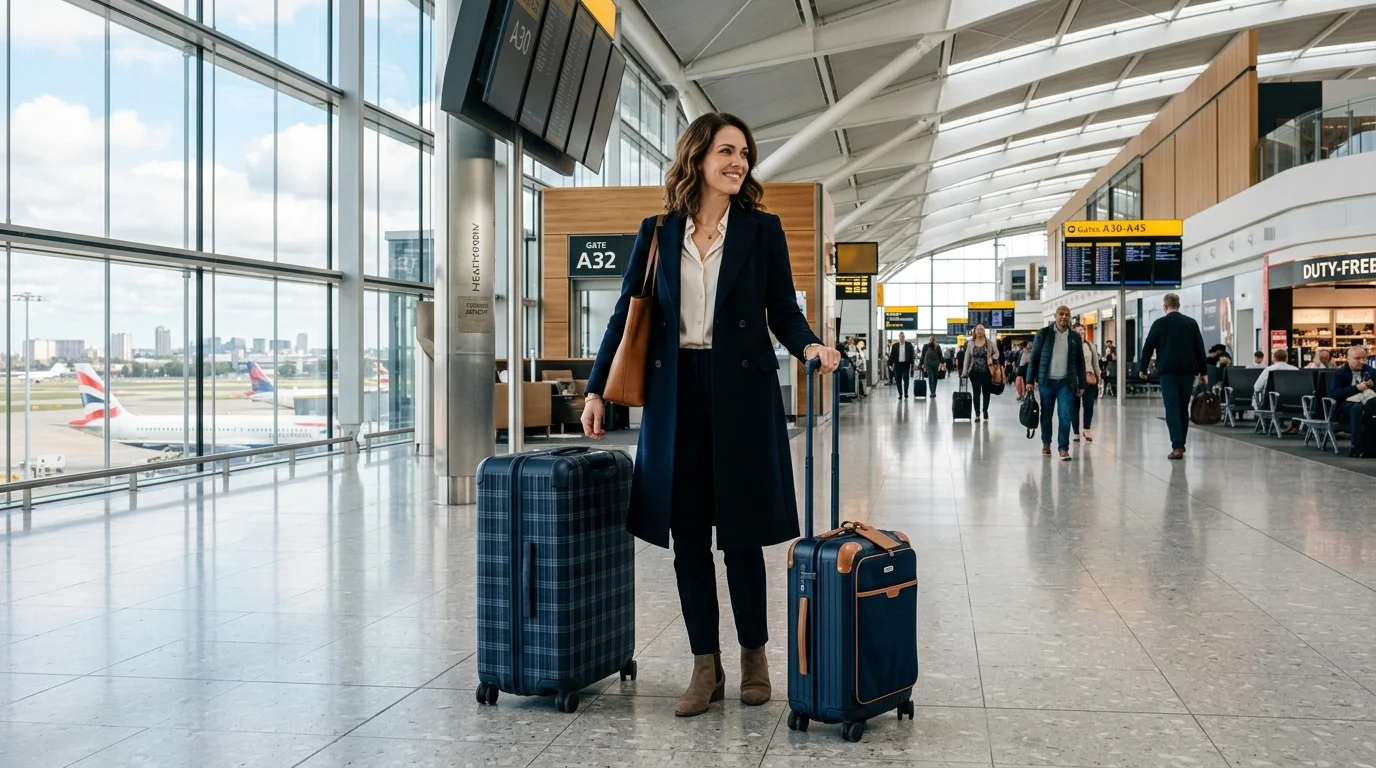
You are standing in your room the evening before a flight, looking at an open suitcase on the floor and a backpack on the desk, wondering where your laptop, toiletry bottles, spare shoes, and portable charger actually belong. A quick check of your ticket confirmation shows cryptic abbreviations like "0 PC" or "15 K," and suddenly it is unclear whether that small rolling suitcase can come with you into the cabin or if you will be stopped at the gate and forced to pay an unexpected fee.
The practical difference between cabin baggage and checked baggage comes down to custody, location, and regulation. Cabin baggage stays in your physical possession inside the aircraft passenger cabin, while checked baggage is handed over at the terminal counter, scanned, and transported out of sight in the airplane’s lower cargo hold. Deciding which one to use—or how to balance both—depends on understanding how airline allowances, airport security mandates, and destination customs laws govern every item you pack.
Cabin Baggage vs Checked Baggage at a Glance
| Feature | Cabin Baggage (Carry-On / Hand Luggage) | Checked Baggage (Hold Luggage) |
|---|---|---|
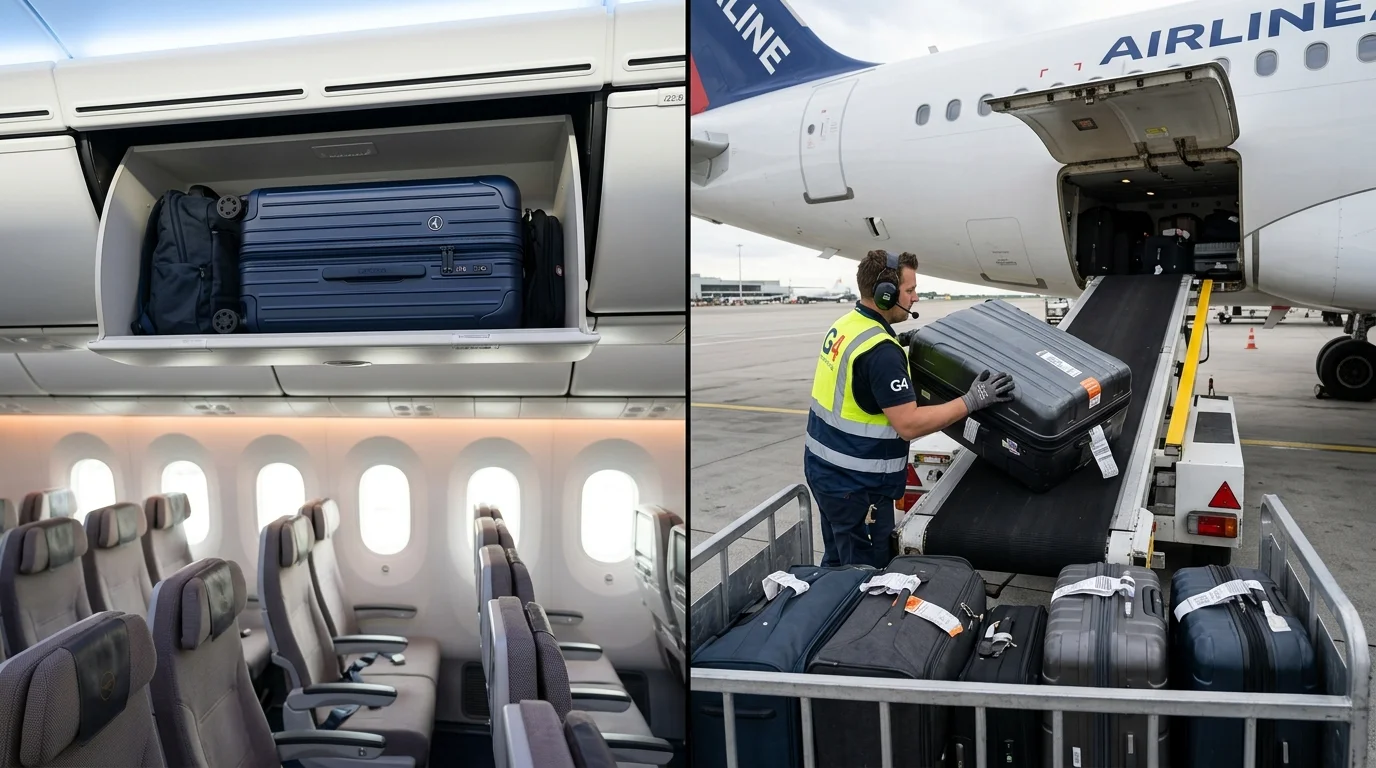
| Where it travels | Inside the passenger cabin (overhead bin or under the seat) | Lower aircraft cargo hold compartments |
| Where you hand it over | Retained through airport security screening to the boarding gate | Handed over at airline check-in counters or self-bag-drop units |
| Access during flight | Fully accessible throughout the journey | Inaccessible during transit |
| Typical storage | Overhead locker or under the seat in front of you | Secured in cargo hold containers (Unit Load Devices) or bulk hold |
| Weight limits | Varies by airline and fare (typically 7 kg to 10 kg, or unweighted if lifted unassisted) | Varies by airline and fare (commonly 15 kg, 23 kg, or 32 kg per piece/tier) |
| Size limits | Varies by carrier to match bin clearances (approx. 56 × 36 × 23 cm baseline) | Varies by carrier; industry baseline is typically 158 linear cm (62 in) |
| Fees | Often bundled in standard fares; frequently monetized on Basic Economy/budget carriers | Included on long-haul standard tickets; frequently an extra fee on domestic/basic fares |
| Retrieval on arrival | Leaves the aircraft in your hands immediately upon disembarkation | Collected at destination terminal baggage reclaim carousels |
| Best for | Documents, valuables, fragile electronics, medications, and short trips | Bulk apparel, shoes, liquids over 100 ml, and longer vacations |
Note: Rules vary by airline, route, fare and airport, so check the conditions attached to your ticket before traveling.
Three Distinct Rule Systems Every Flyer Must Know
A common mistake among travelers is assuming that if an airline allows an item, it is legal to fly with everywhere. Your journey is governed by three independent regulatory frameworks:
- Airline Baggage Allowance: The contractual commercial agreement defining how many bags you can bring, their external dimensions, and their maximum weight based on the fare family you bought. Review our comprehensive Airline Baggage Policy guide to explore carrier allowances in detail.
- Airport Security Rules: Aviation safety mandates enforced at departure terminal checkpoints (such as the TSA in the US or BCAS in India). These regulations determine whether items like liquids, sharp tools, sporting bats, or batteries pose a security or safety risk in the cabin. An airline cannot grant permission to bypass airport security rules.
- Customs and Border Immigration Rules: The sovereign laws governing what goods, food products, currency, and pharmaceuticals may cross into your destination country. An item may pass airport security screening easily only to be confiscated with heavy fines at international border control.
Governs weight, size, piece count, and fare charges at the ticketing desk.
Screens for hazardous goods, liquids over 100 ml, and dangerous cabin items.
Enforces agricultural biosecurity, currency limits, and duty taxes upon arrival.
Comparing Fares for Your Route?
Search live multi-airline schedules, spot discount windows, and baggage fee rules on FareWander.
What Is Cabin Baggage?
Cabin baggage—also referred to interchangeably as carry-on baggage, hand baggage, or hand luggage—encompasses any item you carry through the security checkpoint and bring on board the aircraft yourself.
The journey of cabin baggage follows a direct path:
Airlines divide cabin baggage into two functional categories:
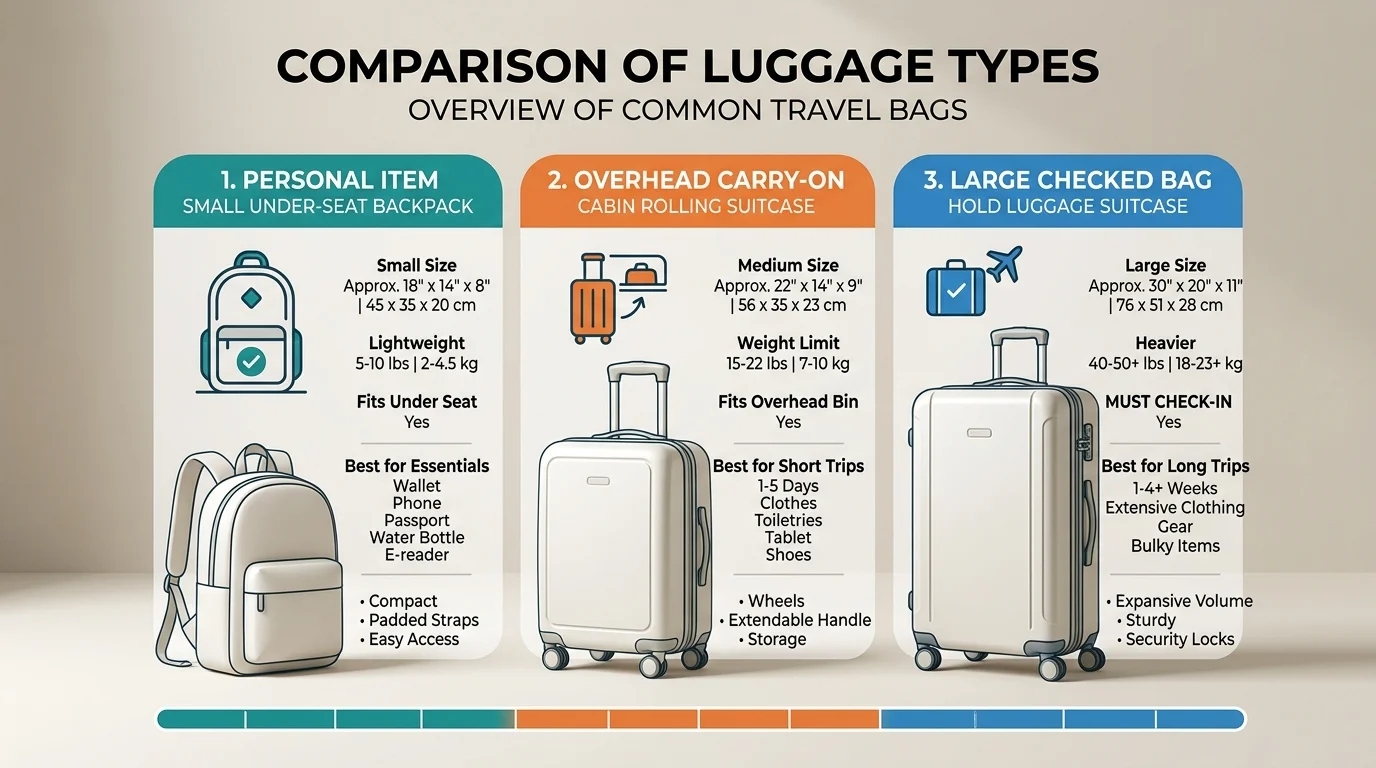
- Overhead Cabin Bag: Typically a compact rolling suitcase, duffel, or travel backpack designed to fit inside enclosed overhead storage lockers.
- Personal Item: A smaller item—such as a laptop briefcase, handbag, or small daypack—that must fit completely underneath the passenger seat directly in front of you.
Airlines impose strict weight and dimension limits on cabin baggage for structural aircraft safety and boarding efficiency. Overhead lockers have certified load-bearing ratings, and aisles must remain entirely unobstructed during taxi, takeoff, and landing.
What Is Checked Baggage?
Checked baggage (often called hold luggage or cargo baggage) refers to suitcases, large boxes, and sports gear that you relinquish to the airline before passing through security screening.
The journey of checked baggage moves behind the scenes:
When you present your luggage at check-in, an agent prints an adhesive barcode tag linking the piece to your ticket reservation (PNR) and hands you a claim receipt. The bag travels along conveyor belts through automated explosive detection systems before ground handlers load it into cargo compartments below the passenger cabin floor. Because checked luggage is handled mechanically and stacked under heavy cargo, it is built to hold bulkier, heavier personal belongings that are neither needed nor permitted in the cabin.
Cabin Baggage vs Checked Baggage: Main Differences
Understanding the operational differences between these options helps you avoid delays and unexpected expenses.
1. Location During Flight
Cabin luggage travels in the pressurized, temperature-controlled passenger cabin within arm's reach or a short walk down the aisle. Checked luggage rests in the aircraft belly hold, completely inaccessible from the moment you drop it off until you reach the arrival hall.
2. Size and Weight Limits
Cabin luggage is constrained by the physical size of overhead compartments and under-seat clearances. Most international airlines enforce cabin weight caps between 7 kg and 10 kg, although some North American legacy carriers do not set a weight cap as long as you can lift the bag unassisted. Checked bags enjoy much larger dimensional thresholds (standard industry ceiling of 158 linear centimeters / 62 linear inches) and baseline weight allowances of 15 kg to 23 kg per piece.
3. In-Flight Accessibility
Need your prescription pills, wired headphones, a jacket, or baby formula mid-flight? Those must be in your cabin baggage. Once checked luggage disappears behind the counter belt, you cannot retrieve a single item until you clear customs and baggage reclaim at your final destination.
4. Security Screening
Cabin luggage passes through passenger checkpoint X-ray and CT scanners where screeners enforce strict liquid container volumes, weapon bans, and battery rules. Checked luggage undergoes automated inline screening for explosives and hazardous industrial chemicals, but permits full-sized liquids, aerosols, and tools that security prohibits inside the cabin.
5. Fees and Fare Structures
Legacy carriers often include a cabin bag and a personal item in standard fares, while low-cost carriers and Basic Economy tickets increasingly charge fees for overhead bin bags. Checked luggage is almost universally monetized as an add-on fee on short-haul and budget routes, while full-service long-haul tickets generally bundle one or two checked bags.
6. Risk of Delay, Damage, or Misrouting
Checked baggage moves through complex airport sorting belts and transfer trucks, meaning bags can occasionally be delayed, misrouted during tight connections, or scuffed by mechanical baggage systems. Cabin luggage never leaves your sight, removing the risk of airline transit loss. If your checked luggage is misplaced, consult our step-by-step Lost/Delayed Baggage: Claim Process to initiate airport claims and carrier compensation.
7. Airport Arrival Experience
Travelers flying cabin-only can bypass check-in queues with a digital boarding pass, head directly to security upon arrival at the airport, and walk straight out to ground transport after landing. Traveling with checked bags requires arriving at the departure airport early enough to beat bag-drop cutoffs and waiting at baggage reclaim carousels after landing.
8. Packing Flexibility
Checked luggage allows you to transport full-sized perfume bottles, sunscreen, wine, kitchen knives, trekking poles, and heavy garments without worrying about security liquid pouches or tight bin frames. Cabin baggage demands disciplined packing with travel-sized bottles, minimalist clothing, and tight compression.
9. Airport Check-In Process
With checked baggage, you must join the check-in desk or automated bag-drop queue before strictly enforced deadlines (typically 45–60 minutes before domestic flights and 60–75 minutes before international departures). With cabin baggage only, you skip the ticketing counters entirely.
10. Connection Mechanics
On single-ticket connecting flights, checked bags are usually transferred automatically between planes by ground crews. However, on self-transfer itineraries (separate tickets) or flights entering certain countries like the United States, you must collect your checked bags, clear border customs, and re-check them for your onward flight. Cabin bags remain with you during every layover, regardless of ticketing arrangements.
Planning Travel Logistics?
Use FareWander tools to calculate flight times, luggage rules, and visa requirements.
What Should Go in Cabin Baggage?
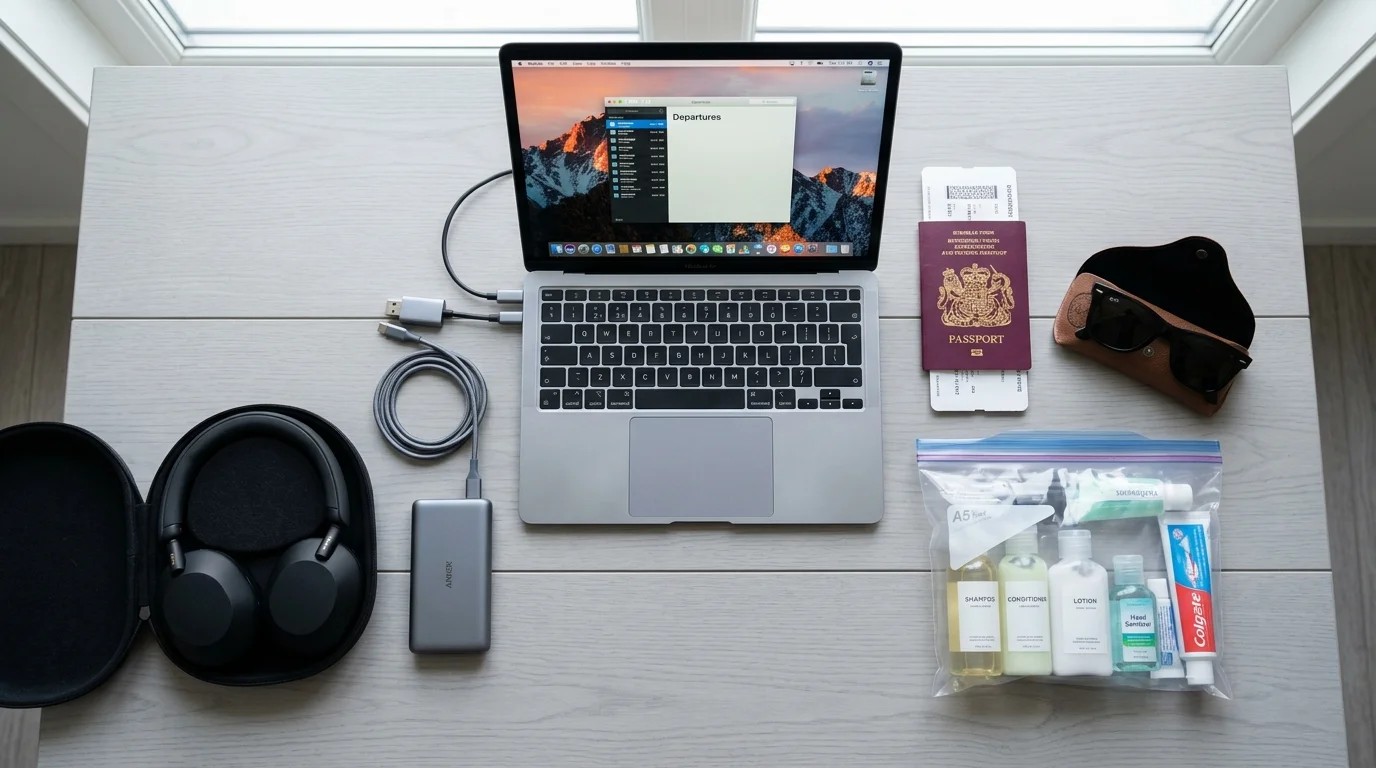
Pack critical personal items, valuable assets, and flight essentials in your cabin baggage. For a detailed breakdown of permitted items and carry-on packing strategies, read our guide on What Can You Carry in Cabin Baggage?.
- Travel Documents: Passports, paper visas, boarding passes, national identity cards, and travel insurance records.
- High-Value Assets: Cash, wallets, credit cards, luxury watches, and fine jewelry (which airline carriage contracts generally exclude from cargo loss liability).
- Essential Devices: Laptops, tablets, smartphones, cameras, and external memory drives.
- Power Banks & Spare Batteries: Dedicated external battery banks and loose lithium-ion cells.
- Essential Medications: Daily prescriptions in original labeled packaging, alongside doctor documentation and medical hardware.
- Transit Comfort: Noise-canceling headphones, eyeglass cases, charging cables, and a neck pillow.
- Emergency Garments: A spare change of clothing, underwear, and socks to keep you comfortable if your checked luggage is delayed.
What Should Go in Checked Baggage?
Reserve your checked hold baggage for bulky items, non-essential apparel, and belongings restricted from the cabin:
- Heavy Apparel & Footwear: Bulk sweaters, jackets, hiking boots, formal dresses, and suits.
- Full-Sized Toiletries: Shampoo bottles, body wash, hairsprays, and lotions exceeding 100 ml (securely sealed in plastic pouches to protect against cargo pressure changes).
- Permitted Sporting Equipment: Golf clubs, cricket bats, baseball gear, tennis rackets, and ski equipment.
- Blunt Tools & Grooming Hardware: Kitchen cutlery, work tools, safety straight razors, and scissors with blades exceeding 6 cm.
- Souvenirs & Liquids: Bottled wines, spirits, olive oils, and local preserves purchased prior to airport security screening.
What Must NOT Go in Checked Baggage?
Never place safety-regulated hazardous materials or irreplaceable personal valuables into your checked luggage:
- Power Banks and Loose Lithium-Ion Batteries: External battery banks, uninstalled lithium-ion camera batteries, and portable chargers present serious thermal runaway fire risks. Aviation dangerous goods regulations mandate that these remain in the cabin where crew can access fire suppression kits.
- E-Cigarettes and Vaporizers: Vapes and electronic nicotine delivery systems must stay in the cabin to prevent accidental heating in cargo holds.
- Critical Daily Medication: Life-sustaining prescription medications should never be checked. If your hold luggage is delayed or misrouted, missing critical medication can cause an immediate medical emergency.
- Passports & Cash: Never place travel identity documents or physical money into cargo luggage.
What Must NOT Go in Cabin Baggage?
Airport security checkpoints enforce strict prohibitions on items that could be used to compromise cabin safety:
- Liquids Exceeding Container Limits: At standard security checkpoints, liquids, aerosols, and gels (LAGs) are restricted to individual containers of 100 ml (3.4 oz) or less, all fitting comfortably inside a single 1-liter transparent plastic bag. A half-full 200 ml bottle will be confiscated regardless of how little liquid remains inside. While airports rolling out advanced 3D CT scanners increasingly allow full-sized liquids, rules vary by airport and country, so you must confirm policies for every airport on your routing.
- Blades and Pointed Items: Pocket knives, box cutters, straight razors, scissors with blades longer than 6 cm from the pivot point, and martial arts weapons are banned from carry-ons.
- Impact Sporting Gear: Baseball bats, cricket bats, golf clubs, and trekking poles cannot pass checkpoint screening and must be checked.
- Flammable Liquids and Explosives: Lighter fluids, fireworks, strike-anywhere matches, spray paints, and industrial solvents are prohibited from passenger aircraft entirely.
Packing Comparison: Where Does It Go?
| Item Category | Cabin Baggage | Checked Baggage | Operational Reason |
|---|---|---|---|
| Laptops & Tablets | Yes (Recommended) | Strongly Discouraged | Lithium fire risk; heavy risk of physical damage in the hold. |
| Power Banks / Loose Cells | Mandatory | STRICTLY PROHIBITED | Fire suppression equipment is accessible only in the cabin. |
| Prescription Medications | Yes (Recommended) | Strongly Discouraged | Prevents emergency loss if checked baggage is delayed. |
| Liquids > 100 ml | Prohibited (Standard lanes) | Permitted | Security restrictions at checkpoints; check departure rules. |
| Pocket Knives / Blades | Prohibited | Permitted | Checkpoint safety rules; must be securely sheathed. |
| Passports & Cash | Yes (Recommended) | Strongly Discouraged | Excluded from carrier liability policies. |
Cabin Baggage Size and Weight Limits
Airlines establish their own carry-on parameters based on fleet configurations, cabin class, and ticketing tiers. Understanding fare class differences, such as Basic Economy vs Economy: What's the Difference?, prevents expensive boarding gate surprises.
- Dimensions: External measurements are calculated as Length $\times$ Width $\times$ Height, including wheels, handles, and bulging pockets. While 56 $\times$ 36 $\times$ 23 cm (22 $\times$ 14 $\times$ 9 inches) is a standard baseline across legacy carriers, low-cost airlines frequently employ narrower sizing frames at boarding gates.
- Weight Allowances: Weight caps range from strict 7 kg or 8 kg limits on carriers like Aegean Airlines to 10 kg on airlines like Copa or Aer Lingus, up to 25 lbs (11.3 kg) on Hawaiian Airlines. Major US airlines like Delta or United generally enforce no weight ceiling for standard carry-on bags, requiring only that you lift the bag overhead without assistance.
- Personal Items: Most airlines permit a separate personal item (averaging roughly 40 $\times$ 30 $\times$ 15 cm) that must fit beneath the seat in front of you.
To verify your exact allowance, open your booking confirmation email, log into the airline’s Manage Booking portal using your booking reference (PNR), and review the baggage allowance attached to your fare class.
Checked Baggage Size and Weight Limits
Checked luggage rules distinguish between your included allowance and the maximum weight an airline will accept:
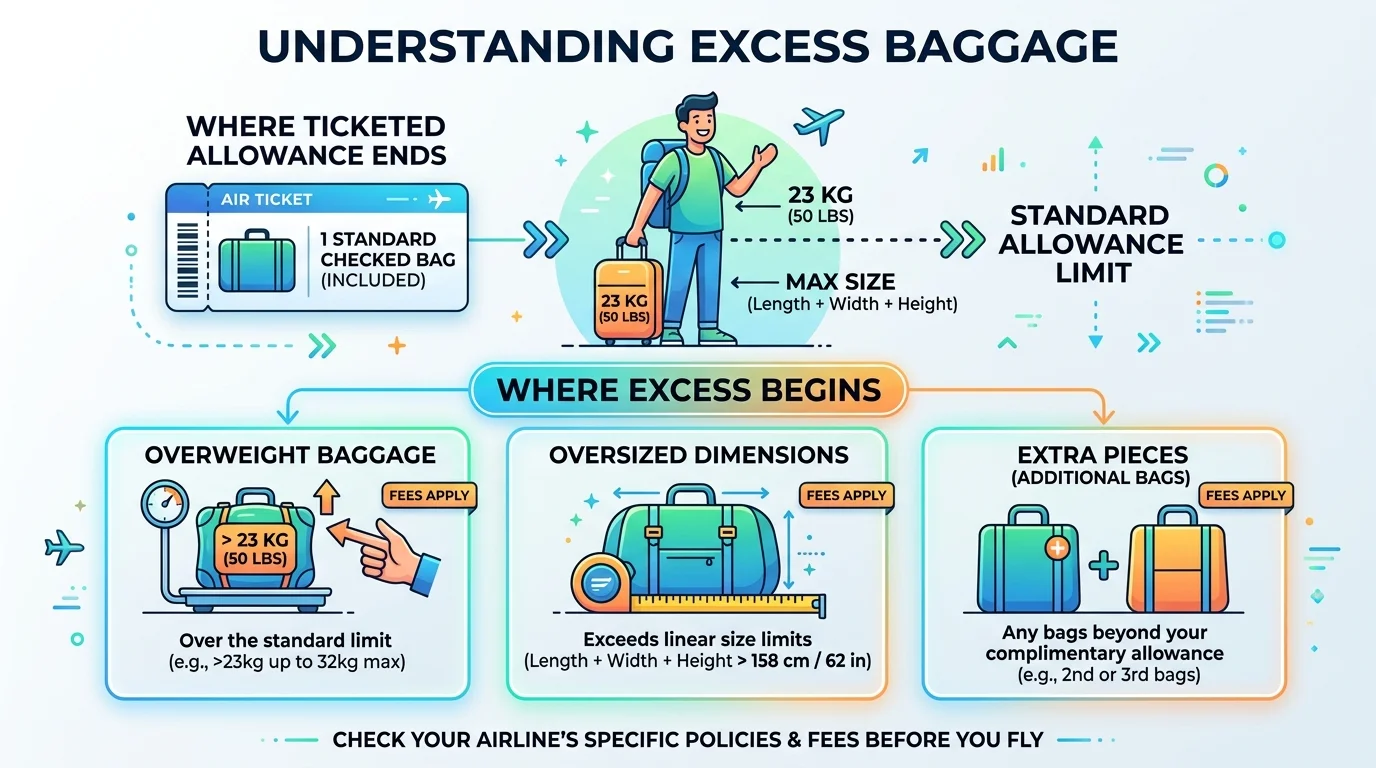
- Free Checked Allowance: Refers to the luggage included in your base fare without additional payment. While long-haul international flights often include one or two checked bags, unbundled Basic Economy fares include none.
- Weight vs Piece Concept: In the Americas and transatlantic routes, airlines use the Piece Concept, allocating a specific number of bags (e.g., 1 bag up to 23 kg / 50 lbs). Across domestic Asian markets, India, and parts of the Middle East, carriers often use the Weight Concept, where your ticket grants a gross aggregate weight (e.g., 15 kg or 30 kg) that can be spread across one or more pieces.
- Dimensional Ceiling: Standard checked suitcases must not exceed 158 linear centimeters (62 linear inches), calculated as Length + Width + Height. Bags measuring beyond this threshold trigger oversized luggage handling fees.
- The 32 kg Occupational Safety Limit: A traveler's included ticket allowance (such as 23 kg) is not the maximum weight accepted. However, commercial airlines enforce an absolute safety cap of 32 kg (70 lbs) for any single piece of passenger baggage. Bags exceeding 32 kg cannot be checked onto passenger aircraft under any circumstances to prevent physical injury to ramp baggage handlers, and must travel via cargo freight.
Can You Take a Suitcase as Cabin Baggage?
Yes, provided the suitcase complies with your airline's specific cabin size and weight restrictions.
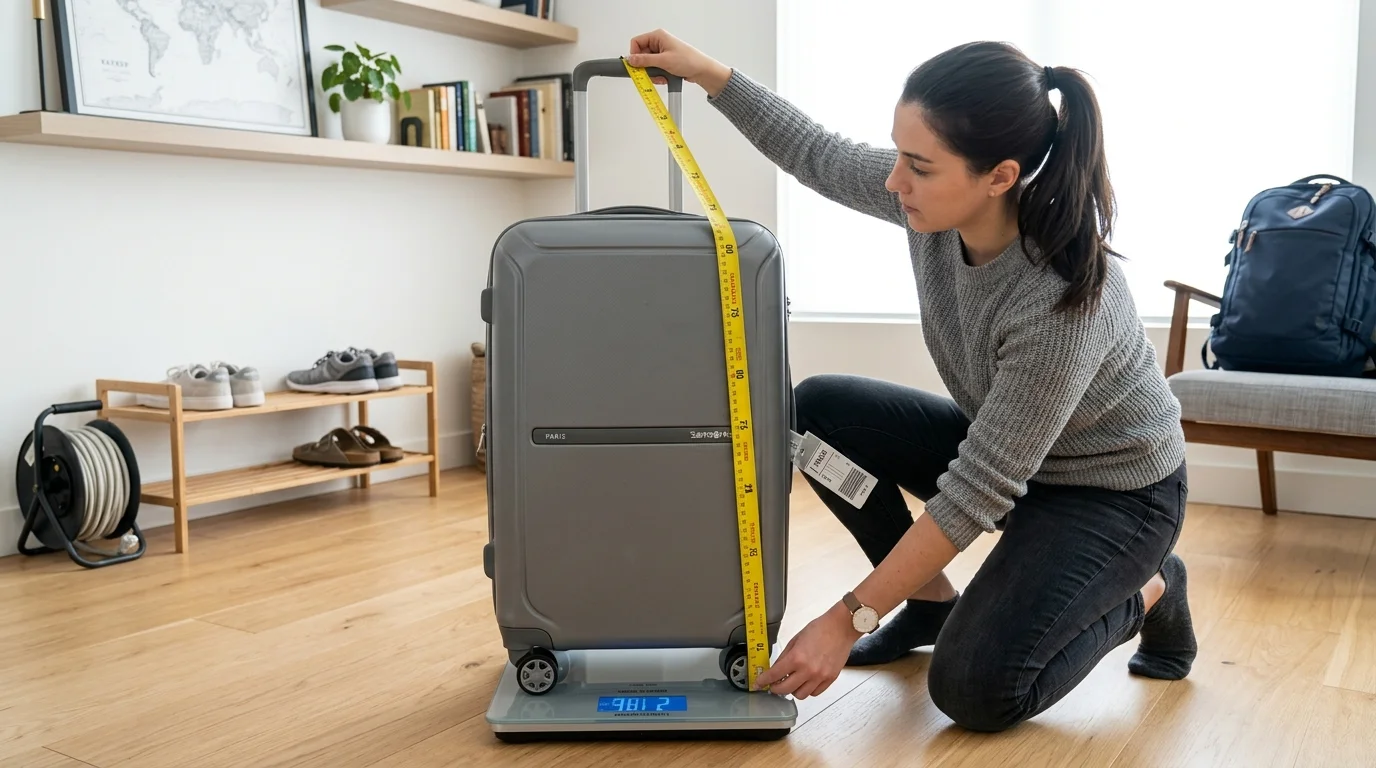
A standard cabin-sized rolling suitcase (often labeled as 20-inch or 22-inch luggage) is built specifically to clear overhead bin dimensions. However, a medium or large suitcase (24 to 30 inches) exceeds cabin dimensions and must be checked into the cargo hold. Always measure your suitcase from the floor to the top of the handle, including spinner wheels, because rigid sizing cages at the gate do not bend to accommodate protruding wheels.
Cabin Baggage Fees vs Checked Baggage Fees
Airline pricing models determine when and how baggage fees are applied. For a comprehensive review of airline surcharge formulas, consult our guide on Excess Baggage Fees & Weight Limits.
- Cabin Baggage Charges: While full-service airlines bundle carry-on luggage into standard economy tickets, budget carriers and Basic Economy fares frequently charge for overhead bin access, restricting free travel to an under-seat personal item.
- Checked Baggage Charges: Checked bags are typically an add-on expense on short-haul domestic flights, while standard long-haul tickets often bundle hold luggage.
- Online Pre-Purchase vs Airport Desks: If you need extra weight or an additional bag, pre-purchasing allowance through the airline's website or mobile app is generally 20% to 50% cheaper than paying counter rates at the terminal.
Personal Item vs Cabin Baggage
Many first-time flyers confuse a personal item with an overhead cabin bag.
| Feature | Personal Item | Overhead Cabin Bag |
|---|---|---|
| Where it is stowed | Under the seat in front of you | Closed overhead storage bin |
| Typical dimensions | Approx. 40 $\times$ 30 $\times$ 15 cm | Approx. 56 $\times$ 36 $\times$ 23 cm |
| Typical formats | Handbag, small laptop backpack, tote bag | Small rolling suitcase, large weekender duffel |
| Fare inclusion | Almost universally free across all ticket tiers | Included in standard fares; often monetized on basic/budget fares |
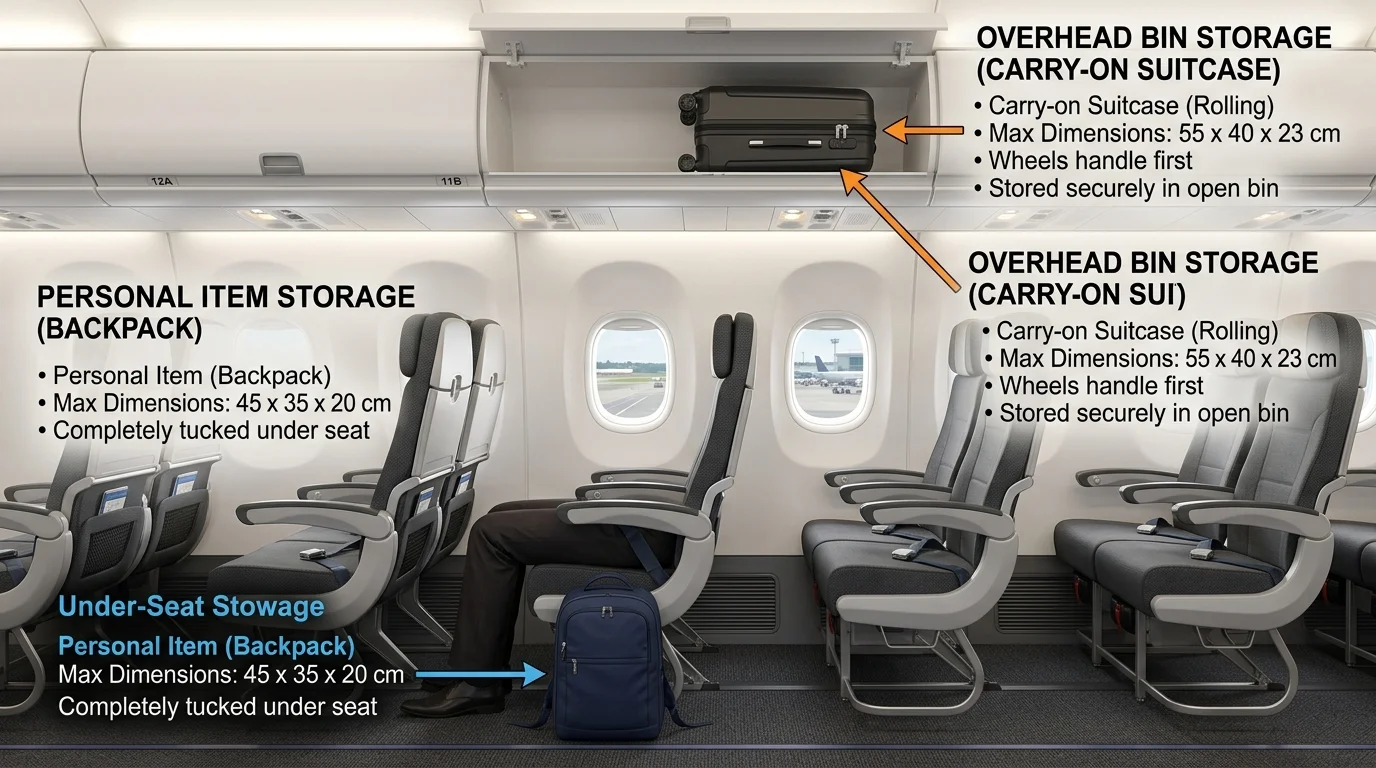
If your backpack is packed so full that it blocks footwell space or extends into the aisle, flight attendants will require it to be moved to an overhead locker or checked.
What Happens at the Airport: Step-by-Step
Understanding the airport sequence helps you manage your time effectively. Check our detailed Airline Check-In Policy guide to verify cut-off times and boarding schedules.
Flying with Cabin Baggage Only
- Check in online 24 to 48 hours before departure via the airline's app to download your mobile boarding pass.
- Arrive at the airport terminal and proceed directly past ticketing desks straight to passenger security screening.
- Place liquids in a transparent pouch and separate your laptop into screening bins if required by airport security lanes.
- Carry your bags to the departure gate, boarding when your assigned zone is called.
- Stow your larger carry-on wheels-first in the overhead bin and place your personal item under the seat ahead.
- Disembark with your bags in hand and proceed directly to ground transport.
Flying with Checked Baggage
- Complete online check-in in advance, or check in at airport kiosks upon arrival.
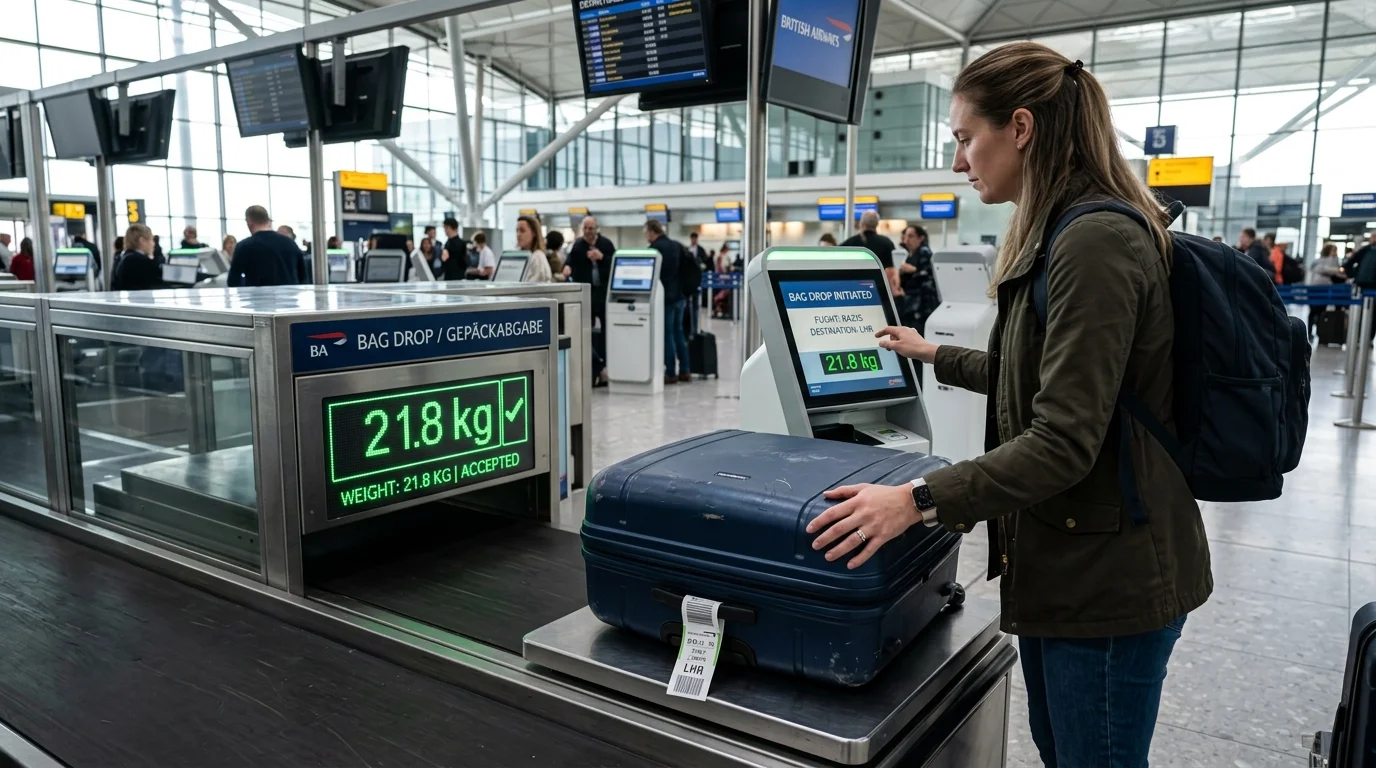
- Head to the airline check-in desks or dedicated bag-drop area before the baggage cutoff time.
- Place your suitcase on the digital scale; the agent prints an adhesive barcode tag and attaches it to the handle.
- Collect your physical baggage claim receipt (retain this until you leave your destination airport).
- Proceed through security screening carrying only your personal item and cabin essentials.
- After landing, follow signs to Baggage Reclaim and locate your flight's designated carousel to collect your luggage.
Can You Take Both Cabin and Checked Baggage?
Yes. Most full-service standard economy tickets allow travelers to bring both cabin baggage and checked baggage on the same journey.
For example, a passenger flying international standard economy might travel with:
- One personal item: Small laptop backpack under the seat
- One overhead cabin bag: Small rolling suitcase up to 8 kg in the overhead bin
- One checked suitcase: Up to 23 kg in the aircraft hold
This combination is an example rather than a universal allowance. Your specific ticket may include only a personal item, require payment for hold luggage, or offer multiple checked bags if traveling in premium cabins.
Which Is Better: Cabin Baggage or Checked Baggage?
Neither option is universally better; the right choice depends on the logistics of your itinerary.
Cabin baggage makes more sense when:
- Your trip lasts under a week and clothing needs are modest.
- You have a tight flight connection and want to eliminate the risk of delayed hold luggage.
- You want to skip check-in lines and head straight out of the airport upon landing.
- You are flying a budget carrier where checked luggage fees exceed the base ticket price.
Checked baggage makes more sense when:
- You are traveling for several weeks or packing for variable climates.
- You need to bring full-sized liquids, perfumes, or specialized equipment prohibited in the cabin.
- You are traveling with young children and need your hands free in the terminal.
- Your ticket already bundles checked luggage inclusions.
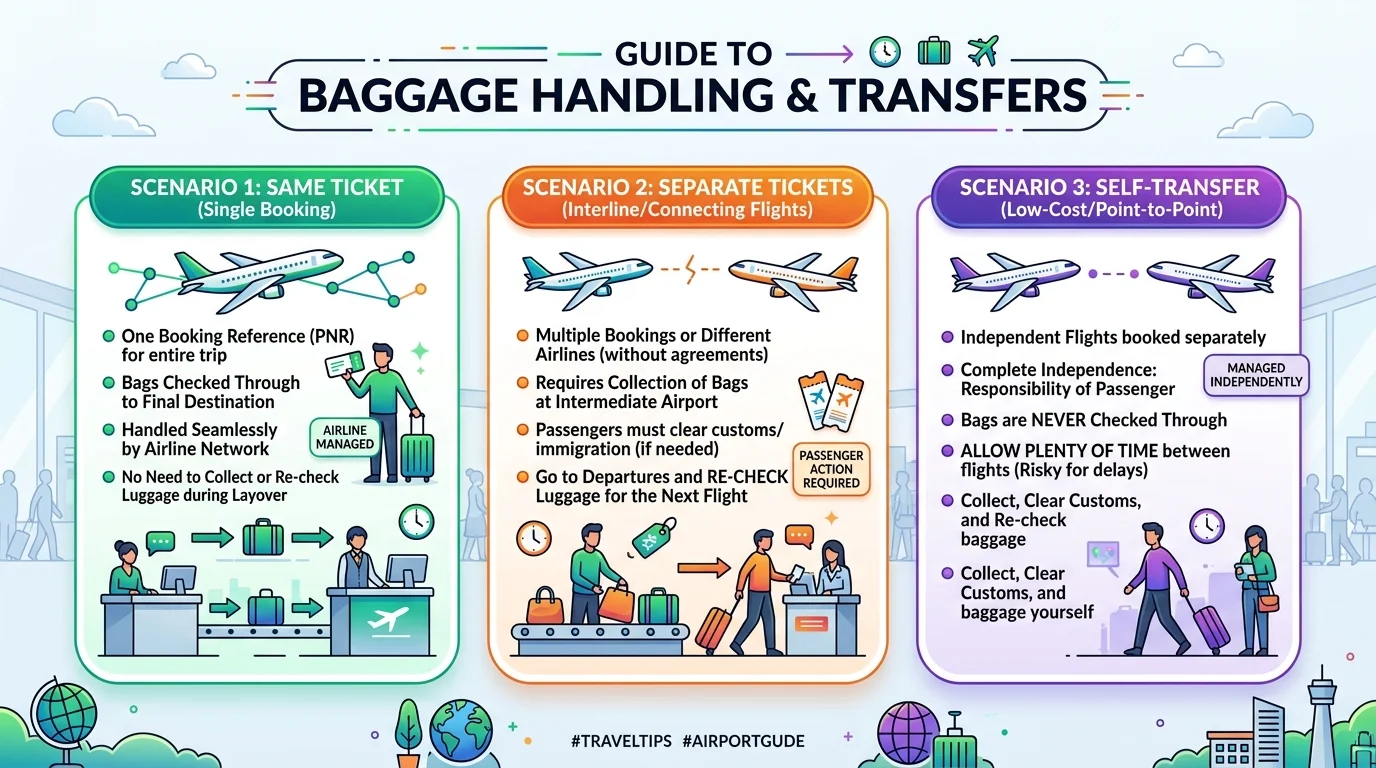
Connecting Flights and Codeshares
Baggage rules become more complex when itineraries involve connections or multiple airlines:
- Single-Ticket Connections: When flights are booked under a single confirmation reference, your checked luggage is usually "through-checked" to your final destination. Ground personnel transfer the bags between planes during your layover.
- Customs Clearance Exceptions: When entering certain countries (such as landing in the United States on an international connection), federal regulations require you to collect your checked luggage at your first port of entry, pass through customs, and place the bags on a transfer belt.
- Codeshare Flights: If your flight is marketed by one airline but operated by a partner carrier, baggage rules are governed by the "Most Significant Carrier" (MSC) principle under IATA Resolution 302, or by the first marketing carrier under consumer protection regulations. Verify the allowance printed on your e-ticket receipt, as partner airlines may enforce different cabin weight limits on smaller regional aircraft.
- Separate Tickets (Self-Transfer): If you book two separate tickets across different airlines, bags will not transfer automatically. You must collect your luggage at the layover airport, clear immigration, check in again at the next airline's desk, and clear security screening a second time.
Baggage Considerations for Different Travelers
- Weekend Traveler: Travel cabin-only with an under-seat backpack and lightweight rollaboard to bypass airport counters and bag-reclaim lines entirely.
- Business Traveler: Keep laptops, chargers, suits in garment sleeves, and essential presentations in the cabin. If checking luggage, ensure business cards and contact tags are secured inside and outside the bag.
- Family Traveler: Check large suitcases to keep hands free for managing strollers and children in the terminal. Carry spare clothes, snacks, baby formula, and entertainment in cabin bags.
- Long Vacation Traveler: Rely on a durable 23 kg checked suitcase for bulk apparel, packing fragile souvenirs, electronics, and documents in your cabin bag.
- Budget Traveler: Review your fare rules carefully; booking an unbundled ticket that excludes carry-ons may lead to expensive gate-check surcharges if your bag exceeds personal-item limits.
Special Baggage and Bulky Equipment
Items outside standard luggage shapes require specialized procedures:
- Sports Equipment: Bicycles, golf bags, skis, and surfboards often require advance booking and may incur fixed equipment handling fees. Some airlines count golf or ski bags as standard checked pieces if they fall within regular weight limits.
- Musical Instruments: Small instruments (violins, flutes) can often replace a standard overhead bag if they fit cabin dimensions. Larger instruments (cellos, guitars) require purchasing an adjacent passenger seat ("Cabin Seat Baggage") or must be packed in a certified hard flight case for hold transport.
- Mobility Aids: Wheelchairs and mobility equipment are transported free of charge across commercial airlines, subject to advance safety declarations regarding battery types.
Common Cabin and Checked Baggage Mistakes
- Assuming Every Airline Shares the Same Rules: Believing a carry-on that passed on a domestic carrier will automatically meet the narrower dimensions of an international or regional airline.
- Checking Dimensions but Forgetting Weight: Verifying that a suitcase fits inside the sizing cage while ignoring an airline's 7 kg or 8 kg cabin weight cap.
- Packing Power Banks in Checked Luggage: Leaving external battery packs in hold bags, which triggers automated security holds and removal of the battery.
- Assuming Checked Bags Are Always Free: Overlooking Basic Economy ticket conditions that exclude checked luggage.
- Putting Critical Documents in Hold Luggage: Placing passports, home keys, or daily medication into checked suitcases.
- Waiting Until the Airport to Add Baggage: Paying top-tier walk-up excess fees at the check-in desk instead of pre-purchasing allowance online.
Practical Packing Tips
- Weigh your bags at home: Use a digital hanging luggage scale to confirm that your bags fall comfortably below your ticketed weight thresholds before leaving for the terminal.
- Measure exterior boundaries: Use a tape measure to verify that your carry-on length, width, and depth (including wheels and handles) meet your carrier's published cabin sizer limits.
- Use packing cubes: Compressing clothing organizes your items and makes security screening repacking far simpler if your bag is pulled for manual inspection.
- Leave a buffer: Leave 1 to 2 kg of spare weight margin in your checked suitcase to absorb souvenir purchases and differences between home scales and certified airport scales.
- Recheck rules before flying: Airline policies, security screening protocols, and fees update periodically; review your booking details 48 hours before departure.
Frequently Asked Questions
Cabin baggage is carried into the aircraft passenger cabin and stored in overhead bins or under seats, remaining accessible during flight. Checked baggage is handed to airline agents at check-in, transported in the cargo hold, and collected at baggage reclaim after landing.