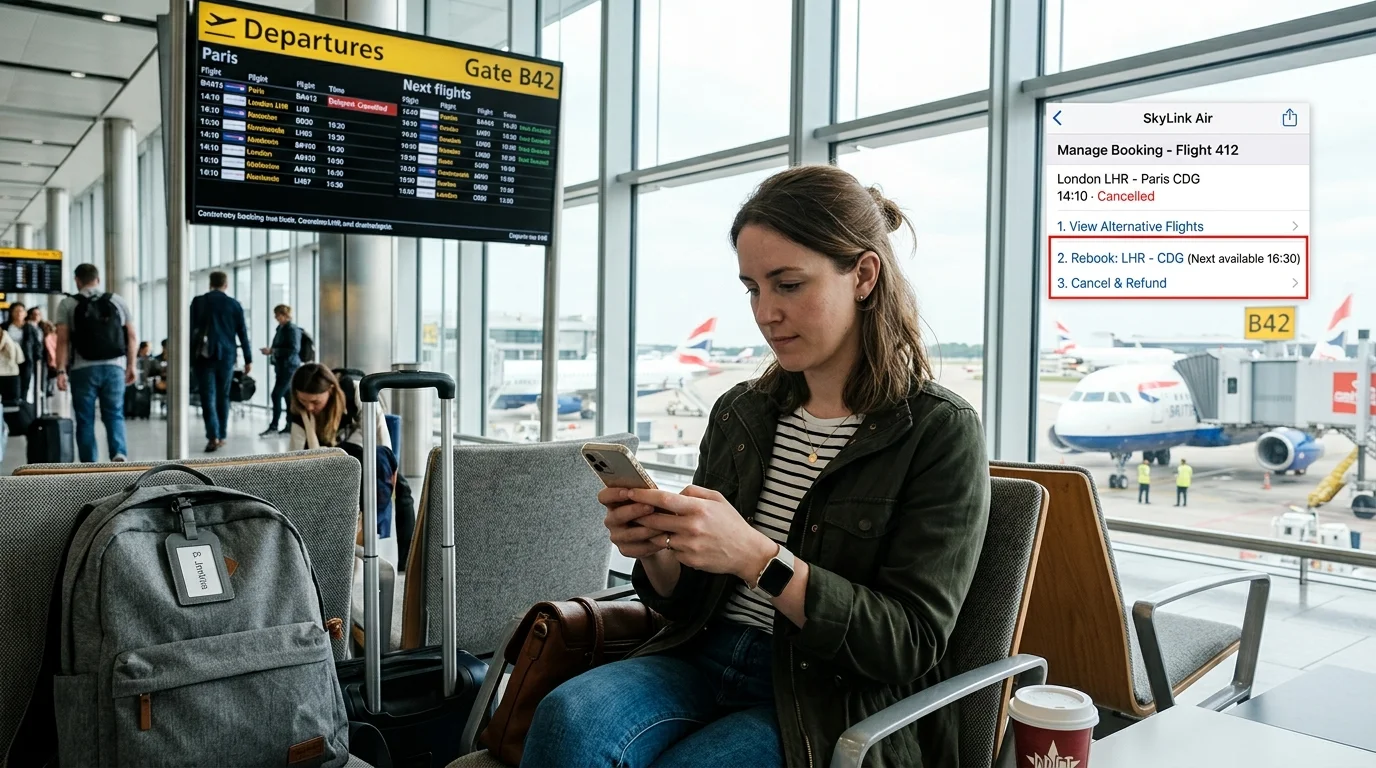
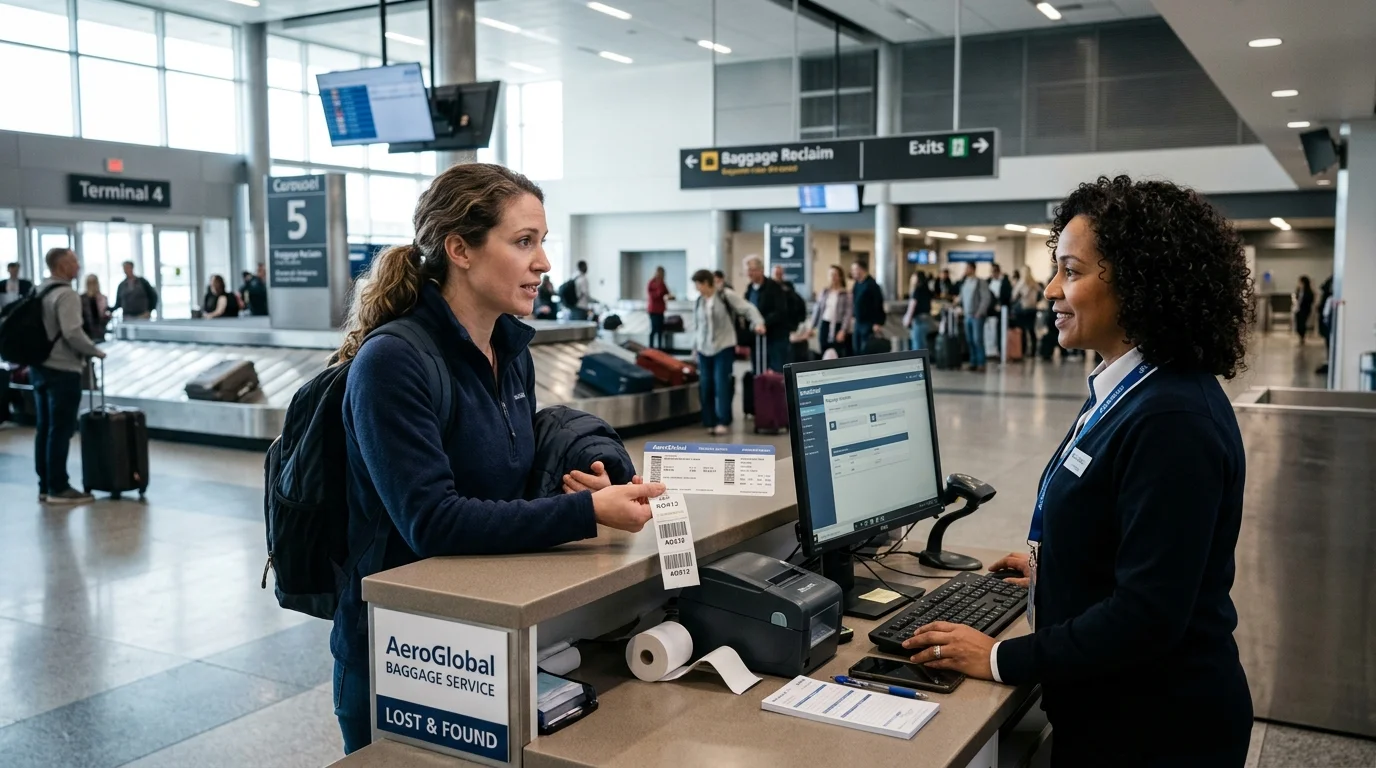
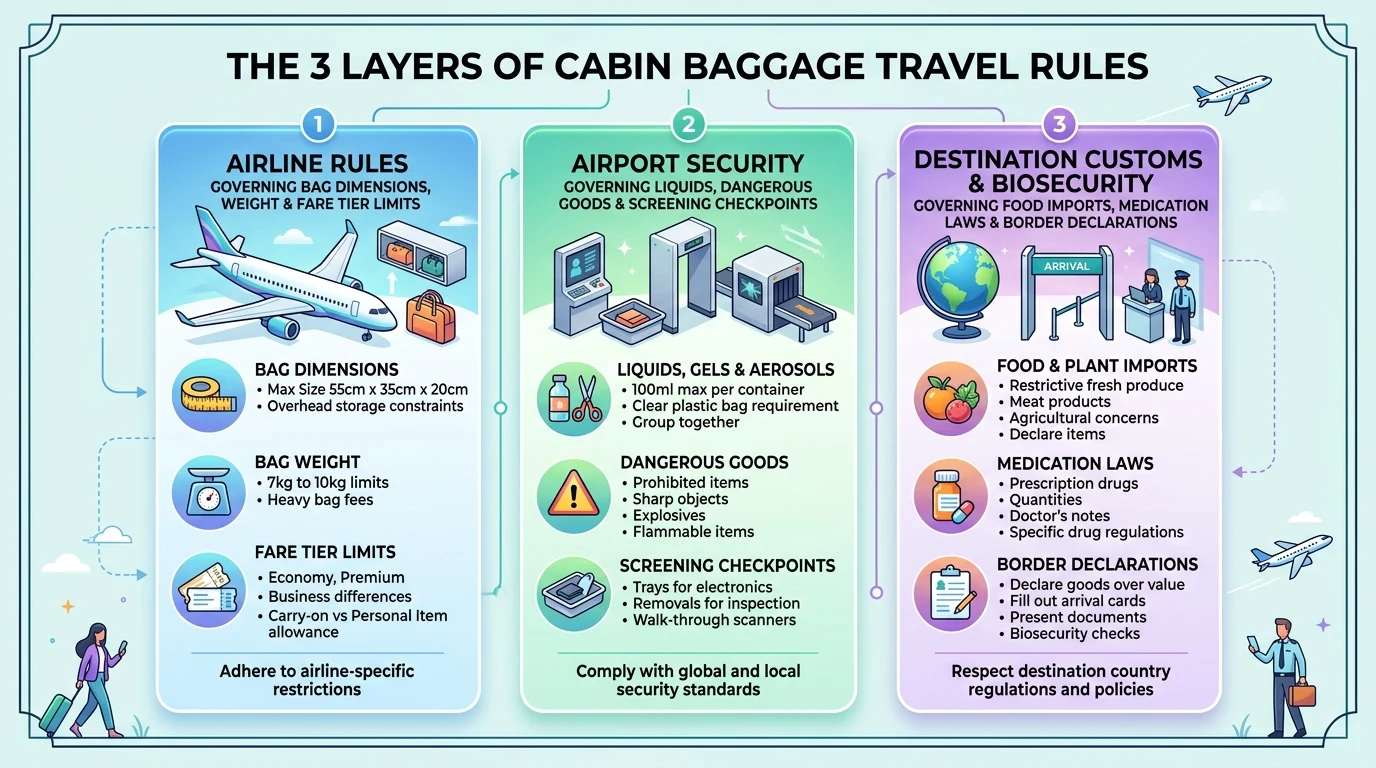
You have your carry-on open on the bed the evening before your flight, surrounded by charging cables, travel-sized toiletries, prescription bottles, a power bank, and a laptop. You start calculating whether your daily moisturizer counts toward a liquid cap, whether your external battery will be flagged by security screeners, or if the snacks you packed will clear international customs at your destination. Packing a cabin bag is rarely straightforward because you are not following a single master rulebook; you are navigating three completely separate layers of authority simultaneously.
Before touching a zipper, you need to understand the critical operational separation between airline baggage policies, airport security screening checkpoints, and destination-country customs laws:
- Airline Rules: Govern the physical architecture of your bag—its weight, linear dimensions, and whether your ticket tier permits an overhead roller bag or strictly an under-seat personal item.
- Airport Security Rules: Enforce flight safety and counter-terrorism mandates at the security checkpoint, deciding whether your liquids, scissors, tools, or electronics are allowed into the passenger terminal.
- Destination Customs & Biosecurity Rules: Determine what goods, plants, packaged foods, or prescription pharmaceuticals can legally cross an international border when you land.
An item can clear your airline's weight check without an issue, only to be confiscated at the security X-ray scanner. Conversely, an item might glide right through security screening, only to trigger heavy agricultural fines or confiscation at your destination's customs line. Ensuring a smooth trip means satisfying all three layers.
- •Power Banks & Spare Batteries: Under 100 Wh (fire prevention mandate).
- •E-Cigarettes & Vapes: Must remain on person or in cabin bag; charging banned.
- •Critical Medications: Daily prescriptions and emergency inhalers/insulin.
- •Valuables: Cash, passport, jewelry, and primary laptops.
- •Liquids & Pastes: Containers must be ≤ 100 ml (3.4 oz) in 1 clear 1-liter bag.
- •Solid Toiletries: Bar soap, stick deodorants, powders exempt from liquid caps.
- •Water Bottles: Must be completely empty at security; refill airside.
- •Baby Formula & Milk: Fully exempt from 100 ml limit; declare to screeners.
1. What Is Cabin Baggage?
Cabin baggage (frequently called carry-on baggage or hand luggage) refers to all baggage you bring through the airport terminal, carry into the aircraft passenger cabin, and keep in your custody throughout the flight. Understanding your carrier's baseline airline baggage policy ensures you avoid surprise gate fees.
It is divided into two operational formats, compared below against cargo luggage:
| Baggage Type | Where It Goes | Typical Physical Purpose | Common Contents |
|---|---|---|---|
| Personal Item | Under the seat directly in front of you | In-flight access to essentials, work, and documentation | Laptop bag, small backpack, purse, medications, headphones |
| Cabin Bag (Carry-On) | Closed overhead bin compartments | Short-trip clothing, primary electronics, and delicate gear | Rolling trolley, weekender duffel, spare garments, toiletries |
| Checked Baggage | Aircraft lower cargo hold (inaccessible during flight) | High-volume gear, long-haul apparel, oversized liquids | Heavy luggage, large liquid containers, tools, sports gear |
There is no universal size or weight across global carriers. Regional turboprops have tighter bin clearances than wide-body international jets, making it essential to consult your airline's specific fleet specifications.
2. What Can You Generally Carry in Cabin Baggage?
Most personal belongings can be brought into the cabin, provided they fit comfortably within your airline's physical dimensions and comply with dangerous-goods and security criteria.
| Item Category | Generally Allowed? | Important Conditions |
|---|---|---|
| Clothing & Footwear | Yes | Must fit in overhead bins or personal item allowances without blocking aisles. |
| Laptops & Tablets | Yes | Must pass security screening; lithium batteries must remain protected. |
| Smartphones & E-Readers | Yes | Must be set to airplane mode during flight taxi, takeoff, and landing. |
| Books & Printed Materials | Yes | Kept accessible for under-seat or overhead stowage. |
| Prescription Medications | Yes | Must comply with local narcotics laws; keep original pharmacy labels accessible. |
| Baby Essentials & Formula | Yes | Security exemptions apply for liquid baby food, breast milk, and formula. |
| Toiletries & Cosmetics | Restricted | Subject to checkpoint liquid volume limits (or C3 scanner rules where active). |
| Snacks & Packaged Food | Generally Yes | Must clear checkpoint liquid/paste limits; subject to destination border restrictions. |
| Power Banks & Batteries | Restricted | Allowed in the cabin only; strictly forbidden in checked luggage. Subject to capacity caps. |
| Eyewear & Sunglasses | Yes | Keep in hard cases inside your personal item to avoid transit crushing. |
Note: General passenger acceptance does not override checkpoint screening protocols or airline carry-on size allowances.
Comparing Fares for Your Route?
Search live multi-airline schedules, spot discount windows, and baggage fee rules on FareWander.
3. Cabin Baggage Size and Weight
Airlines use strict sizing frames at the boarding gate to prevent cabin delays and ensure bags can fit inside overhead compartments. Because airlines price their cabin real estate differently, there is no single international weight or size standard:
- Size Limits: Common legacy standards frequently target dimensions around $56 \times 36 \times 23\text{ cm}$ ($22 \times 14 \times 9\text{ inches}$), but low-cost carriers frequently configure their metal sizers to smaller dimensions.
- Weight Limits: Certain international airlines enforce a strict $7\text{ kg}$ or $8\text{ kg}$ cabin limit, while others allow up to $10\text{ kg}$, or cap bags at $25\text{ lbs}$ ($11.3\text{ kg}$). Many major carriers do not enforce a maximum carry-on weight on standard routes, provided you can lift the bag overhead unassisted.
- Fare-Specific Allowances: Basic Economy and "Light" unbundled tickets frequently strip out overhead bin access entirely, restricting passengers strictly to a small under-seat personal item.
- Aircraft Constraints: Flying on smaller regional aircraft (e.g., Embraer, Bombardier, ATR) often forces a "valet check" or "gate drop" at the aircraft door because overhead bins are too narrow for standard rollaboard suitcases, even if your ticket class permits a full carry-on.
4. What Electronics Can You Carry?
You can carry virtually all standard consumer electronics in your cabin baggage: smartphones, laptops, tablets, smartwatches, mirrorless or DSLR cameras, noise-canceling headphones, portable gaming consoles, and handheld e-readers.
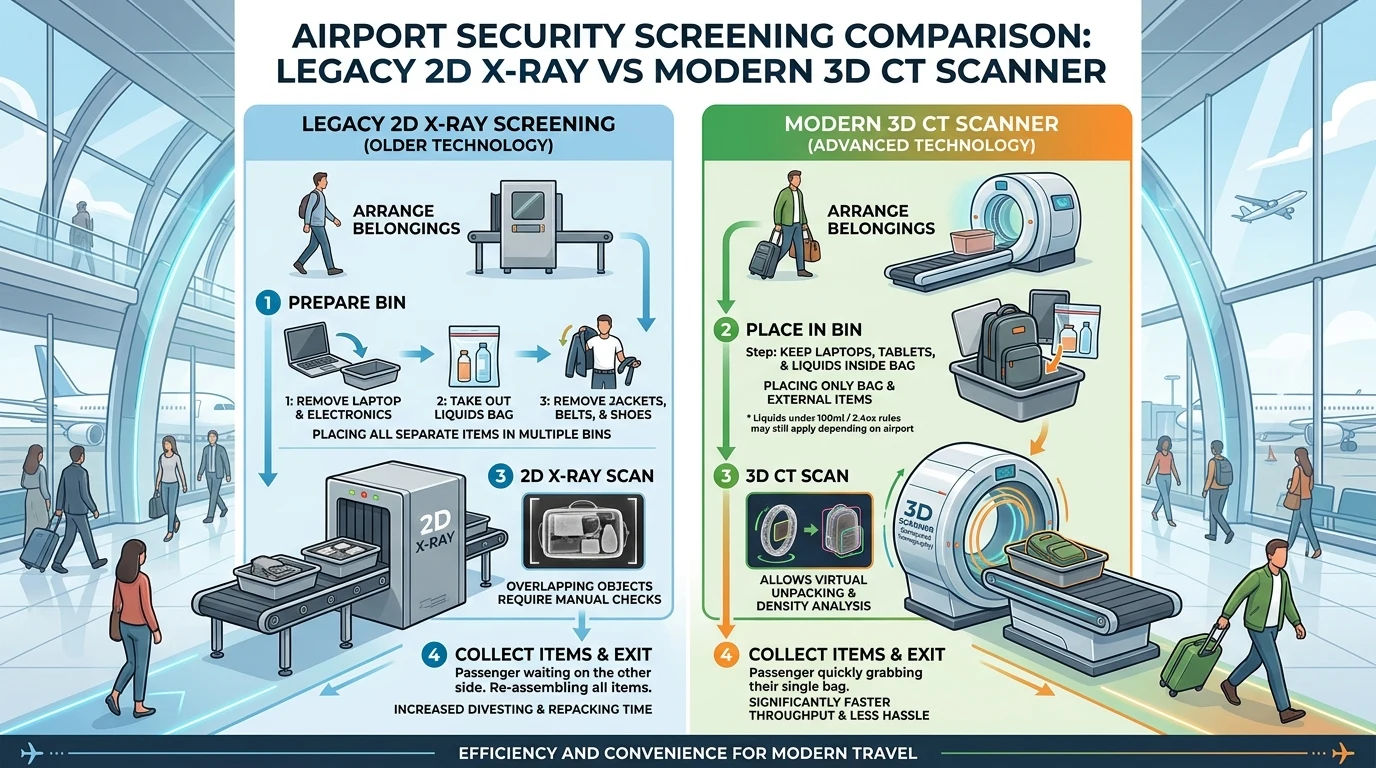
- Security Screening Variations: At conventional security lanes equipped with legacy 2D X-ray systems, laptops and large electronics must be unzipped and placed in a dedicated plastic bin with nothing covering them. At security lanes equipped with modern Computed Tomography (CT) 3D scanners, many airports allow electronics to remain packed inside your carry-on. Always follow the explicit instructions of checkpoint officers.
- Lithium Fire Protection: Consumer tech devices contain integrated lithium-ion cells. Because fire-suppression tools are immediately deployable inside the passenger cabin, aviation authorities mandate that lithium-powered electronic items remain in the cabin rather than the inaccessible cargo hold.
5. Power Banks and Spare Batteries
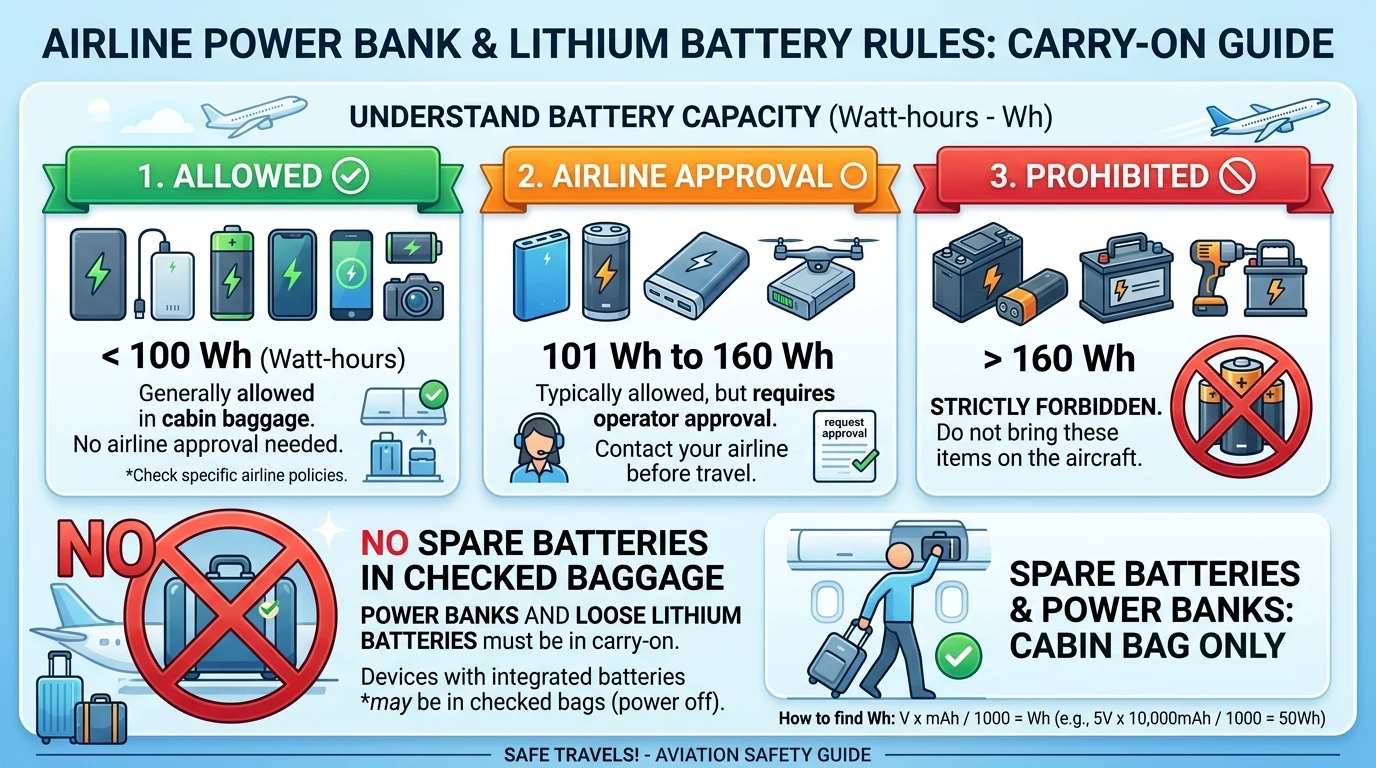
Spare lithium batteries and portable power banks present a known thermal runaway hazard. For this reason, power banks and loose/spare batteries are strictly prohibited from checked luggage worldwide and must travel in your cabin baggage.
What Is a Watt-Hour (Wh)?
Watt-hours represent the overall energy capacity of a battery cell. If your power bank displays capacity only in milliamp-hours (mAh), calculate the Watt-hour rating with this formula:
$$\text{Wh} = \frac{\text{mAh} \times \text{Volts}}{1000}$$
(Most consumer smartphone power banks run at nominal internal cell voltages around $3.7\text{V}$. A $20,000\text{ mAh}$ bank equals approximately $74\text{ Wh}$, placing it comfortably under the standard $100\text{ Wh}$ limit.)
- Capacity Caps: Uninstalled batteries under $100\text{ Wh}$ are universally permitted in cabin bags across standard aviation guidelines. Batteries between $101\text{ Wh}$ and $160\text{ Wh}$ (found in heavy-duty production video equipment or industrial laptop packs) require prior airline notification and approval. Items exceeding $160\text{ Wh}$ are forbidden on passenger commercial flights.
- Short-Circuit Prevention: Spare batteries must be protected against accidental short-circuiting. Leave them in original retail packaging, slide them into individual non-conductive plastic pouches, or apply insulating electrical tape over exposed metal contact terminals.
Planning Travel Logistics?
Use FareWander tools to calculate flight times, luggage rules, and visa requirements.
6. Can You Carry a Laptop in Cabin Baggage?
Yes, laptops are allowed in cabin baggage and should always be brought into the passenger compartment rather than checked.
[Arrival at Checkpoint]
       │
       ├── Modern 3D CT Scanner? ──> Leave Laptop Inside Bag
       │
       └── Traditional 2D X-Ray?  ──> Remove Laptop; Place Flat in Bin
- Checkpoint Readiness: Pack your laptop in an easily accessible exterior pocket or top sleeve so you can quickly slide it into a security tray without delaying the screening line.
- Damaged or Recalled Devices: Laptops subject to active safety recalls regarding defective, overheating lithium-ion batteries may be barred from carriage by safety regulators unless serviced or disabled according to manufacturer and airline instructions.
7. Liquids in Cabin Baggage
Aviation checkpoint rules for liquids, gels, creams, pastes, and aerosols (LGA) depend on the screening technology deployed at each specific airport terminal:
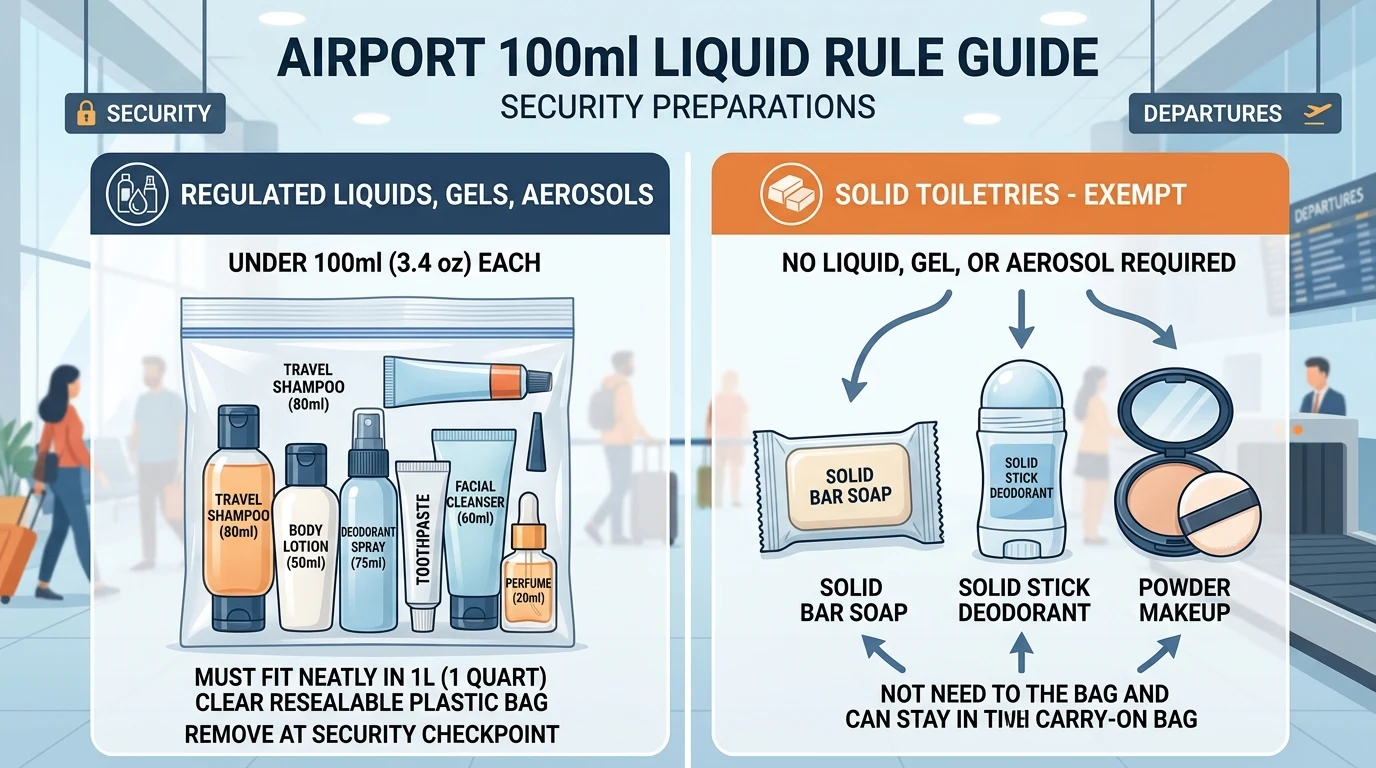
- The Baseline (100 ml / 3.4 oz Rule): Across most global airports (enforced by authorities such as the US TSA, Indian BCAS, and European aviation security bodies), all liquids, gels, and aerosols must be held in individual containers no larger than $100\text{ ml}$ ($3.4\text{ fluid ounces}$). All containers must fit inside a single clear, transparent, resealable 1-liter plastic bag (approximately $20 \times 20\text{ cm}$).
- The Container Size Rule: Security regulations assess the volume capacity of the container, not the liquid volume remaining inside. A $200\text{ ml}$ tube containing only $30\text{ ml}$ of leftover toothpaste will be confiscated at standard checkpoints.
- Advanced CT Scanner Installations: Certain international airports using advanced 3D Computed Tomography security equipment allow larger liquid volumes to remain packed. However, because airport rollouts are ongoing and regulatory caps can adjust based on testing directives, always pack under the standard $100\text{ ml}$ limit unless you have verified the return and departure security systems for every leg of your itinerary.
8. What Toiletries Can You Carry?
Understanding what security checkpoints categorize as a "liquid" is critical for personal toiletries:
| Regulated as Liquids (≤ 100 ml) | Treated as Non-Liquids (Solids) |
|---|---|
| • Liquid Shampoo & Conditioner | • Solid Bar Soap |
| • Toothpaste & Gels | • Solid Stick Deodorant |
| • Aerosol Sprays & Mousse | • Powder Foundation / Eye Shadow |
| • Foundation, Mascara & Lip Gloss | • Standard Lip Balm / Chapstick |
| • Creams, Sunscreens & Lotions | • Wet Wipes / Makeup Remover Pads |
| • Perfumes & Colognes | • Disposable Safety Razor Cartridges |
Solid toiletries (such as bar soap, stick deodorants, and facial powders) are exempt from liquid limits and can be packed freely in your cabin luggage without taking up space in your clear toiletry bag.
9. Can You Carry Medicines in Cabin Baggage?
Essential medical supplies should always travel in your cabin luggage. If your checked baggage is delayed or misdirected, losing access to critical daily prescriptions can create immediate health emergencies.
- Medical Liquid Exemptions: Most international security agencies (including the TSA and CATSA) exempt medically necessary liquid, gel, and aerosol pharmaceuticals from the standard $100\text{ ml}$ limit. You can carry liquid medications, cough syrups, insulin, and eye drops in reasonable quantities needed for the duration of your journey.
- Checkpoint Declaration: You must separate oversized liquid medications from your standard toiletry bag and declare them to the screening officer at the beginning of the security checkpoint. They are subject to additional screening, such as exterior bottle swabs or vapor testing.
- Documentation & Original Packaging: Keep medications in their original pharmacy-labeled containers displaying your legal name, physician name, and dosage instructions. Carry a signed doctor’s prescription note or travel medical letter, particularly when crossing international borders.
- Controlled Substances: Narcotic pain medications, amphetamine-based ADHD treatments, and medical cannabis are strictly regulated or criminalized in many destinations (including Japan, Singapore, and the UAE). Check with the destination country's embassy or health ministry before traveling abroad with controlled pharmaceuticals.
10. Can You Carry Food in Cabin Baggage?
Packing food requires navigating both airport security screening and destination biosecurity:
- Security Consistency Rules: Solid foods (sandwiches, dried fruit, chips, baked goods, protein bars) clear airport security checkpoints with minimal friction. However, soft or spreadable foods—including peanut butter, jams, hummus, yogurt, honey, soft cheeses (like brie), soups, and dips—are legally classified as liquids or gels and must remain under $100\text{ ml}$.
- Destination Customs Barriers: While an apple, fresh sandwich, or citrus fruit will pass through departure security, destination customs agencies (such as US CBP, Australian Biosecurity, or New Zealand MPI) impose strict bans on raw agricultural goods, fresh fruit, seeds, and uncured meats. Dispose of or consume fresh food items before reaching border immigration.
11. Water Bottles and Drinks
Carrying water through an airport involves a simple sequence:
- Before Security: You cannot bring standard water bottles filled with liquid through security checkpoints operating under standard $100\text{ ml}$ limits. You will be instructed to drink or dump the contents before the scanner.
- The Empty Bottle Strategy: You can carry an empty, reusable metal or plastic water bottle through airport security screening without issue. Once you clear the checkpoint, refill the bottle for free at terminal water fountains or bottle-filling stations before boarding.
- Post-Security Purchases: Water, iced coffees, and beverages purchased inside the sterile airside gate area can be taken directly into the passenger cabin.
12. Baby Items in Cabin Baggage
Aviation security administrations and commercial airlines provide specific allowances for families traveling with infants and small children:
- Liquid Exemptions: Breast milk, formula, distilled baby water, liquid toddler meals, and electrolyte solutions are exempt from standard $100\text{ ml}$ liquid caps. You do not need to squeeze these items into a 1-liter plastic bag.
- Screening Procedures: Inform screening officers at the conveyor belt that you are carrying baby liquids. Screeners may inspect bottles using non-invasive analytical scanners or test the outside rims for trace explosives.
- Cooling Packs: Frozen ice bricks, gel packs, and thermal freezer bags needed to chill breast milk or formula are permitted through checkpoints. If the packs are partially slushy or thawed, they may undergo secondary screening.
- Airline Carry-On Rules: Most legacy full-service carriers allow parents traveling with a lap infant to bring an extra diaper bag on board free of charge. On ultra-low-cost carriers, any baby essentials must fit within your purchased ticket cabin allowances.
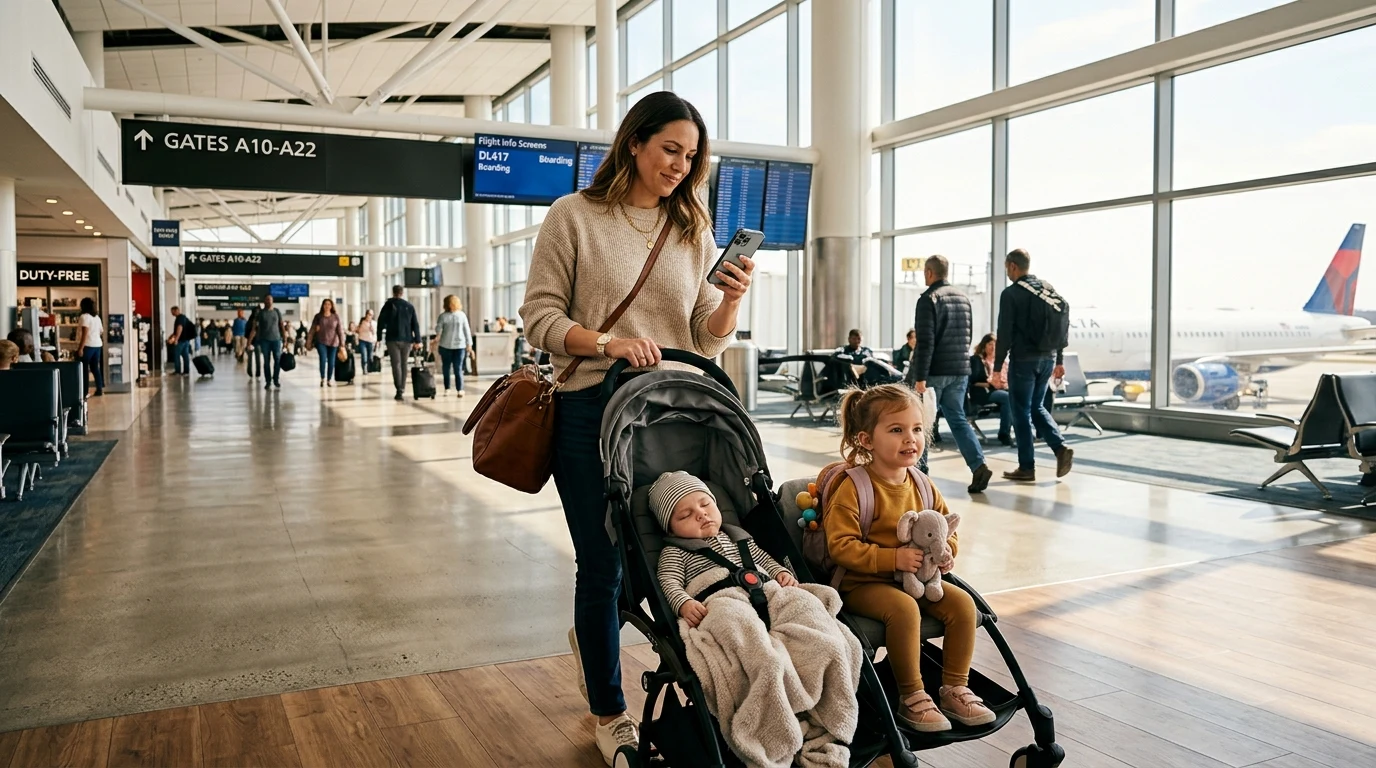
13. Can You Carry a Stroller or Car Seat?
Carrying infant mobility gear depends on its folded size and your airline's specific fleet setup. For complete details, consult our guide on infant stroller and airline travel policies:
- Compact Cabin Strollers: Ultra-compact folding strollers (such as the Babyzen YOYO or similar travel designs) that fold to standard overhead bag dimensions (around $55 \times 35 \times 25\text{ cm}$) can typically be brought into the cabin overhead bins. These items usually count toward your carry-on luggage limit.
- Gate-Checking Strollers: Standard-sized collapsible pushchairs and strollers are wheeled directly to the aircraft boarding door or jet bridge, tagged by ground staff, and loaded into the cargo hold just before departure. They are returned to the jet bridge upon arrival.
- Car Seats in the Cabin: You can use an approved car seat inside the aircraft cabin only if you have purchased an individual ticketed passenger seat for the infant. The car seat must feature an official aviation certification sticker (such as FAA airworthiness text in red lettering or UN ECE R44/129 labels) and fit between the aircraft's fixed armrests (typically 16 to 18 inches wide).
14. Important Travel Documents
Keep all physical documentation organized inside your personal item:
- Valid Passport (ensuring at least six months of validity beyond your stay)
- Entry Visas, transit authorizations, or digital travel receipts (ESTA, eTA, ETA)
- Physical printed and mobile boarding passes
- Printed hotel confirmations, tour bookings, and return flight itineraries
- Medical documentation, international vaccination records, or travel insurance certificates
- Local emergency contact phone numbers and consulate addresses
Never put travel documents into checked baggage. If an overhead bin is gate-checked due to space constraints, retrieve your document folder before releasing the bag to airline staff.
15. Valuables and Important Items
High-value, fragile, or irreplaceable items should always remain inside your carry-on bag:
- Passports, government IDs, credit cards, and cash
- High-end electronics, laptops, tablets, and mobile devices
- Prescription medications and essential medical equipment
- House keys and vehicle key fobs
- Delicate optical items and luxury watches
Under international aviation frameworks (such as the Montreal Convention), airline financial liability for lost, delayed, or damaged baggage is strictly capped at statutory maximum limits (approximately 1,288 Special Drawing Rights, roughly $1,700 USD). Airlines expressly exclude cash, jewelry, and expensive consumer electronics from checked-bag damage or theft claims under their standard Conditions of Carriage.
16. Jewelry, Cash and Valuables
- Cash Limits: You can carry cash through airport security checkpoints without universal airline limits. However, international customs rules require you to declare physical currency, negotiable instruments, or checks exceeding specific legal thresholds (typically $10,000 USD or local equivalent) upon entry or departure.
- Jewelry Handling: Keep valuable rings, necklaces, and luxury watches on your person or zipped into an interior pocket of your personal item. Never place loose valuables in security bins where they can be forgotten or misplaced.
17. What Sharp Objects Can You Carry?
Sharp items are heavily regulated at the security checkpoint to maintain aircraft safety:
- Scissors: Most international authorities (including the US TSA and UK DfT) permit small scissors if the blades measure less than $6\text{ cm}$ ($2.4\text{ inches}$) from the pivot point. However, policies vary; authorities in certain countries prohibit scissors of any size in the cabin.
- Razors: Disposable safety razors and disposable multi-blade cartridge heads are permitted in cabin baggage. Straight-edge barber blades, safety razor heads with exposed replaceable blades, and loose razor blades are strictly prohibited at the checkpoint and must be packed in checked luggage.
- Knives & Multi-Tools: Pocket knives, folding utility blades, Swiss Army knives, and multi-tools containing exposed blades of any length are prohibited in cabin bags.
- Nail Clippers & Tweezers: Standard personal grooming tweezers, metal nail clippers, and small emery boards are permitted through security screening.
18. Sports Equipment in Cabin Baggage
Aviation security rules classify heavy, blunt sporting equipment as potential weapons:
- Prohibited in Cabin: Baseball bats, cricket bats, golf clubs, hockey sticks, ski poles, trekking/hiking poles, martial arts gear, and pool cues are banned from cabin baggage. These items must travel in checked luggage.
- Permitted in Cabin: Tennis, squash, and badminton rackets are generally allowed through security, provided their length complies with your airline's carry-on dimensional boundaries. Deflated sports balls (basketballs, soccer balls) are permitted; inflatable balls must have air partially released to prevent pressure-related expansion at cruising altitudes.
19. Musical Instruments
Airlines manage musical instruments using three distinct approaches:
- Small Instruments: Violins, flutes, clarinets, and small ukuleles can generally be brought on board as your primary cabin overhead bag, provided they fit comfortably inside overhead bins.
- Large Instruments (Cabin Seat Baggage): Instruments too large for overhead lockers but too fragile for the cargo hold (cellos, guitars, double basses) can travel in the cabin if you purchase an extra adjacent passenger seat (often ticketed as "Seat Baggage" or "CBBG"). The instrument is strapped into a window seat using specialized seatbelt extensions.
- Checked Travel: Larger gear traveling in the hold should be packed in hard-shell flight cases built to withstand heavy mechanical baggage handling.
20. Cameras, Drones and Photography Equipment
Professional photographic gear is welcome in the cabin:
- Cameras & Lenses: Pack expensive camera bodies, delicate optical lenses, and memory card cases inside a padded carry-on bag to protect them from impact damage.
- Drones: Drones are permitted through security checkpoints, but their lithium-polymer (LiPo) batteries must be carried in cabin baggage. Store spare drone batteries in fire-retardant LiPo bags with terminals taped.
- Destination Drone Laws: Clearing departure security with a camera drone does not mean you can legally operate it at your destination. Destinations like Egypt, India, Morocco, and the UAE enforce strict import bans, licensing protocols, or confiscation procedures at customs for undeclared civilian drones.
21. E-Cigarettes / Vapes and Similar Devices
Electronic cigarettes, vape pens, and personal vaporizers are subject to strict dangerous-goods mandates:
- Cabin Bags Only: E-cigarettes and vape devices must be carried on your person or packed inside cabin baggage. They are strictly forbidden in checked luggage due to fire risks from accidental activation or battery malfunctions.
- Charging & Usage Banned: Recharging e-cigarette devices via aircraft seat USB ports or power outlets is banned by international civil aviation safety rules. Using or "vaping" on board an aircraft is a serious federal offense carrying heavy fines or arrest.
- Destination Legality: Ensure vapes are legal in your arrival country; destinations like Singapore, Thailand, and India enforce strict import bans on electronic nicotine delivery systems.
22. Lighters and Matches
- Permitted Formats: Security screening generally permits one small box of safety matches or one common consumer lighter (such as a standard Bic butane lighter) carried on your physical person (in your pocket).
- Prohibited Formats: "Strike-anywhere" matches, torch lighters, blue-flame jet lighters, and unsealed cans of lighter fuel/butane refill are strictly banned from both cabin and checked baggage.
- Never Pack in Bags: Lighters carried through security should remain on your person rather than packed inside your overhead carry-on.
23. Alcohol in Cabin Baggage
Carrying and consuming alcohol on an airplane involve two distinct sets of regulations:
- Checkpoint Restrictions: Alcohol brought from home must comply with standard liquid limits ($100\text{ ml}$ containers in your clear 1-liter plastic bag).
- Airport Purchases: Bottled wine and spirits purchased at post-security duty-free shops can be carried directly into the cabin.
- No Self-Service Consumption: Passengers are legally prohibited from opening and consuming their own alcohol on board an aircraft. Under global aviation safety rules, all alcohol consumed on a flight must be poured and served directly by cabin crew personnel.
24. Duty-Free Liquids
Duty-free purchases require careful handling, especially on a connecting flight:
[Purchase at Duty-Free] ──> Sealed in STEB with Visible Receipt
                                     │
         ┌───────────────────────────┴───────────────────────────┐
         ▼                                                       ▼
   Non-Stop Flight:                                        Connecting Flight:
 Direct to final destination;                       Subject to transit security rescreening;
 keep bag sealed until exit.                        must verify local hub transfer rules.
- Security Tamper-Evident Bags (STEBs): When purchasing liquid duty-free items exceeding $100\text{ ml}$ (perfumes, cosmetics, spirits), the retail store must seal the bottles in an officially approved STEB with the receipt clearly visible inside.
- Connecting Flight Complications: If you are connecting through another airport, you must pass through a transfer security checkpoint. Many international transit hubs (including those in the US and Europe) will clear sealed STEBs through special liquid scanners, provided the receipt was issued within the previous 48 hours. If a transfer checkpoint lacks compatible screening technology, your duty-free liquids will be confiscated unless you can exit to the ticketing hall and pack them into checked bags.
25. What Cannot Be Carried in Cabin Baggage?
The following table summarizes high-level prohibited categories across international aviation security standards:
| Prohibited Category | Specific Item Examples | Legal / Safety Justification |
|---|---|---|
| Explosives & Pyrotechnics | Flares, fireworks, dynamite, blasting caps, replica grenades | Severe risk of structural aircraft destruction |
| Flammable Liquids & Solids | Gasoline, lighter fluid, turpentine, spray paint, strike-anywhere matches | Uncontrollable cabin fire hazard |
| Firearms & Kinetic Weapons | Pistols, rifles, ammunition, stun guns, tear gas, pepper spray | Unlawful interference; immediate threat to cabin safety |
| Bludgeoning Tools | Baseball bats, billy clubs, crowbars, brass knuckles, heavy hammers | Classified as blunt weapons capable of incapacitating crew |
| Cutting & Piercing Blades | Utility box-cutters, straight razors, pocket knives, large shears | High-risk sharp weapons |
| Toxic & Corrosive Chemicals | Chlorine, bleach, spillable acid batteries, radioactive substances | Severe toxicity; corrosive risk to aircraft control systems |
26. Restricted vs Prohibited Items
Understanding the legal distinction between restricted and prohibited items prevents costly mistakes:
| Classification | Legal Aviation Meaning | Real-World Example |
|---|---|---|
| Prohibited | Items that cannot be carried on your person or in cabin baggage under any circumstances. | Dynamite, utility knives, pepper spray, lighter fluid |
| Restricted | Items permitted in the cabin only when specific parameters (volume, quantity, or packaging) are satisfied. | Liquids under $100\text{ ml}$, power banks under $100\text{ Wh}$, medical syringes with prescriptions |
27. Cabin Baggage vs Checked Baggage
Deciding where to pack your belongings requires balancing safety regulations, security restrictions, and airline handling practices:
| Travel Item | Cabin Baggage | Checked Baggage | Packing Guidelines |
|---|---|---|---|
| Laptops & Tablets | Yes (Recommended) | Strongly Discouraged | Lithium safety risks; damage or loss risks in the cargo hold. |
| Power Banks / Loose Cells | Mandatory | STRICTLY BANNED | Must remain in cabin to manage fire safety risks. |
| Prescription Medications | Yes (Recommended) | Strongly Discouraged | Keep in cabin to avoid loss during baggage delays. |
| Liquids Over 100 ml | Prohibited (Standard lanes) | Permitted | Pack tightly in leakproof bags inside checked luggage. |
| Large Sharp Objects / Knives | Prohibited | Permitted | Sheath securely to protect ground handlers. |
| Valuable Jewelry & Cash | Yes (Recommended) | Strongly Discouraged | Excluded from carrier liability policies. |
| Sports Bats & Clubs | Prohibited | Permitted | Must travel in heavy-duty checked sports bags. |
| E-Cigarettes & Vapes | Mandatory | STRICTLY BANNED | Fire prevention rules prohibit vapes in the hold. |
28. What Should You ALWAYS Keep in Cabin Baggage?
Never place the following items in your checked hold luggage:
- Passports, visas, and physical identification cards
- Essential prescription drugs and emergency medical hardware
- Lithium power banks and spare electronic device batteries
- Laptops, tablets, hard drives, and professional camera lenses
- House keys, car fobs, and apartment access cards
- High-value jewelry, luxury watches, and physical currency
- One full change of clothing and basic underwear (in case checked bags are delayed)
29. What Should NOT Be Packed in Cabin Baggage?
Avoid placing these items in your carry-on luggage:
- Full-sized liquids, full shampoo bottles, and sunscreen over $100\text{ ml}$
- Multi-tools with locking blades, pocket knives, or large scissors
- Trekking poles, tent pegs, and sporting bats
- Oversized power banks with capacities exceeding $160\text{ Wh}$ (prohibited entirely)
- Agricultural produce, raw meats, or fresh fruit meant for international arrival
30. Domestic vs International Cabin Baggage
| Travel Factor | Domestic Flights | International Flights |
|---|---|---|
| Security Screening | Enforces regional dangerous-goods and checkpoint liquid rules. | Enforces international standards; involves transit screening on connections. |
| Border Controls | No customs declarations upon landing. | Mandatory customs declarations for food, alcohol, tobacco, and high cash amounts. |
| Medication Rules | Domestic prescription labels are generally accepted. | Cross-border narcotics and controlled-medicine restrictions apply. |
| Duty-Free Liquids | Limited or non-existent for domestic legs. | Requires approved STEB packaging and verification of transfer rules. |
| Agricultural Products | Usually unrestricted (except between specific agricultural biosecurity zones). | Heavily restricted; raw food, produce, and plants are confiscated. |
31. Security Checkpoint: What Should You Remove From Your Bag?
Checkpoint screening setups vary by airport, terminal, and lane technology:
| Legacy 2D Lanes (Standard Steps) | Modern 3D CT Lanes (Automated) |
|---|---|
| • Remove laptop and place in bin | • Leave laptop and electronics inside bag |
| • Remove clear liquid bag | • Leave approved liquids in bag |
| • Remove bulky jacket / outerwear | • Remove bulky coats and heavy belts |
| • Empty all pocket contents into bin | • Keep luggage fully zipped closed |
Always follow the verbal instructions provided by screening personnel at your specific lane.
32. What Happens If Security Finds a Restricted Item?
If the X-ray operator flags an ambiguous or prohibited silhouette, your bag will be diverted to a secondary search table:
- Manual Physical Search: A screening officer will open your bag in your presence, systematically swabbing surfaces or visually inspecting flagged compartments.
- Voluntary Surrender (Confiscation): If an item is prohibited (e.g., an oversized bottle of perfume or a pocket knife), you will be given options: surrender the item for disposal, hand it to a non-traveling companion outside security, return to check-in to place it in checked baggage (if time permits), or mail it home via airport post services (where available).
- Security Escalation: If you attempt to carry undeclared weapons, explosive components, or severe hazardous goods, airport police will intervene, potentially resulting in civil fines, travel bans, or criminal charges.
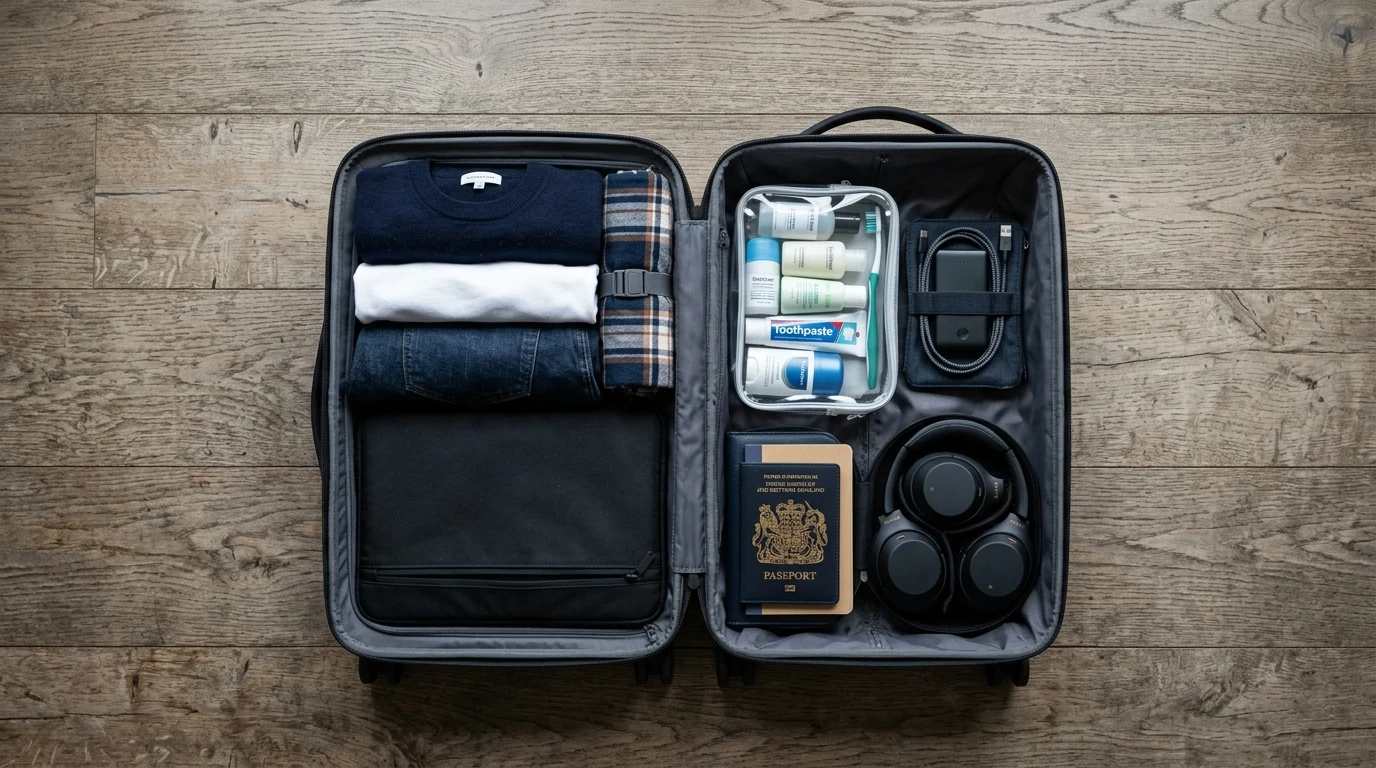
33. How to Pack Cabin Baggage Properly
Organize your bag strategically to make security screening fast and protect fragile equipment:
- Top Compartment & Easy-Access Pockets: Place your clear liquid pouch, boarding documents, and passport in top-zippered compartments so you can reach them instantly at the conveyor belt.
- Padded Tech Compartment: Slide your laptop, tablet, and e-reader into dedicated, padded sleeves positioned close to your back for balanced weight distribution.
- Middle Packing Zone: Pack soft clothing, shoes (stuffed with socks to preserve shape), and non-liquid toiletries in the center of your bag.
- Under-Seat Personal Item: Keep your prescription medications, charging cords, wired headphones, a power bank, and a light jacket in your small personal item under the seat so you do not need to open overhead lockers during the flight.
34. Cabin Baggage Packing Checklist
Use this pre-departure checklist before closing your carry-on bag:
- Passport, entry visas, and physical identification cards
- Mobile boarding passes downloaded locally for offline access
- Wallet, primary credit cards, and backup cash currency
- Smartphone, charging cables, and universal plug adapters
- Laptop and tablet fully charged for checkpoint power-on verification
- External power bank packed in the cabin (under $100\text{ Wh}$)
- Prescription medications in original containers with doctor's notes
- Liquids, gels, and aerosols packed in containers under $100\text{ ml}$
- All liquid containers placed in a 1-liter clear, resealable plastic bag
- Empty reusable water bottle ready for post-security refilling
- Baby formula, milk, or specialized food declared for separate screening
- House keys, jewelry, and irreplaceable family heirlooms
- Checked airline carry-on dimensions and maximum weight allowances
- Confirmed destination-country customs and biosecurity regulations
35. Common Cabin Baggage Mistakes
- Checking Dimensions Only: Forgetting to weigh your bag at home. A rolling suitcase may fit standard dimensions but still exceed an airline's $7\text{ kg}$ or $8\text{ kg}$ limit.
- Assuming Modern Scanners Are Everywhere: Packing full-sized liquids assuming your return airport features new 3D CT scanners, only to have expensive cosmetics confiscated on the way home.
- Packing Power Banks in Checked Luggage: Placing an external battery into checked baggage, triggering bag holds, manual luggage searches, or removal of the battery by ramp security.
- Carrying Fresh Produce Abroad: Forgetting an apple or sandwich in your backpack, leading to biosecurity inspection fines at international border control.
- Packing Daily Medicines in Checked Bags: Leaving essential daily medications in checked luggage that gets delayed or misplaced.
- Overlooking Codeshare Limits: Flying the return leg of an international journey on a regional partner airline with tighter carry-on weight limits than the mainline carrier.
36. Real-Life Examples
Example 1: Laptop + Charger + Power Bank
- Scenario: A business traveler packs an enterprise laptop, an AC charger cord, and a $20,000\text{ mAh}$ ($74\text{ Wh}$) power bank.
- The Rule: Laptops and chargers are permitted in the cabin. The power bank is well under the $100\text{ Wh}$ ceiling and must travel in cabin baggage.
- Mistake to Avoid: Do not put the power bank in a checked suitcase; it will be detected and removed by baggage screeners.
Example 2: Perfume, Toothpaste and Sunscreen
- Scenario: A passenger packs a $50\text{ ml}$ perfume spray, a $150\text{ ml}$ tube of toothpaste with only a quarter remaining, and a $90\text{ ml}$ bottle of liquid sunscreen.
- The Rule: The perfume and sunscreen are accepted because their containers are under $100\text{ ml}$. The toothpaste will be confiscated at standard checkpoints because its container capacity ($150\text{ ml}$) exceeds the legal threshold, regardless of how much paste remains inside.
- Mistake to Avoid: Do not evaluate liquids by remaining volume; security staff assess printed container capacity.
Example 3: Prescription Liquid Medication
- Scenario: A passenger travels internationally carrying a $250\text{ ml}$ bottle of essential prescription cough medication and daily asthma inhalers.
- The Rule: Medically necessary liquids are exempt from the standard $100\text{ ml}$ limit at security screening.
- Action Required: Keep the medication in its original pharmacy packaging showing your name, carry a doctor's prescription note, and declare the liquid to the screening officer before your bag enters the scanner.
Example 4: Packaged Snacks on an International Route
- Scenario: A traveler packs pre-packaged dry crackers, sealed candy bars, and two fresh oranges for a transatlantic flight.
- The Rule: All items easily clear departure airport security screening. However, arrival customs regulations ban fresh citrus fruit to protect domestic agriculture.
- Action Required: Eat or dispose of the fresh oranges before reaching the international border control hall; the processed crackers and candy bars can be brought through safely.
Example 5: Empty Reusable Water Bottle
- Scenario: A flyer brings an empty $750\text{ ml}$ stainless-steel thermal water bottle through the terminal screening lane.
- The Rule: Completely permitted. Empty containers of any volume size can pass through security screening.
- Action Required: Ensure the bottle is completely dry and empty before joining the queue, then refill it at a post-security water station before heading to your gate.
Example 6: Duty-Free Spirits on a Connecting Itinerary
- Scenario: A traveler buys a bottle of whiskey at a duty-free shop during a layover in Europe, then catches a connecting domestic flight.
- The Rule: The bottle exceeds $100\text{ ml}$ and must remain sealed inside an approved Security Tamper-Evident Bag (STEB) with the retail receipt visibly sealed inside.
- Mistake to Avoid: Never break the tamper-evident seal before reaching your final destination, and verify whether the transit hub's security checkpoint accepts off-airport duty-free liquids during transfers.
37. Quick Answer Table
| Item | Can You Carry It in Cabin? | Important Conditions to Verify |
|---|---|---|
| Smartphone | Yes | Switch to airplane mode during flight taxi, takeoff, and landing. |
| Laptop / Tablet | Yes | Must be accessible for security screening; check lane scanning rules. |
| Power Bank | Yes (Cabin Only) | Must be under $100\text{ Wh}$ (101–160 Wh requires airline consent; >160 Wh banned). |
| Prescription Medicine | Yes | Medically necessary liquids are exempt from the 100 ml cap; carry prescriptions. |
| Toiletries (Liquids/Gels) | Restricted | Containers must be $\le 100\text{ ml}$ and fit in a 1-liter clear bag (standard lanes). |
| Solid Snacks / Packaged Food | Yes | Spreads and dips count as liquids; fresh foods face destination customs bans. |
| Empty Water Bottle | Yes | Must be fully empty before security screening; refill after the checkpoint. |
| Compact Travel Stroller | Airline Dependent | Allowed in overhead bins if folded within cabin bag dimensions; else gate-check. |
| Certified Infant Car Seat | Airline Dependent | Permitted in cabin only with a separate purchased passenger seat and safety label. |
| Camera & Lenses | Yes | Pack in padded carry-on; spare lithium batteries must remain in the cabin. |
| Civilian Camera Drone | Yes | Drone batteries must be in cabin bags; check destination-country drone laws. |
| E-Cigarettes / Vapes | Yes (Cabin Only) | Strictly banned in checked luggage; onboard charging and use are prohibited. |
| Small Safety Scissors | Restricted | Blades must measure under $6\text{ cm}$ ($2.4\text{ in}$) from pivot; rules vary by country. |
| Duty-Free Alcohol | Restricted | Must be sealed in an official STEB with receipt; check transit screening rules. |
Frequently Asked Questions
You can carry standard clothing, books, personal documents, laptops, mobile devices, external power banks, essential medications, small snacks, and toiletries that comply with applicable liquid restrictions.