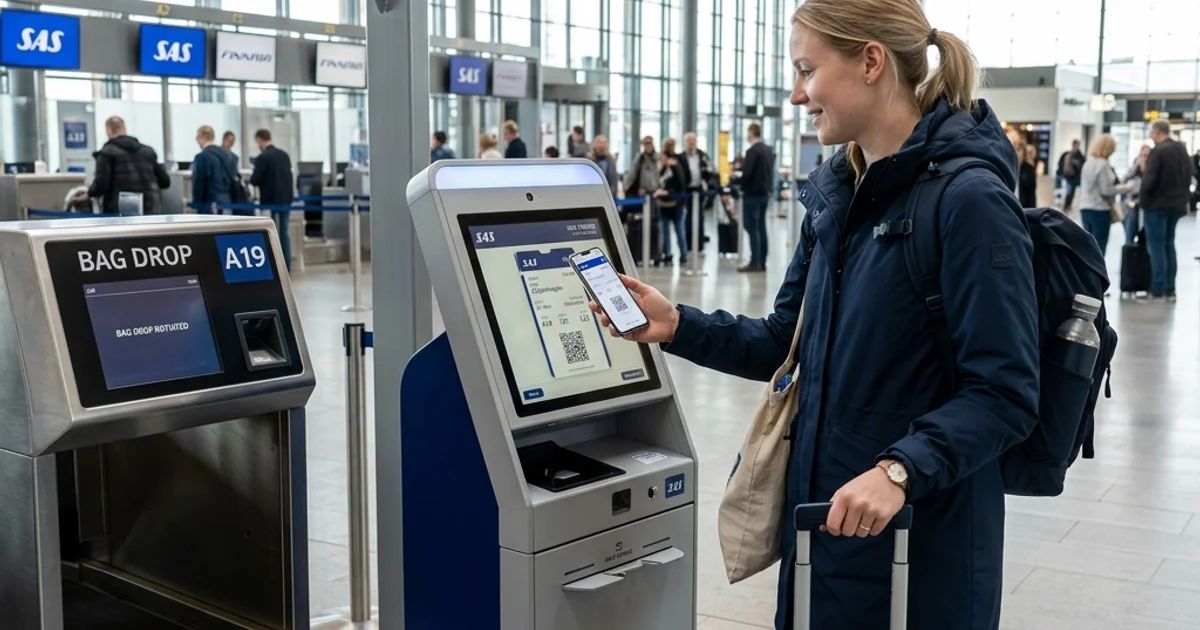
If you miss a connecting flight, what happens next depends mainly on why you missed it and whether the flights are part of the same ticket.
Missing a flight connection is incredibly stressful, but the solution is usually straightforward if you understand the rules. If the first flight is delayed and causes you to miss a connection booked on the same ticket, the airline may have obligations to assist or rebook you depending on the airline's rules and applicable passenger-rights laws.
Conversely, if you booked separate tickets or are making a self-transfer, the second airline may generally treat the missed flight differently, often leaving you responsible for purchasing a new ticket out of pocket.
The outcome also changes drastically if you missed the flight due to your own delay—such as lingering too long at a restaurant or misjudging the time it takes to clear transit security. Below, we break down exactly what to expect, who pays for a replacement ticket, and what you should do immediately to get back on track.
 Original AI-generated editorial image created for Farewander. Knowing your rights immediately after a missed connection saves time and stress.
First: Find Out Why You Missed the Connection
Before asking for a new ticket or compensation, identify the exact reason the connection was missed. This is the most important factor in determining the airline's responsibility.
A connection can be missed due to:
- First flight delay
- First flight cancellation
- Unannounced gate change
- Airport operational disruption
- Security or immigration delay
- Passenger arrived late to the airport
- Passenger went to the wrong gate
- Passenger intentionally skipped the flight
- Separate-ticket connection misalignment
- Self-transfer complications
Documenting the reason matters because it directly dictates whether you are entitled to a free rebooking, alternative transportation, meals, hotel accommodation, or financial compensation. Always ask airline staff for a written delay certificate or make a note of the exact operational issue provided.
If You Miss a Connecting Flight on the Same Ticket
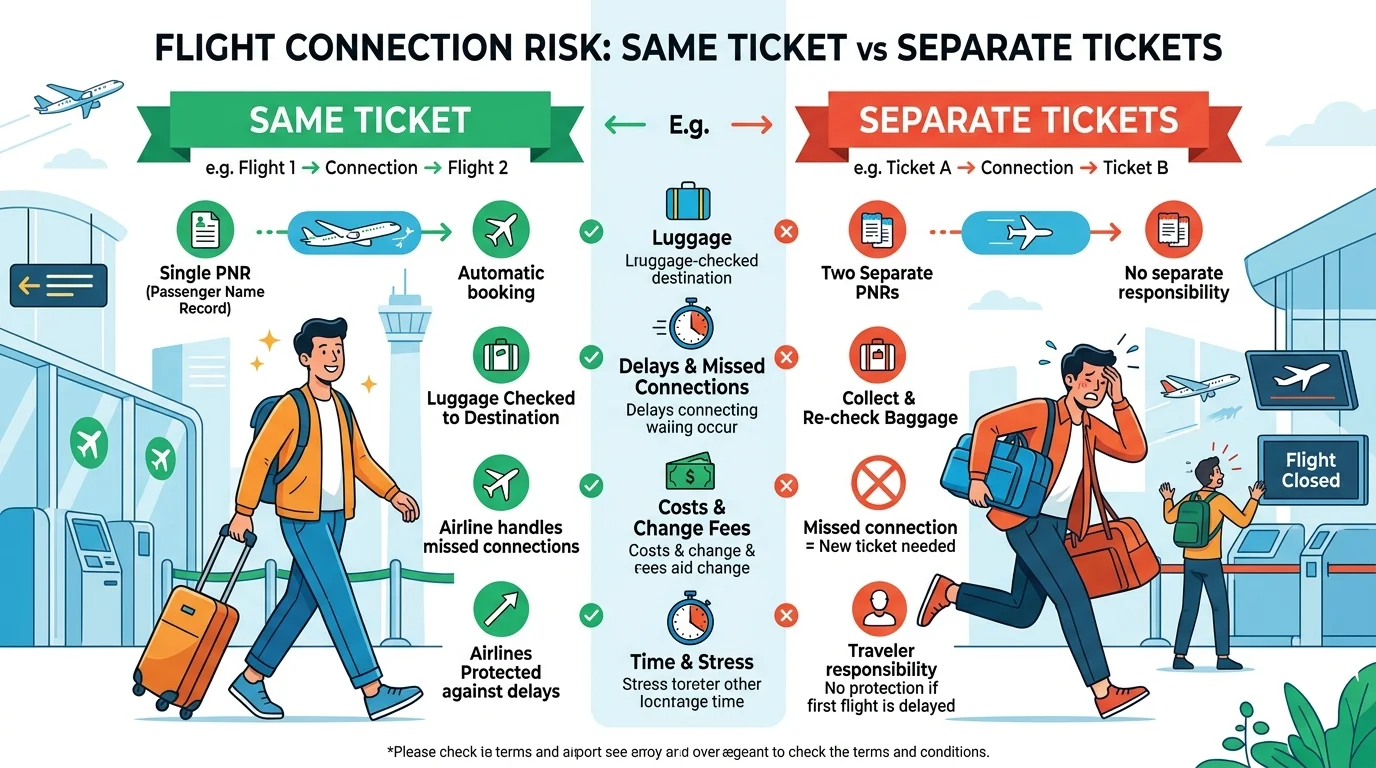
A same-ticket itinerary is generally different from separate tickets. When you book a single itinerary, the airline has sold you a contract to transport you from your origin to your final destination.
If an earlier flight disruption (like a delayed departure or maintenance issue) causes a missed connection, the airline may rebook the traveler under its applicable rules and conditions of carriage.
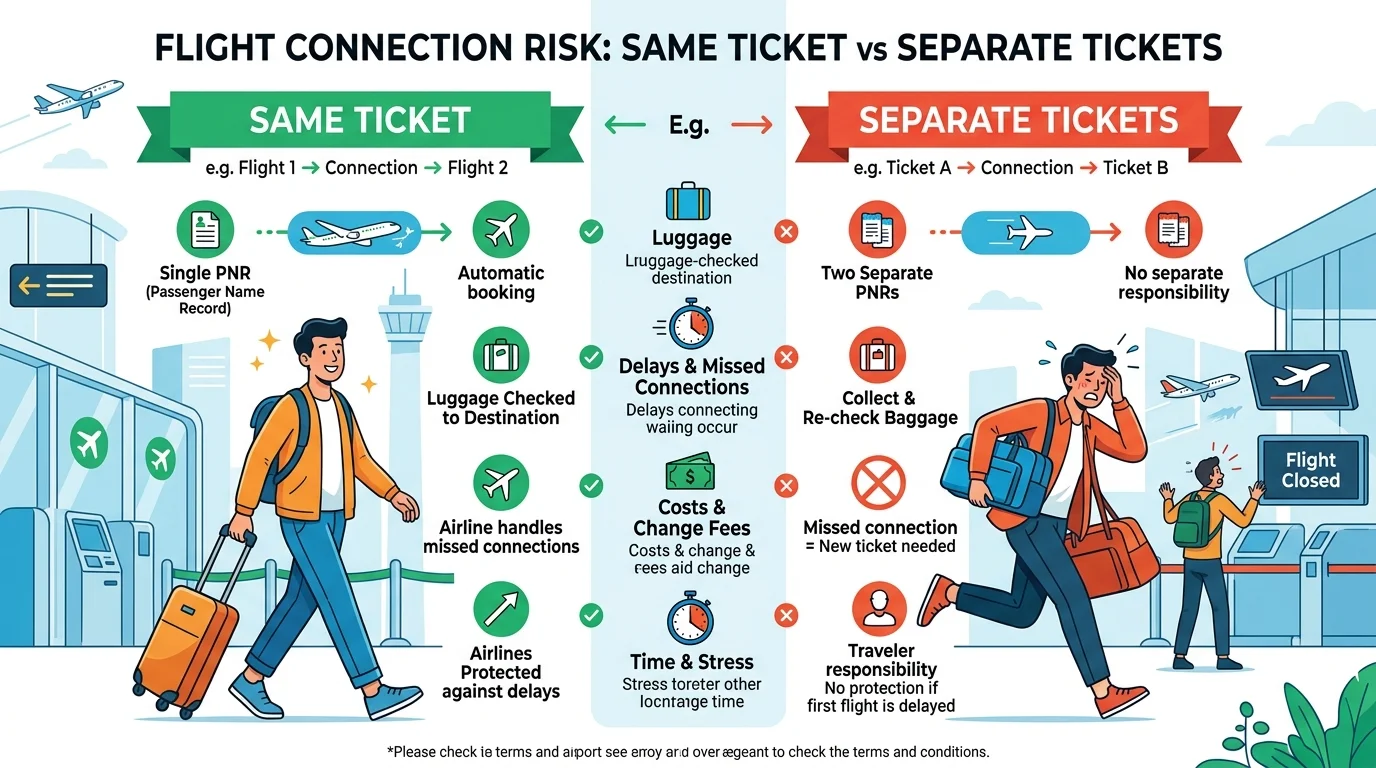 Original AI-generated editorial image created for Farewander. Booking on the same ticket offers vital protection.
Possible outcomes on a protected itinerary may include:
- Rebooking on the next available flight to your destination.
- Rerouting through a different hub or on a partner airline.
- Standby placement if confirmed seats are unavailable.
- Alternative transportation in some circumstances (e.g., trains for short distances).
- Refund options in applicable cases if you choose to abandon the journey.
- Hotel and meal vouchers where required by law or airline policy for overnight delays.
Keep in mind that rights depend heavily on the country/jurisdiction, the specific cause of the disruption, the airline, ticket conditions, and applicable passenger-rights regulations.
Comparing Fares for Your Route?
Search live multi-airline schedules, spot discount windows, and baggage fee rules on FareWander.
If the Airline Caused You to Miss the Connection
If you missed your second flight due to circumstances under the airline's control, they generally bear the responsibility of getting you to your destination.
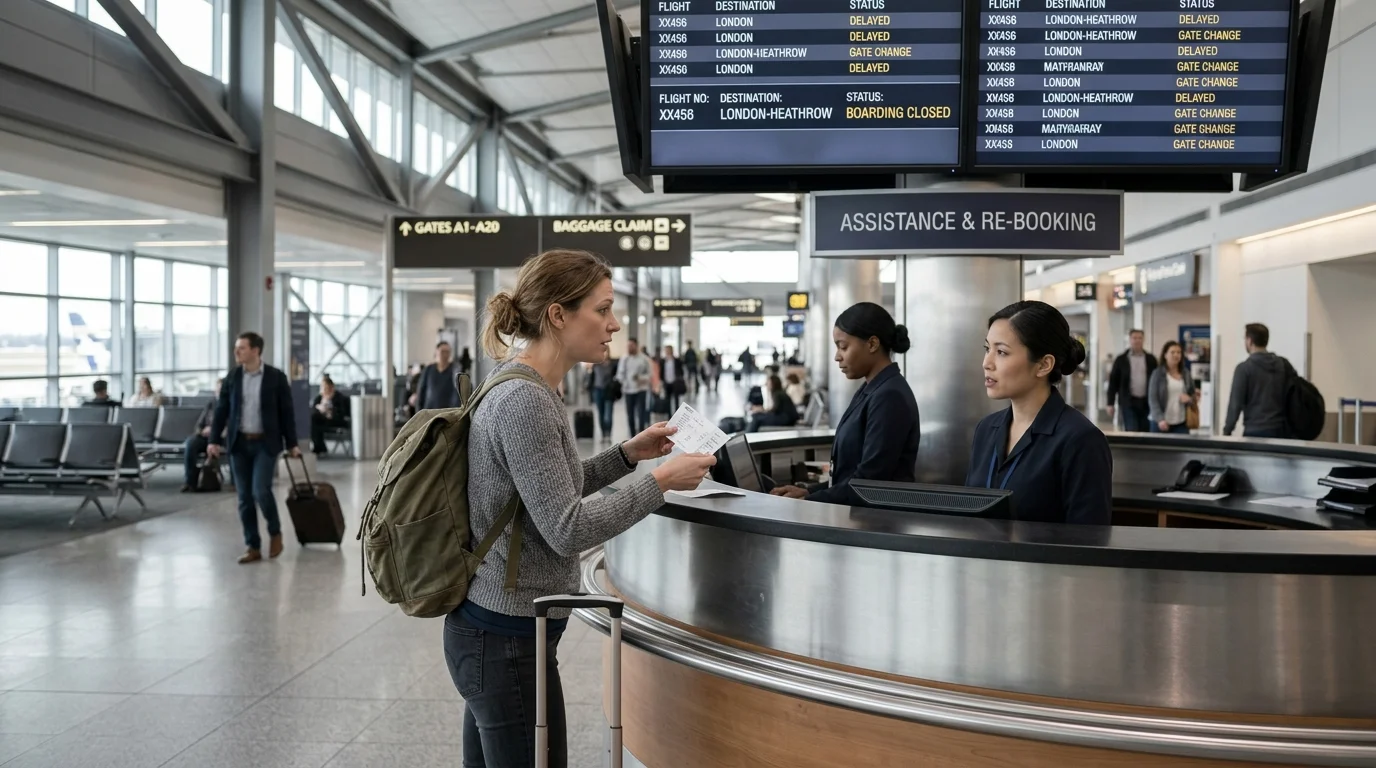 Original AI-generated editorial image created for Farewander. If the airline caused the delay, they are generally responsible for rebooking you.
Examples of airline-caused missed connections include:
- First flight delayed
- Flight cancellation
- Operational disruption
- Aircraft issue or maintenance delay
- Crew issue or staffing shortage
- Airline schedule change
It is vital to understand the difference between rebooking/assistance and compensation. A traveler may have a right to assistance or rerouting without necessarily having a right to monetary compensation. For example, an airline may rebook you on the next flight and pay for your hotel, but they may not owe you a cash payout depending on the jurisdiction and cause of the delay.
If You Miss the Connection Because of Your Own Delay
Sometimes, the traveler is at fault. Examples of passenger-caused missed connections include:
- Arriving late at the airport.
- Arriving after check-in closes.
- Arriving late at the departure gate.
- Spending too long outside the terminal or in an airport lounge.
- Ignoring boarding announcements.
- Voluntarily leaving the airport without enough time to return.
- Failing to meet airline documentation requirements.
If the delay is your fault, the airline may not be responsible for the resulting missed flight. In this situation, the traveler may need to contact the airline, request a rebooking, pay any applicable fare difference or change fees, or purchase an entirely new ticket depending on the fare rules.
What If You Miss a Connecting Flight on Separate Tickets?
Booking separate tickets means you hold two distinct booking confirmation codes that are not linked in the airline's reservation system.
Example:
- Ticket 1: Delhi → Dubai
- Ticket 2: Dubai → London
If the first airline delays the first flight and the traveler misses the separately booked second flight, the second airline may not be obligated to protect the connection in the same way as a single-ticket itinerary. To the second airline, you are simply a "no-show".
Risks of separate tickets include:
- A new, expensive last-minute ticket may be required.
- Substantial rebooking fees and fare differences.
- Baggage must be collected and re-checked.
- Visa/transit complications if you must cross the border to retrieve luggage.
- No protected connection or guaranteed assistance.
Do not assume two flights form a protected connection just because a booking website displayed them together.
Planning Travel Logistics?
Use FareWander tools to calculate flight times, luggage rules, and visa requirements.
What If You Miss a Self-Transfer?
A self-transfer means the passenger independently manages the connection, often utilizing separate booking references on airlines that do not have interline agreements.
During a self-transfer, baggage may need collection, immigration/customs may be required, check-in may need to be repeated, and security must be cleared again. The passenger generally carries all connection risk. If you miss a self-transfer due to a delay on your first leg, you are almost always liable for the cost of a replacement flight.
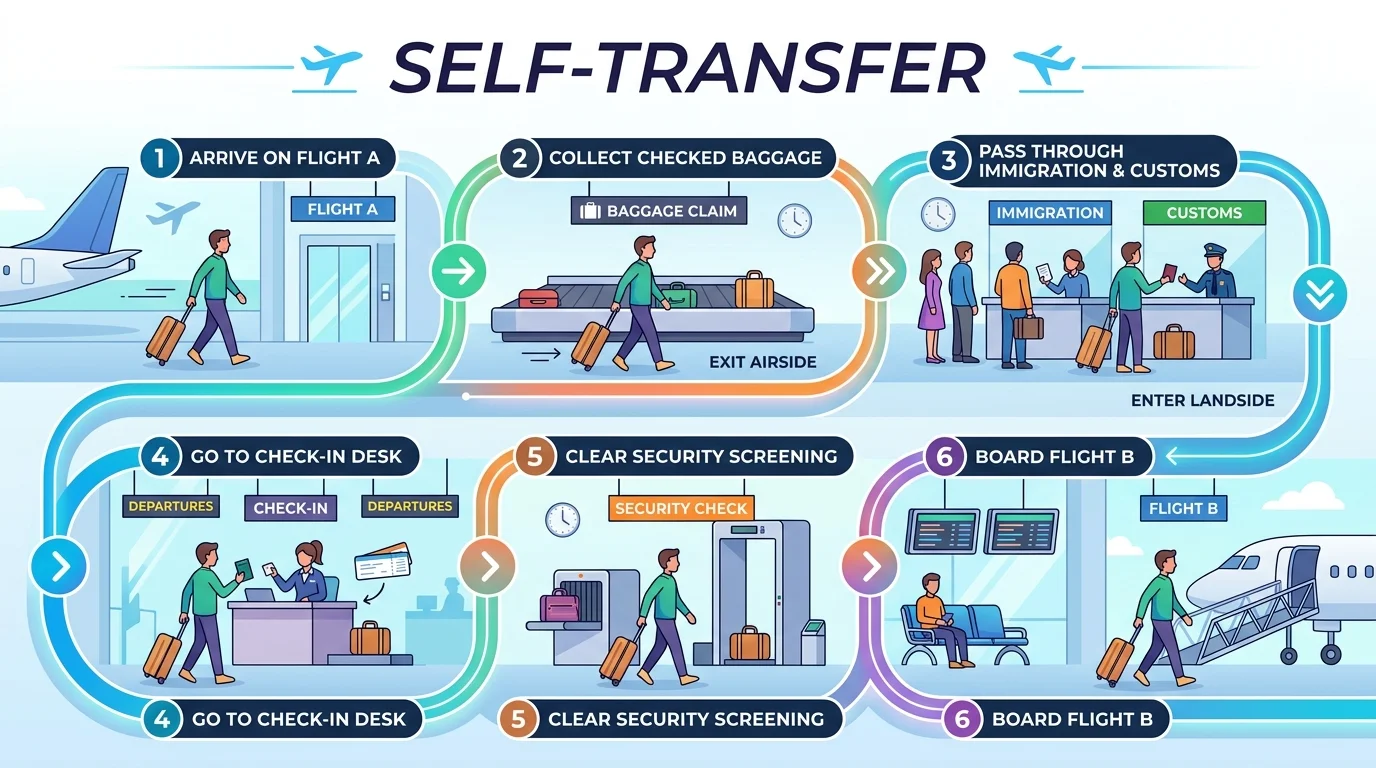 Original AI-generated editorial image created for Farewander. Self-transfers carry significantly more risk and require careful planning.
What Happens to Your Checked Baggage?
Baggage handling during a missed connection is a major concern. It generally depends on the ticketing arrangement:
- Same-ticket protected itinerary: If both flights are booked together, your checked bags are typically transferred automatically to your final destination. If you are rebooked due to a missed connection, the airline's baggage system usually reroutes your luggage to match your new flight.
- Separate tickets: You must collect your bags from the baggage carousel, exit to the public check-in hall, and re-check them for the second carrier. If you miss the flight, you must take your bags with you and manage them yourself while rebooking.
- Self-transfer: The passenger manages the baggage independently.
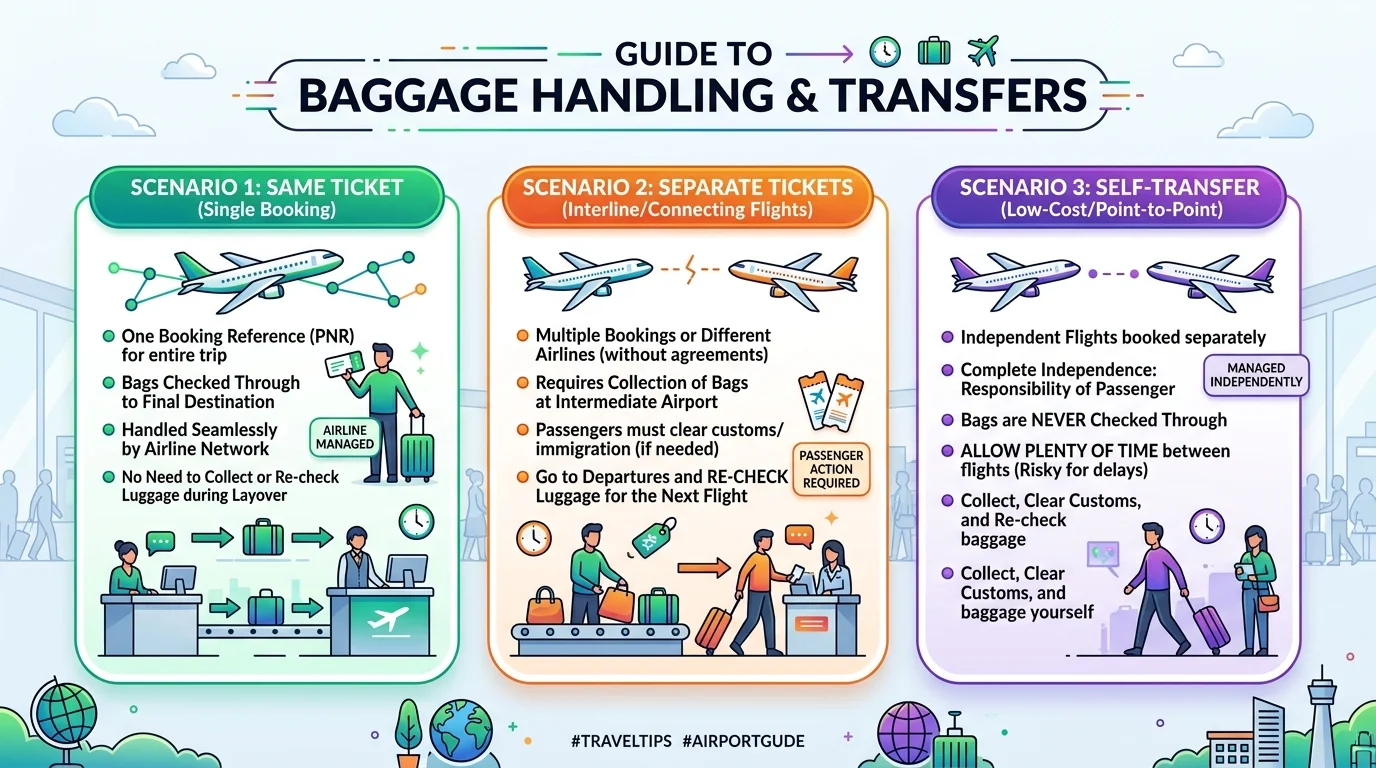 Original AI-generated editorial image created for Farewander. Always verify your baggage's final destination at the check-in desk.
Never assume your bag will automatically follow you if travel plans change abruptly. Always check the final destination printed on your baggage tag, follow airline instructions, and visit the transfer desk or baggage tracing desk to confirm your luggage's status.
Will the Airline Rebook You?
Rebooking depends on the circumstances and applicable rules.
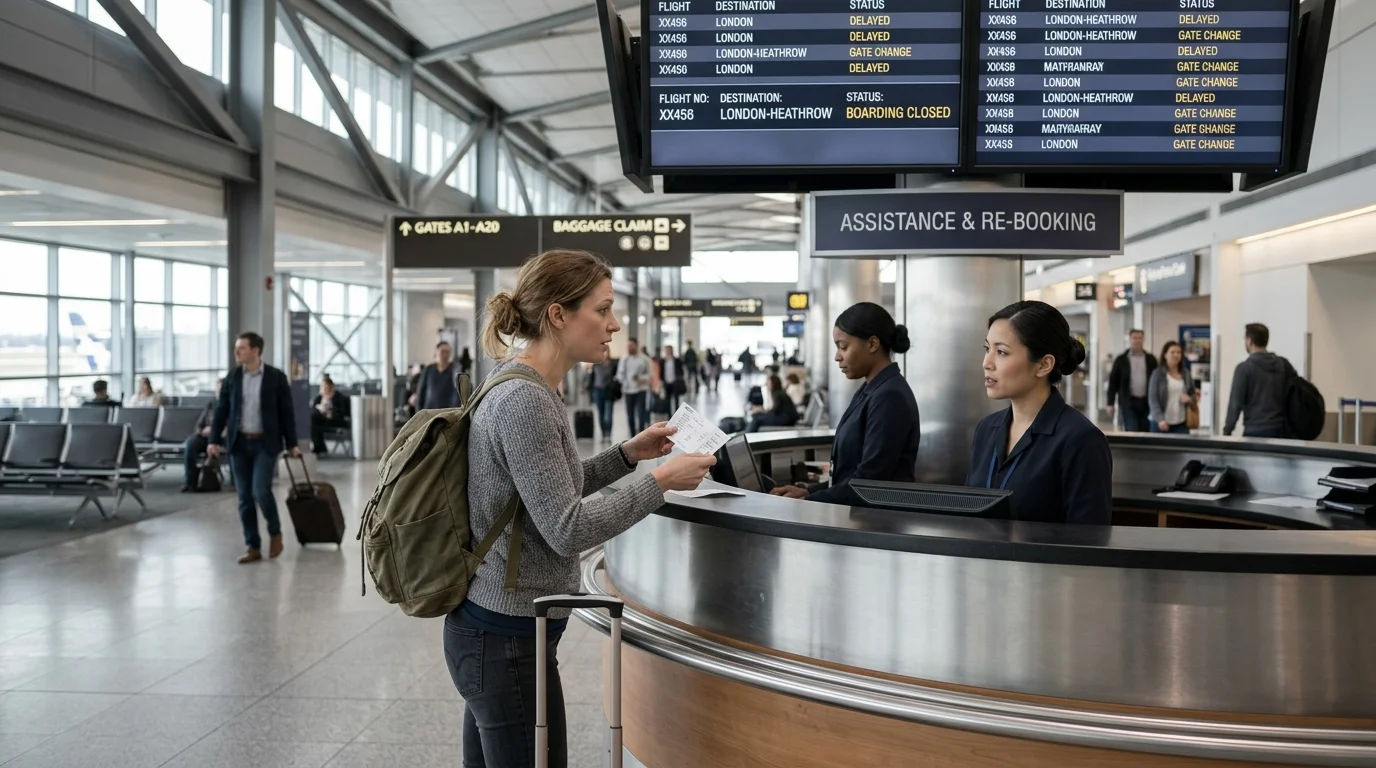
 Original AI-generated editorial image created for Farewander. Speak to a transfer agent as soon as possible to secure a seat on the next available flight.
On a same-ticket + airline-caused disruption, the airline will generally provide a confirmed rebooking on the next available flight to your destination, or place you on standby if flights are full. They may also explore rerouting on partner airlines.
For a passenger-caused missed connection, the airline may rebook you, but they are likely to charge a fee or fare difference depending on the strictness of the ticket's fare class.
For a separate-ticket missed connection or self-transfer, the second airline is under no obligation to rebook you for free. You will likely be asked to purchase a new flight at the current market rate.
Who Pays for a New Flight?
Applicable laws and airline terms can change the outcome, but here is a general overview:
| Situation | Who may bear the cost? |
|---|---|
| Airline-caused missed connection on protected itinerary | The operating/ticketing airline |
| Passenger-caused missed connection | The passenger |
| Separate-ticket connection missed | The passenger |
| Self-transfer missed | The passenger |
| Weather disruption | Airline rebooks for free on protected tickets, but usually doesn't pay compensation |
| Airport/security issue | Varies; usually the passenger on standard tickets |
| Visa/immigration issue | The passenger |
Can You Get Compensation for a Missed Connection?
Compensation is highly jurisdiction-specific. Eligibility can depend on the departure/arrival jurisdiction, airline nationality, the specific reason for the disruption, the total delay at your final destination, whether the itinerary was a single reservation, extraordinary circumstances under applicable law, and passenger compliance.
Do not assume you will receive cash just because you missed a flight. Assistance (like a hotel and a new flight) is different from financial compensation.
EU Passenger Rights and Missed Connections
Under EU Regulation 261/2004, passengers enjoy robust protections. When EU rules apply (e.g., departing from an EU airport, or arriving in the EU on an EU carrier), a missed connection caused by an airline delay may entitle you to assistance, rerouting, or a refund.
 Original AI-generated editorial image created for Farewander. Passenger rights differ greatly depending on your jurisdiction.
If the delay at your final destination exceeds three hours, you may also be eligible for monetary compensation, provided the delay was not caused by "extraordinary circumstances" (such as severe weather or air traffic control strikes). These rules generally apply strictly to qualifying itineraries booked as a single reservation. Check the latest official European Commission passenger-rights source for detailed eligibility as of 28 August 2026.
UK Passenger Rights and Missed Connections
Following Brexit, the UK implemented UK261, a UK passenger-rights framework heavily based on the EU model. Where applicable, it offers similar provisions for rerouting, care, and compensation for delays and missed connections caused by airline faults. Research the current official UK Civil Aviation Authority (CAA) guidance for exact compensation limits and qualifying itineraries as of 28 August 2026.
U.S. Passenger Rights and Missed Connections
U.S. passenger protections differ drastically from EU/UK frameworks. The U.S. Department of Transportation (DOT) does not mandate flat-rate financial compensation for ordinary flight delays or airline-caused missed connections.
However, airlines are bound by their specific Customer Service Plans and conditions of carriage regarding delays, cancellations, and rebooking policies. Many major U.S. airlines have committed to providing meals and hotel accommodation for significant, controllable delays. Passengers may also have refund rights if they choose not to travel following a significant schedule change or cancellation.
What If the Missed Connection Was Caused by Weather?
Weather may affect airline responsibility and compensation differently from airline-controlled disruptions. If severe storms cause you to miss a protected connection, the airline will generally rebook you on the next available flight.
However, because weather is considered an "extraordinary circumstance" outside the airline's control, they are usually exempt from paying monetary compensation. Furthermore, airline-specific policies may limit their obligation to provide hotel accommodations or meal vouchers during weather events, which is where having comprehensive travel insurance becomes critical.
What If Immigration or Security Made You Miss the Flight?
Lengthy security queues, terminal transfers, customs processing, or visa document issues frequently cause travelers to miss flights.
It is important to distinguish an airline operational issue from a passenger documentation issue or a normal airport bottleneck. Airlines generally view security and immigration delays as the passenger's responsibility to manage by allowing adequate time. Unless the airline explicitly provided an invalid minimum connection time on a protected ticket, you may be responsible for the cost of rebooking.
What If the Gate Closes Before You Arrive?
The gate closing deadline can be significantly earlier than the scheduled departure time. A flight scheduled to depart at 8:00 AM may have a strict gate closure at 7:45 AM. If you arrive at 7:46 AM, you will be denied boarding, even if the aircraft is still parked.
Always follow the airline's published boarding deadlines and check-in deadlines. These times are absolute, and arriving late at the gate shifts the fault of the missed connection to the passenger.
What to Do Immediately After Missing Your Connection
If you realize you have missed or are about to miss your flight, follow this action plan:
 Original AI-generated editorial image created for Farewander. Follow these essential steps immediately after a missed flight.
- Stay at the airport; do not leave the secure area if possible.
- Check the airline app or website for automatic rebooking updates.
- Go directly to the airline transfer desk or rebooking desk.
- Explain clearly why you missed the connection.
- Ask for the next available routing to your destination.
- Ask whether your checked baggage has been rerouted.
- Ask about hotel and meal vouchers if the delay extends overnight.
- Keep all receipts for essential purchases.
- Keep boarding passes and booking confirmations.
- Take screenshots of delay or cancellation notices on airport boards.
- Ask for written confirmation of your rebooking or a delay certificate.
- Contact your travel insurance provider if relevant.
Do not immediately buy a new ticket out of pocket before checking whether the airline will rebook you, unless you are on separate tickets and have no other choice.
What to Say to the Airline Agent
Approaching the desk with a clear, calm explanation yields the best results.
Same-Ticket Version:
"My inbound flight was delayed and I missed my connecting flight. Both flights are on the same reservation. Could you please check the next available protected routing to my final destination and confirm what happens to my checked baggage?"
Separate-Ticket Version:
"I missed my flight due to a delay on a separate incoming carrier. I know these are separate tickets, but could you please let me know my options for rebooking or flying standby on the next departure?"
Can You Get a Hotel If You Miss Your Connection?
Hotel accommodation may depend on the cause of the disruption, the jurisdiction, the airline's policy, the length of the delay, and whether an overnight stay is required.
If the airline caused the delay on a single-ticket itinerary, many jurisdictions (like the EU) mandate hotel care. In the U.S., it depends on the airline's specific commitments. If weather caused the delay, or if you booked separate tickets, you will likely need to pay for a hotel yourself. Always ask the airline before paying for accommodation where practical.
Can You Get a Refund If You Miss Your Connection?
Refund rights depend on applicable law and fare/ticket terms.
You must distinguish between a voluntarily missed flight, an airline cancellation, an airline-caused missed connection where the passenger chooses not to travel, and an involuntary rerouting. If an airline severely delays your first leg and you miss your connection, you may have the right to abandon the trip and seek a refund for the unused portions of the ticket. If you simply arrived late, your ticket may be non-refundable. Consult official government sources for country-specific legal rights.
What Happens to the Rest of Your Itinerary?
If a passenger misses a flight segment without contacting the airline, later segments can sometimes be affected depending on the airline's rules.
Failure to notify the airline or check in prior to flight departure results in a "no-show" status. On a round-trip or multi-segment ticket, missing one flight segment typically forfeits the ticket value and automatically cancels downstream flight segments on the same itinerary. Contact the airline immediately if you miss a flight to protect your return journey.
Missed Connection vs Missed Flight
Understanding the terminology is crucial:
- Missed flight: A passenger fails to board the flight they were booked on, often at their initial origin airport.
- Missed connection: A passenger successfully completes one flight segment but fails to board the next consecutive segment in the itinerary due to delays or transit issues.
Minimum Connection Time: Why It Matters
Minimum Connection Time (MCT) is the absolute minimum time an airport and airline system may allow for a valid connection under specific conditions.
An MCT takes into account terminal changes, domestic to international routing, international to domestic routing, security screening, immigration, and airport size. However, a valid MCT is not the same as a comfortable buffer. Just because a system allows a 45-minute connection does not mean it guarantees a stress-free or successful transfer.
How Much Connection Time Should You Leave?
While there is no universal number, practical planning guidance suggests:
- Domestic connections: Generally 45 to 90 minutes.
- International connections: Usually 90 to 150 minutes to clear passport control and security.
- Separate tickets or Self-transfer: A minimum of 3 to 4+ hours.
Many travelers prefer a larger buffer for international or self-transfer itineraries because more steps, such as terminal changes and baggage re-checks, can be involved.
Travel Insurance for Missed Connections
Coverage can depend entirely on your specific policy. Look for benefits regarding missed connections, trip delay, trip interruption, additional transportation, accommodation, and meals.
Read your policy's covered reasons, exclusions, documentation requirements, claim limits, excess/deductible, and notification requirements. Always obtain written proof of the delay from the airline to file a successful claim.
Common Mistakes After Missing a Connecting Flight
- Leaving the airport secure area without contacting the airline.
- Buying a replacement ticket immediately before checking your rights.
- Assuming separate tickets are automatically protected.
- Ignoring baggage tracing procedures.
- Not checking if future segments (like a return flight) were automatically canceled.
- Throwing away itemized receipts for meals and hotels.
- Not documenting the delay with a formal airline certificate.
- Assuming financial compensation is automatic everywhere.
- Ignoring visa or transit requirements if rerouted through a different country.
- Booking an airport hotel out of pocket without checking for airline assistance first.
Realistic Examples
Example 1: Delhi → Doha → London
- First flight delayed → missed London connection → same ticket.
- What happened: Airline-caused delay on a protected itinerary.
- Likely next step: The airline will rebook the traveler on the next flight to London and transfer the baggage.
- What traveler should do: Visit the transfer desk immediately.
Example 2: Mumbai → Dubai → Paris
- Passenger arrives late at gate.
- What happened: Passenger-caused delay.
- Likely next step: The airline may rebook, but the passenger may face fees or fare differences.
- What traveler should do: Speak to the airline; do NOT assume it's free.
Example 3: Delhi → Dubai (Ticket 1) / Dubai → London (Ticket 2)
- First flight delayed → missed second flight.
- What happened: Separate-ticket connection missed.
- Likely next step: The second airline treats the passenger as a no-show. The passenger must buy a new ticket to London.
Example 4: Bengaluru → Doha → Frankfurt
- Self-transfer missed.
- What happened: Passenger failed to manage the connection in time.
- Likely next step: Passenger assumes all financial responsibility.
Example 5: International arrival → immigration delay → missed onward flight.
- What happened: Airport bottleneck on a same-ticket domestic connection.
- Likely next step: The airline will generally place the traveler on standby for the next flight, though it can be stressful.
Example 6: Weather disruption → missed connection.
- What happened: Uncontrollable delay.
- Likely next step: The airline rebooks the passenger on a protected ticket, but hotel and compensation are typically not provided.
Missed Connecting Flight: Decision Tree
 Original AI-generated editorial image created for Farewander. A quick guide to identifying your next steps following a missed connection.
DID YOU MISS YOUR CONNECTION? ↓ Was it caused by the airline?
- YES ↓
- Were both flights on the same ticket?
- YES → Contact airline for rebooking/assistance and check applicable passenger rights.
- NO → Contact both airlines; the second ticket may not be protected.
- Were both flights on the same ticket?
- NO ↓
- Did you miss it because of your own actions?
- YES → Contact airline immediately; rebooking may involve additional cost.
- NO / UNCLEAR → Document what happened and speak to the airline transfer desk.
- Did you miss it because of your own actions?
How to Prevent Missing a Connecting Flight
- Choose a reasonable connection time, leaving a solid buffer.
- Avoid risky self-transfers unless you leave 4+ hours.
- Prefer one-ticket itineraries when appropriate.
- Check terminal changes before booking.
- Know the airport's minimum connection time.
- Keep passport and travel documents accessible.
- Monitor flight status constantly.
- Download the airline's mobile app for live alerts.
- Go directly to the connecting gate upon landing.
- Understand the airport layout.
- Allow extra time for immigration and security checkpoints.
- Avoid unnecessary airport exits during short connections.
- Verify baggage arrangements at your first check-in point.
Internal Links & Guides
- What Is a Layover? Complete Guide to Layover Flights — Understand how layovers work.
- What Is a Stopover? Stopover vs Layover Explained — Learn the difference between a stopover and a layover.
- What Is a Codeshare Flight? How Codeshare Flights Work — Understand codeshare flights.
- How Early Should You Arrive at the Airport for an International Flight? — See how early you should arrive at the airport.
- What Is a Red-Eye Flight? — Explore red-eye flights.
Conclusion
If you miss a connecting flight, the single most important factor is why the connection was missed and whether both flights were on the same ticket. Single-ticket itineraries offer vital protections: if the airline caused the delay, they generally bear the responsibility of getting you on the next available flight and managing your baggage.
However, if you missed the connection due to arriving late at the gate, or if you booked flights on separate tickets, the financial and logistical burden almost entirely falls on you. Understanding these rules, along with your regional passenger rights, allows you to navigate disruptions calmly and effectively.
Before buying a replacement ticket, check with the airline first—especially when an airline delay or cancellation caused the missed connection.