What Is a Stopover? Stopover vs Layover Explained
 Original AI-generated editorial image created for Farewander.
- • Stopover: An intentional, extended break (typically >24 hours) in an intermediate city, usually leaving the airport to explore.
- • Layover: A standard connection between flight segments where the primary goal is simply to change planes.
- • Duration: Layovers take hours; Stopovers span days.
- • Visas & Baggage: Stopovers often require visitor visas and bag re-checking.
A stopover is a planned longer break in an intermediate city during a journey, allowing you to spend meaningful time there before continuing to your final destination. A layover is generally a shorter connection between flights.
The exact time that separates a stopover from a layover is not universal; airlines, fare rules and travel systems can define them differently.
For an illustrative example, imagine a journey flying: Delhi → Singapore → Tokyo
If you have a short connection in Singapore just to change planes, that wait is considered a layover. However, if you intentionally schedule a planned multi-day stay in Singapore to explore the city before catching your onward flight to Tokyo, that break is a stopover. Understanding how airline tickets treat these stops helps you navigate fare rules, entry requirements, and baggage policies.
What Is a Stopover?

A stopover is an intentional, extended break in your journey. It represents a planned intermediate stay in a transit city that is longer than a normal flight connection. During a stopover, the traveler typically leaves the airport to explore the city or rest in a hotel for one or more nights before the journey continues later.
In a flight itinerary, a stopover usually appears as an intermediate destination. While many travelers use "stopover" to describe any long wait, the actual ticket treatment depends on the specific itinerary and fare rules established by the operating airline.
For an illustrative example: New York → Doha → Bangkok If the traveler spends several days in Doha before continuing to Bangkok, the airline ticket can be structured as a stopover.
What Is a Layover?

A layover is a scheduled stop at an intermediate airport between two flight segments (to dive deeper into connection rules, learn how layover flights work). It is a temporary connection where the traveler changes from one flight segment to another.
Layovers are usually shorter than stopovers. Passengers often remain within the airport transit process, though they may require security screening again. Depending on the airport, country, and itinerary, a layover may also require clearing immigration and customs.
A layover can be:
- 30 minutes
- 2 hours
- 6 hours
- Overnight
The layover meaning is simply the transit period between two individual flight legs that make up a single journey. Do not imply that every long airport connection is automatically a stopover.
Comparing Fares for Your Route?
Search live multi-airline schedules, spot discount windows, and baggage fee rules on FareWander.
Stopover vs Layover: What's the Difference?
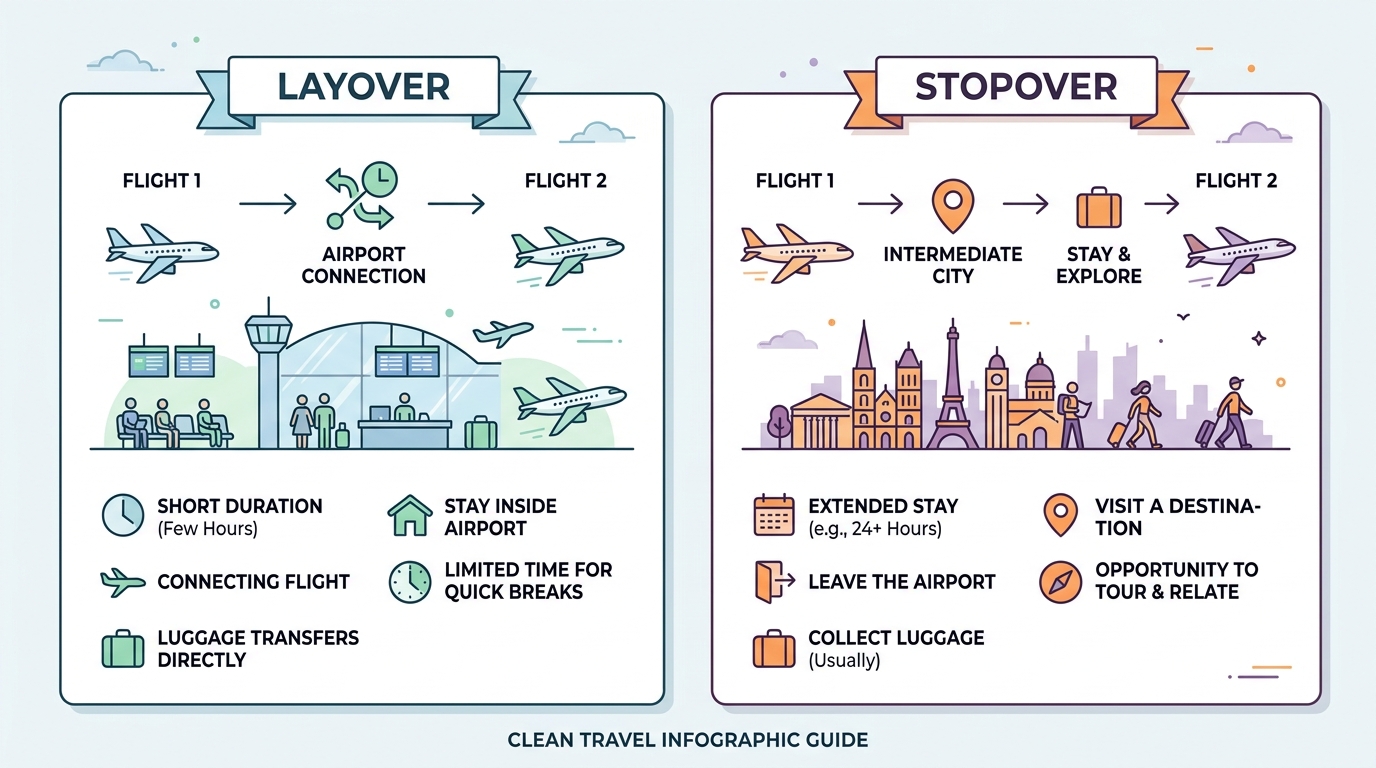
A layover is primarily a connection; a stopover is intentionally part of the travel experience.
| Feature | Layover | Stopover |
|---|---|---|
| Duration | Typically shorter (hours) | Typically longer (days) |
| Purpose | To change planes | To visit an intermediate destination |
| Leaving airport | Usually stay airside | Yes, explore the city |
| Hotel stay | Sometimes (transit hotels) | Usually |
| Airport transit | Yes, part of the standard connection | No, traveler exits the airport |
| Ticketing | Single connection | Planned multi-leg journey |
| Fare rules | Standard connection rules | Specific stopover fare conditions |
| Visa | Transit visa or visa exemption | Full visitor visa often required |
| Baggage | Usually checked through | Re-checked or collected |
| Risk | Missed connection due to delays | Low risk for onward flight |
| Planning | Minimal | Requires hotel, visa, and local transport |
How Long Is a Stopover?
There is no universal global duration threshold that definitively categorizes a stopover. Different airlines, fare rules and booking systems can distinguish stopovers differently.
When planning, you might encounter:
- Short stopovers: A full day to explore before an evening departure.
- Overnight stopovers: Arriving late and leaving the next day.
- Multi-day stopovers: Spending several days in the hub city.
- Extended stopovers: Weeks spent in an intermediate destination before continuing.
In international ticketing, a stopover is often described as a break in the journey lasting more than 24 hours. However, strictly verify the current official rule of your specific airline as of 28 August 2026, as domestic flights and specific fare rules may define a stopover as any connection longer than 4 hours.
How Long Is a Layover?
A layover can range from a short connection to an overnight connection.
There is an important distinction between a minimum connection time and a comfortable connection time. Airlines build minimum connection times into their systems, which represent the absolute shortest time legally permitted to transfer at a specific airport. However, these are bare minimums, not guarantees of a relaxed transfer.
You may need 45 minutes for a simple domestic layover, or well over 2 hours for an international layover requiring terminal changes and security screening.
Planning Travel Logistics?
Use FareWander tools to calculate flight times, luggage rules, and visa requirements.
Can You Leave the Airport During a Stopover?

Usually, yes, if immigration, visa and entry requirements allow it. Since a stopover is designed as a planned break to visit the intermediate city, leaving the airport is expected.
However, the traveler must always consider:
- Visa requirements for their passport nationality.
- Transit rules of the host country.
- Immigration and customs processing times.
- Airport location relative to the city center.
- Time required to return to the airport.
- Next flight check-in and bag drop deadlines.
- Security screening queues upon return.
Never assume you can leave the airport simply because you have a long break between flights. Entry requirements must be verified for the passenger's nationality and destination using official government sources.
Can You Leave the Airport During a Layover?
Sometimes, but it depends heavily on the circumstances.
You can generally leave if your layover is long enough and you meet the immigration and visa requirements of the connecting country. You must also consider airport transit rules, baggage arrangements, connection duration, airline check-in deadlines, and the terminal layout.
Safety Rule: Leaving the airport during a short layover can be risky because you must allow enough time to return, clear security and reach the gate.
If you are traveling internationally, you must pass through immigration to enter the country, and you will need to clear security again when you return.
Do You Need a Visa for a Stopover?
Visa requirements vary significantly based on your passport, the destination, and the route. It is vital to understand the distinction between transit and entering a country.
A traveler may need a:
- Transit visa
- Visitor visa
- Electronic travel authorization (eTA)
- Visa exemption
Because a stopover generally involves passing through immigration to enter the destination country, you will likely be subject to standard visitor entry requirements rather than transit rules. Visa requirements change frequently based on bilateral government updates. For country-specific information, use official government immigration or foreign affairs sources. Never rely solely on travel blogs for legally important visa information.
What Happens to Your Baggage During a Stopover?
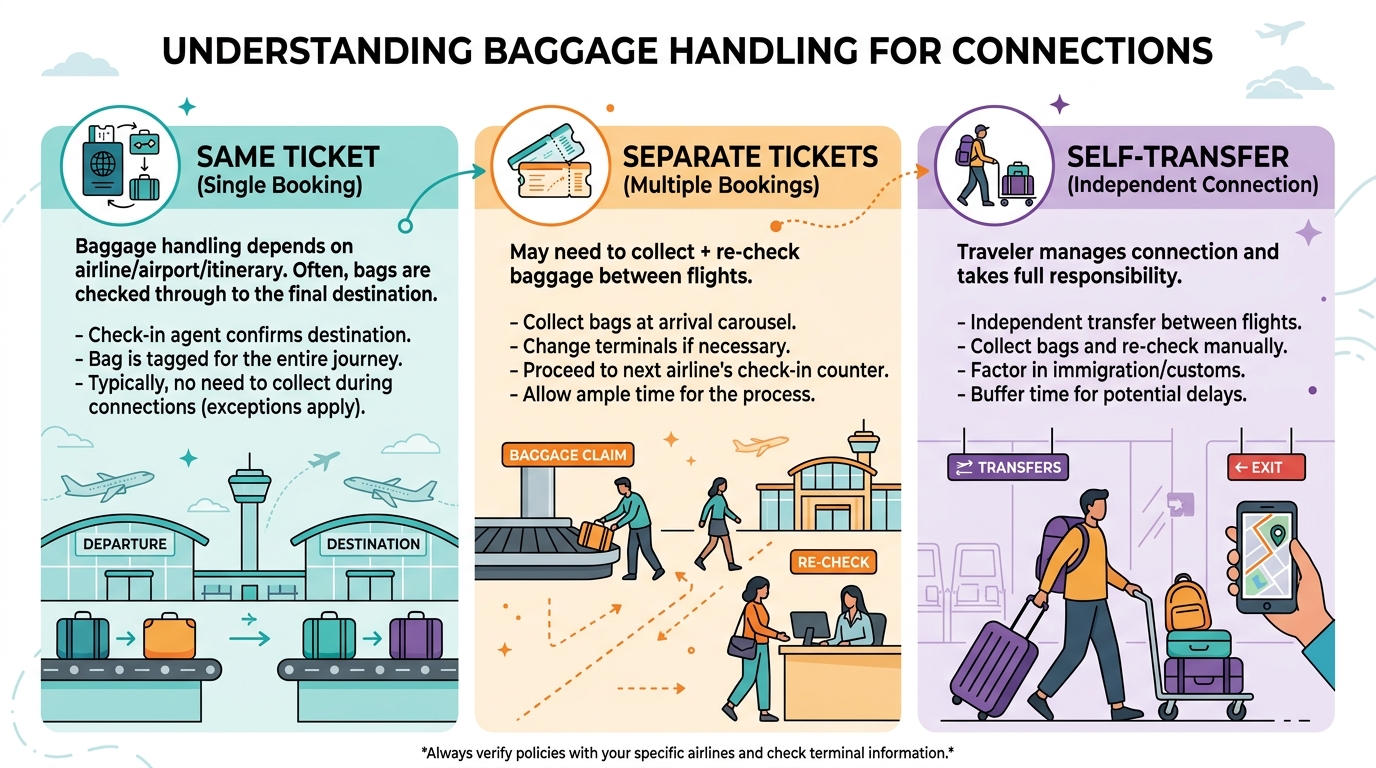
Baggage handling is one of the most complex parts of connecting travel. The rules depend entirely on your itinerary structure:
- Same-ticket itinerary: Baggage may be checked through to the final destination, depending on airline, airport and itinerary.
- Stopover where traveler enters destination: Baggage may need to be collected depending on customs and immigration rules, or because the stay is so long the airline will not store the bags.
- Separate tickets: The traveler will generally need to collect and re-check baggage.
- Self-transfer: The traveler is fully responsible for managing the connection and luggage transfer.
Never guarantee baggage will be automatically through-checked. Always confirm the final destination printed on your baggage tag and follow the airline instructions at check-in.
Stopover on the Same Ticket vs Separate Tickets
Booking a stopover can be done in two primary ways, each with distinct implications.
Same Ticket:
- Generally a coordinated itinerary.
- Potentially protected connection under applicable airline rules.
- Baggage handling may be easier.
Separate Tickets:
- Different booking references.
- Connection may not be protected.
- Baggage may need re-check.
- Missed connection risk can be higher.
Exact passenger rights depend on applicable laws, airline policies and ticket conditions.
What Is a Self-Transfer?
A self-transfer means the traveler independently connects between flights, often on separate tickets.
Because the airlines are operating independently, a self-transfer typically requires the traveler to:
- Collect baggage from the first flight.
- Clear immigration and customs.
- Check-in again at the public departure hall.
- Clear security.
- Manage terminal transfers.
A self-transfer is fundamentally different from a normal connection where luggage is routed automatically and boarding passes are issued together.
Stopover vs Multi-City Flight
A stopover can be part of a broader multi-city itinerary.
A multi-city flight is a single ticket booking that includes three or more flight segments across different destinations. This booking structure lets travelers specify multiple flight destinations and segments manually (to compare fare structures, compare one-way and round-trip flights).
Example:
- Delhi → Singapore
- Singapore → Tokyo
- Tokyo → Delhi
Not every multi-city itinerary is technically described as a "stopover" under airline fare rules. An airline stopover program usually involves specific fare rules that allow a break in a hub city without triggering a massive price increase.
Stopover vs Direct Flight vs Nonstop Flight
Understanding flight terminology is crucial when booking travel.
| Flight Type | Description |
|---|---|
| Nonstop | Flies straight to the destination with zero intermediate stops. |
| Direct | Keeps the same flight number but may make an intermediate stop. |
| Layover/Connecting | Requires changing planes at an intermediate airport. |
| Stopover | A planned, extended break in a connecting city. |
| Multi-city | An itinerary linking multiple distinct destinations. |
Remember that "direct" and "nonstop" are not always interchangeable in airline terminology. A direct flight does not always mean nonstop.
What Is an Overnight Stopover?

An overnight stopover is a stopover that includes one or more nights in the intermediate destination.
Because you are spending the night outside the airport, you must account for:
- Hotel accommodations.
- Local transport.
- Visa and entry requirements.
- Baggage collection.
- Next flight check-in requirements.
(Illustrative Example)
- Delhi → Istanbul
- 2-night stay in Istanbul
- Istanbul → London
What Is an Overnight Layover?
An overnight layover is a connection requiring the traveler to wait overnight before the next flight (especially common when booking a red-eye flight).
Travelers facing an overnight layover must consider:
- Whether the airport remains open 24/7.
- Airside terminal access limitations.
- Hotel availability (transit hotel vs landside hotel).
- Immigration requirements to reach a hotel.
- Baggage access.
- Airline check-in operating hours.
- Airline-provided accommodation, if applicable to the fare rules.
Do not assume an airline will automatically provide a free hotel for an overnight layover unless you have verified their specific current policy.
Are Stopovers Free?
Sometimes, but not universally.
While some airlines market a "free stopover," the actual execution may involve:
- A fare difference.
- Additional taxes.
- Increased airport charges.
- A specific stopover fee.
- Hotel costs.
- Local transport.
- Visa and entry costs.
Some airlines have promotional or structured stopover programs designed to boost tourism in their home countries. Never describe a stopover as "free" without checking the current airline program terms and conditions.
Are Stopover Flights Cheaper?
Not necessarily.
The price of any flight itinerary depends heavily on:
- Origin and destination.
- Operating airline.
- Fare class.
- Booking date and demand.
- Routing and taxes.
- Specific stopover rules.
- Seat availability.
A stopover can sometimes provide more value—giving you two vacations for the price of one flight ticket—even if it is not strictly cheaper than a direct flight.
Why Travelers Choose Stopovers
Travelers intentionally build stopovers into their itineraries for several reasons:
- Visit an additional destination on one trip.
- Break up a grueling, long-haul journey.
- Explore an airline's primary global hub.
- Reduce severe travel fatigue and jet lag.
- Combine two distinct destinations into one vacation.
- Potentially access subsidized airline stopover programs.
- Turn an unavoidable connection into an enjoyable part of the trip.
Disadvantages of a Stopover
While rewarding, stopovers introduce complexity:
- Longer total travel time.
- Added hotel and food costs.
- Stringent visa requirements.
- Baggage complications and re-packing.
- More logistical planning.
- Possibility of cascading schedule changes.
- Additional local transport needs.
- Missed-connection implications if the first leg is severely delayed.
Stopover Examples
Here are 5 realistic, illustrative examples of how an itinerary changes when a layover becomes a stopover (feel free to explore flight routes to map out your journey):
- The Middle East Hub
- Layover version: Delhi → Doha (2-hour connection) → London
- Stopover version: Delhi → Doha (3-day stay) → London
- The Southeast Asia Link
- Layover version: Mumbai → Singapore (3-hour connection) → Tokyo
- Stopover version: Mumbai → Singapore (2-night stay) → Tokyo
- The Gulf Transit
- Layover version: Bengaluru → Dubai (4-hour connection) → Paris
- Stopover version: Bengaluru → Dubai (4-day stay) → Paris
- The European Bridge
- Layover version: New York → Istanbul (2.5-hour connection) → Rome
- Stopover version: New York → Istanbul (3-night stay) → Rome
- The Transatlantic Break
- Layover version: London → Reykjavik (90-minute connection) → New York
- Stopover version: London → Reykjavik (5-day stay) → New York
(Note: These are purely illustrative routes to demonstrate routing logic.)
How to Book a Stopover Flight
Follow these steps to structure your stopover:
- Decide on your desired intermediate city.
- Check whether the primary airline flying that route supports stopovers (to avoid ticketing issues, understand codeshare flights).
- Search using multi-city or open-jaw booking tools if appropriate.
- Compare the total fare against standard connecting flights.
- Check the baggage rules for multi-leg journeys.
- Check the visa and entry requirements for the intermediate country.
- Check minimum connection and airport requirements.
- Confirm whether both flight segments are protected on the same ticket.
- Check the maximum stopover duration permitted by the fare conditions.
- Verify the final itinerary dates and times before payment.
How to Find Airlines With Stopover Programs
To research official stopover options, travelers should consult:
- The official airline website.
- Dedicated airline stopover program pages.
- Detailed fare conditions during checkout.
- Destination eligibility lists.
- Official hotel offers or subsidized packages.
- Duration limits applied to promotional stopovers.
- Specific booking requirements (e.g., booking directly vs via an agency).
Always verify current programs through official airline sources as of your travel date, as promotional packages change frequently.
Stopover vs Layover: Which One Should You Choose?
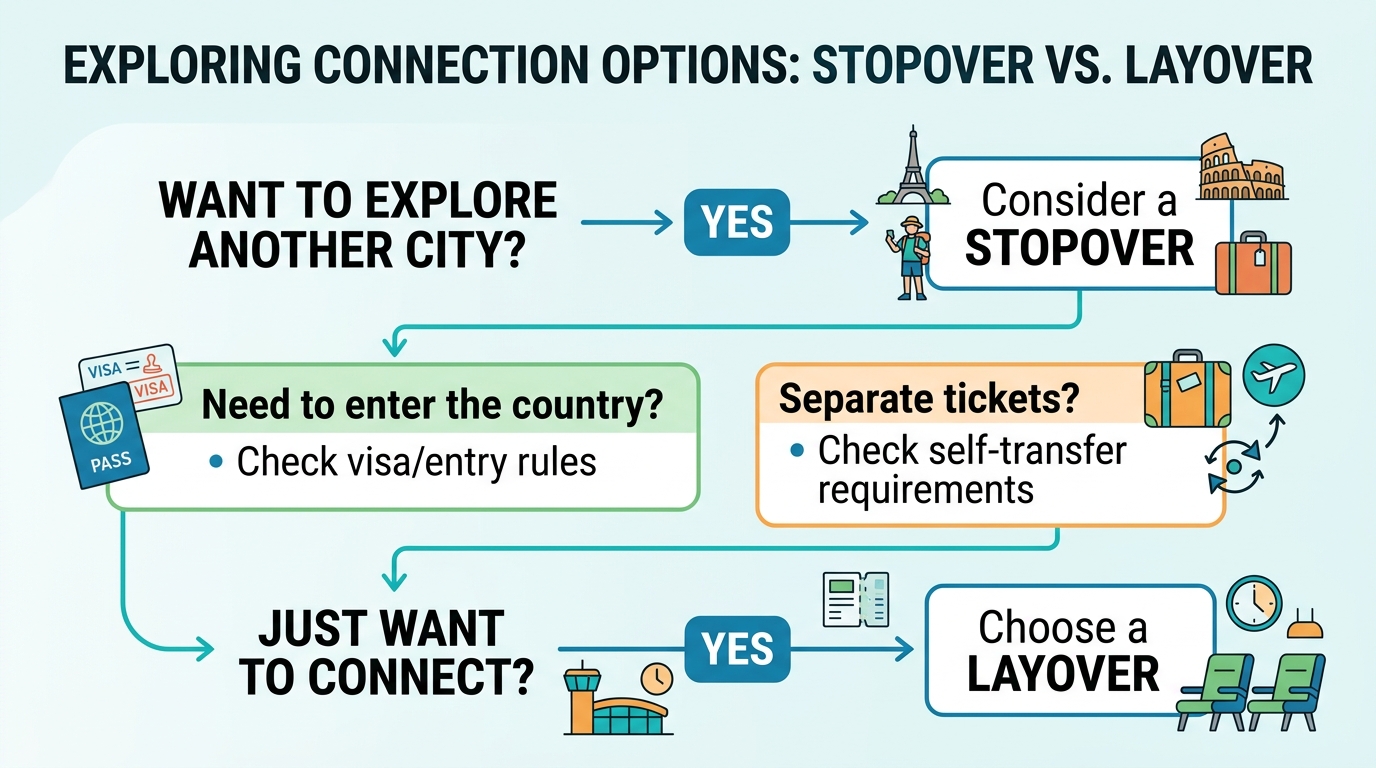
Use this decision framework when booking your next trip.
Choose a layover if:
- You want the fastest possible trip.
- You don't want to pay for an extra hotel stay.
- You are comfortable connecting smoothly through a transit hub.
- The connection time is sufficiently long for the itinerary without causing stress.
Choose a stopover if:
- You want to explore another city.
- You want to split a long journey to reduce fatigue.
- You have enough vacation time to spare.
- Visa and entry requirements are manageable for your passport.
- The itinerary makes financial and logistical sense for your budget.
Important Things to Check Before Booking
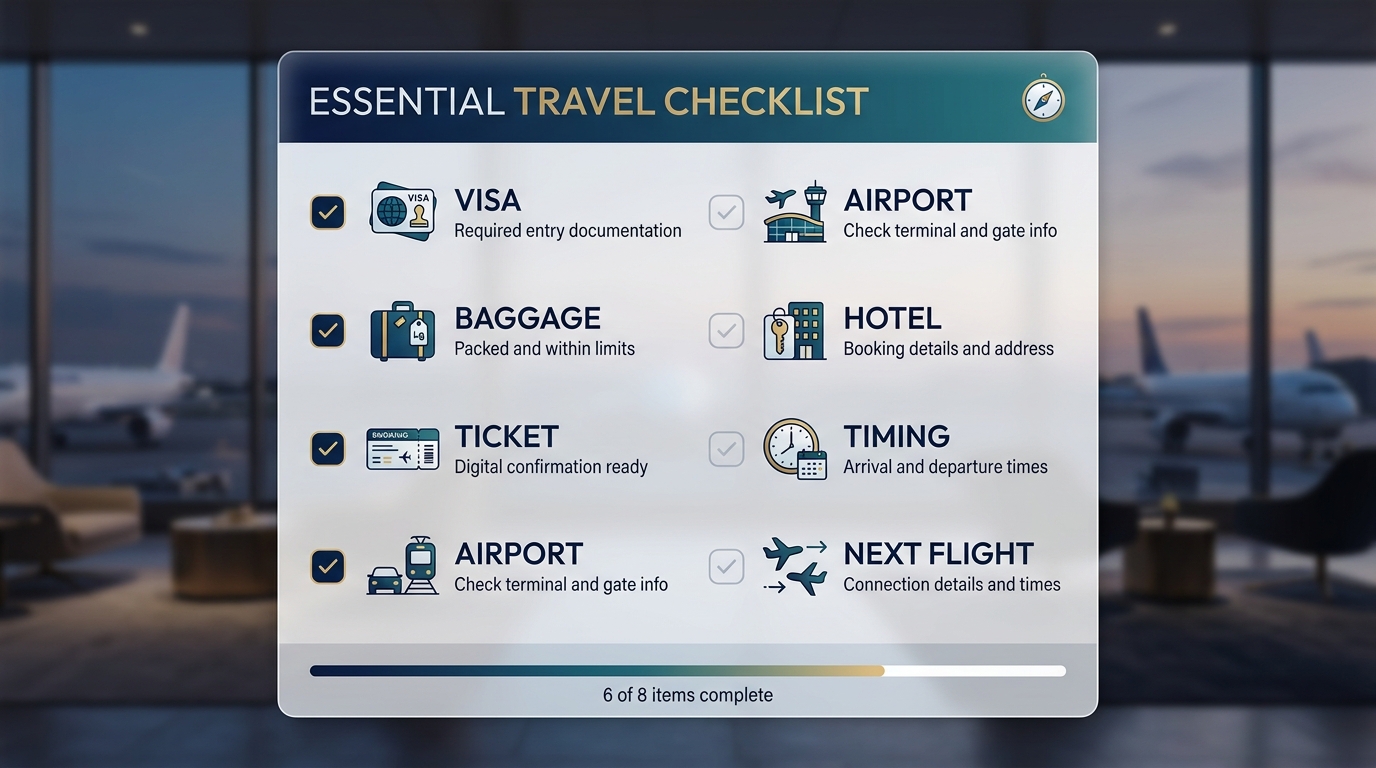
Always review this checklist before confirming your itinerary:
- Passport validity (often 6 months required)
- Visa requirements for the intermediate city
- Transit rules
- Stopover duration limits
- Fare conditions and change fees
- Baggage rules
- Same ticket or separate tickets
- Airport transfer requirements
- Terminal changes
- Check-in deadline for the onward flight
- Hotel arrangements
- Local transportation
- Schedule changes
- Travel insurance where appropriate
Common Stopover & Layover Mistakes
Avoid these frequent pitfalls:
- Assuming a stopover always means a free hotel.
- Assuming every long connection is automatically a stopover.
- Assuming you can legally leave the airport during any transit.
- Ignoring transit or visitor visa rules.
- Assuming baggage is automatically checked through to the final destination.
- Booking separate tickets without understanding the massive financial risk.
- Ignoring terminal or even airport changes within the same city.
- Not checking the specific airline fare rules before booking.
- Assuming airline terminology is universally identical worldwide.
- Planning elaborate sightseeing during a connection that is simply too short.
Conclusion
A layover is primarily a connection designed to get you from one aircraft to another. A stopover is an intentional longer break in an intermediate destination, allowing you to turn a transit hub into a secondary vacation.
But the exact terminology and duration thresholds can vary by airline and fare rules. What one airline considers a long layover, another might classify as a stopover subject to different pricing.
Before booking, check the airline's fare conditions, baggage rules and the entry or transit requirements for the stopover country to ensure your multi-destination journey is smooth, legal, and stress-free.