You heave your packed suitcase onto the bathroom scale the evening before your flight, watch the display stabilize at 26.4 kilograms, and immediately check your confirmation email to find a 23-kilogram limit staring back.
In that instant, a familiar set of stressful calculations begins: Do you start ripping open packing cubes to shuffle heavy boots into your hand luggage, pay whatever penalty the airline demands at the departures desk, or try to buy extra allowance on your phone before check-in closes?
What happens next depends heavily on whether your airline treats those extra kilos as simple overweight baggage, forces you to check a second piece, or penalizes you for exterior dimensions.
1. What Is Excess Baggage?
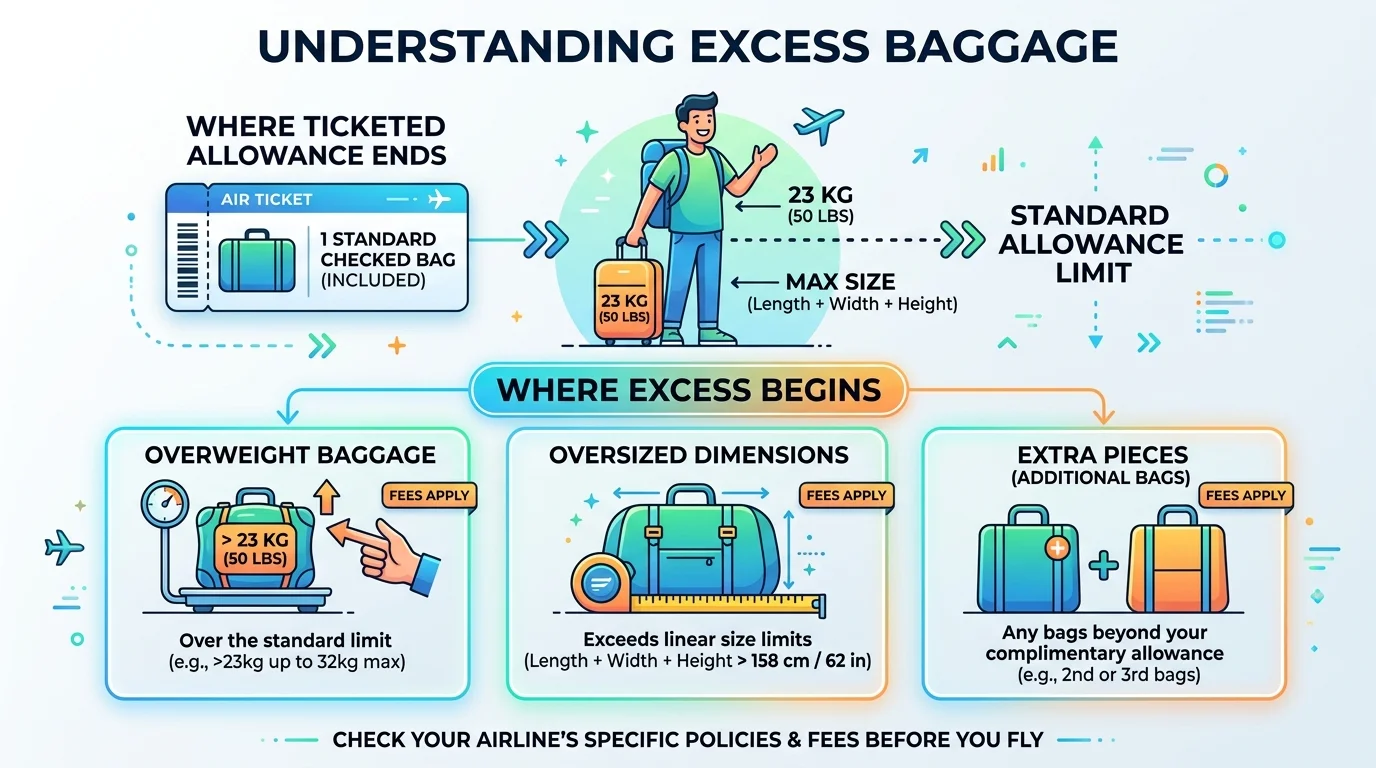
Excess baggage is any personal property accepted for carriage in the aircraft cargo hold that surpasses the baggage allowance included with your ticket. When an airline issues a boarding contract, your fare covers a predetermined volume, piece count, or gross weight of luggage. Anything beyond those parameters requires additional handling, uses more aircraft fuel, and consumes finite hold capacity, prompting the carrier to assess an excess baggage charge.
Critically, excess baggage does not always mean your bag is overweight. A suitcase weighing 18 kilograms can still be classified as excess luggage if your ticket only covers cabin bags, or if it represents an un-ticketed second piece on a fare allowing only one bag. It serves as an umbrella term covering several distinct baggage issues.
2. Excess Baggage vs Extra Baggage
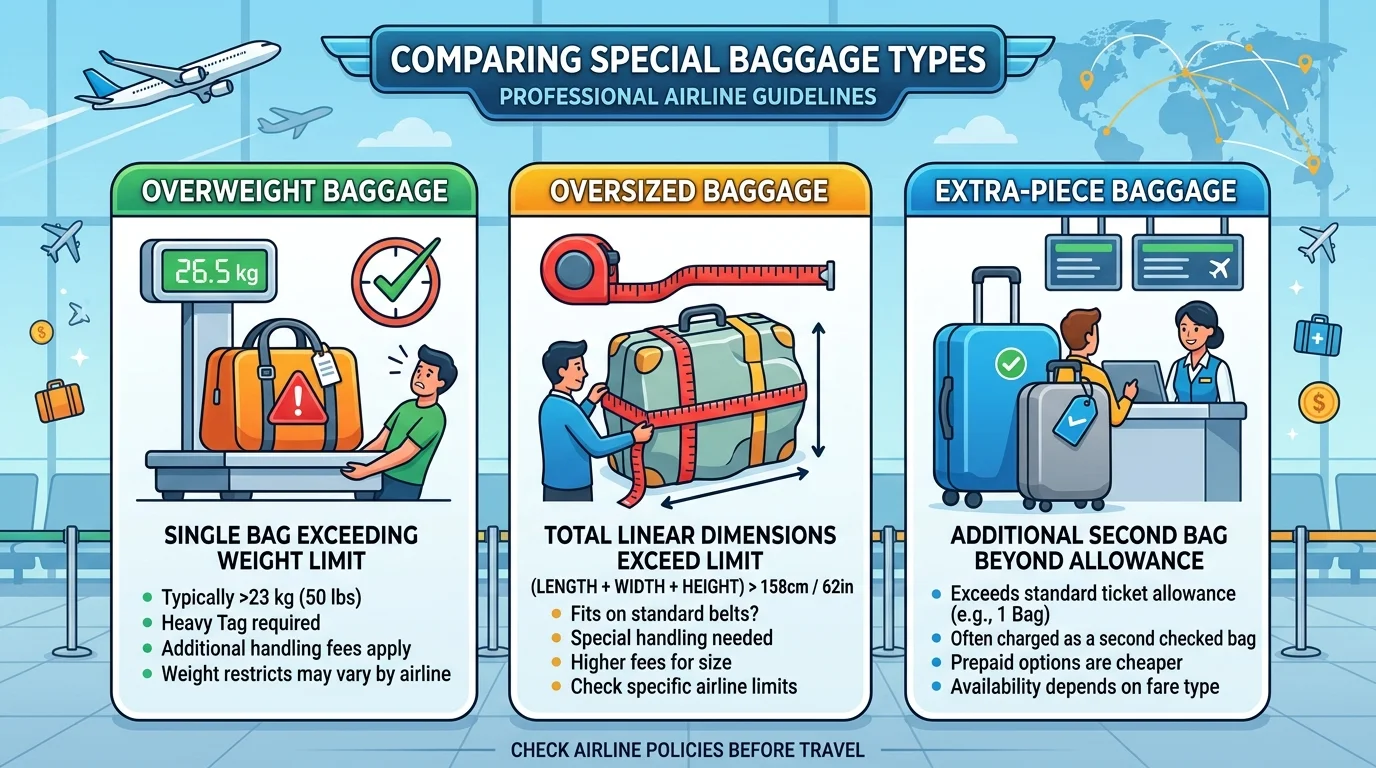
Airlines frequently use baggage terms interchangeably across their websites and tariff disclosures, creating confusion for passengers trying to price their journey.
| Term | Operational Meaning | Real-World Scenario |
|---|---|---|
| Excess Baggage | Broad contractual term for any hold luggage exceeding ticket parameters. | Arriving at check-in with more weight, volume, or pieces than booked. |
| Overweight Baggage | An individual bag that exceeds the permitted weight cap for that piece tier. | A bag weighing 27 kg against an allowed single-piece limit of 23 kg. |
| Oversized Baggage | A bag whose external linear dimensions exceed published carrier thresholds. | A box or duffel measuring 170 linear cm against a standard 158 cm cap. |
| Extra Baggage | Bringing a greater numerical count of bags than included in the base fare. | Checking two bags when your ticketed fare explicitly includes one bag. |
Comparing Fares for Your Route?
Search live multi-airline schedules, spot discount windows, and baggage fee rules on FareWander.
3. When Does Baggage Become Excess Baggage?
Luggage transitions into excess status under four common operational circumstances:
- Excess Weight: The individual bag or combined baggage pool weighs more than the fare allows (e.g., presenting 26 kg when your fare includes 23 kg).
- Excess Pieces: The total count of physical bags exceeds your ticketed entitlement (e.g., checking two 12-kilogram bags on a one-piece ticket).
- Excess Dimensions: The physical frame of the bag exceeds linear size parameters, even if it weighs very little.
- Zero Hold Allowance: The booked ticket is an unbundled fare (such as a basic economy or light tier) that includes cabin baggage only, making any checked bag an excess addition.
4. How Airline Baggage Allowance Works
Baggage entitlements depend on ticket type, route, cabin class, and frequent-flyer status. For a foundational breakdown of cabin versus hold luggage policies, consult our pillar guide on Airline Baggage Policy: Cabin & Checked Baggage Rules Explained.
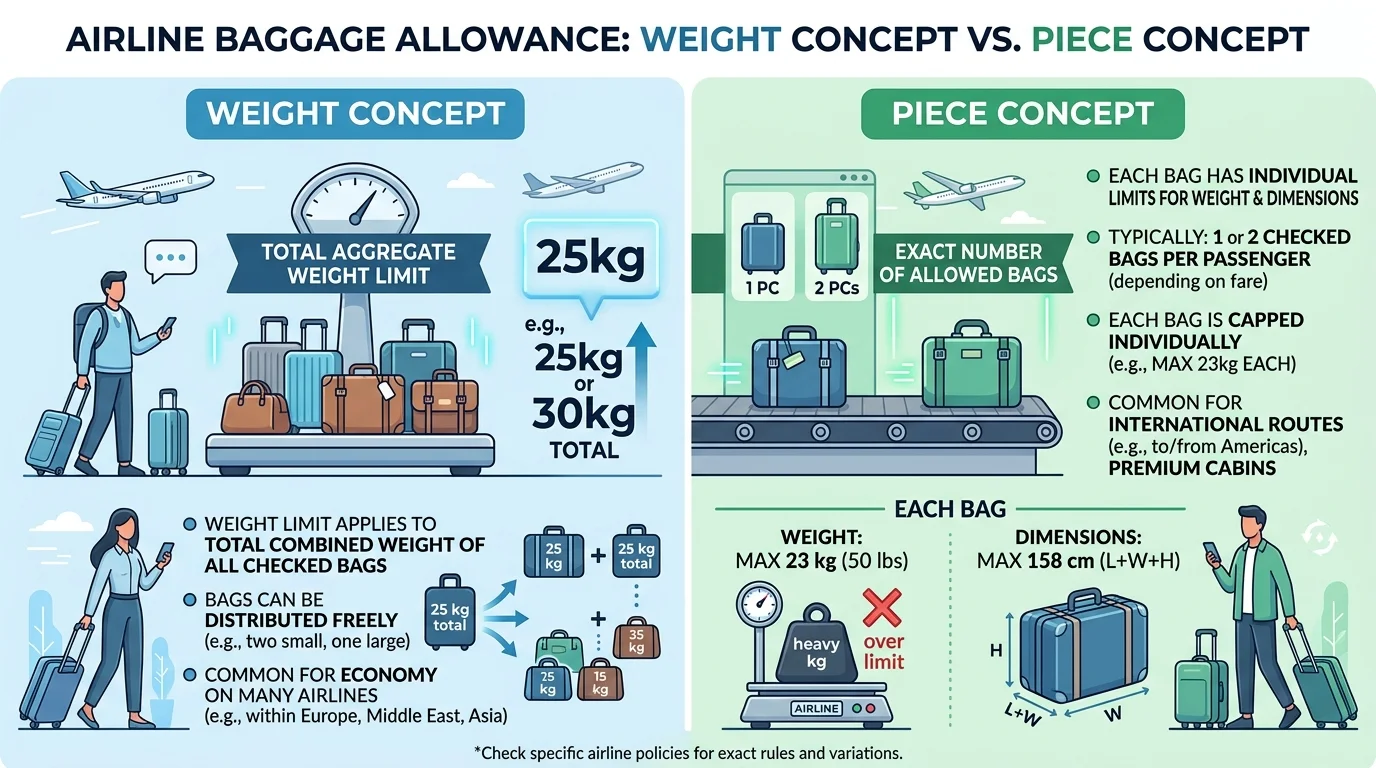
Your baseline allowance is governed by one of two core aviation frameworks:
- The Weight Concept: Your allowance is calculated as a total gross weight limit (e.g., 20 kg or 30 kg total). You can check one or multiple bags, provided the cumulative scale weight remains below the limit. This system is widely used on domestic routes within Asia and India, as well as regional sectors across the Middle East and Africa.
- The Piece Concept: Your allowance dictates an exact number of physical bags, with each individual bag capped at a specific weight and size (e.g., 1 bag up to 23 kg). This framework dominates transatlantic flights, routes touching the Americas, and European international networks.
5. Overweight Baggage
An overweight bag occurs when a single piece stays within physical dimensions but exceeds the weight limit allocated to that individual bag tier (most commonly 23 kg in standard economy).
Airlines generally address overweight luggage through dedicated fee tiers (such as a 23.1 kg to 32 kg heavy-bag surcharge) or by multiplying each excess kilo by a route-specific rate. At the check-in desk, agents will typically give you the option to repack items into another bag or pay the fee. If the bag is accepted between 23 kg and 32 kg, handlers affix a bright "HEAVY" tag to alert ramp personnel.
Planning Travel Logistics?
Use FareWander tools to calculate flight times, luggage rules, and visa requirements.
6. Oversized Luggage Rules
A bag is oversized when its physical dimensions surpass the maximum size allowed for standard automated baggage systems.
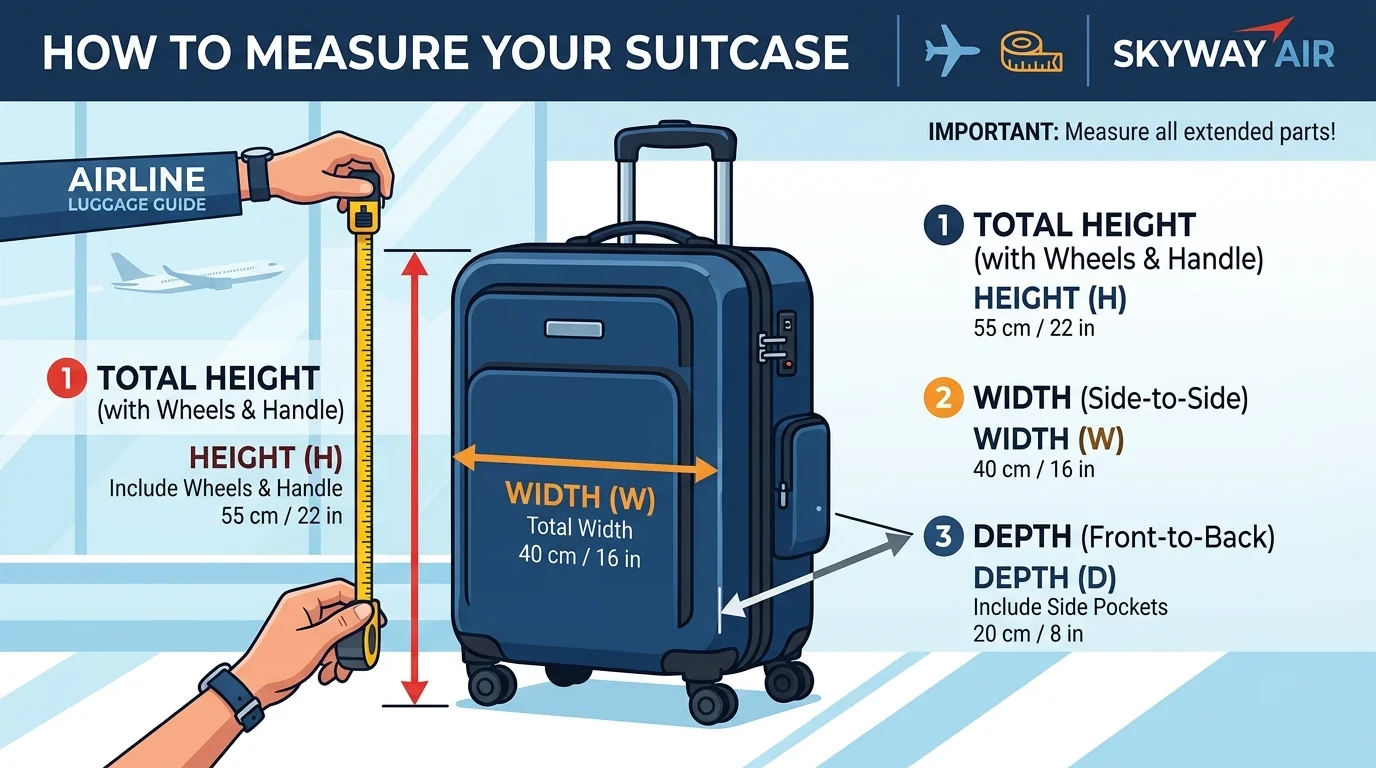
Airlines measure luggage using linear dimensions:
$$\text{Linear Dimensions} = \text{Length} + \text{Width} + \text{Height}$$
Measurements must include wheels, handles, and bulging exterior pockets. While 158 linear centimeters (62 linear inches) is a standard baseline across many major full-service airlines, thresholds are set by individual carriers. Oversized bags cannot traverse automated conveyor belts and must be dropped at dedicated Out-of-Gauge (OOG) desks.
7. Extra Baggage Charges
Airlines employ several pricing models to charge for luggage beyond your allowance:
- Per-Kilogram Pricing: Each kilo above the allowance is assessed a direct rate based on route distance.
- Per-Piece Pricing: A fixed flat rate is charged for each extra physical bag checked into the hold.
- Weight-Band Tiers: A fixed surcharge covers weight brackets (e.g., a flat fee for bags between 23.1 kg and 32 kg).
- Route-Based Pricing: Flights over ocean sectors or longer distances carry substantially higher fees than regional hops.
- Cabin/Fare-Based Pricing: Passengers in flexible or premium economy may receive discounted excess rates compared to basic fare holders.
8. Excess Baggage Fees
Because different baggage triggers involve distinct airport handling operations, carriers apply specialized fees for each category.
| Fee Type | What Triggers It | How It Is Billed |
|---|---|---|
| Standard Baggage Fee | Checking a bag on an unbundled, zero-bag ticket. | Flat fee per bag, usually cheaper online. |
| Overweight Fee | Single bag exceeding the 23 kg (or fare) limit up to 32 kg. | Flat weight-band surcharge or per-kg rate. |
| Oversized Baggage Fee | Bag dimensions exceeding standard linear limits (e.g., >158 cm). | Flat handling surcharge per oversized piece. |
| Extra-Piece Fee | Checking an additional suitcase beyond numerical allowance. | Flat fee scaling higher for 2nd, 3rd, or 4th pieces. |
9. How Are Excess Baggage Fees Calculated?
Final excess fees depend on your route, cabin, ticket fare family, the timing of payment (online vs airport counter), and currency exchange rates.
Illustrative calculation example (not an actual airline fee):
- Included Allowance: 1 checked piece up to 23 kg
- Actual Bag Presented: 1 piece weighing 28 kg (5 kg excess)
If operating under a Per-Kg Carrier charging a hypothetical $15/kg rate: $$\text{Fee} = 5\text{ kg} \times $15 = $75$$
If operating under a Weight-Band Carrier charging a flat $85 fee for the 24–32 kg bracket: $$\text{Fee} = $85\text{ flat surcharge}$$
10. Excess Baggage Cost: International Flights
International excess baggage charges are considerably higher than domestic rates due to long flight times, complex ground-handling operations, and customs processing. Interline and codeshare itineraries complicate pricing further because connecting carriers may charge disparate rates if baggage is not checked through under a single ticketing rule. Check the operating carrier's published tariff table for your specific origin-destination pair to avoid steep counter charges.
11. Domestic vs International Excess Baggage
Operational parameters shift significantly between domestic hops and cross-border itineraries.
| Factor | Domestic Itineraries | International Itineraries |
|---|---|---|
| Primary System | Often weight-based (Asia) or flat per-bag (US/EU). | Heavy mix of piece concept and route-zone weight bands. |
| Average Cost Profile | Generally lower per-kilo or per-piece charges. | Significantly higher fees, often billed in USD, EUR, or GBP. |
| Customs Scrutiny | No international customs checks. | Mandatory baggage clearance and agricultural inspections. |
| Multi-Carrier Risk | Low; often single-carrier operations. | High; codeshares can introduce varying partner policies. |
12. Maximum Luggage Weight Limit
It is vital to distinguish your ticketed baggage allowance from the absolute maximum accepted baggage weight. Your ticket might include 23 kg, but commercial airlines generally enforce a hard safety cap of 32 kilograms (70 pounds) per individual piece.
OCCUPATIONAL HEALTH & SAFETY MANDATE: This 32 kg threshold is not an arbitrary airline fee tier; it is an international occupational health and safety regulation enforced to protect airport ramp workers from severe musculoskeletal injury. Even if you offer to pay hundreds of dollars in excess fees, check-in agents cannot accept a single suitcase exceeding 32 kg. Such items must be split into separate bags or booked through an air cargo facility.
13. What Happens If Your Bag Is Too Heavy?
When your suitcase is placed on the check-in scale and the reading exceeds your allowance:
- The automated scale alerts the agent to the excess weight.
- The agent informs you of the discrepancy and presents your operational options.
- You may choose to pay the applicable overweight or per-kilogram fee directly at the counter.
- Where permitted, you can step aside to redistribute weight into a companion's bag or your cabin luggage.
- If the bag weighs over 32 kg, you will be required to repack items into a secondary container before it can be tagged.
14. Can You Repack an Overweight Bag at the Airport?
Most airlines allow passengers to step out of the queue to repack an overweight suitcase. However, repacking must remain fully compliant with aviation security. You cannot bypass rules by moving restricted dangerous goods (like loose lithium batteries, power banks, or full-sized liquid bottles) into containers where they are prohibited. The objective of repacking is strictly compliant weight balancing, not circumventing safety standards.
15. Can You Combine Baggage Allowances?
Baggage pooling—combining allowances across a traveling party—is subject to individual carrier policy. While many full-service carriers allow passengers on the exact same booking reference (PNR) to pool weight when checking in together, low-cost carriers frequently forbid it. Furthermore, pooling never overrides the 32 kg single-bag safety cap: two travelers with 23 kg allowances cannot check a single 35 kg suitcase.
16. Can You Buy Additional Baggage Online?
Passengers can typically add hold luggage using this general process:
- Navigate to your airline's official website or mobile application.
- Open the Manage Booking or My Trips section.
- Input your 6-character booking reference (PNR) and passenger surname.
- Select the baggage add-on or extra baggage service.
- Review available weight slabs or additional piece options.
- Complete the payment via credit card or digital wallet.
- Download or save the updated itinerary showing the new baggage entitlement.
17. Pre-Booking Additional Baggage Online
Pre-booking baggage online allows the airline to forecast aircraft cargo weight and fuel requirements in advance. Because of this operational advantage, many carriers price pre-booked baggage lower than counter check-in rates (often saving 20% to 50%). However, online pre-booking is not universally cheaper on every carrier or route, and cut-off deadlines (often 2 to 24 hours prior to departure) strictly apply. Always verify your carrier's current fee schedule.
18. How to Avoid Extra Baggage Fees
Minimizing baggage fees requires structured preparation:
- Confirm the exact baggage allowance on your e-ticket receipt immediately after booking.
- Weigh every bag with a calibrated digital hanging luggage scale while packing at home.
- Measure the exterior linear dimensions (including wheels and handles).
- Wear your bulkiest clothing, such as heavy coats and boots, during transit.
- Review elite frequent-flyer tier perks to determine whether complimentary bag waivers apply.
- Compare the cost of upgrading to the next fare tier against paying piecemeal baggage fees.
19. What Should You Pack in Cabin Baggage to Reduce Checked Weight?
Dense, valuable, and fragile items should generally travel in your cabin bag, subject to security compliance:
- Laptops, tablets, cameras, and corresponding chargers
- Essential prescription medications in original packaging
- High-value jewelry, cash, and critical travel identification documents
- Approved portable power banks and spare lithium batteries (which are strictly barred from cargo holds)
For complete item-by-item safety details, see our dedicated guide on What Can You Carry in Cabin Baggage?.
20. Cabin Baggage Weight Still Matters
Transferring weight to your carry-on luggage only works if your cabin baggage remains compliant. Airlines frequently enforce cabin weight limits ranging between 7 kg and 10 kg, while sizer boxes at boarding gates monitor length, width, and height. An oversized or visibly heavy carry-on can be intercepted at the gate, resulting in an expensive gate-check fee.
21. Excess Baggage on Connecting Flights
On single-ticket connecting itineraries, your baggage is generally checked through to your final destination under a unified policy. However, if your itinerary consists of separate tickets on different airlines (a self-transfer), you must collect your luggage at the connection hub, clear customs, and pay the individual excess baggage rates of each connecting airline.
22. Codeshare and Interline Baggage Rules
When multiple carriers operate under a codeshare or interline ticket, determining which baggage rules apply requires checking international standards:
- IATA Resolution 302 (Most Significant Carrier): For most international journeys, baggage allowances and excess fees are dictated by the carrier operating the longest or most significant geographical sector.
- US DOT & Canadian Regulations: For itineraries touching the United States or Canada, federal rules dictate that the baggage terms of the marketing carrier on the first flight segment govern the entire journey.
23. Basic Economy / Light / Saver Fares
Unbundled economy fares strip away standard inclusions to compete on baseline search pricing. These tickets routinely exclude checked baggage entirely and may restrict cabin luggage strictly to an under-seat personal item. Always verify whether paying for a bag on a Basic fare negates the initial savings.
24. Business Class / First Class Baggage
Premium cabin bookings typically include expanded baggage allowances. Rather than a single 23 kg bag, premium tickets frequently include two or three checked pieces, with individual bag weight ceilings raised to 32 kg without incurring overweight penalties.
25. Frequent Flyer Baggage Benefits
Airline loyalty programs reward elite status holders with elevated luggage allowances. Benefits typically include one additional complimentary checked bag under the Piece Concept or an extra 10 kg to 20 kg under the Weight Concept. Note that some airlines suppress elite baggage benefits on basic economy tickets.
26. Special Baggage and Sports Equipment
Items like surfboards, golf clubs, bicycles, ski bags, and musical instruments are governed by special baggage rules. While some airlines count golf bags or skis as standard checked pieces within the regular allowance, other gear (particularly bicycles and surfboards) often incurs fixed handling charges and requires advance registration.
27. What Happens If Your Bag Is Both Overweight and Oversized?
If a piece of luggage exceeds both the permissible weight threshold and exterior dimensions, airlines rarely combine the violation into a single charge. Most carriers levy the overweight surcharge and the out-of-gauge oversized fee concurrently, resulting in substantial cumulative fees at the check-in desk.
28. What Happens If You Have More Bags Than Your Allowance?
Arriving at the airport with more bags than permitted requires purchasing additional pieces. Check-in agents assess extra-baggage fees per piece, which scale upwards for third or fourth bags. During peak travel seasons, carriers may place an embargo on extra bags due to cargo hold space constraints.
29. Baggage Allowance for Infants and Children
Infants traveling on an adult's lap typically receive a reduced checked allowance (often 10 kg or one piece), while ticketed children receive standard adult allowances. Most carriers allow one fully collapsible stroller or car seat to be checked free of charge. For fleet-wide stroller dimensions and family seating rules, consult our dedicated guide to Infant & Child Airline Policies.
30. Lost, Delayed or Damaged Baggage
Excess baggage fees cover transportation, not guaranteed special handling. If an excess bag is delayed, lost, or damaged, it is governed by standard carrier liability rules under the Montreal Convention. Always file a Property Irregularity Report (PIR) before leaving the baggage reclaim area. For a step-by-step claim walkthrough, refer to our guide on Lost/Delayed Baggage: Claim Process.
31. Excess Baggage vs Buying a New Ticket
When faced with steep excess baggage fees at the airport, weigh the full range of alternatives:
- Option A: Pay the assessed excess charges to travel with all items immediately.
- Option B: Pre-purchase an extra baggage allocation online if check-in has not closed.
- Option C: Repack, dispose of low-value heavy items, or ship belongings separately via an international courier service.
- Option D: In rare cases of extreme excess weight, upgrading to a higher cabin class (such as Business) may provide the necessary allowance while offering a better travel experience.
32. Real-Life Hypothetical Examples
Example 1 — Overweight Bag (Piece Concept)
A passenger checks one bag weighing 27 kg against an allowance of 1 piece up to 23 kg. The carrier charges a flat heavy-bag surcharge for the 23.1–32 kg bracket. (Illustrative example — actual airline rules and fees vary.)
Example 2 — Extra Piece (Piece Concept)
A traveler with a 1-piece allowance checks two bags weighing 11 kg and 12 kg. Even though the combined weight is only 23 kg, the second bag triggers an extra-piece fee. (Illustrative example — actual airline rules and fees vary.)
Example 3 — Oversized Bag
A piece weighing 18 kg measures 172 linear cm, exceeding the carrier's 158 cm limit. The passenger pays an out-of-gauge oversize surcharge. (Illustrative example — actual airline rules and fees vary.)
Example 4 — International Flight
A traveler on a multi-zone route incurs per-kilogram excess fees, demonstrating how long-haul distance scales charges. (Illustrative example — actual airline rules and fees vary.)
Example 5 — Connecting Flights
A passenger transfers from an international carrier to a regional airline on separate tickets, incurring local baggage fees on the second leg. (Illustrative example — actual airline rules and fees vary.)
Example 6 — Repacking
A traveler redistributes 3 kg of clothing from an overweight checked bag into their carry-on prior to check-in, avoiding extra fees. (Illustrative example — actual airline rules and fees vary.)
33. Excess Baggage Quick Decision Guide
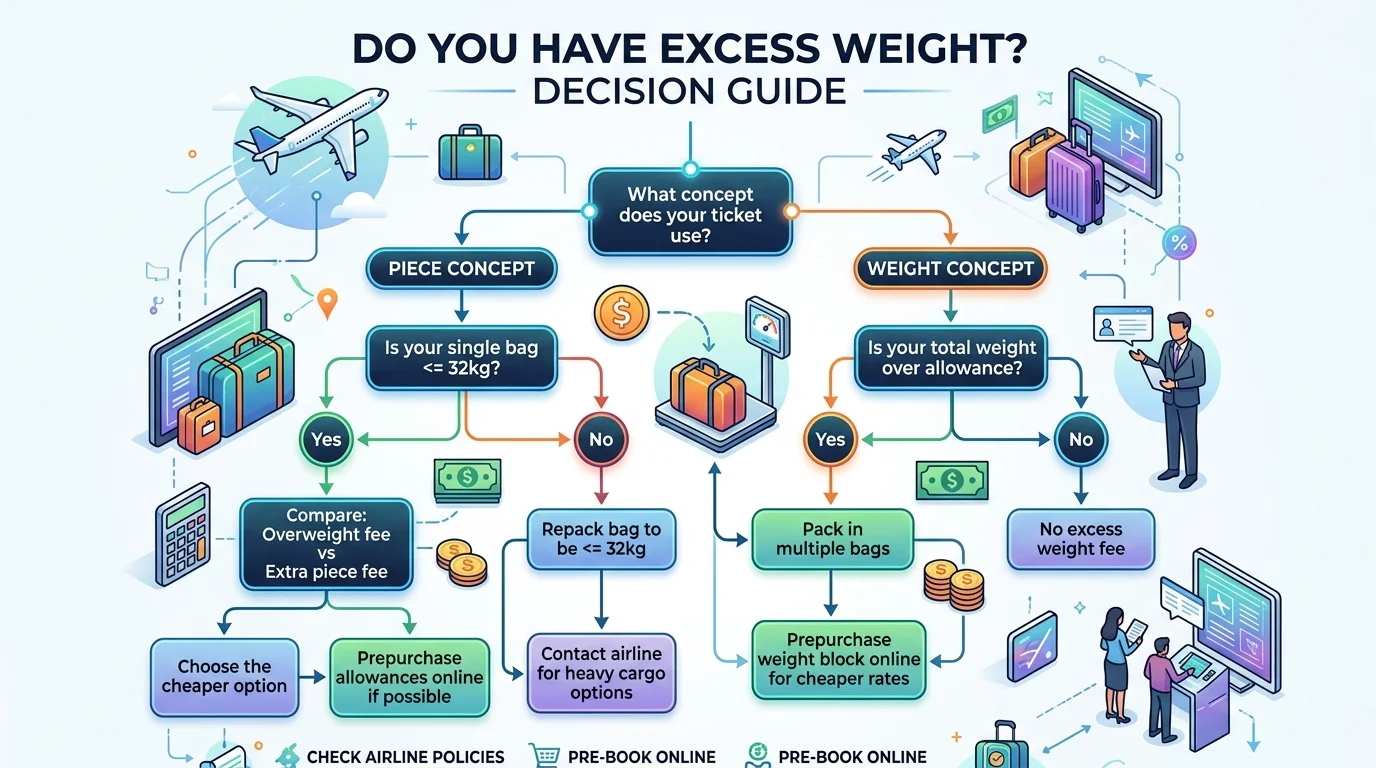
When you are facing luggage weight or piece issues at check-in, follow this operational decision path:
- Is the bag > 23 kg? Check if it is $\le 32$ kg. If yes, compare repacking into cabin bags versus paying the flat overweight surcharge. If $> 32$ kg, it must be split into two bags.
- Too many bags? Check your ticketed piece allowance. Pre-book the extra bag online before airport check-in to access lower advance rates.
- Dimensions > 158 cm? Check oversized handling surcharges and proceed to the Out-of-Gauge (OOG) baggage desk.
34. Excess Baggage Checklist
Before Leaving for the Airport
- Checked free baggage allowance printed on your confirmation
- Confirmed fare family rules and restrictions
- Checked cabin class entitlements
- Measured exterior dimensions ($Length + Width + Height$)
- Weighed every individual bag using a digital scale
- Confirmed no single bag exceeds 32 kg
- Verified total number of included pieces
- Reviewed published airline excess baggage rates
- Evaluated online pre-purchase baggage options
- Checked connecting and partner airline allowances
- Verified rules for sports gear or special luggage
- Saved baggage purchase receipts to your phone
35. Common Mistakes
- Assuming 23 kg is a universal worldwide allowance: Thinking every ticket grants 23 kg without checking unbundled basic fare terms.
- Assuming excess baggage is always billed per kilogram: Failing to recognize that Piece Concept routes charge flat fees per piece or heavy weight band.
- Confusing an extra bag with an overweight bag under the Piece Concept: Splitting 23 kg into two bags on a 1-piece allowance triggers an expensive extra-piece fee.
- Measuring luggage weight while ignoring physical exterior dimensions: Arriving with a lightweight box that exceeds linear size limits.
- Assuming you can pay to check a bag weighing more than 32 kg: Overlooking the absolute 32 kg occupational safety barrier.
- Waiting until the airport counter to check additional baggage prices: Missing out on 20% to 50% discounts available through advance online booking.
- Assuming online pre-purchase is universally available or refundable: Failing to note strict online cutoff deadlines before departure.
- Assuming baggage pooling is permitted across all airlines and fares: Overlooking budget airline restrictions on weight sharing.
- Overlooking operating carrier rules on codeshare flights: Checking baggage policies only for the marketing airline rather than the operating carrier.
The most reliable way to handle excess baggage is to address it before you leave home. Check the exact allowance attached to your reservation, weigh your luggage with a dependable scale, and evaluate whether rearranging items between bags or purchasing an advance weight allocation online provides the most cost-effective path forward. Confirming these details in advance keeps your airport departure predictable, organized, and free of surprise expenses.
Frequently Asked Questions
Excess baggage is any luggage that exceeds the weight, piece count, or dimension parameters included in your ticket fare.