You book a flight for an upcoming trip, but a family conflict arises four days before departure. You open your booking portal expecting to cancel and receive a quick refund to your card—much like cancelling a hotel room—only to discover that your ticket is marked non-refundable, or that the cancellation penalty wipes out most of what you originally paid. You are left wondering: Can I get any money back? How much will the airline deduct? And what happens if I simply do not show up?
Every day, passengers run into this exact wall. Commercial aviation does not operate under a single, universal airline cancellation policy. The outcome of cancelling an airline ticket depends on your fare conditions, when you cancel, your itinerary, who issued the ticket, and whether the cancellation is initiated by you or by the airline.

Quick Answer: What Happens When You Cancel a Flight?
When you voluntarily cancel a flight, the outcome is determined entirely by your ticket’s contractual fare rules, the route, the timing of your cancellation, your booking channel, and applicable aviation consumer protection laws.
- If you hold a refundable fare: The airline returns your eligible payment to the original payment method, sometimes deducting an administrative fee depending on the fare class.
- If you hold a non-refundable fare: The base airfare is generally forfeited or converted into an airline travel credit minus a cancellation penalty, though unused third-party airport taxes can usually be claimed back upon request.
- If you fail to notify the airline before departure: You become a no-show, which routinely results in the total forfeiture of your ticket value and the automatic cancellation of all remaining segments on your itinerary.
- If the airline cancels your flight: You are generally entitled to alternative transportation to your destination or a full cash refund to your original payment method, regardless of whether your ticket was originally non-refundable.
What Is an Airline Cancellation Policy?
An airline cancellation policy is the formal contractual framework—governed by the airline's Conditions of Carriage and specific fare rules—that determines how a reservation is handled when travel plans are terminated before departure.
This framework dictates:
- Whether voluntary cancellation is permitted.
- The exact cancellation cutoff deadlines.
- The penalty charges deducted from your fare value.
- Whether your funds are returned as cash to your original payment method or issued as a restricted travel voucher.
- The financial and operational consequences of failing to board without notice (no-show status).
Airline Cancellation Policy vs Ticket Fare Rules
A critical distinction travelers often miss is the difference between an airline’s general cancellation policy and your specific ticket fare rules.
An airline’s broad cancellation policy outlines the general rules of engagement across its network. However, a single flight carries passengers traveling under dozens of different "fare buckets". A traveler seated in standard economy may be subject to strict non-refundable terms, while the passenger in the next seat traveling on a flexible fare can cancel minutes before departure for a full refund. Your ticket’s fare conditions always override broad assumptions about an airline.
Comparing Fares for Your Route?
Search live multi-airline schedules, spot discount windows, and baggage fee rules on FareWander.
Flight Cancellation vs Flight Change
Cancelling a flight and changing a flight are procedurally and financially distinct. If you are debating between rebooking and terminating your reservation, consult our comprehensive Flight Change Policy guide to compare amendment fees against cancellation costs.
| Feature | Flight Cancellation | Flight Change |
|---|---|---|
| Primary Intent | You no longer wish to complete the trip. | You still plan to travel but need to alter the date, time, or route. |
| Outcome | The booking is terminated; eligible funds are refunded or credited. | The ticket is reissued for a new flight schedule. |
| Costs Incurred | Applicable cancellation fee + forfeiture of non-refundable components. | Applicable change fee + any difference in airfare and taxes. |
| Best Used When | Your trip is abandoned entirely. | You have alternative travel dates confirmed. |
When you change a flight, you must settle any fare difference if the new departure is priced higher than the original ticket. In contrast, cancelling terminates the transportation contract altogether.
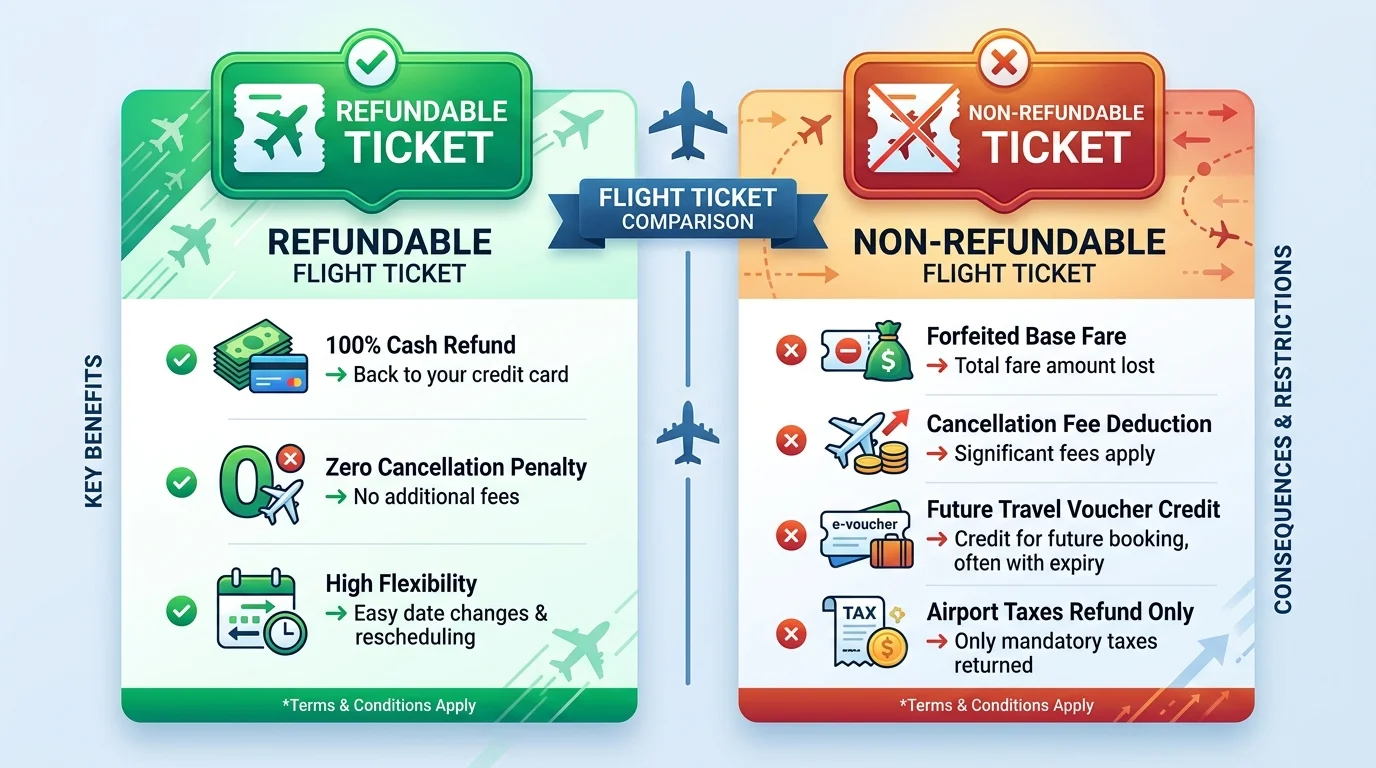
Refundable vs Non-Refundable Tickets
Understanding your fare type before booking is the single most effective way to avoid unexpected financial losses.
| Feature | Refundable Ticket | Non-Refundable Ticket |
|---|---|---|
| Cancellation Privilege | Permitted up to departure cutoff. | Permitted, but base fare is typically forfeited or restricted. |
| Form of Refund | Returned to original payment method. | Eligible unused taxes returned; remaining value may become an airline credit. |
| Cancellation Fee | None or a nominal processing charge. | Substantial administrative fee or 100% of the base fare. |
| Flexibility Level | Highest flexibility. | Low to zero flexibility. |
| Upfront Price | Significantly higher baseline price. | Lower baseline promotional price. |
"Non-refundable" does not mean that every cent is permanently lost under all circumstances. Even on highly restricted tickets, mandatory third-party government charges and unutilized airport user fees are generally refundable upon request if you formally cancel before the departure cutoff.
How Airline Refunds Work
When you initiate a flight cancellation, the refund workflow follows a precise operational sequence:
- Direct Airline Bookings: If you booked directly through the carrier’s website or app, refunds are processed by the carrier's merchant account back to your original payment method.
- Travel Agency & OTA Bookings: If you booked via a third-party agent or online travel agency (OTA), the carrier often remits eligible funds back to the agency's global distribution account. You must claim the refund directly through that agency, which may deduct independent agency processing fees.
- Refund Processing Timelines: While an airline may approve and release a refund within several business days, your financial institution or card issuer often requires an additional 7 to 14 business days to clear and post the credit to your statement. Third-party agency reconciliations can extend this process further.
Planning Travel Logistics?
Use FareWander tools to calculate flight times, luggage rules, and visa requirements.
Cancellation Charges
An airline cancellation charge is an administrative penalty deducted from the eligible fare value when a passenger voluntarily terminates a confirmed booking.
Airlines levy these fees to mitigate the financial risk of carrying empty inventory that could have been sold to other travelers. Cancellation charges are not standardized across the industry; they vary based on:
- Fare Category: Deeply discounted "Saver" or "Light" fares impose the highest penalties (often forfeiting the entire base fare), while premium cabin or flexible fares carry low or zero cancellation fees.
- Timing: Many international airlines use tiered fee models, where cancelling 30 days before departure incurs a smaller deduction than cancelling 48 hours prior.
- Route Type: Domestic itineraries frequently feature lower flat cancellation charges compared to complex long-haul international journeys.
Hypothetical Cost Example:
A passenger purchases a semi-flexible international Economy ticket for $600 (comprising a $450 base fare and $150 in government and airport taxes). The fare rules specify a $150 cancellation charge for cancellations made at least 72 hours before departure.
If the passenger cancels on time, the airline deducts the $150 fee from the $450 base fare. The traveler receives a refund of $450 ($300 remaining base fare + $150 fully refundable taxes). If the fare had been fully non-refundable, only the $150 in third-party taxes would have been eligible for recovery.
What Does "Non-Refundable" Really Mean?
Purchasing a non-refundable ticket means the carrier is under no contractual obligation to return the base transportation fare to your credit card simply because you changed your personal schedule. However, several legal and contractual mechanisms may allow you to recover value:
- Refundable Taxes and Fees: Government-imposed taxes, passenger facility charges, and airport security levies are collected by airlines on behalf of public authorities. If you do not board the aircraft, the airline does not remit these funds to the government, making them refundable to you upon formal request.
- Carrier Travel Credits: Many full-service airlines allow you to convert the residual value of a non-refundable ticket into an expiring travel credit or flight voucher, minus any applicable cancellation penalties.
- Airline Cancellations and Major Schedule Changes: If the airline cancels the flight or introduces a significant schedule change, standard non-refundable restrictions are legally superseded, granting you the right to a full cash refund.
- Compassionate Waivers: Under strictly documented events—such as the verified death of an immediate family member or mandatory military deployment—select airlines may issue fee waivers or credit extensions at their discretion.
- Travel Insurance: If you must cancel due to a sudden illness, medical emergency, or jury duty, a comprehensive travel insurance policy can reimburse non-refundable out-of-pocket costs.
What Happens If You Cancel a Flight Before Departure?
Cancelling proactively before departure is crucial. If you know you cannot travel, follow this practical checklist:
- Review Your E-Ticket Fare Conditions: Check whether your ticket tier permits voluntary cancellation and note the exact deadline. Read our comparison on Flight Booking Confirmation vs E-Ticket to understand where fare conditions and coupon status are listed.
- Calculate Net Recoverable Value: Determine whether the refund amount or credit voucher exceeds the applicable cancellation charge.
- Compare Cancellation with a Flight Change: If you plan to travel within the next few months, paying a change fee plus fare difference to modify dates may preserve more value than cancelling outright.
- Locate Your Booking Details: Locate your 6-character reference code (see What Is a PNR Number? for help finding your PNR) and initiate cancellation through the correct provider:
- If booked directly, use the airline’s "Manage Booking" tool.
- If booked through an OTA, submit the cancellation through your agency account.
- Retain Written Documentation: Save the cancellation reference number, email confirmation, and any credit voucher codes with their stated expiration dates.
Cancelling prior to the cutoff protects you from being classified as a no-show, which strips away almost all remaining ticket rights.
What Happens If You Cancel After Check-In?
Completing web or mobile check-in transitions your reservation into active airport operational status.
If you decide not to travel after checking in:
- You cannot simply click "cancel" on standard booking pages; your electronic ticket is locked to a boarding pass.
- You must first cancel your check-in status (offload yourself) via the airline's app, website, or customer support desk.
- Once offloaded, the ticket returns to an editable status, allowing you to proceed with standard cancellation or rebooking workflows.
If you abandon the journey after checking in without formally offloading, the airline will mark you as a no-show when the boarding gate closes, resulting in the forfeiture of your fare.
What Is a No-Show in Aviation?
A no-show occurs when a ticketed passenger fails to board their flight and fails to cancel or alter their reservation prior to the airline’s published deadline.
When a passenger fails to show up, the empty seat cannot be offered to standby travelers or resold. Consequently, airlines enforce severe penalties. Becoming a no-show typically triggers:
- Total forfeiture of the entire base fare and carrier surcharges.
- Invalidation of travel credit options.
- Automatic cancellation of all remaining segments on the itinerary, including connecting legs and the return flight.
No-Show vs Voluntary Cancellation vs Missed Flight
| Situation | Who Initiated It? | Meaning | Typical Practical Outcome |
|---|---|---|---|
| Voluntary Cancellation | Passenger | Passenger formally cancels before published deadlines. | Refund, credit, or tax recovery subject to fare conditions. |
| No-Show | Passenger | Passenger fails to board without prior cancellation. | Fare forfeiture; all downstream/return legs automatically cancelled. |
| Missed Flight | Passenger | Passenger arrives at the gate after closure due to personal delays. | Subject to airline discretionary policies (e.g., standby or rebooking fees). |
| Airline Cancellation | Airline | Carrier cancels the service due to operational/weather reasons. | Full cash refund, alternate rebooking, or travel vouchers. |
| Significant Schedule Change | Airline | Carrier materially modifies scheduled departure/arrival times. | Free rebooking or full cash refund under consumer rights rules. |
What Happens If You Miss Your Flight?
Missing a flight due to road traffic or security delays is procedurally different from proactively cancelling. Review our emergency guidance on What Happens If You Miss Your Flight? to explore immediate airport standby policies.
If you arrive at the terminal after the boarding gate has closed:
- Head immediately to the airline’s customer service counter.
- Do not wait: Airlines often enforce time-sensitive discretionary policies (sometimes referred to as "flat-tire rules") that allow agents to place late-arriving passengers on standby for the next available flight for a nominal fee, provided they report within a short window following departure.
- If you simply leave the airport without speaking to airline staff, your record is finalized as a no-show, extinguishing your options.
What Happens to Return and Connecting Flights After a No-Show?
One of the most devastating traps in airline ticketing is the sequential coupon rule embedded in airline Conditions of Carriage.
Under standard airline ticketing rules, flight coupons must be used in the exact order listed on the electronic ticket. If you hold a round-trip ticket and fail to take the outbound flight without notifying the carrier, the reservation system automatically voids and cancels all remaining segments, including your return flight.
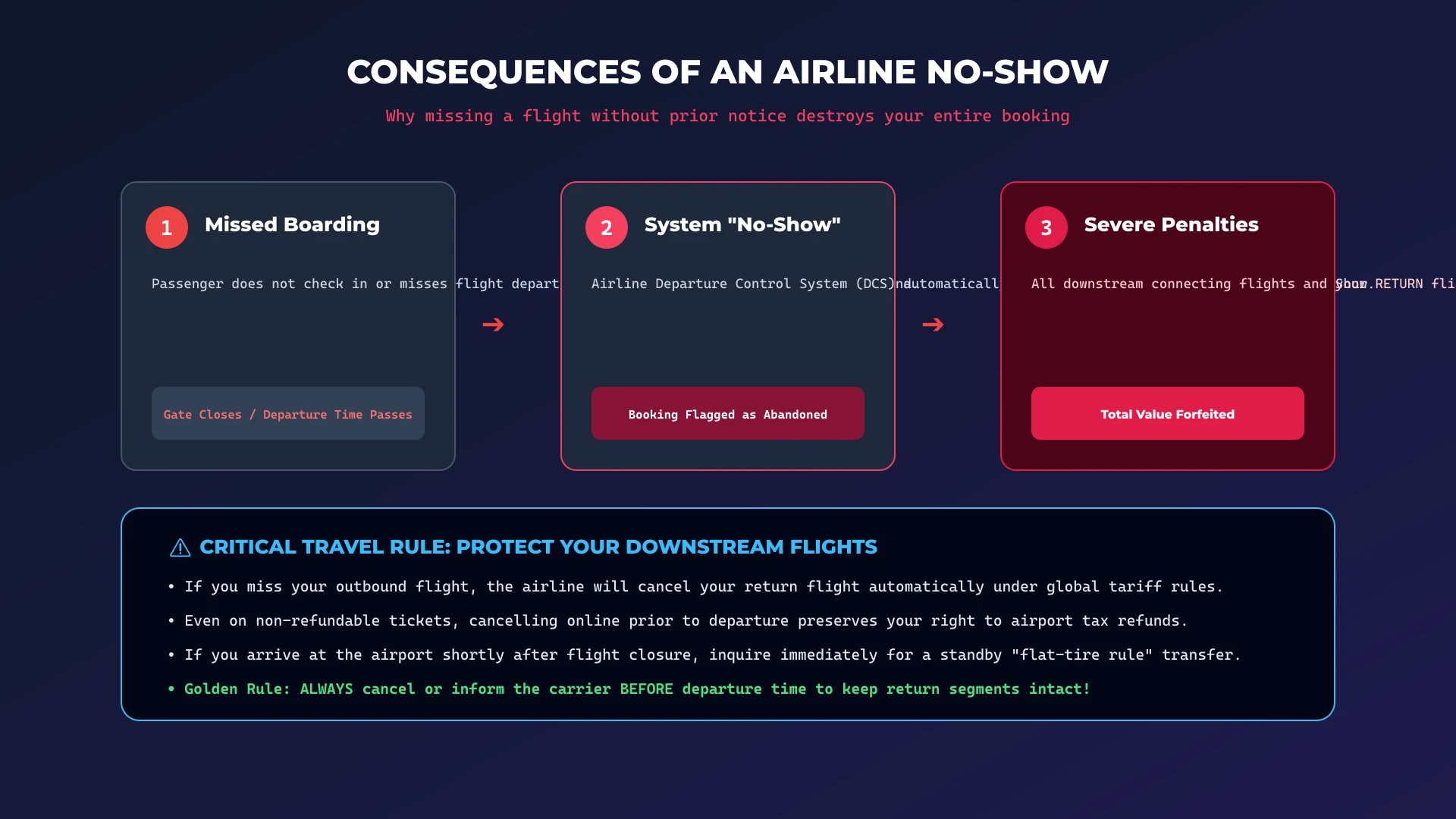
If an emergency prevents you from taking your outbound flight, but you still plan to use your return ticket, you must contact the ticketing airline immediately. An agent may be able to reprice the ticket to preserve the return journey, though this typically incurs fare adjustments and administrative fees.
What Happens If the Airline Cancels Your Flight?
When the carrier cancels your service, the standard restrictions attached to non-refundable tickets no longer apply. Under general Conditions of Carriage and regional passenger protection laws, affected passengers are entitled to choose between:
- Complimentary rebooking on the next available flight to their destination.
- Rerouting via an alternative routing or partner airline.
- A full refund of the unused ticket value paid back to the original payment method, rather than an expiring voucher.
Jurisdiction-Specific Passenger Protections
- European Union & United Kingdom (EU261 / UK261): Cancellations announced fewer than 14 days before departure may require the airline to pay statutory cash compensation, unless the disruption was caused by "extraordinary circumstances" (such as extreme weather or air traffic management restrictions).
- United States (DOT Regulations): If an airline cancels a flight for any reason and the passenger declines alternative rebooking options, the carrier must provide a prompt, full cash refund to the original payment method.
- India (DGCA Civil Aviation Requirements): Under DGCA CAR Section 3, Series M, Part IV, passengers affected by airline-initiated cancellations must be provided with alternate flights, refunds, and specified compensation depending on how far in advance the cancellation was communicated.
Schedule Changes: Minor vs Significant
Airlines frequently adjust schedules weeks or months prior to departure due to network optimization or slot changes.
- Minor Schedule Changes: Adjustments shifting departure or arrival times by a few minutes do not trigger special cancellation rights. You are expected to travel on the updated schedule.
- Significant Schedule Changes: When a schedule adjustment materially alters your itinerary—such as shifting departure by several hours, introducing an unexpected layover, or causing a misconnection—you are generally entitled to reject the change and receive a complimentary rebooking or a full refund to your original payment method. What constitutes a "significant" delay is defined by regional aviation regulators and carrier policy.
The 24-Hour Flight Cancellation Rule
The concept of a "24-hour free cancellation window" is frequently misunderstood because it is not a universal global aviation rule.
- United States: The U.S. Department of Transportation mandates that for flights departing to, from, or within the U.S., airlines must either allow consumers to cancel their reservation without penalty for a full refund within 24 hours of booking, or allow them to hold the reservation at the quoted fare for 24 hours without payment, provided the booking is made at least 7 days before departure.
- Other Markets: In jurisdictions such as the EU, UK, and India, mandatory 24-hour cooling-off periods depend on individual airline policies, specific booking channels, or domestic consumer protection frameworks. Never assume a 24-hour grace period exists unless explicitly stated in your fare conditions during purchase.
Direct Airline Bookings vs Third-Party Travel Agencies
Where you purchase your flight dictates how cancellations and refunds must be serviced.
| Booking Method | Where to Initiate Cancellation | Servicing Considerations |
|---|---|---|
| Airline Direct Website/App | Airline Customer Portal | Direct processing; no intermediary agency fees; instant credit generation. |
| Online Travel Agency (OTA) | OTA Portal / Customer Support | The OTA controls the ticketing file; agency processing charges may apply on top of airline fees. |
| Traditional / Corporate Travel Agent | Corporate Travel Desk / Booking Agent | Handled via corporate account managers; subject to bespoke corporate fare agreements. |
Airlines routinely refuse to process voluntary cancellations for tickets issued by third-party agencies, directing the passenger back to the original ticketing vendor.
Decision Framework: What to Do With Your Ticket
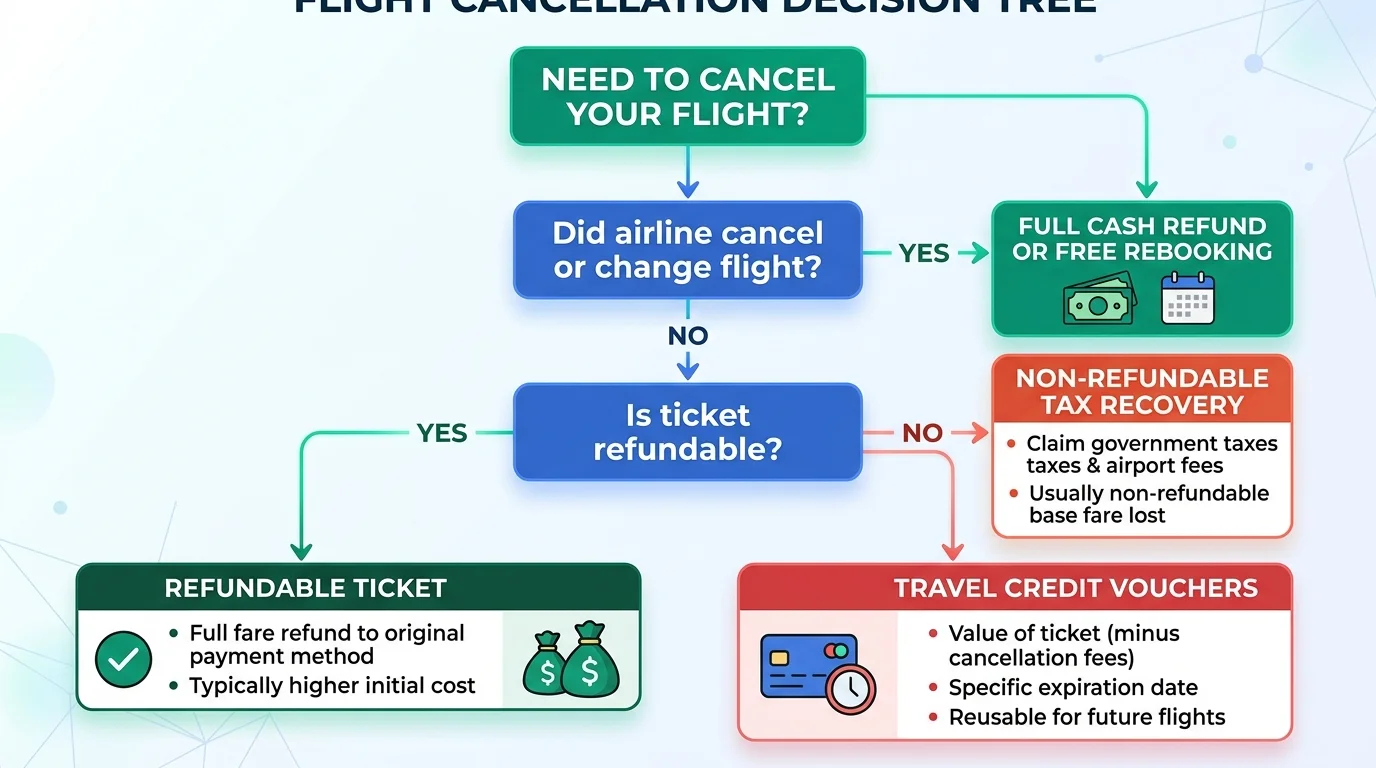
Follow this logical sequence before submitting a cancellation request:
- Did the airline cancel or heavily change the flight?
- Yes: You are generally entitled to a free rebooking or a 100% full cash refund to your original payment method.
- No: Proceed to step 2.
- Is your ticket refundable?
- Yes: Check your cancellation deadline and submit for a full cash refund to your original payment card.
- No: Proceed to step 3.
- Does your non-refundable fare allow travel credit or rebooking minus a fee?
- Yes: Cancel online proactively before departure to retain travel credit and avoid no-show penalties.
- No: Submit a formal request to recover unused third-party government and airport taxes only.
Practical Examples of Flight Cancellation Scenarios
The following examples are hypothetical illustrations designed to explain standard aviation pricing and operational mechanics:
- Scenario 1 — Cancelling a Fully Refundable Ticket: A traveler purchases a Flexible Business Class fare for $1,200. Due to a meeting postponement, they cancel 24 hours before departure via the airline app. Because the ticket has no cancellation penalties, the full $1,200 is credited back to the original credit card.
- Scenario 2 — Cancelling a Non-Refundable Basic Ticket: A passenger books a $220 promotional economy fare. A personal conflict arises, and they cancel online two days prior to departure. The base fare of $170 is forfeited under the restrictive fare conditions, but the $50 in government airport and security fees is refunded to their card.
- Scenario 3 — Cancelling Minutes Before Departure: A traveler with a semi-flexible domestic ticket gets delayed in transit and cancels online 30 minutes before the scheduled departure cutoff. They successfully prevent a no-show classification, preserving their $300 ticket value as an airline travel voucher minus a $75 cancellation fee.
- Scenario 4 — The Costly No-Show: A passenger misses an outbound morning flight from New York to London and decides to purchase a separate one-way ticket on another carrier without notifying their original airline. The original carrier logs a no-show and automatically cancels the return leg from London, forcing the traveler to buy an expensive last-minute return ticket.
- Scenario 5 — Involuntary Airline Cancellation: An airline cancels a regional flight due to a mechanical issue. The passenger declines the replacement flight scheduled for the following afternoon. Despite holding a restricted non-refundable ticket, the passenger receives a 100% cash refund to their credit card.
- Scenario 6 — Third-Party Agency Complication: A traveler attempts to cancel an OTA-issued ticket directly through the airline’s website. The airline system displays an error directing the user to the agent. The passenger cancels through the OTA, which deducts an independent $35 administrative fee alongside the airline's standard cancellation penalty.
Common Airline Cancellation Mistakes to Avoid
- Assuming Every Ticket Can Be Refunded: Confusing the ability to cancel with the right to receive cash back.
- Ignoring the No-Show Cutoff: Waiting until after departure to notify the airline, voiding the ticket and cancelling onward flights.
- Confusing Change Fees with Cancellation Fees: Believing that changing a flight date is the same as terminating the itinerary.
- Failing to Reclaim Taxes on Non-Refundable Fares: Walking away from a cancelled restricted ticket without submitting a claim for unused airport taxes.
- Assuming 24-Hour Free Cancellation Is Universal: Relying on U.S.-specific 24-hour cancellation rules for bookings made outside eligible jurisdictions or within 7 days of departure.
- Failing to Protect Downstream Segments: Skipping an outbound flight while expecting the return ticket to remain valid.
- Not Retaining Documentation: Failing to save cancellation confirmation numbers, fee breakdowns, and credit voucher expiration terms.
Frequently Asked Questions
An airline cancellation policy is the set of contractual rules governing whether a flight booking can be cancelled, the deadlines for cancellation, the fees deducted, and whether the traveler receives cash, travel credits, or tax refunds.
Before cancelling a flight, take five minutes to inspect the exact fare conditions attached to your electronic ticket receipt. Review the specific cancellation deadline, verify the net amount you will recover after administrative deductions, and determine whether converting the ticket to a future travel credit or modifying your travel dates preserves more value than cancelling outright. If your booking was made through an online travel agency or corporate booking platform, route your request through their management portal rather than the carrier’s direct desk. Taking a methodical approach before confirming a cancellation ensures you protect your travel investment and keep your return flights intact.