You booked a departure for Friday evening, but a work meeting shifts to Saturday, or a family commitment forces you to push your vacation back by three days. Your first impulse is likely relief that tickets can usually be modified, followed immediately by dread over what the airline will charge to move you to a new seat.
While commercial airlines permit schedule adjustments in many scenarios, the total cost and eligibility depend on your specific fare conditions, how close you are to departure, and who issued your ticket. Understanding the mechanics of ticket modification before clicking confirm helps you preserve your travel funds and avoid paying more for a modification than the cost of a fresh reservation.
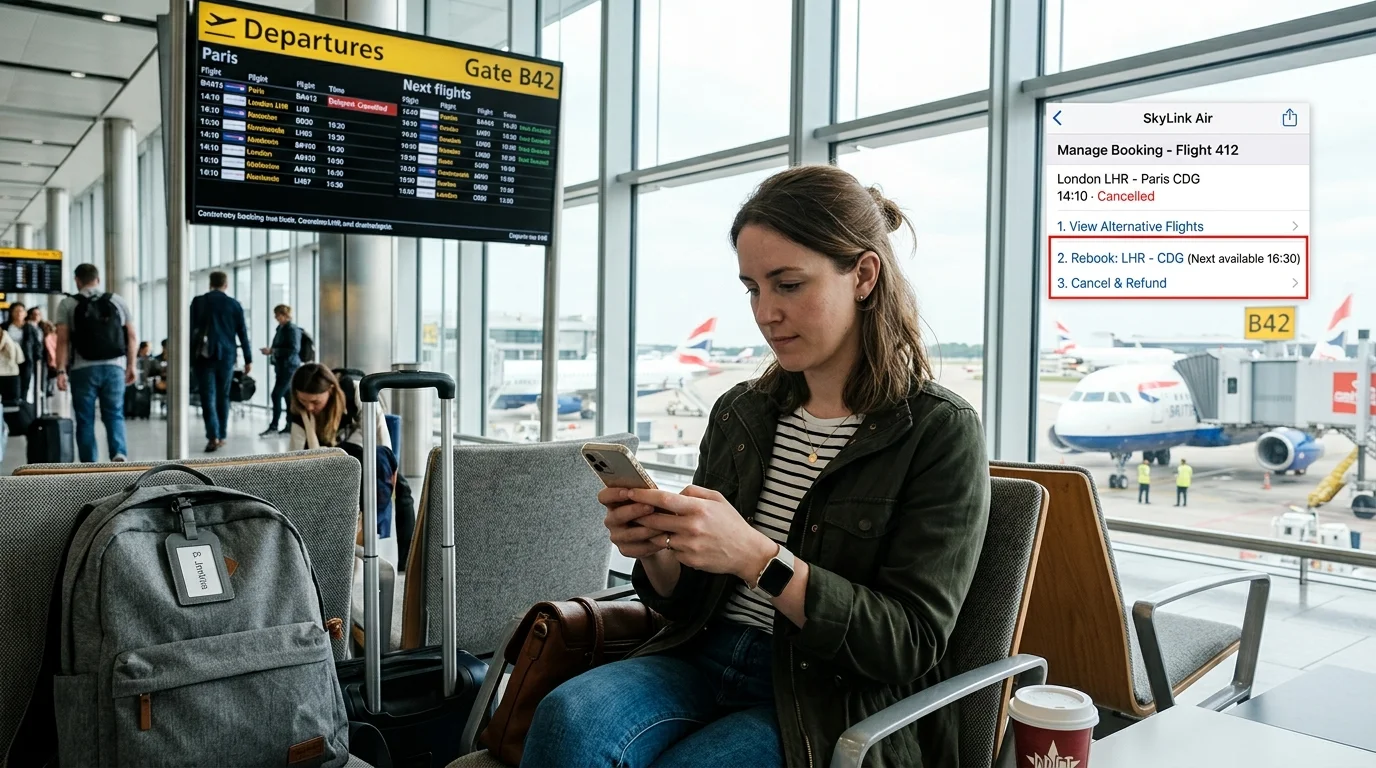 Reviewing fare conditions and managing ticket modifications early helps avoid steep penalties and unexpected airfare differences.
Section 1: What Is a Flight Change Policy?
An airline flight change policy is the formal set of contractual conditions within a ticket’s fare rules that dictates whether, when, and how a passenger can modify a confirmed reservation. It outlines the exact parameters for switching departure dates, shifting flight times, or altering routes.
Airlines do not maintain one universal set of rules across all customers on an aircraft. Instead, permissions are governed by the specific fare family purchased (such as Basic Economy, Main Cabin/Standard Economy, or Flexible Business). The fare conditions attached to your ticket establish whether changes are permitted with a penalty, allowed without an administrative charge, or restricted entirely.
Section 2: Can You Change a Flight After Booking?
Yes, you can change a flight after booking in most circumstances, but your ability to do so is not absolute. Ticket adjustability depends on several key variables:
- The Operating and Marketing Carrier: Airlines enforce distinct commercial terms.
- Fare Type: Fully flexible fares accommodate adjustments freely, whereas deeply discounted promotional tickets often restrict modifications.
- Timing: Making an adjustment weeks in advance provides broader availability and avoids close-in cutoffs.
- Route Type: Domestic point-to-point journeys often have different change rules than multi-carrier international itineraries.
- Booking Channel: Tickets bought directly from an airline portal are serviced under different operational workflows than tickets purchased through an online travel agency (OTA).
Comparing Fares for Your Route?
Search live multi-airline schedules, spot discount windows, and baggage fee rules on FareWander.
Section 3: What Parts of a Flight Can You Change?
A ticket modification is not an open-ended voucher; it applies to specific components of your itinerary:
- Travel Date: Shifting your departure or return to an earlier or later calendar date is the most standard adjustment.
- Departure Time: Moving to an earlier or later departure slot on the exact same travel date.
- Flight Number: Switching to an alternative operational flight on the same route to alter layovers or aircraft equipment.
- Destination & Origin: Some fare classes permit rerouting to alternative airports or changing city pairs entirely, though this triggers a comprehensive recalculation of the itinerary's base fare and airport taxes. Changing an origin city is subject to tighter fare rule constraints than adjusting a destination.
- Passenger Names (Crucial Distinction): A flight change policy does not allow you to transfer your ticket to another traveler. Correcting a minor typographical error on a passenger's legal name is an administrative name correction, whereas changing the person flying is considered a passenger transfer, which commercial airlines almost universally prohibit.
Section 4: How Much Does It Cost to Change a Flight?
The final price tag of a flight change rarely consists of a single static number. Instead, it comprises multiple financial components:
- Flight Change Fee: An administrative fee levied by the airline simply for processing the modification. While many full-service carriers removed standard change fees on main-cabin domestic routes, budget airlines and select international tickets still enforce them.
- Fare Difference: Airfares fluctuate continuously due to dynamic pricing algorithms. If your original seat cost $200 and the seat on the newly requested flight sells for $280, you must fund the $80 gap.
- Taxes and Airport Charges: Shifting dates or routes can alter passenger facility charges, security fees, and international departure taxes. Any net increase in local taxes must be settled upon rebooking.
- Residual Value or Fare Credits: If the new flight happens to be cheaper than your original purchase, airline treatment varies: some carriers issue the difference as an expiring travel voucher, while others forfeit the remaining value entirely based on the fare rules.
To calculate the expense, use this decision framework:
$$\text{Potential Total Change Cost} = \text{Applicable Change Fee} + \text{Fare Difference} + \text{Applicable Tax Adjustments}$$
(Note: This is a practical traveler decision model, not an airline accounting formula.)
Section 5: Flight Change Fee vs Fare Difference
Many travelers mistakenly believe that if an airline advertises "no change fees," modifying the ticket is entirely free. A change fee and a fare difference are two completely separate charges.
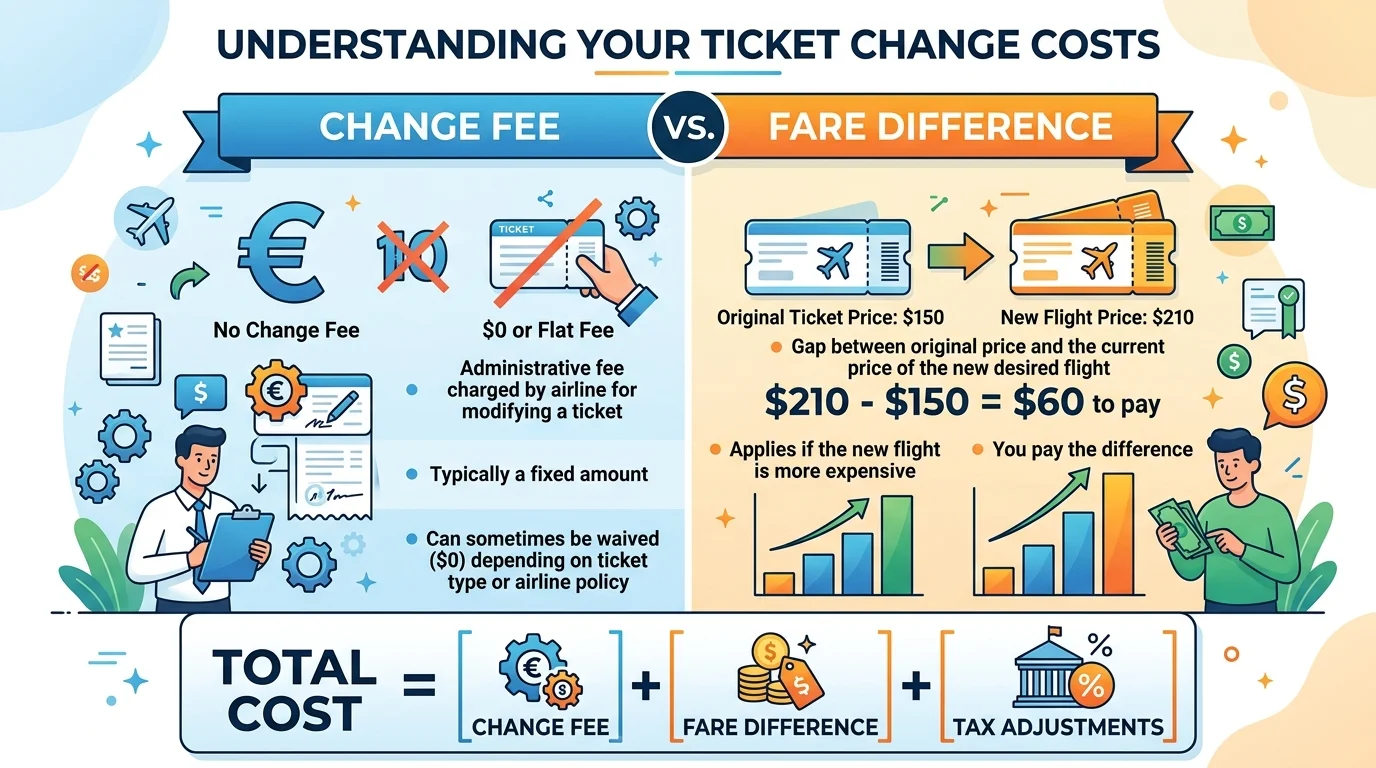 Visual breakdown of how a flat administrative change fee differs from the dynamic airfare difference between flights.
| Cost Component | What It Means | When It May Apply |
|---|---|---|
| Change Fee | A flat penalty for altering the confirmed reservation. | Depends on fare class, airline, and route rules. |
| Fare Difference | The price gap between the original fare paid and the new flight's current rate. | Applies whenever the replacement flight costs more than the original. |
Hypothetical Example:
Suppose you purchased an Economy ticket from Chicago to Denver for $150. You now need to change your departure to a flight departing two days later.
- The airline does not charge a change fee ($0 change fee).
- However, seats on the requested new flight currently sell for $210.
- You must pay the $60 fare difference to secure the new flight.
If you had purchased a restricted ticket carrying a $50 administrative change penalty on a budget carrier, your total out-of-pocket cost would be $110 ($50 change fee + $60 fare difference).
Planning Travel Logistics?
Use FareWander tools to calculate flight times, luggage rules, and visa requirements.
Section 6: Are Flight Changes Free?
Flight changes are rarely completely free in terms of net out-of-pocket spend.
When a carrier promotes "fee-free flight changes," it specifically means they have eliminated the administrative penalty for modifying the itinerary. You are still responsible for paying any fare difference between your old ticket and the new seat, alongside any difference in government or airport taxes.
The only circumstances where a flight change is genuinely zero-cost are:
- You switch to an alternative flight that happens to sit in an identical or lower fare bucket on the same route.
- You modify the flight within a legally mandated window, such as the U.S. Department of Transportation (DOT) 24-hour rule (applicable to qualifying reservations booked at least 7 days prior to departure).
- The airline initiates an involuntary schedule disruption, triggering fee waivers and fare-difference absorption.
Section 7: Can You Change a Non-Refundable Flight?
Non-refundable does not mean non-changeable.
Refundability and changeability are governed by independent fare clauses. A non-refundable ticket simply dictates that if you decide not to travel, the airline will not return your money to your original payment method (though unused third-party taxes can usually be claimed back).
However, many standard non-refundable tickets permit schedule changes. You will be required to pay any applicable fare difference, and the base value of your original ticket is preserved and rolled over into the new booking.
Section 8: Basic Economy and Restricted Fares
Basic Economy and entry-level "Saver" or "Light" fares exist to provide the lowest advertised baseline price by unbundling all non-essential perks and removing flexibility.
Airlines frequently place severe restrictions on modifying these tickets:
- Total Prohibition on Changes: Many carriers strictly prohibit voluntary date or time modifications once the initial booking grace period has expired.
- High Administrative Deductions: Select carriers permit cancel-and-rebook workflows for a substantial cancellation fee, returning any residual balance solely as an airline credit.
- Exclusion from Same-Day Adjustments: Basic Economy passengers are routinely excluded from same-day standby or confirmed same-day flight switches.
Because Basic Economy policies vary across legacy and low-cost carriers, checking the explicit fare conditions displayed during checkout is critical.
Section 9: Same-Day Flight Change
A same-day flight change allows a passenger to switch to an alternative flight operating on their original date of travel. This differs from a standard date change, which requires recalculating the ticket against current dynamic inventory.
Airlines generally offer two types of same-day adjustments:
- Confirmed Same-Day Change: You secure a dedicated, guaranteed seat on an earlier or later flight on the day of departure. Depending on airline policy and fare class, this may incur a flat administrative charge (often waived for elite frequent flyers and premium cabin tickets).
- Same-Day Standby: You do not receive a confirmed seat; instead, you are placed on a waitlist at the airport gate and boarded only if an unassigned seat remains after all ticketed passengers have boarded.
Eligibility typically requires that your departure and destination airports remain identical, and changes usually open within 24 hours of scheduled departure.
Section 10: How to Change a Flight Online
Changing a booking through digital self-service tools is significantly faster and often avoids manual call-center support ticketing fees.
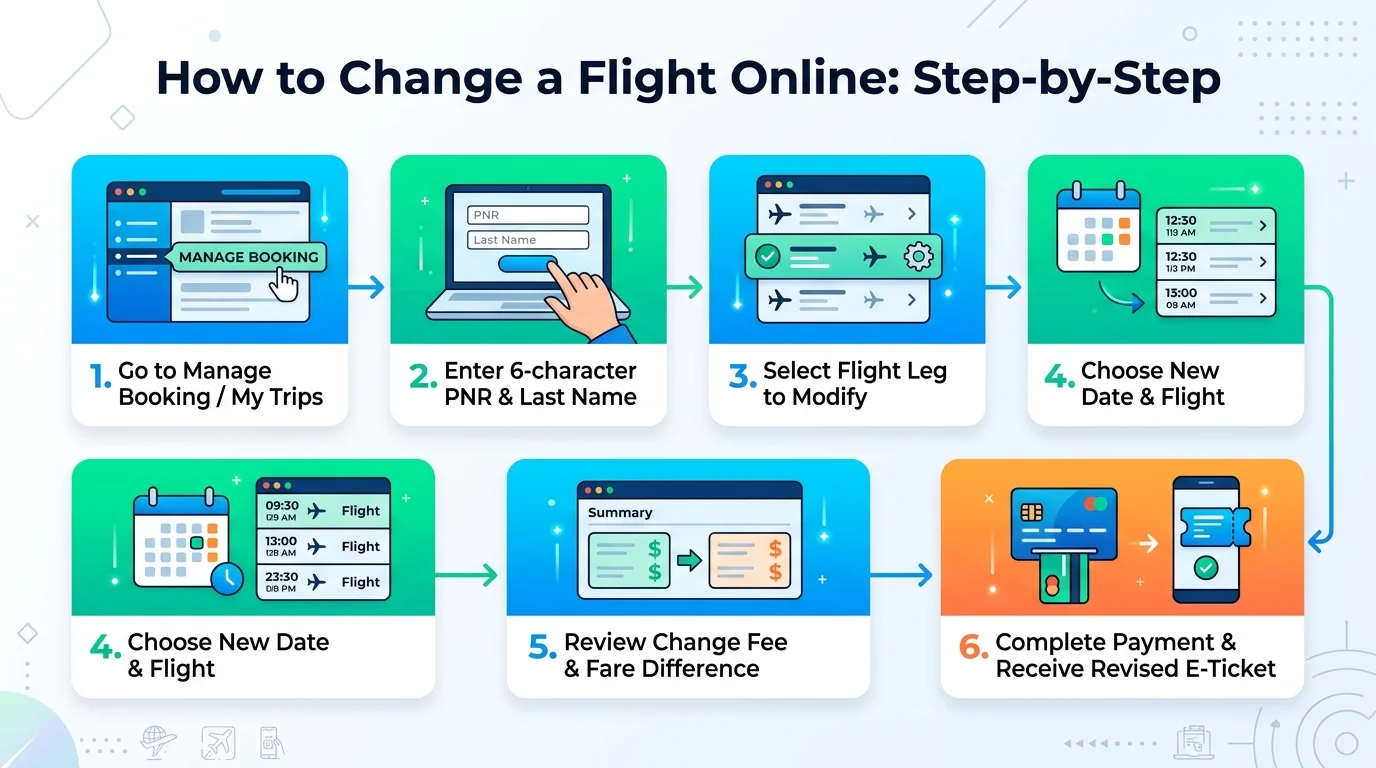 Step-by-step digital process for modifying an airline ticket online through web self-service portals.
- Navigate to the airline's official website or open their mobile application.
- Select Manage Booking, My Trips, or the carrier's equivalent section.
- Enter your six-character booking reference (PNR) and the passenger’s last name.
- Locate your active itinerary and click Modify Flight or Change Flight.
- Select the specific flight leg you wish to update (outbound, return, or both).
- Input your new travel date, time, or preferred routing to browse available departures.
- Review the itemized cost breakdown, verifying the exact fare difference, taxes, and change charges.
- Confirm the flight selection and proceed to the payment gateway if additional charges apply.
- Complete payment and verify that your screen displays a success confirmation.
- Check your email to verify that a revised e-ticket receipt reflecting the new flight numbers has been issued.
Section 11: How to Change a Flight Through Customer Support
While online tools handle straightforward point-to-point switches, direct customer support intervention is necessary in specific scenarios:
- Multi-city itineraries with complex open-jaw stops.
- Bookings involving multiple partner airlines or complex codeshare agreements.
- Reservations where technical errors prevent online modification.
- Tickets requiring emergency, bereavement, or military documentation reviews.
When calling, have your 6-character PNR, full passenger legal names, and target flight numbers ready to provide to the agent to streamline rebooking.
Section 12: What If You Booked Through a Travel Agency or OTA?
If your reservation was processed through an Online Travel Agency (such as Expedia, Booking.com, or MakeMyTrip) or a corporate travel management desk, the travel agency owns the ticketing file.
- Primary Point of Contact: You must generally contact the booking agency directly to modify the ticket before travel. The airline’s web portal will often display an error stating that the reservation was booked via a third party and must be serviced through the original agent.
- Layered Agency Fees: Travel agencies frequently charge their own administrative handling fees on top of any airline change penalties and fare differences.
- Day-of-Travel Exception: Once the flight enters the immediate departure window (typically within 24 hours of travel), control of the electronic ticket record usually transfers to airport operational control, allowing airline agents at the airport desk to handle emergency rebooking.
Section 13: What Happens If the Airline Changes Your Flight?
An airline-initiated flight change (involuntary schedule change) is fundamentally different from a passenger-initiated adjustment. Commercial carriers routinely alter schedules months or weeks in advance due to fleet maintenance, airport slot modifications, or seasonal demand shifts.
If the airline materially changes your departure time, alters your routing, or cancels a segment, you are generally not held to standard voluntary change restrictions:
- Complimentary Rebooking: You are entitled to be rebooked onto an alternative flight operated by the carrier on the same or adjacent dates without paying change fees or fare differences.
- Refund Eligibility: If the schedule adjustment is "significant" (such as a time shift exceeding several hours, an added layover, or an undesirable route downgrade), regional passenger protections and airline conditions of carriage grant you the right to reject the itinerary and receive a full cash refund to your original payment method, even on a non-refundable ticket.
Section 14: Airline Flight Change vs Passenger Flight Change
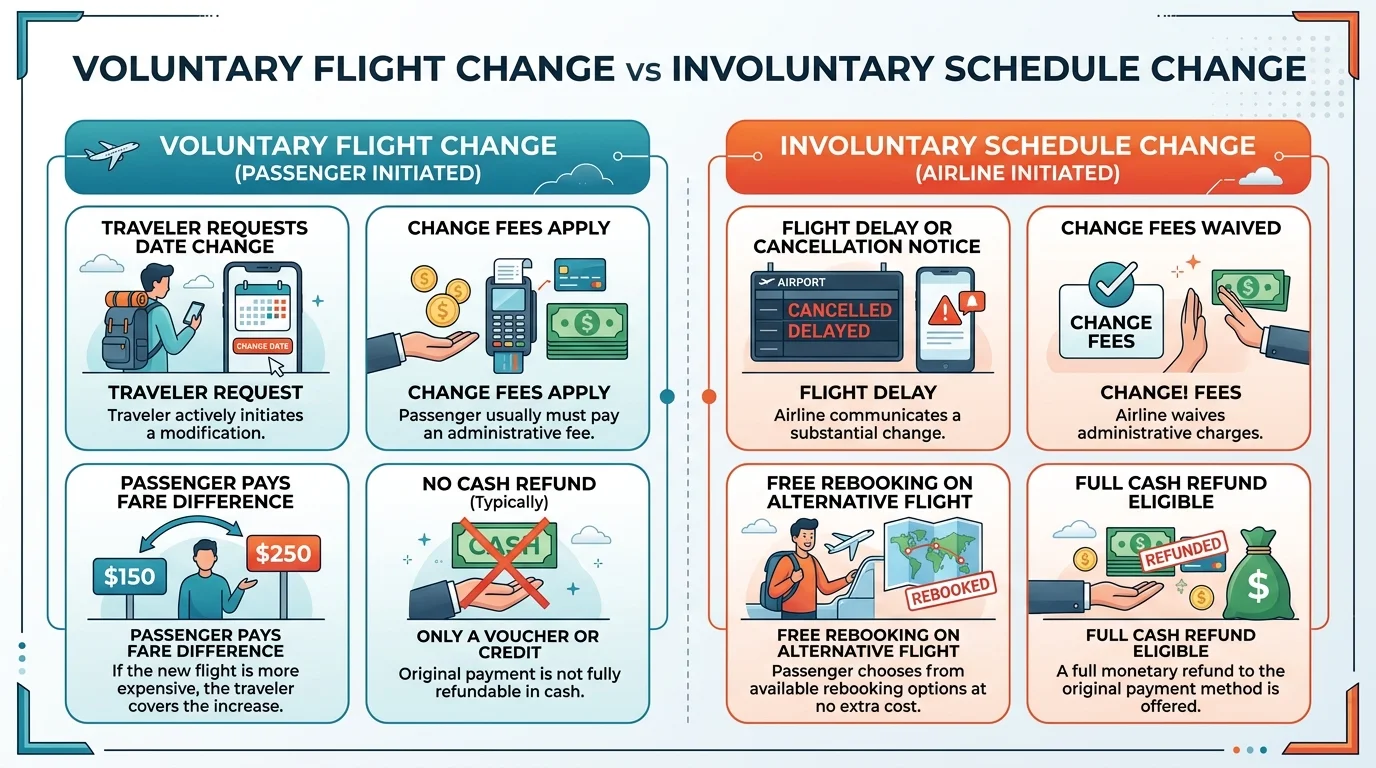 Comparison of passenger-initiated voluntary modifications versus carrier-initiated involuntary schedule changes.
| Factor | Voluntary Flight Change | Involuntary Schedule Change |
|---|---|---|
| Initiated By | The Passenger. | The Operating/Marketing Airline. |
| Change Fees | Apply based on the purchased fare conditions. | Strictly waived. |
| Fare Difference | Passenger must pay if the new seat costs more. | Waived within airline-defined rebooking windows. |
| Cash Refund Option | Only available if a fully refundable fare was purchased. | Available if the schedule change exceeds regulatory/policy thresholds. |
Section 15: What Happens to Your Seat, Baggage and Add-Ons?
Never assume ancillary purchases automatically transfer to your newly modified flight.
- Assigned Seats: Changing flights releases your original seat assignment. The airline's reservation system will attempt to assign an equivalent seat, but if premium or extra-legroom seats are unavailable on the new aircraft, you may be downgraded to standard seating.
- Prepaid Baggage: Checked baggage allowances associated with your baseline fare typically transfer, but separately purchased prepaid bags occasionally require manual re-association by customer service.
- Meals and Special Services: Special meal requests, wheelchair assistance, and pet-in-cabin reservations must be re-requested for the new flight date and time to ensure catering and airport operations accommodate them.
- Third-Party Travel Insurance: Policies purchased through airline checkouts or independent travel insurance providers do not update automatically; you must contact the insurance underwriter to adjust coverage dates to match your new flight.
Section 16: Can You Change a Flight After Check-In?
Yes, but checking in locks your electronic ticket into active airport status.
To modify your flight after completing online or mobile check-in:
- You must first use the airline app or contact an agent to cancel your check-in status (referred to as "offloading").
- Once the check-in lock is removed, the electronic ticket re-enters an editable state, allowing you to select an alternative date or flight.
- If you have already dropped checked baggage at the terminal bag drop, changing your flight requires airline ground staff to physically retrieve your bags from airport sort facilities, which is rarely permitted for voluntary schedule adjustments shortly before departure.
Section 17: Can You Change a Flight After Missing It?
Attempting to change a flight after departure is far more difficult than adjusting it beforehand.
If you fail to board and do not contact the carrier before departure, your ticket is marked as a no-show. When a no-show occurs, the airline automatically cancels all remaining downstream segments on that reservation, including return flights. The remaining value of a no-show ticket is often forfeited completely under standard fare rules.
If you arrive at the airport shortly after the flight departs, contact customer support or visit an airport ticket desk immediately. Some carriers maintain discretionary customer-service policies (such as a "flat tire rule") that allow passengers to pay a rebooking fee or standby charge to catch a later departure, but this is an exception rather than a guaranteed contractual right.
Section 18: Flight Changes for Domestic vs International Flights
| Comparison Factor | Domestic Flight Changes | International Flight Changes |
|---|---|---|
| Fare Structure | Often simpler; many mainline carriers waive change fees on standard fares. | More complex fare ladders; change fees frequently apply to discounted long-haul tiers. |
| Tax Variations | Minor local airport fees. | Substantial international customs, security, and immigration tax adjustments. |
| Border Controls | Standard domestic government identification required. | Passport validity (6-month rules), transit visas, and entry compliance must be re-verified. |
| Rebooking Flexibility | High flight frequencies allow easier same-day switches. | Limited daily departures often push rebooked flights to subsequent calendar days. |
Section 19: What Happens to Connecting Flights?
Adjusting one segment of an itinerary has a domino effect on the rest of your travel:
- Single Protected Ticket: If you change your first flight to a later time, the airline system will verify whether you still meet the Minimum Connection Time (MCT) at the transit airport. If the new arrival makes catching your second flight impossible, the connecting segment must also be shifted, potentially triggering fare differences across both legs.
- Repricing the Entire Itinerary: In many international fare families, modifying a single flight segment triggers a complete historical repricing of the entire booking based on current available inventory.
- Separate Self-Transfer Bookings: If you booked two independent flights on separate airlines, changing flight one does not protect flight two. The second carrier treats any delay or schedule change on your first ticket as a passenger-caused no-show if you fail to arrive on time.
Section 20: Codeshare and Partner Airline Changes
In modern aviation, itineraries frequently involve codeshares—where the marketing carrier sells you a seat under their flight number, but an operating partner physically flies the plane.
- Who Controls Voluntary Changes: Prior to the day of departure, any voluntary flight change must be processed by the ticketing carrier (the airline that issued your 13-digit electronic ticket and collected payment).
- System Synchronization: When the ticketing airline alters a flight operated by a partner, their reservation engines must successfully synchronize inventory. This extra technical layer can sometimes delay ticket reissuance or restrict seat selection until the operating carrier updates its manifest.
Section 21: Award Tickets / Miles / Points Bookings
Modifying a flight booked with frequent flyer miles follows distinct loyalty program rules:
- Mileage Recalculations: If the newly selected flight falls into a higher redemption tier or peak pricing band, you must pay the additional points or miles required.
- Redeposit and Change Fees: Many major frequent flyer programs have eliminated redeposit and modification fees for award travel, while other international programs still charge fixed fees to adjust award itineraries.
- Award Inventory Availability: You cannot simply switch to any flight with empty seats; the new flight must have dedicated award seat inventory available in your specific loyalty tier.
Section 22: Can You Change a Flight for Free Due to an Emergency?
Airlines are commercial transport providers bound by contract law, not social services; they are not legally mandated to offer fee-free adjustments for personal emergencies.
However, many full-service carriers provide compassionate exceptions at their discretion:
- Bereavement or Severe Illness: Carriers may waive change penalties (though fare differences usually still apply) upon submission of formal documentation, such as an official death certificate or a signed hospital admission record.
- Military Orders: Active-duty personnel redeployed on short notice frequently qualify for administrative waivers with proof of official military directives.
- Severe Weather / Force Majeure: When hurricanes, blizzards, or major airspace disruptions occur, airlines issue widespread travel waivers allowing all ticketed passengers on affected routes to change their dates without change fees or fare differences within a defined travel window.
Section 23: Flight Change vs Cancellation and Rebooking
| Decision Option | What Happens | When It Makes Sense |
|---|---|---|
| Change Existing Ticket | Existing ticket is modified; fare difference and any change fees are settled immediately. | You know your exact new travel dates and the current fare difference is manageable. |
| Cancel for Travel Credit | Itinerary is cancelled; residual funds are stored as a travel voucher with an expiration date. | You know you cannot travel on the original date, but do not yet know your future schedule. |
| Involuntary Alternative | Airline re-accommodates you on an alternative flight due to schedule disruptions. | The carrier initiated the schedule change, granting you free rebooking rights. |
| Full Refund Claim | Money is returned to original payment card. | You hold a fully refundable fare or the airline canceled/heavily altered your flight. |
Section 24: Is It Cheaper to Change the Flight or Buy a New Ticket?
Before committing to a flight modification, conduct a comparative cost assessment:
- Calculate the total modification expense: $$\text{Change Fee} + \text{Fare Difference} + \text{Processing Fees}$$
- Search current one-way fares across competing airlines for your target departure date.
- Compare the net cost.
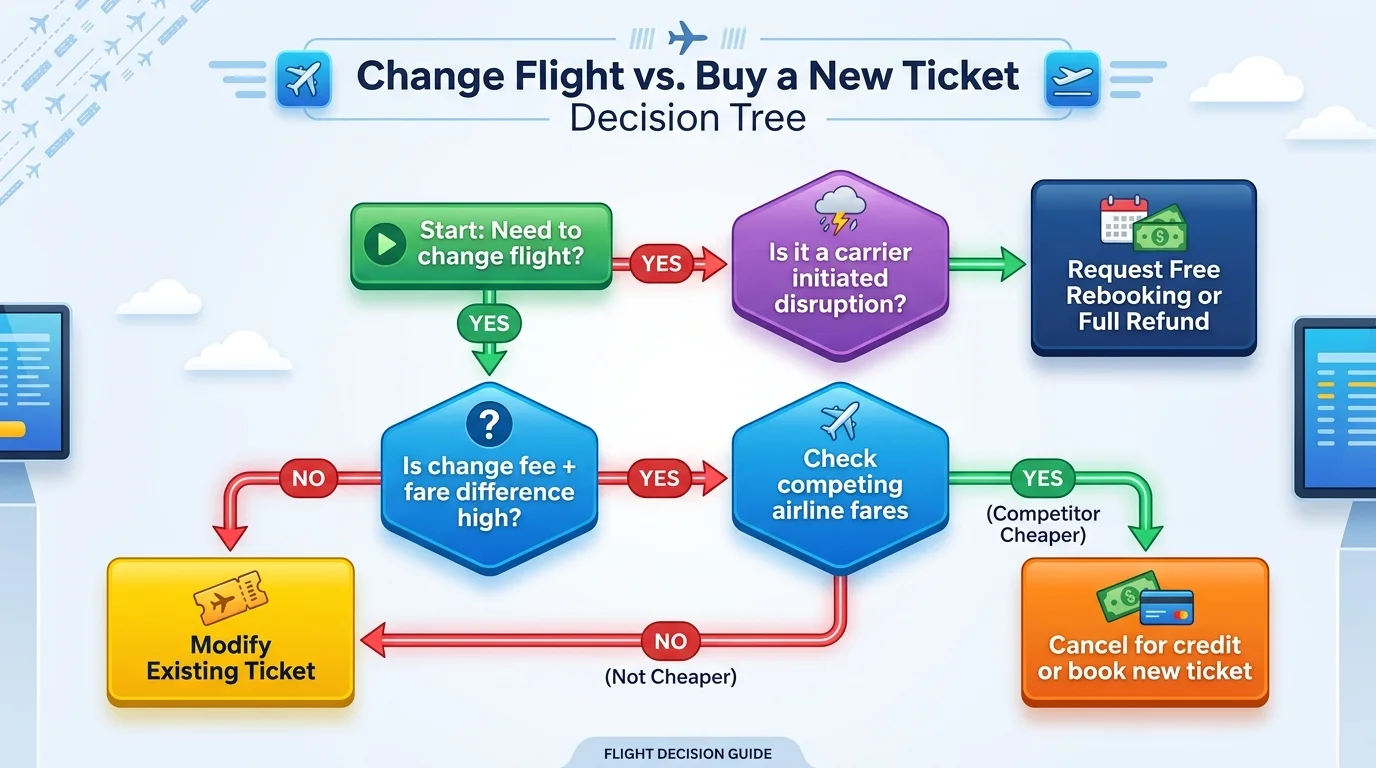 Decision tree comparing whether to modify an existing ticket, cancel for travel credit, or purchase a new flight.
If your current ticket carries a heavy change fee and the fare difference on your original airline is high, abandoning the unused ticket (and requesting a refund of the unused airport taxes) while booking a brand-new flight on a competing carrier can occasionally save you money.
Section 25: Examples of Flight Change Costs
The following examples are purely illustrative to demonstrate common pricing mechanics:
-
Example 1 — Advance Domestic Date Change: A passenger holds a $180 Main Cabin ticket with a legacy carrier that charges no voluntary change fees. Three weeks before travel, they switch to a flight departing two days later. The new flight is currently priced at $220. Total Cost: $40 ($0 change fee + $40 fare difference).
-
Example 2 — Same-Day Confirmed Switch: A passenger holding a $250 ticket needs to take an earlier flight on the same morning. The airline’s policy permits confirmed same-day adjustments for a flat $50 charge without charging a fare difference. Total Cost: $50.
-
Example 3 — International Route Adjustment: A passenger on a promotional transatlantic ticket wishes to delay their return flight by one week. The fare rules require a $150 international change penalty, and seasonal demand has increased the base fare by $300, alongside a $25 airport tax adjustment. Total Cost: $475 ($150 fee + $300 fare difference + $25 tax difference).
-
Example 4 — Airline Schedule Disruption: An airline moves a morning departure back by four hours, causing the passenger to miss an essential event. The passenger contacts the carrier and selects an alternative departure the preceding evening. Total Cost: $0 (The carrier absorbs all fees and fare differences due to the involuntary schedule change).
Section 26: Flight Change Checklist
Use this scannable checklist before modifying your reservation:
- Locate your six-character booking reference (PNR) and e-ticket number.
- Verify the specific fare rules and restrictions of your ticket class.
- Check current ticket prices for your desired new departure date.
- Calculate the total cost: change fee + fare difference + tax variations.
- If booked via a travel agency, contact the agency directly to process changes.
- Verify the status of add-ons: seat assignments, checked bags, and special requests.
- Verify connection feasibility and Minimum Connection Times on multi-leg routes.
- Check passport validity and visa requirements if traveling internationally.
- Authorize payment and verify that a new e-ticket number has been generated.
- Save your revised itinerary and digital confirmation receipt.
Section 27: Common Mistakes When Changing a Flight
- Focusing Exclusively on the Change Fee: Assuming that because an airline advertises "no change fees," modifying your ticket will cost nothing.
- Equating Non-Refundable with Non-Changeable: Throwing away an expensive non-refundable ticket when the fare rules would have permitted rolling its value into a new flight.
- Failing to Cancel Prior to Departure: Becoming an accidental no-show and voiding the entire remaining value of your itinerary.
- Overlooking Connection Times: Manually changing one segment online without ensuring sufficient layover time to catch the next flight.
- Forgetting About Third-Party Booking Rules: Calling the operating airline to modify a ticket issued by an online travel agency that must be handled by the agency.
- Neglecting Ancillary Add-Ons: Assuming your paid extra-legroom seats or prepaid baggage automatically transfer to the new flight.
Before committing to a flight change, review the fare conditions on your original booking receipt, search live availability to see the current fare difference, and calculate the complete cost—including baggage and seat selections—against the price of a completely new ticket. Once you verify that the new itinerary fits your schedule and budget, finalize the modification through the original booking channel and ensure you save the revised confirmation receipt displaying your updated e-ticket details.
Frequently Asked Questions
Yes, most airlines permit schedule modifications, but your eligibility depends on your specific fare rules, the route, and how close you are to departure. Highly restricted fares, like Basic Economy, may prohibit changes entirely.