Airline Refund Policy Explained: When Are You Eligible for a Refund?
You review your credit card statement after cancelling a flight, expecting the money to return to your account within a few business days, only to discover an expiring flight voucher or an email stating that your ticket is completely non-refundable. Commercial aviation does not treat travel purchases like retail returns. An airline refund policy is rarely a single, blanket promise; it is a legal contract shaped by your ticket's fare conditions, who canceled the flight, when the cancellation happened, where you were flying, and which consumer protection regulations govern the route.
 Reviewing your fare rules before cancelling helps you determine your refund eligibility.
Quick Answer: When Are You Eligible for an Airline Refund?
There is no universal aviation rule that guarantees a full cash return on every flight ticket. Whether money returns to your original payment method depends on several distinct factors:
- The Ticket Fare Type: Fully flexible or refundable fares allow voluntary cancellations for a refund under stated fare rules. Standard non-refundable tickets restrict voluntary cash returns.
- Who Initiated the Disruption: If the airline cancels your flight or makes a significant schedule alteration, you are generally entitled to a full cash refund, even if you purchased a non-refundable ticket.
- Timing of Cancellation: Cancellations completed within statutory cooling-off windows (such as qualifying 24-hour booking rules) or prior to departure cutoffs yield different results compared to missing a flight.
- No-Show Status: Failing to cancel before departure usually voids the ticket's base value and forfeits refund eligibility.
- Booking Source: Direct airline bookings are processed directly by the carrier, whereas tickets issued by an Online Travel Agency (OTA) or traditional travel agent are serviced according to the agency's ticketing arrangement.
- Applicable Consumer Laws: Statutory frameworks like the U.S. Department of Transportation (DOT) rules, EU Regulation 261/2004, UK261, and India's DGCA Civil Aviation Requirements legally supersede restrictive airline terms during severe disruptions.
What Is an Airline Refund Policy?
An airline refund policy is the formal contractual framework within an airline's Conditions of Carriage and fare rules defining the conditions, methods, and fees under which a carrier returns money to a customer.
Airlines manage risk by selling seats under varying pricing models. On a single flight, identical economy seats may be sold across different "fare buckets". A deeply discounted promotional fare shifts operational risk onto the passenger through non-refundable terms, whereas a premium or flexible ticket includes the option to cancel for a refund at an increased upfront price.
A critical distinction to remember is that an airline's internal commercial policy and your legal passenger rights are not always the same thing. An airline's website may guide passengers toward accepting future travel vouchers, but government aviation regulations frequently mandate full monetary refunds if the airline was responsible for cancelling the flight. Read our Airline Cancellation Policy guide for details on overall cancellation mechanics.
Comparing Fares for Your Route?
Search live multi-airline schedules, spot discount windows, and baggage fee rules on FareWander.
What Is a Flight Refund Policy?
When evaluating a specific ticket's flight refund policy, several core conditions dictate whether money can be returned:
- Voluntary Cancellation: You choose to abandon the journey. Cash refund eligibility is dictated almost entirely by your purchased fare rules.
- Airline-Initiated Cancellation: The carrier removes the flight from the schedule. Contractual rules and aviation laws generally provide a right to a complete cash refund.
- Schedule Changes: The airline materially shifts your departure or arrival times. Significant schedule disruptions often grant the right to reject the change and receive your money back.
- No-Show Status: If you fail to check in or board without cancelling beforehand, you are classified as a no-show, which routinely voids the ticket value.
- Partial Ticket Usage: If you fly the outbound portion of a round-trip ticket and cancel the return, the refund is not simply cut in half. The airline recalculates the flown segment as an expensive one-way fare; any residual refund depends on whether the original ticket value exceeds that one-way cost.
Airline Ticket Refund: How Does It Work?
While each airline operates its own reservation software, processing an airline ticket refund follows a standard operational procedure:
1. Reservation Identification (PNR / Ticket Number Located)
                           │
                           ▼
2. Fare Condition Validation (Refundability & Cutoff Times Checked)
                           │
                           ▼
3. Cost Calculation (Cancellation Fees & Unused Taxes Applied)
                           │
                           ▼
4. Remittance (Funds Returned to Original Payment Channel)
- Reservation Identification: The traveler accesses the booking using the Passenger Name Record (PNR) and passenger surname.
- Eligibility Audit: The reservation system cross-references the electronic ticket record against the underlying fare rules, checking whether the fare is refundable, whether deadlines were met, and whether check-in status was properly cleared.
- Fee Application: The airline or booking agent deducts administrative cancellation fees, retains non-refundable base fare amounts where applicable, and calculates remaining third-party government charges.
- Processing and Remittance: The refund is issued to the original form of payment. If purchased through an agent, funds are remitted to the agency account, which then handles the payout to the consumer.
How to Get a Flight Refund
If you need to cancel and seek your money back, following a methodical sequence prevents processing delays and avoids no-show classifications:
- Locate Your Booking Details: Find your 6-character booking reference (PNR number) and your 13-digit e-ticket receipt.
- Review the Fare Conditions: Check whether your fare tier allows voluntary cancellations and identify any published cancellation deadlines.
- Verify Disruption Status: Check if the airline has delayed, rescheduled, or canceled the flight. If the airline caused the disruption, you qualify for an involuntary refund regardless of your ticket's standard non-refundable restrictions.
- Log into Manage Booking: Access the reservation through the website or app of the provider that issued your ticket (the airline or the booking agency).
- Review the Financial Breakdown: Inspect the itemized refund calculation showing deducted cancellation fees, non-refundable components, and eligible tax amounts before confirming.
- Submit the Formal Request: Complete the cancellation and refund submission workflow.
- Document the Transaction: Save screenshots, cancellation numbers, and automated confirmation emails.
- Track Your Account: Monitor your payment method statements over the subsequent billing cycles.
Planning Travel Logistics?
Use FareWander tools to calculate flight times, luggage rules, and visa requirements.
Flight Ticket Refund Rules You Should Check
Before submitting a request, verify these specific contractual elements on your ticket receipt:
- Refundable vs Non-Refundable Status: Whether the base airfare is eligible for cash return.
- Cancellation Deadlines: How many hours or days prior to scheduled departure a request must be recorded.
- Cancellation Charges: The flat-rate penalty or percentage deducted from eligible fare components.
- No-Show Clauses: Penalties applied if you fail to cancel before the flight closes.
- Date Change Alternatives: Whether rebooking for a future date incurs lower costs than an outright cancellation.
- Airline Disruption Clauses: How the airline handles involuntary cancellations or significant delays in its Conditions of Carriage.
- Third-Party Taxes: Specific rules governing the reimbursement of unused government and passenger facility fees.
- Travel Voucher Conditions: Expiration windows and usage constraints if the airline offers credit instead of cash.
Refund for a Canceled Flight: Who Canceled It Matters
A core concept of an airline refund policy is that who cancels the flight alters your financial outcome completely:
| Scenario | Initiated By | Baseline Refund Right | Available Alternatives |
|---|---|---|---|
| Passenger Cancellation | Traveler | Dictated strictly by fare family rules. Non-refundable fares forfeit base airfare. | Travel credits (minus penalties), rebooking (with fare difference), or unused airport tax claims. |
| Airline Cancellation | Carrier | Passenger has a legal and contractual right to a full cash refund. | Complimentary rebooking on the next available flight or rerouting via partner carriers. |
When an airline terminates scheduled service, it fails to fulfill its contract of carriage. In this case, standard non-refundable restrictions do not apply. You are not required to accept a travel voucher; you are entitled to request your money back to the original payment card.
Airline Refund Eligibility: How to Know If You Qualify
Use this structured decision framework to evaluate your refund standing:
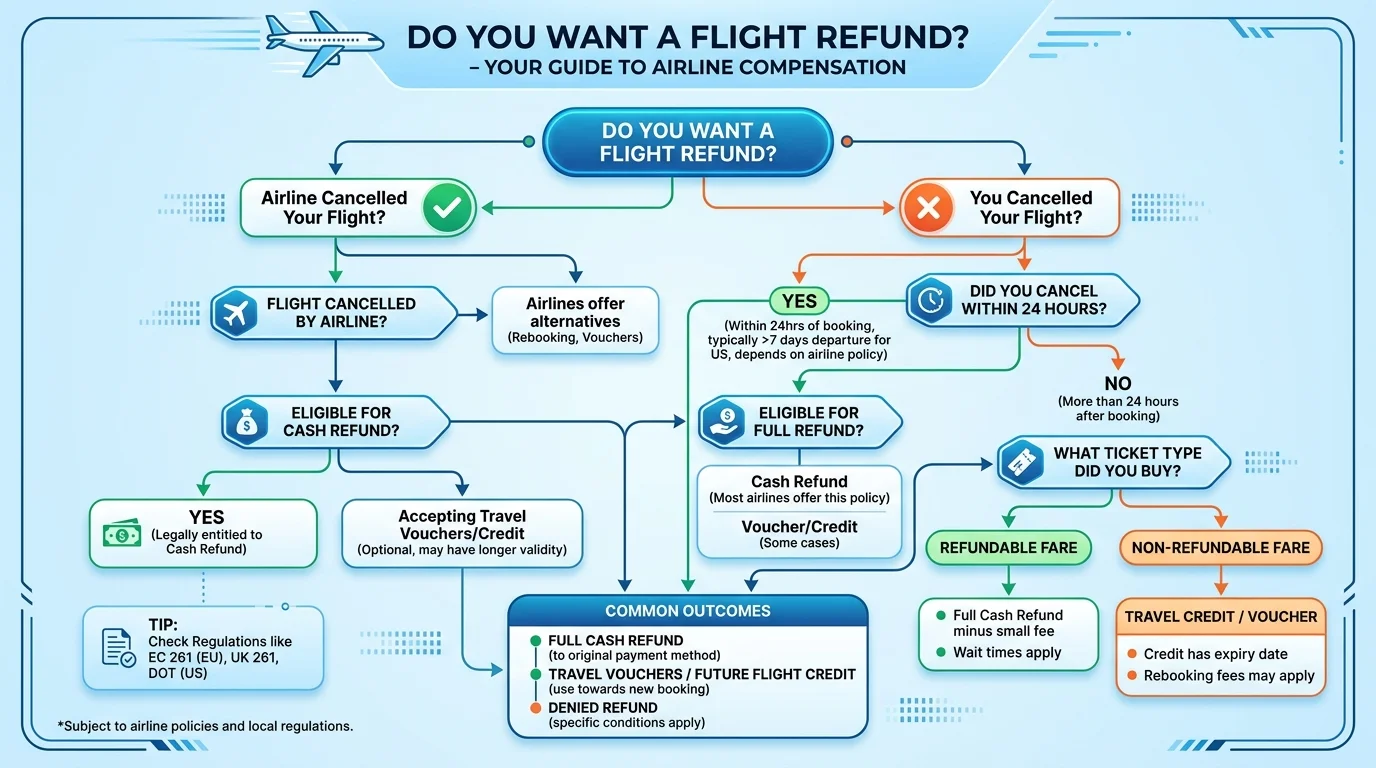 Follow this structured framework to determine whether you qualify for cash, credit, or tax refunds.
                    Do You Want a Flight Refund?
                                 │
                                 ▼
         Did the airline cancel or significantly change the flight?
                                 │
                 ┌───────────────┴───────────────┐
                 ▼                               ▼
                YES                              NO
       You generally qualify                     │
       for a 100% cash refund                    ▼
       under passenger rights.             Is your ticket refundable?
                                                 │
                                 ┌───────────────┴───────────────┐
                                 ▼                               ▼
                                YES                              NO
                     Submit cancellation                         │
                     before departure cutoff                     ▼
                     for a cash refund.            Did you cancel within a
                                                         qualifying 24-hour window?
                                                                 │
                                                 ┌───────────────┴───────────────┐
                                                 ▼                               ▼
                                                YES                              NO
                                      Full cash refund                   │
                                      under specific regional            ▼
                                      statutes (e.g., US DOT).     Check fare rules:
                                                                         reclaim unused airport
                                                                         taxes or take credit.
Refund Eligibility Matrix
| Situation | Refund Possibility | Key Details to Check |
|---|---|---|
| Passenger cancels refundable fare | Eligible under stated terms. | Cancellation cutoff deadline and administrative fees. |
| Passenger cancels non-refundable fare | Restricted or partial. | Base fare is forfeited; unused third-party taxes can usually be claimed. |
| Airline cancels flight | Eligible for a full cash refund. | Airline operational policy and regional passenger protection laws. |
| Significant schedule change | Eligible if threshold met. | Extent of delay; right to reject modified itinerary. |
| No-show on flight | Heavily restricted. | Ticket value is routinely forfeited; tax recovery may remain subject to fees. |
Refundable vs Non-Refundable Tickets
Commercial tickets are divided into distinct product categories balancing flexibility against price:
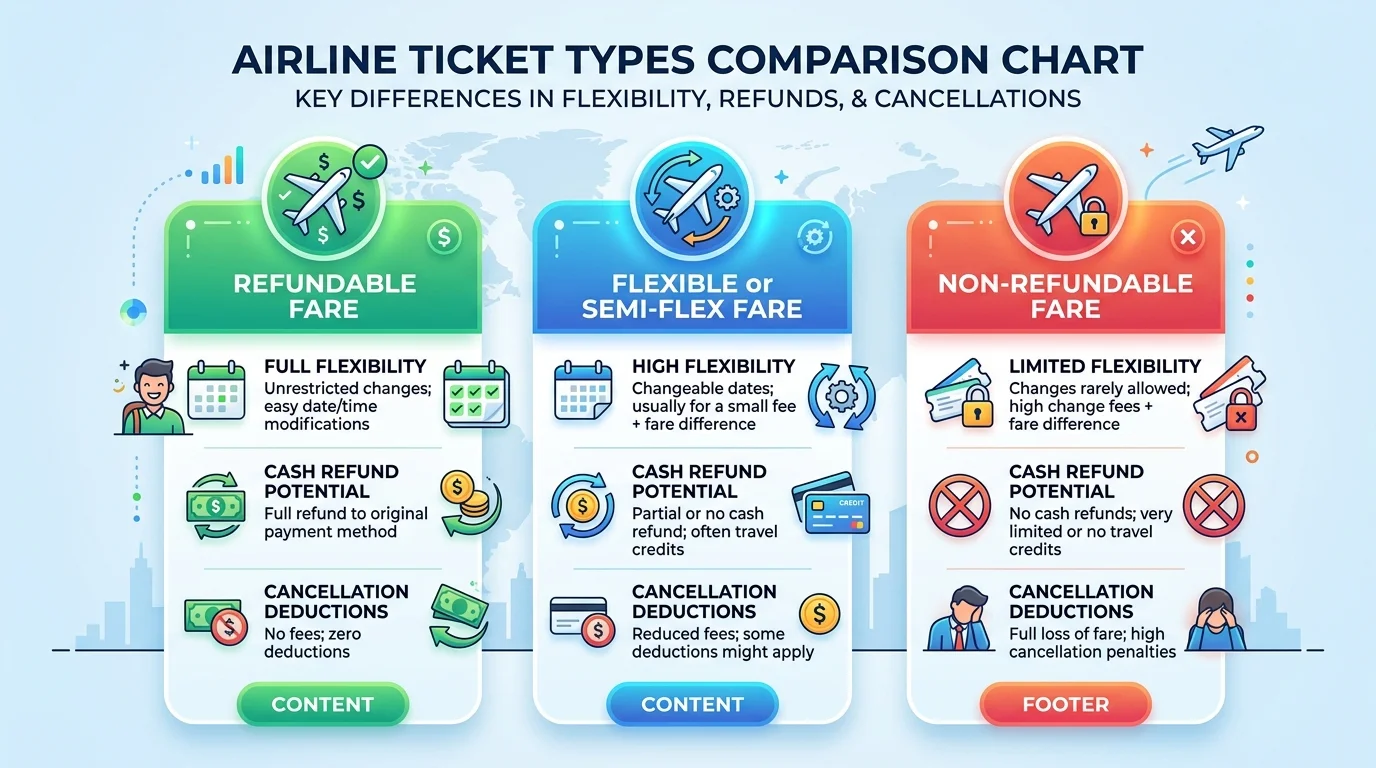 Comparing fare types clarifies whether base airfares can be returned as cash.
| Feature | Refundable Fare | Non-Refundable Fare | Flexible / Semi-Flex Fare |
|---|---|---|---|
| Meaning | Fare terms permit voluntary cash cancellation. | Fare rules restrict voluntary cash returns. | Permits modifications or cancellations under defined conditions. |
| Cash Refund Possibility | High (subject to timing rules). | Base fare is non-refundable; taxes may be reclaimed. | Depends on fare conditions (often returned as credit or cash minus fee). |
| Upfront Cost | Highest initial baseline price. | Lowest baseline promotional rate. | Mid-tier pricing structure. |
| Cancellation Deductions | Zero or nominal administrative charge. | 100% of base fare or substantial cancellation penalty. | Pre-defined, moderate administrative fee. |
Can You Get a Refund for a Non-Refundable Flight Ticket?
Holding a non-refundable ticket does not automatically mean all money is lost under every circumstance. While you cannot voluntarily cancel an economy flight simply due to a change in personal schedule and expect a full cash refund, several practical exceptions exist:
- Involuntary Flight Cancellation: If the airline cancels the flight, non-refundable clauses are voided, entitling you to a full refund.
- Significant Schedule Adjustments: If the airline modifies the schedule beyond regulatory or contractual thresholds, you can reject the update and claim a refund.
- Statutory 24-Hour Windows: If your booking qualifies under mandatory consumer protection laws, you can cancel within 24 hours of ticketing for a complete refund.
- Unused Government Taxes: Third-party airport and government fees can be reclaimed upon formal request because the passenger did not use the facility.
- Travel Insurance Claims: If cancellation is forced by a sudden, covered emergency (such as severe illness), your third-party insurer may reimburse forfeited non-refundable costs.
24-Hour Flight Cancellation Refund: Does It Apply to You?
A widespread misconception among travelers is that every airline globally provides a penalty-free 24-hour cancellation window. In reality, 24-Hour Flight Cancellation Refund policies depend on geographic market, ticketing channel, and local law:
- United States: Under U.S. Department of Transportation regulations, airlines operating flights to, from, or within the U.S. must either allow passengers to cancel a booking within 24 hours of purchase for a full cash refund without penalty, or allow them to hold the reservation at the quoted fare for 24 hours without payment, provided the booking is made at least 7 days before scheduled departure.
- India: The Directorate General of Civil Aviation (DGCA) mandates that passengers be allowed a 24-hour look-in period following booking to cancel or modify a ticket without additional charges, provided the flight departs at least 7 days later for domestic flights or 15 days later for international flights.
- Europe and the United Kingdom: European Union and UK consumer frameworks do not mandate a universal 24-hour right of withdrawal for scheduled passenger flights under standard distance-selling rules. Some individual airlines (such as British Airways, Lufthansa, or Air France) provide 24-hour cooling-off policies voluntarily, but it is not a statutory requirement across all carriers.
Always confirm the specific cooling-off terms displayed on the booking review screen before submitting payment.
Passenger-Initiated Cancellation
When you choose to cancel a flight voluntarily, the airline's contractual fare sheet governs the outcome:
- Refundable Fares: The remaining balance returns to the original payment method after any stated administrative charges are deducted.
- Non-Refundable Fares: The base airfare is forfeited. Depending on the airline and fare family, the residual value may be converted to an airline credit voucher valid for future travel, minus a cancellation penalty.
- Importance of Timing: Cancelling days or weeks ahead often incurs lower penalties than attempting to cancel within hours of departure.
- Tax Reclamation: Even when base airfare is forfeited, travelers retain the right to request the return of eligible statutory passenger taxes.
What Happens When the Airline Cancels Your Flight?
When a carrier cancels a scheduled service, the operational failure falls on the airline. Affected passengers are generally presented with several clear options:
- Complimentary Rebooking: Acceptance of a seat on the next available flight to the destination without paying change fees or fare differences.
- Alternative Routing: Rerouting via an alternative transit hub or partner carrier.
- Full Cash Refund: A complete return of the unused ticket value to the original payment method.
Refund vs Compensation
A refund and statutory compensation are separate legal concepts:
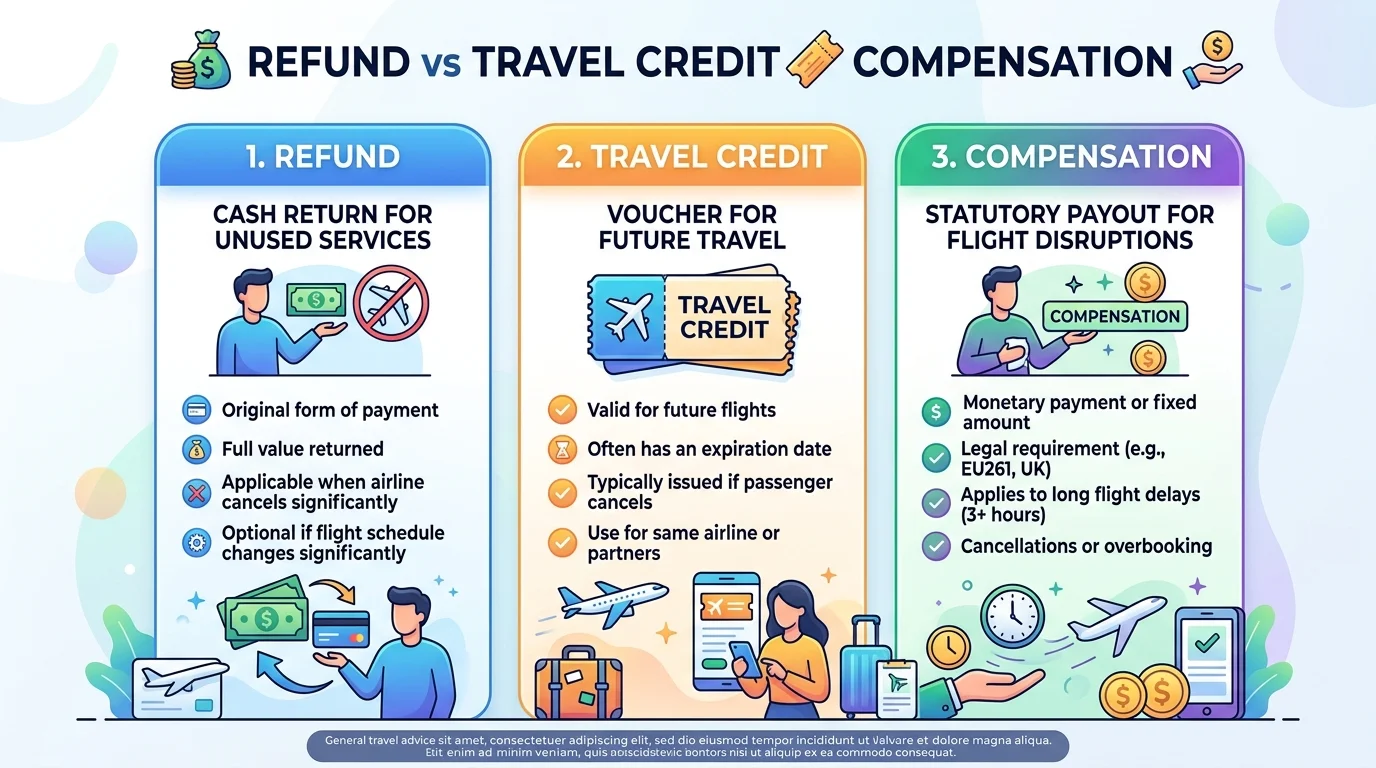 Understand the differences between a flight refund, an airline voucher, and statutory compensation.
| Remedy Type | Definition | Primary Governing Basis |
|---|---|---|
| Refund | Returning money paid for air transportation services that were not provided. | Airline Conditions of Carriage, fare rules, and consumer protection laws. |
| Travel Credit | Stored monetary balance issued for future flight bookings. | Commercial airline terms and ticket conditions. |
| Compensation | Financial payment intended to redress passenger inconvenience caused by airline fault. | Statutory regulations (e.g., EU261, UK261, DGCA CAR). |
Under regulations such as EU261 or UK261, if a carrier cancels a flight fewer than 14 days before departure for reasons within its control (such as crew shortages or operational snags), passengers may qualify for statutory compensation in addition to a full refund if they decline alternative transport. If the cancellation stems from extraordinary circumstances like severe weather or air traffic management strikes, the right to a full refund remains, but statutory compensation is exempt.
Schedule Changes and Refund Eligibility
Airlines routinely update operational schedules months ahead of departure. How these changes affect refund rights depends on the scale of the disruption:
- Minor Schedule Changes: Adjustments shifting departure or arrival by a few minutes (e.g., 10 to 15 minutes) do not grant automatic refund rights. Passengers are expected to fly on the adjusted timetable.
- Significant Schedule Changes: Material disruptions—such as shifting a flight by several hours, adding an unscheduled layover, switching to an alternative airport, or causing a misconnection—entitle the traveler to reject the revised schedule.
Under U.S. DOT rules and international carrier conditions of carriage, passengers facing significant schedule changes who decline the alternative routing are entitled to a full cash refund.
No-Show and Refund Eligibility
A no-show occurs when a passenger fails to board an aircraft without properly cancelling or modifying the reservation prior to the carrier's departure cutoff.
Allowing a reservation to lapse into a no-show carries severe financial and operational consequences:
- Forfeiture of Ticket Value: The base fare and carrier-imposed surcharges are completely lost.
- Ineligibility for Travel Credits: Most airlines prohibit converting a no-show ticket into a future flight credit.
- Sequential Coupon Invalidation: Under standard Conditions of Carriage, missing an outbound leg automatically cancels all downstream flights, including connecting sectors and the return flight.
Proactively cancelling even an hour before departure preserves tax recovery rights and credit options. Learn more in our guide on What Happens If You Miss Your Flight?.
Flight Change vs Refund
If your travel dates must change, evaluate the operational differences between modifying the booking and cancelling outright:
| Option | Primary Purpose | Key Considerations |
|---|---|---|
| Flight Change | Retain the journey on an adjusted date, time, or route. | Check administrative change fees and dynamic fare differences between flights. Review our Flight Change Policy guide. |
| Refund | Terminate the trip and recover eligible funds. | Check fare refundability, cancellation deductions, and payment processing timelines. |
| Travel Credit | Preserve residual funds for unscheduled future travel. | Verify voucher expiration deadlines, transferability, and fee deductions. |
| Involuntary Rebooking | Adjust itinerary after airline disruption. | Carrier absorbs fare differences and waives change fees within rebooking windows. |
Taxes, Fees and Airline Charges
The price of a flight ticket is broken down into multiple components on your e-ticket receipt:
- Base Airfare: The core transportation charge set by the carrier.
- Carrier Surcharges (YQ/YR): Fuel and operational surcharges, which airlines usually treat as part of the base fare.
- Government Taxes: Mandated statutory levies (such as international departure taxes and customs fees).
- Airport Charges: Passenger Facility Charges (PFCs) and terminal security fees.
On non-refundable tickets, the carrier retains the base fare and carrier surcharges. Government and airport facility fees, however, are collected by the airline to fund public security and airport usage. If you do not travel, the airline does not remit these funds to the authorities. Consequently, travelers can generally reclaim these unused taxes upon request. Some carriers impose an administrative tax processing fee, which in some instances may equal or exceed the taxes owed.
How Much Will You Get Back?
The net refund returned to your account is calculated as follows:
$$\text{Net Refund} = (\text{Eligible Base Fare} - \text{Cancellation Charges}) + \text{Eligible Unused Taxes and Fees}$$
Illustrative Scenarios
- Hypothetical Scenario A (Refundable Fare): A traveler books a flexible economy fare for $700 ($550 base fare + $150 taxes). Fare rules carry a $50 administrative fee. Upon voluntary cancellation, the traveler receives $650 ($500 net fare + $150 taxes) back to their card.
- Hypothetical Scenario B (Non-Refundable Fare): A passenger purchases a basic economy seat for $300 ($220 base fare + $80 third-party taxes). The passenger cancels voluntarily. The $220 base fare is forfeited, but the traveler claims back the $80 in unused statutory taxes.
- Hypothetical Scenario C (Airline Disruption): The carrier cancels an economy flight for which the passenger paid $400 ($320 base fare + $80 taxes). The passenger declines rebooking. The traveler receives a 100% cash refund of $400 to the original payment card.
Refund Processing Time
There is no single global timeline for when refund funds will appear in your bank account. The total duration depends on several operational steps:
- Airline Processing: The carrier reviews the booking and approves the remittance. Depending on the airline, this internal step takes between 3 to 10 business days.
- Financial Institution Clearing: Once the airline releases funds, credit card companies and retail banks take an additional 7 to 14 business days to settle and post the transaction to your statement.
- Booking Intermediaries: If your ticket was issued by an online travel agency, the airline remits funds to the agency first, after which the agency processes the payment to the passenger, adding extra administrative time.
How to Claim an Airline Refund
To claim an airline ticket refund, follow these practical steps:
- Determine the Ticketing Entity: Verify whether your e-ticket was issued directly by the airline or by an intermediary travel agency.
- Review Refund Eligibility: Confirm whether your cancellation qualifies under fare rules, an airline-initiated disruption, or statutory consumer laws.
- Submit the Request via Official Portals: If booked directly, submit through the carrier's "Manage Booking" or dedicated online refund page. If booked through an agent, initiate the claim through the agency's customer platform.
- Record Case References: Note your refund request tracking number, cancellation timestamp, and customer service reference.
- Monitor and Escalate: If the refund does not post within the stated window, contact the provider with your case number. If an eligible refund is improperly denied, escalate through regional consumer aviation bodies (such as the U.S. DOT Aviation Consumer Protection Division, the UK CAA, or India's AirSewa portal).
Who Processes Your Refund: Airline or Travel Agency?
Where you purchase your flight dictates who holds operational control over your refund:
| Booking Method | Where to Begin | Servicing Workflow |
|---|---|---|
| Airline Website / App | Direct Airline Portal | Direct processing from the airline's merchant account; no third-party handling fees. |
| Online Travel Agency (OTA) | OTA Support / App | The agency controls the booking file; agency administrative fees may apply on top of airline charges. |
| Traditional Travel Agency | Booking Agent / Office | Handled manually through agency global distribution systems (GDS). |
| Corporate Travel Desk | Corporate Portal | Serviced under specialized corporate accounts with negotiated cancellation parameters. |
Airlines frequently decline to process voluntary refunds for tickets issued by third-party agencies, redirecting the passenger to the booking intermediary.
What to Do If Your Airline Refund Is Denied
If an airline or travel agency denies your refund request, take the following steps:
- Obtain the Denial Reason in Writing: Request the specific fare condition or operational clause used to reject your claim.
- Review the Ticket Record: Check if the disruption involved an airline-initiated cancellation or significant schedule change that legally overrides non-refundable terms.
- Verify Third-Party Tax Eligibility: If base fare refundability was rightfully denied, confirm whether unused government taxes and airport facility fees were calculated and returned.
- Submit an Official Internal Complaint: File a formal case through the carrier's customer relations department, citing your PNR, e-ticket number, and disruption timeline.
- Lodge an Aviation Regulatory Complaint: If an airline refuses a legally mandated refund following a cancellation, file a formal complaint with the relevant aviation authority (e.g., U.S. DOT, national civil aviation authorities in the EU/UK, or DGCA in India).
Travel Insurance vs Airline Refund
An airline refund policy and a travel insurance policy operate under completely separate terms:
- Airline Refund: Governed by ticket fare rules, carrier Conditions of Carriage, and aviation regulations. An airline is not contractually obligated to refund a non-refundable ticket simply because you broke an arm or faced a personal family emergency.
- Travel Insurance Claim: A private policy covering pre-defined unforeseen risks. If you must cancel a non-refundable flight due to a covered medical emergency, severe weather, or bereavement, the insurer reimburses the out-of-pocket expenses that the airline refused to refund.
Insurance claims require written proof of airline forfeiture, detailed receipts, and official documentation (such as medical reports or death certificates).
Practical Hypothetical Examples
- Example 1 — Refundable Ticket Voluntary Cancellation: A passenger cancels a fully refundable business class ticket 48 hours before departure via the airline website. The carrier verifies the fare class and processes a 100% refund of the $1,400 fare back to the credit card.
- Example 2 — Non-Refundable Fare Voluntary Cancellation: A traveler cancels a $280 economy ticket ($200 base fare + $80 third-party taxes) two weeks prior to departure. The base fare is forfeited, but the traveler receives an $80 tax refund.
- Example 3 — Airline-Initiated Cancellation: An airline cancels an international flight due to mechanical problems. The traveler declines a flight departing the following evening. The airline issues a full $650 cash refund, despite the ticket being non-refundable.
- Example 4 — Significant Schedule Disruption: An airline moves a morning flight departure back by 6 hours. The passenger rejects the revised schedule and receives a 100% cash refund to their original payment method.
- Example 5 — 24-Hour Rule Application: A traveler books a non-refundable flight departing three months later directly on a U.S. carrier's website. Realizing the date is wrong 12 hours later, they cancel under the U.S. DOT 24-hour rule and receive a full cash refund.
- Example 6 — OTA Intermediary Booking: A passenger cancels a semi-flexible ticket booked through an online travel portal. The airline issues a $300 refund to the OTA. The agency deducts a $30 administrative service fee and remits $270 to the traveler.
- Example 7 — Passenger No-Show: A passenger misses their outbound morning flight and makes alternative travel plans without notifying the airline. The airline marks the passenger as a no-show, forfeits the ticket value, and automatically cancels the return leg.
- Example 8 — Travel Insurance Recovery: A traveler holding a non-refundable ticket is hospitalized two days before departure. The airline denies a voluntary cash refund but returns $60 in unused airport taxes. The passenger files a claim with their travel insurance provider and is reimbursed for the remaining $340 out-of-pocket base fare.
Common Flight Refund Mistakes
- Assuming All Tickets Are Cash-Refundable: Expecting a cash return on promotional or basic economy fares.
- Assuming Non-Refundable Means Complete Loss: Failing to claim back unused airport and government taxes.
- Confusing Refunds with Compensation: Treating statutory inconvenience payments as identical to the return of ticket funds.
- Confusing Airline Cancellations with Passenger Cancellations: Believing standard fare restrictions apply when the airline terminates the service.
- Failing to Cancel Prior to Gate Closure: Allowing an itinerary to become a no-show, which strips away ticket rights and cancels return sectors.
- Assuming a Universal 24-Hour Rule: Expecting penalty-free 24-hour cancellations on flights booked outside applicable regulatory frameworks.
- Contacting the Airline for Agency Bookings: Attempting to process direct refunds on tickets owned and issued by third-party OTAs.
- Failing to Retain Records: Discarding booking references, cancellation numbers, or written confirmation emails.
Frequently Asked Questions
An airline refund policy is the formal contractual set of rules governing when and how an airline returns ticket money to a passenger, including fare restrictions, cancellation fees, and statutory consumer protections.
Related Travel & Airline Guides
- Airline Cancellation Policy: Connects readers to overall cancellation rules and fee structures.
- Flight Change Policy: Directs users to rebooking guidelines when modifying travel dates.
- What Happens If You Miss Your Flight?: Provides next steps for travelers facing airport terminal delays.
- What Is a PNR Number?: Explains how to locate the 6-character booking code.
- FareWander Flight Search: Search and compare flights with transparent fare rules and flexible options.
Authoritative External Sources
- U.S. Department of Transportation (DOT): transportation.gov/airconsumer — Aviation Consumer Protection, 24-Hour Booking Rules, and Mandatory Flight Refund Regulations. (Jurisdiction: United States)
- European Commission: europa.eu/youreurope — Directorate-General for Mobility and Transport, Air Passenger Rights under Regulation (EC) No 261/2004. (Jurisdiction: European Union / EEA)
- UK Civil Aviation Authority (CAA): caa.co.uk — Passenger Rights on Flight Cancellations and Delays under UK261. (Jurisdiction: United Kingdom)
- Directorate General of Civil Aviation (DGCA) India: dgca.gov.in — Civil Aviation Requirements (CAR) Section 3, Series M, Part IV (Refund of Airline Tickets & Passenger Facilities). (Jurisdiction: India)
- International Air Transport Association (IATA): iata.org — General Conditions of Carriage and Ticket Coupon Standards. (Jurisdiction: Global Aviation)