What Is an Airline No-Show Policy? Fees, Refunds & Rebooking
You get stuck in gridlock on the highway to the terminal, watch the minutes tick past the boarding cutoff, and arrive at the departure gate ten minutes after the jet bridge has pulled away. Or perhaps unexpected work came up, you abandoned the trip, and you forgot to hit "cancel" on your booking app. A few hours later, you check your airline itinerary only to see the flight marked with a status that triggers panic: no-show. What does this mean for the money you spent, can you rebook without paying full price again, and is your return ticket still valid for next week?
[!NOTE] Quick Explanation: What Does an Airline No-Show Mean? An airline no-show occurs when a ticketed passenger does not board their scheduled flight and fails to cancel or change the reservation before the airline's established departure cutoff. When this happens, the airline's system records the seat as abandoned. Depending on the fare conditions and the airline, this status can lead to the total loss of the base fare, the invalidation of travel credits, and the automatic cancellation of any downstream or return segments on the same ticket. However, exact outcomes are not uniform: some fare types allow rebooking for a fee, and statutory airport taxes can often be reclaimed.
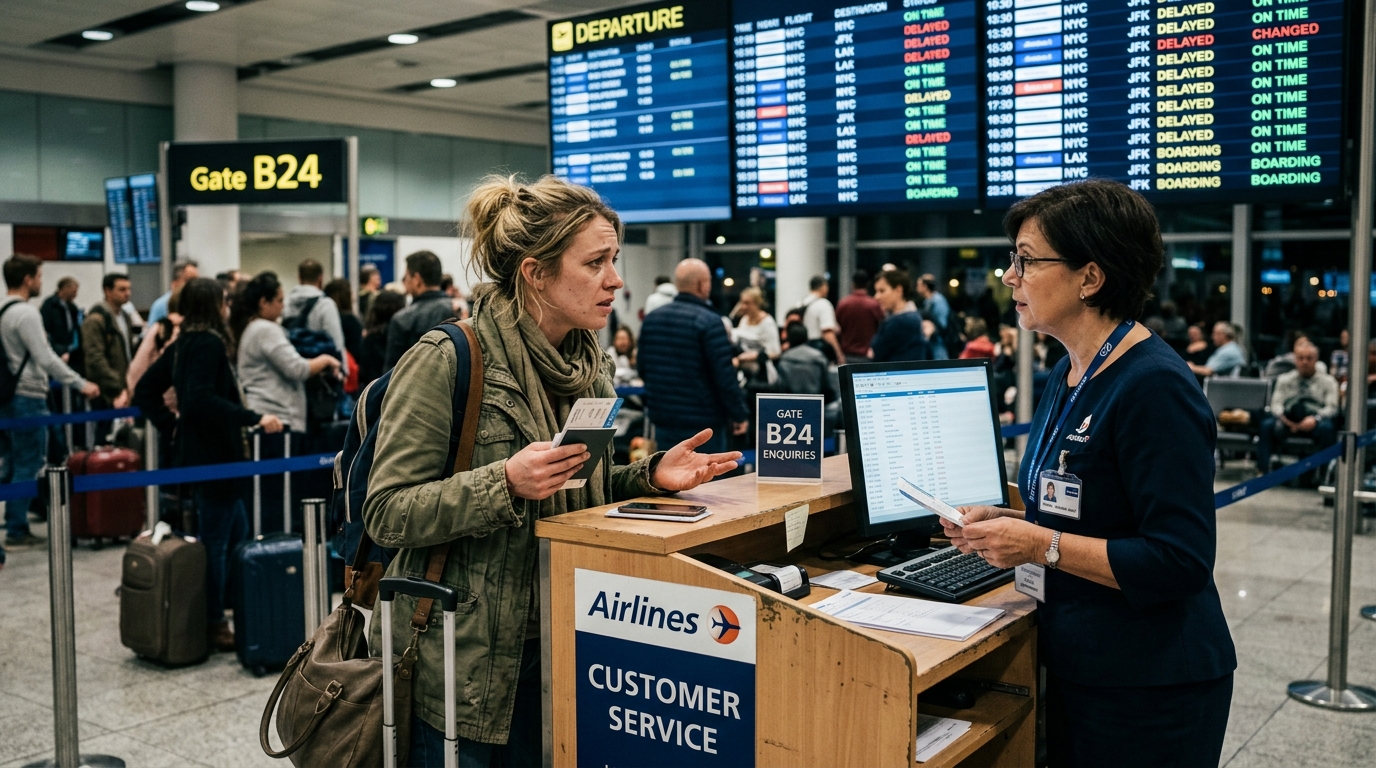 Speaking directly with an airport agent as soon as you miss a flight can help you explore standby or rebooking options.
What Is an Airline No-Show Policy?
An airline no-show policy (also referred to as a flight no-show policy or airline ticket no-show policy) is a formal contractual rule set within an airline's Conditions of Carriage and fare rules. It specifies what happens to your ticket value, your remaining itinerary, and your rebooking privileges if you fail to take a flight without cancelling it in advance.
Airlines operate on tight scheduling and revenue models. When you hold a confirmed reservation, that seat cannot be sold to another customer. If you simply fail to appear, the plane departs with an empty seat that might otherwise have gone to a standby passenger or a last-minute ticket buyer. To deter passengers from abandoning bookings without notice, carriers attach strict contractual consequences to no-shows.
A carrier generally marks a passenger as a no-show under any of the following circumstances:
- No-show before check-in: You never check in online or at the airport, and the check-in window closes without any cancellation request from you.
- No-show after check-in: You complete mobile or web check-in, but you do not clear security or report to the gate before boarding concludes.
- Missing boarding: You are inside the terminal, but you arrive after the gate doors have formally closed (usually 15 to 20 minutes before scheduled takeoff).
- Not appearing for any segment: You fail to fly any intermediate or initial segment of a multi-leg journey without prior notification.
What Happens If I Don't Show Up for My Flight?
The consequences of failing to show up depend on your ticket's fare conditions, whether you contacted the airline before departure, and whether other flights exist on the same booking. While policies vary between carriers and fare classes, several outcomes are common across the industry:
- The ticket status changes to no-show: The airline marks your electronic coupon as "suspend," "void," or "no-show," removing your ability to modify the booking online through standard self-service tools.
- Loss of the flight segment: The specific flight you missed is gone, and the base fare for that flight is typically forfeited unless your fare rules state otherwise.
- Cancellation of remaining itinerary segments: On most traditional round-trip or connecting itineraries, missing an earlier segment causes the automated booking engine to cancel all subsequent flights, including return trips.
- Loss of travel credit conversion: While passengers who cancel before departure can frequently retain the unused fare value as a credit voucher, a no-show often strips that right away.
- Taxes and fees retention or return: Even if the airfare is forfeited, government and airport passenger taxes are usually refundable upon request because you did not utilize airport infrastructure.
- Possible rebooking with penalties: Some airlines permit you to re-validate the ticket for a later flight, but this typically requires paying a rebooking fee, a no-show penalty, and any difference in airfare.
- Need to purchase a new ticket: On restrictive basic or promotional tickets, the ticket may hold zero residual value once the flight departs, requiring you to purchase an entirely new seat at prevailing walk-up fares.
Crucially, these outcomes are conditional. If you reach customer service before the flight takes off, many carriers can uncouple your ticket or process a standard cancellation, protecting your return flights or saving the remaining fare value.
Comparing Fares for Your Route?
Search live multi-airline schedules, spot discount windows, and baggage fee rules on FareWander.
What Happens to My Flight Ticket If I Don't Show Up?
When searching what happens to my flight ticket if I don't show up, travelers often conflate ticket value, refunds, travel credits, and rebooking. In commercial aviation, these are four distinct concepts:
| Concept | What It Actually Means After a No-Show |
|---|---|
| Ticket Status | The individual flight coupon transitions from "Open" to "No-Show" or "Suspended" in the airline's reservation database. |
| Unused Ticket Value | The monetary value of the unused base fare. On restrictive fares, this value is frequently set to zero after departure. Flexible tickets may retain some or all residual value. |
| Cash Refund | Direct return of money to your original form of payment. Fares marked non-refundable do not provide a cash return for the base fare. |
| Travel Credit | A voucher stored in your name for future flight purchases. Proactive cancellations often yield credits; no-shows often forfeit them unless the fare conditions explicitly preserve credit rights. |
| Rebooking | Reissuing your existing electronic ticket for a new flight date or time, usually subject to change rules, seat availability, and fare adjustments. |
| New Ticket Purchase | Buying a brand-new reservation at current market rates when the original ticket cannot be salvaged. |
If you simply walk away from a missed flight, the ticket generally enters an unusable state. Contacting the airline quickly—either at an airport counter or via phone—is critical because an agent may have the authority to reinstate the ticket file before the electronic record permanently expires.
Airline No-Show Fees — Do Airlines Charge a No-Show Fee?
A frequent point of confusion is whether airlines charge an active fee when you do not show up.
Airlines generally do not charge your credit card an additional, surprise penalty simply because you failed to board a flight.
Instead, "no-show fees" work as administrative deductions or conditional penalties applied in specific scenarios:
- Deduction from a refund: If you hold a refundable ticket and miss your flight without cancelling, the airline may deduct a published no-show fee (e.g., $100–$200) from the gross refund balance returned to your payment method.
- Reactivation / rebooking penalty: If your ticket conditions permit rebooking after a no-show, the airline may assess a dedicated no-show fee on top of the standard change fee and any fare difference before issuing the new boarding pass.
- Total fare forfeiture: Many restricted non-refundable tickets do not have a separate fee line item; rather, the fare rule states that 100% of the base fare is forfeited upon a no-show, meaning the financial penalty is the loss of the ticket price itself.
To navigate this clearly, keep these distinct costs separated:
- No-Show Fee: A penalty for failing to travel without prior notice.
- Change / Rebooking Fee: An administrative charge for modifying a flight date or route. See our guide to flight change fees.
- Fare Difference: The difference in price between what you originally paid and the active price of the newly requested seat.
- New Ticket Cost: The prevailing rate for a completely new booking if your original ticket is voided.
Airline No-Show Refund Policy
Can you get a refund for a no-show flight? The answer depends on your fare class, local aviation consumer laws, and why the flight was missed.
                         No-Show Refund Eligibility Flow
                                       │
                                       ▼
                   Did the airline cancel or delay the flight?
                                       │
                    ┌──────────────────┴──────────────────┐
                    ▼                                     ▼
                   YES                                    NO
      Full refund generally due                What type of fare was it?
      under Conditions of Carriage/                       │
      passenger-rights rules.      ┌─────────────────┴─────────────────┐
                                       ▼                                   ▼
                                  REFUNDABLE                         NON-REFUNDABLE
                                       │                                   │
                                       ▼                                   ▼
                            Gross fare refunded minus          Base fare is forfeited;
                            applicable no-show penalty         claim unused airport taxes
                            under fare sheet.             and statutory fees.
- Refundable Fares: Purchasing a refundable ticket gives you the highest level of protection, but missing a flight without telling the airline does not always yield an automatic, full payout. Many flexible fare rules state that cancellations requested after scheduled departure incur a no-show fee, which is subtracted from the refund.
- Non-Refundable Fares: On non-refundable or basic economy tickets, voluntary no-shows almost never result in a refund of the base airfare or carrier surcharges. The value is retained by the carrier. Read more in our guide on airline ticket refunds.
- Unused Taxes and Government Fees: Even on restrictive non-refundable tickets, passenger facility charges, security fees, and international departure taxes can generally be reclaimed. Because you did not travel, the airline is not required to remit these statutory fees to airport operators or governments. However, review whether your airline assesses a manual tax-processing fee, which can occasionally reduce the recovered amount.
- Airline Cancellations vs. Passenger No-Shows: If the carrier cancels your flight, grounds the aircraft, or alters the schedule by several hours, you are not a no-show. Involuntary disruptions entitle you to a full refund to your original payment method or free rebooking, regardless of whether your ticket was marked non-refundable.
- Documented Emergencies: Some full-service carriers maintain compassionate waiver policies for unexpected hospitalization or family bereavement. These waivers are discretionary, require official documentation (such as a medical admission record or death certificate), and are rarely honored by low-cost carriers.
- Travel Insurance: If you missed your flight due to a covered reason under an independent travel insurance policy (such as a severe vehicle accident en route to the airport), your insurer may reimburse forfeited, non-refundable expenses that the airline denies.
Planning Travel Logistics?
Use FareWander tools to calculate flight times, luggage rules, and visa requirements.
Can I Get a Refund for a No-Show Flight?
The table below outlines common no-show scenarios, realistic outcomes, and what determines your financial recovery:
| Scenario | Possible Practical Outcome | What Determines It? |
|---|---|---|
| Passenger intentionally skips flight without notice | Base fare forfeited; return segments likely cancelled; taxes may be reclaimed upon request. | Fare rules, ticket conditions, and carrier policies on unused segments. |
| Passenger arrives late due to personal delay (traffic, sleeping in) | Ticket marked as no-show; discretionary rebooking or standby may apply at the counter; no cash refund. | Airline check-in deadlines, airport agent discretion ("flat-tire" rules), fare restrictions. |
| Passenger holds a fully refundable fare | Cash refund permitted, though the carrier may deduct a published no-show penalty. | Specific fare family sheet and post-departure refund conditions. |
| Passenger holds a non-refundable fare | Base fare and carrier surcharges forfeited; statutory airport/government taxes eligible for return. | Carrier Conditions of Carriage and local statutory tax refund rules. |
| Airline cancels the flight | 100% cash refund to original payment method or free alternative routing. | Conditions of Carriage, EU261/UK261, US DOT regulations, or DGCA CAR rules. |
| Major airline schedule change occurs prior to flight | Right to reject the change and receive a full cash refund. | Scale of schedule adjustment and regional consumer protection statutes. |
| Passenger notifies airline prior to departure cutoff | Prevents no-show; preserves travel credit or allows date change minus standard fees. | Timely notification according to fare deadline rules. |
| Passenger takes no action after missing flight | Total forfeiture of base ticket value; all onward and return sectors voided. | Sequential coupon rules and automated airline cancellation routines. |
Can I Rebook a Flight After a No-Show?
Can I rebook my flight after missing it? In many cases, yes—but whether you can rebook, and how much it will cost, depends heavily on how quickly you act and what fare family you bought.
Some flexible and semi-flexible economy fares explicitly permit post-departure changes. However, restrictive basic economy tickets often state that all value is lost the moment the boarding gate closes, leaving rebooking off the table entirely.
When an airline allows you to rebook following a no-show, the final cost is calculated as follows:
$$\text{Total Rebooking Cost} = \text{Applicable Change Fee} + \text{No-Show Penalty (if applicable)} + \text{Fare Difference}$$
Hypothetical Pricing Example
- A traveler buys a standard economy ticket for $250.
- The passenger misses the flight and contacts the carrier two hours later.
- The fare rules permit post-departure changes with a $100 change fee and a $50 no-show fee.
- The next available flight has seats open only in a higher fare inventory priced at $320 ($70 fare difference over the original $250 purchase).
- To rebook, the traveler pays: $100 (change fee) + $50 (no-show fee) + $70 (fare difference) = $220.
If the traveler had purchased a non-changeable promotional ticket, the airline would not apply the original $250 toward the new trip. The passenger would have to buy a new ticket at the full current price of $320. This highlights why a change fee, a fare difference, and a new ticket price are completely distinct.
Missed Flight Refund and Rebooking — What Are Your Options?
What you should do depends on where you are and the timing of your disruption:
1. If You Missed the Flight but Are Still at the Airport
Head straight to the airline’s customer service or ticketing counter inside the terminal. Many full-service airlines instruct customer service agents to use informal discretion (often dubbed "flat-tire" rules) if a passenger reports to the counter within a couple of hours after their flight departed. Agents may be able to place you on same-day standby or rebook you on the next flight for a modest administrative fee rather than forcing you to purchase an entirely new ticket. This is a discretionary customer-service allowance, not a universal contractual right. Learn more about what happens when you have a missed flight.
2. If the Flight Has Already Departed and You Are at Home
Call the airline or your ticketing agency immediately. Ask the representative to inspect your Passenger Name Record (PNR) and confirm whether the ticket holds any residual value. If your ticket cannot be rebooked, explicitly request a refund for the unused airport user fees and statutory government taxes.
3. If You Have a Connecting Flight
If your journey involves multiple legs on a single ticket and you missed the first flight, your connecting boarding passes will be invalidated. You must speak with the ticketing airline before making any alternative travel arrangements to ensure the remainder of your journey is addressed.
4. If You Booked Through an Online Travel Agency (OTA)
If your reservation was issued by a third-party website (such as Expedia, MakeMyTrip, or Booking.com), the OTA owns the ticketing record. While airport agents can sometimes take control of a ticket for same-day operational disruptions, changes requested after the flight has taken off often require contacting the OTA directly. Keep in mind that OTAs may levy their own administrative processing fees in addition to airline penalties.
5. If the Airline Canceled the Flight
If you were unable to fly because the airline canceled the flight, experienced a mechanical breakdown, or adjusted the schedule by several hours, do not allow yourself to be treated as a no-show. You did not miss the flight; the airline failed to provide the contracted service. You are entitled to complimentary rebooking on the next available flight or a full cash refund.
6. If You Know You Will Miss the Flight Before Departure
Never wait until after takeoff. Cancelling or modifying your reservation even 45 minutes before departure via the airline's mobile app or telephone line prevents no-show classification. This preserves your rights under standard airline cancellation policy terms, which usually retain more value than letting the ticket lapse.
Does Missing a Flight Cancel the Return Ticket?
This is one of the most severe traps in commercial aviation: on many itineraries, failing to show up for an outbound flight segment will automatically cancel all downstream flights, including the return ticket.
Airlines manage round-trip and multi-leg journeys under what the industry calls the sequential coupon rule. In the airline's Conditions of Carriage, passengers agree to use flight coupons in the exact order listed on the electronic ticket.
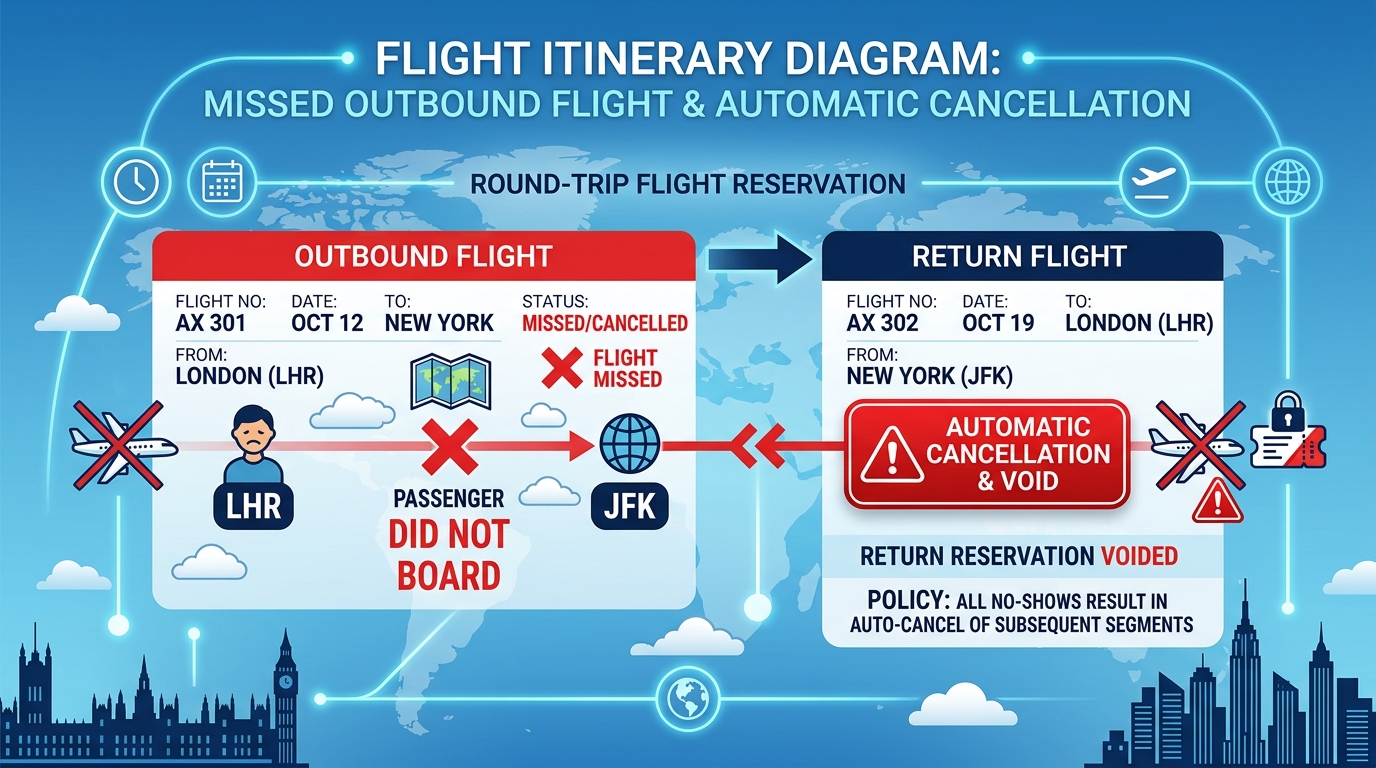 On a round-trip ticket, failing to fly the first leg typically voids the entire remaining itinerary.
Hypothetical Scenario: You purchase a round-trip ticket from Chicago to London. Due to heavy traffic, you miss the outbound morning flight. Without notifying your carrier, you immediately buy a one-way ticket on another airline to make your business meeting in London, assuming you can still use your original return ticket to fly back home next week.
When you show up at Heathrow Airport for your return trip, the agent informs you that you have no booking. The moment you were marked as a no-show in Chicago, the reservation software automatically voided every subsequent segment on that reservation.
However, this does not apply to every ticket structure in the world:
- Separate Tickets: If you booked your outbound and return journeys as two completely independent one-way tickets (holding two distinct booking confirmation numbers), missing your outbound flight on Airline A has zero impact on your return flight on Airline B.
- Carrier and Regional Variations: Certain regional carriers and consumer protection frameworks (including legal rulings in select European jurisdictions) place restrictions on how airlines void return legs, provided the passenger contacts the airline promptly.
If you miss your outbound flight but still intend to use your return ticket, contact the issuing airline immediately. An agent can sometimes remove the outbound coupon and reprice the itinerary to preserve your return seat, though this may require settling a fare adjustment.
Airline No-Show Cancellation Policy
An airline no-show cancellation policy outlines the contractual process an airline follows when an abandoned seat is identified.
Understanding the difference between a voluntary cancellation and an automated no-show cancellation is vital:
- In a voluntary cancellation, the customer initiates the action before the deadline, allowing the airline to release the seat back into inventory and calculating refunds or credits according to standard fare rules.
- In a no-show cancellation, the airline's central reservation engine executes an automatic purge of the remaining segments once the flight manifest is finalized without the passenger onboard.
[!WARNING] Do not assume that missing one flight leaves the rest of your itinerary unchanged. If you miss a segment on a single reservation, assume all subsequent legs are compromised until you speak directly with an airline agent.
No-Show on a Connecting Flight
Missing a connection involves distinct operational rules depending on whether your flights were booked on a single ticket or as separate reservations:
Same-Ticket / Protected Connections
If your entire journey is under a single electronic ticket number and you miss your connection because the first flight was delayed by maintenance, weather, or air traffic control, you are not considered a voluntary no-show. The carrier is contractually obligated to transport you to your final destination. The airline transfer desk will rebook you on the next available departure at no additional charge.
However, if you landed on time on your first flight and missed the connection because you lost track of time in a terminal shop or lounge, the airline may classify you as a passenger-caused missed connection, applying standard no-show rules to your remaining segments.
Separate Tickets (Self-Transfers)
If you independently booked Flight 1 on Carrier A and Flight 2 on Carrier B to save money, the two airlines have no contractual relationship. If Flight 1 is delayed by three hours and you miss Flight 2, Carrier B simply views you as an unexcused no-show. They are under no legal obligation to rebook you or refund your fare, and your return flight with Carrier B may be cancelled.
What If I Know I Will Miss My Flight Before Departure?
If you know ahead of time that you will not make it to the airport, taking proactive steps preserves far more options than simply doing nothing. Follow this sequence:
- Check your fare rules immediately: Open your airline confirmation email or log into the carrier's mobile app to see whether your fare allows voluntary changes or cancellations.
- Contact the airline or booking provider prior to takeoff: Do not wait until you miss the check-in window. Cancelling even 30 to 60 minutes before departure keeps your ticket within voluntary cancellation terms and avoids a no-show penalty.
- Ask to preserve the ticket value: Inquire whether your fare can be converted into an airline travel credit or flight voucher for future use.
- Ask specifically about no-show consequences: Ask the representative: "If I cannot make this flight, how does this affect my return reservation?"
- Request return-segment protection: If you plan to travel by train or take a different flight today, ask the agent to keep your return flight confirmed.
- Confirm any refund or tax recovery: If your ticket is non-refundable, verify that unused third-party airport taxes will be remitted to your account.
- Document everything: Save your cancellation confirmation number, the date and time of the call, and the customer service representative’s name.
- Contact your OTA if applicable: If you purchased through an online agency, use their app or hotline to process the change to ensure their system updates the airline's record.
Taking these steps does not guarantee a free refund, but it prevents the complete forfeiture of your booking.
What If I Missed My Flight Because of a Delay, Emergency or Other Problem?
The airline’s willingness to assist you depends on the root cause of the missed departure:
- Passenger-Caused Delays (Traffic, Long Security Queues, Oversleeping): Under airline ticketing contracts, arriving at the gate before the published cutoff is solely the passenger's responsibility. Airlines are not legally liable if heavy traffic or security lines cause you to miss your flight. However, agents may offer discretionary same-day standby or rebooking for a fee if you report to the desk immediately.
- Airline-Caused Disruptions (Flight Delays, Mechanical Snags, Crew Issues): If an earlier flight delay on a protected ticket causes you to miss a connection, the airline must rebook you for free. Depending on the jurisdiction (such as EU261 in Europe or DGCA CAR in India), you may also qualify for meals, hotel accommodations, and statutory monetary compensation if the delay was within the carrier's operational control.
- Severe Weather and Airport Disruptions: When blizzards, hurricanes, or air traffic ground stops disrupt operations, carriers typically issue formal travel waivers. These waivers allow all passengers on impacted routes to rebook or cancel without administrative penalties, even if they hold basic non-refundable tickets.
- Documented Medical Emergencies: If a sudden illness or accident prevents you from flying, full-service carriers may review your case under compassionate waiver policies. While cash refunds are rare on restricted fares, airlines often issue travel credits or waive change penalties upon receiving verifiable hospital documentation.
No-Show Policy for Refundable vs Non-Refundable Tickets
How a no-show is handled varies widely based on the specific fare product you purchased:
| Ticket Type | No-Show Treatment | Refund Possibility | Rebooking Possibility |
|---|---|---|---|
| Fully Refundable Fare | The ticket retains monetary value, but the carrier may deduct a published no-show fee. | High. Cash refund returned to original payment method minus any applicable no-show penalty. | High. Permitted with zero or minimal change penalties, though fare differences may apply. |
| Standard Non-Refundable Fare | Base fare is generally forfeited upon no-show; downstream segments are cancelled automatically. | Base fare is not refunded; third-party government/airport user taxes remain refundable upon request. | Conditional. Some airlines permit rebooking for an administrative fee plus fare difference if contacted promptly. |
| Flexible / Semi-Flex Fare | More forgiving than basic tickets; retains value as a flight credit if updated within a defined window. | Partial refund or travel voucher issued depending on fare rules and fee structures. | Permitted under flexible fare terms, though dynamic fare differences for new dates still apply. |
| Basic / Restricted Fare | Harshest penalties; ticket is typically voided the moment the gate closes. | Strictly non-refundable; base fare completely lost; only eligible airport taxes can be reclaimed. | Generally prohibited after departure; traveler must buy an entirely new ticket. |
Airline No-Show vs Flight Cancellation — What's the Difference?
Passengers often mix up airline cancellations, passenger cancellations, schedule changes, and no-shows. They carry entirely different legal and financial outcomes:
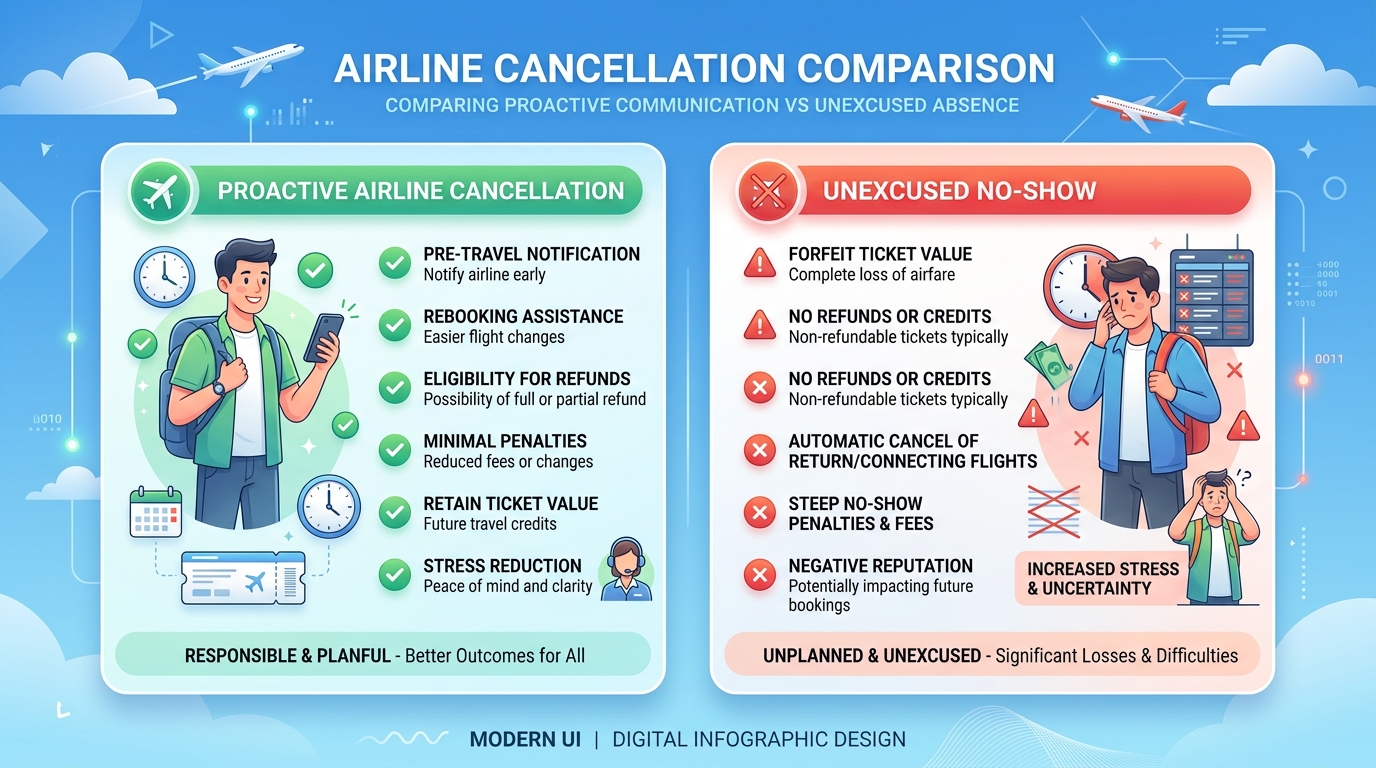 Cancelling before takeoff protects your ticket value and keeps downstream flights safe.
| Situation | Who Initiates It? | Typical Policy Question | Typical Practical Outcome |
|---|---|---|---|
| Passenger Cancellation | Passenger | Can I cancel and receive a refund or credit? | Governed by fare rules; cash refund for flexible fares, travel voucher or tax return for non-refundable fares. |
| No-Show | Passenger (by omission) | What happens to my ticket value and remaining segments? | Ticket marked abandoned; base fare frequently forfeited; remaining downstream flights cancelled. |
| Airline Cancellation | Airline | What options or rebooking rights do I have? | Airline must offer free alternative transportation or a 100% cash refund regardless of ticket type. |
| Schedule Change | Airline | Can I change dates or refund my ticket due to the new time? | If the time shift is significant, passenger may rebook for free or decline and receive a full cash refund. |
| Flight Change | Passenger | What fees and fare differences will I have to pay? | Ticket reissued for new travel dates; customer pays applicable change fees and dynamic fare differences. |
Airline No-Show Policy for Domestic vs International Flights
While core no-show mechanics apply across commercial aviation, domestic and international routes present key differences:
- Domestic Flights: Domestic tickets frequently involve simpler point-to-point pricing. In some domestic markets, full-service airlines have dropped standard change fees on main-cabin fares, making same-day standby or rebooking more accessible if you arrive late. Tax amounts are generally lower, meaning unrecovered taxes represent a smaller sum.
- International Flights: International tickets almost universally carry stricter fare conditions, tiered cancellation penalties, and heavy carrier surcharges. Failing to show up for an international long-haul leg can trigger substantial no-show fees (often exceeding $150 to $300) if you try to rebook. Furthermore, unrecovered statutory taxes on international itineraries often total several hundred dollars, making tax reclamation well worth the administrative effort.
- Border and Immigration Logistics: On international flights, missing an outbound segment can invalidate connected return permits, visa records, or onward transit verifications entered into airline passenger systems.
No-Show Policy When You Booked Through a Travel Agency or OTA
When you buy a flight directly from an airline's website, the airline controls the reservation and handles any refund or modification directly.
When you purchase through an Online Travel Agency (such as Expedia, MakeMyTrip, Agoda, or a corporate travel desk), the third party issues the ticket. This creates unique operational considerations:
- Booking Ownership: If you miss your flight and call the airline hours later, the carrier’s support team may refuse to touch the reservation, instructing you to contact your booking agent.
- Day-of-Travel Discretion: Airport counter staff can sometimes assist with same-day rebooking or standby during an active travel window, but backend refunds or long-term date changes must typically be authorized through the OTA.
- Intermediary Fees: If the airline allows a partial refund or travel credit following a no-show, the agency will receive the funds first. The OTA may deduct its own administrative fee (often $30 to $50) before remitting the remaining balance to you.
Always keep your 6-character airline PNR, your 13-digit electronic ticket number, and your OTA booking confirmation handy when calling for help.
How to Avoid Losing Your Ticket After Missing a Flight
To protect your financial investment when a flight departure goes wrong, keep these practical rules in mind:
- Contact the airline immediately: Every minute counts. Reaching an agent before the flight closes preserves voluntary modification options.
- Do not ignore the booking: Simply walking away from the airport guarantees that automated systems will mark you as a no-show and void remaining sectors.
- Verify downstream and return legs: Explicitly confirm with the agent whether your return flight remains active.
- Ask whether the ticket can be placed on hold: Some full-service carriers allow agents to suspend an open coupon for future travel credit rather than forfeiting the balance.
- Review your fare conditions: Check your e-ticket receipt to see whether post-departure rebooking is permitted.
- Compare rebooking costs with a fresh ticket: If the airline's no-show fee, change fee, and fare difference exceed the price of a one-way seat on a competing carrier, you may save money by booking new travel and claiming the taxes back on the original ticket.
- Save all correspondence: Keep written copies of booking amendments, agent names, and cancellation confirmations.
Step-by-Step — What to Do After a Missed Flight
Use this practical decision process if you miss or are about to miss your departure:
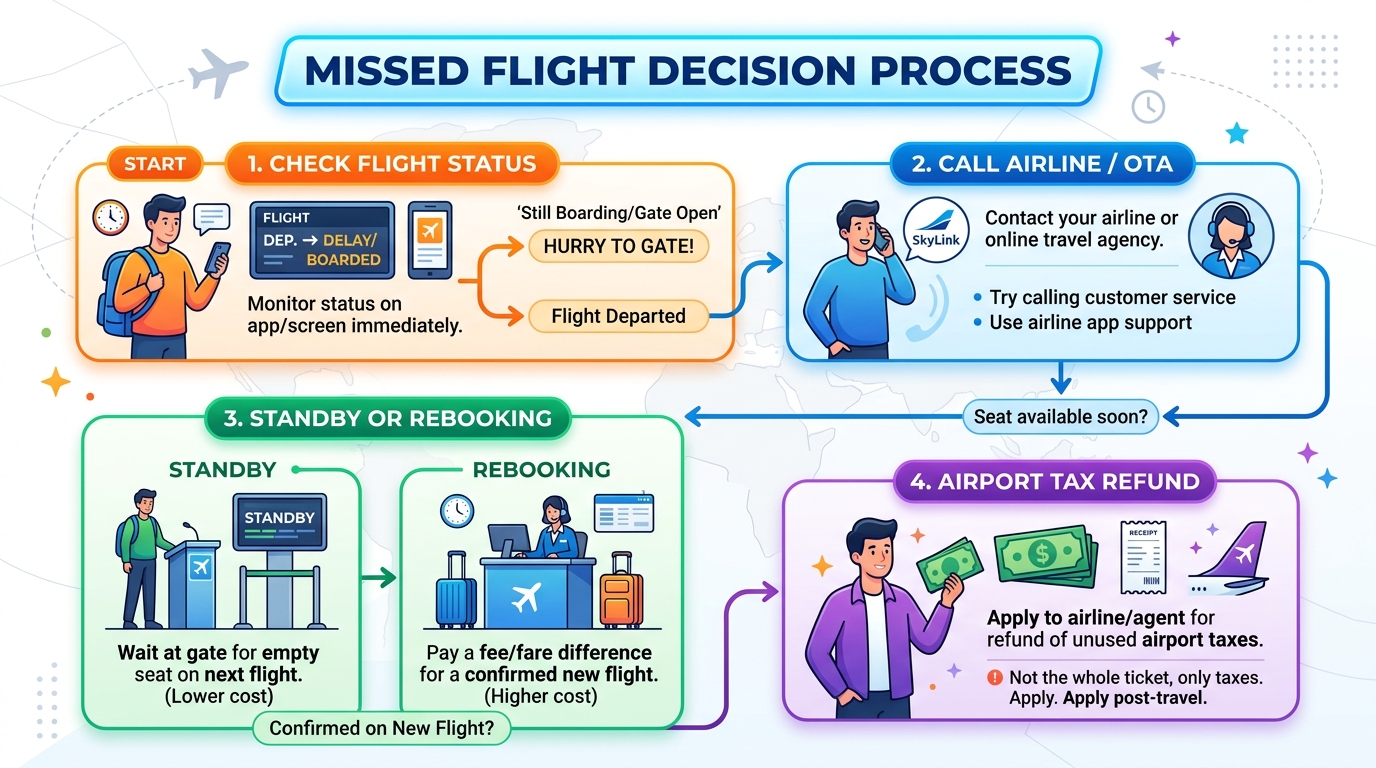 Follow this practical decision tree to avoid forfeiting your remaining ticket value.
                     Step-by-Step Missed Flight Process
                                     │
   1. Confirm Flight Status ─────────┴─────────► Has the aircraft departed?
                                                       │
                               ┌───────────────────────┴───────────────────────┐
                               ▼                                               ▼
                              YES                                              NO
                 Flight has departed                  Flight is still at gate
                               │                                               │
                               ▼                                               ▼
                 2. Call airline/OTA immediately.              Run to gate or customer desk.
                    Ask if PNR is active.         Ask for immediate boarding.
                               │
                               ▼
                 3. Inquire: Was a no-show recorded?
                    Can coupon be reopened?
                               │
                               ▼
                 4. Check remaining itinerary: Protect
                    onward and return flights.
                               │
                               ▼
                 5. Compare options: Standby vs confirmed
                    rebooking vs buying fresh ticket.
                               │
                               ▼
                 6. If un-rebookable: Request return of
                    statutory airport taxes.
                               │
                               ▼
                 7. Secure written confirmation of all
                    itinerary adjustments.
- Confirm whether the flight has departed: If the aircraft is still parked at the gate, an airport agent might still be able to scan your pass if boarding has not completed. Once the gate closes, you must focus on rebooking.
- Check your booking status: Open the airline mobile app to see if your electronic ticket has updated to "suspended" or "cancelled".
- Contact the airline or booking provider: Speak to counter staff if you are at the airport; call customer care immediately if you are elsewhere.
- Ask about no-show consequences: Ask the representative whether your ticket has been flagged as a no-show and whether any grace period applies.
- Check your remaining itinerary: Confirm whether downstream legs or your return flight are still confirmed, and ask to keep them intact.
- Ask about rebooking options: Request same-day standby or confirmed rebooking on the next flight, and ask for a complete cost breakdown.
- Ask about refund or credit eligibility: If you do not plan to travel, request a travel voucher or initiate an unused airport tax refund claim.
- Confirm the final cost before paying: Ensure you understand how much of the fee is an administrative charge versus dynamic fare differences.
- Save the confirmation: Retain your revised e-ticket receipt, updated PNR, and written fee breakdown.
Realistic No-Show Examples
The following hypothetical scenarios demonstrate how airline rules apply in practice:
- Example 1 — Missed Domestic Flight Due to Traffic: A traveler gets stuck in highway traffic and arrives at the terminal 20 minutes after departure. They go directly to the ticket desk. The agent notes the prompt arrival and, applying the airline's informal same-day policy, places the passenger on standby for the next flight for a modest administrative fee rather than charging a new fare.
- Example 2 — Passenger Knows Ahead of Time: A passenger realizes four hours before departure that an urgent family matter prevents them from travelling. Instead of letting the flight depart, they open the airline app and cancel the booking. Because they cancelled before departure, they avoid no-show status and receive a travel credit voucher for the base fare minus standard cancellation penalties.
- Example 3 — Missed Outbound Segment on a Round Trip: A passenger misses their outbound morning flight from New York to London and books a one-way flight on another airline without notifying their original carrier. Four days later, they arrive at London Heathrow for their return flight, only to find the airline canceled their return ticket under sequential coupon rules the moment they failed to show up in New York.
- Example 4 — Missed Connection on a Single Ticket: A traveler flies from Mumbai to Frankfurt with a connection to Paris on a single itinerary. The first flight arrives two hours late, causing the passenger to miss the Paris flight. Because both flights were on a single protected ticket, the carrier does not treat the passenger as a no-show; the transfer desk issues a new boarding pass for the next flight to Paris at no extra charge.
- Example 5 — Airline-Initiated Cancellation: An airline cancels a flight due to a mechanical breakdown. The traveler decides not to take the alternative flight offered the next morning and goes home. The airline's automated system cannot record the passenger as a no-show because the carrier failed to operate the service; the passenger qualifies for a 100% cash refund to their original credit card.
- Example 6 — Booking Handled Through an OTA: A passenger misses a flight booked through an online travel portal. When they call the airline the next day, the airline states that the ticket is restricted and that all changes must be handled by the agency. The passenger contacts the OTA, which calculates the airline's no-show penalty plus an additional agency processing fee before reissuing the ticket.
Common Mistakes After Missing a Flight
- Assuming your return ticket is safe: Believing that missing an outbound flight has no effect on the rest of your itinerary.
- Buying a new ticket immediately: Purchasing an expensive one-way ticket on another airline before checking whether your original carrier can rebook you on standby or for a simple change fee.
- Waiting too long to communicate: Letting hours or days pass before contacting customer support, which allows the electronic ticket record to expire permanently.
- Confusing no-show fees with fare differences: Assuming that paying a published "no-show fee" guarantees a confirmed seat without accounting for higher airfares on the new flight.
- Assuming non-refundable means zero recovery: Forgetting to request a refund for unused airport taxes and government security charges.
- Treating airline cancellations as no-shows: Accepting an expiring travel voucher or paying change fees when the airline was the party that canceled or delayed the flight.
- Ignoring the original booking provider: Calling only the airline when the ticket was issued and controlled by a third-party travel agency.
If you realize that traffic, an unexpected delay, or a sudden change of plans will make catching your flight impossible, pick up your phone and notify the airline or your booking agency before the departure doors close. Taking a minute to cancel or uncouple your booking preserves your statutory tax recovery rights, protects your return journey from automated cancellation, and keeps rebooking avenues open that disappear the moment your ticket is marked as an abandoned seat.