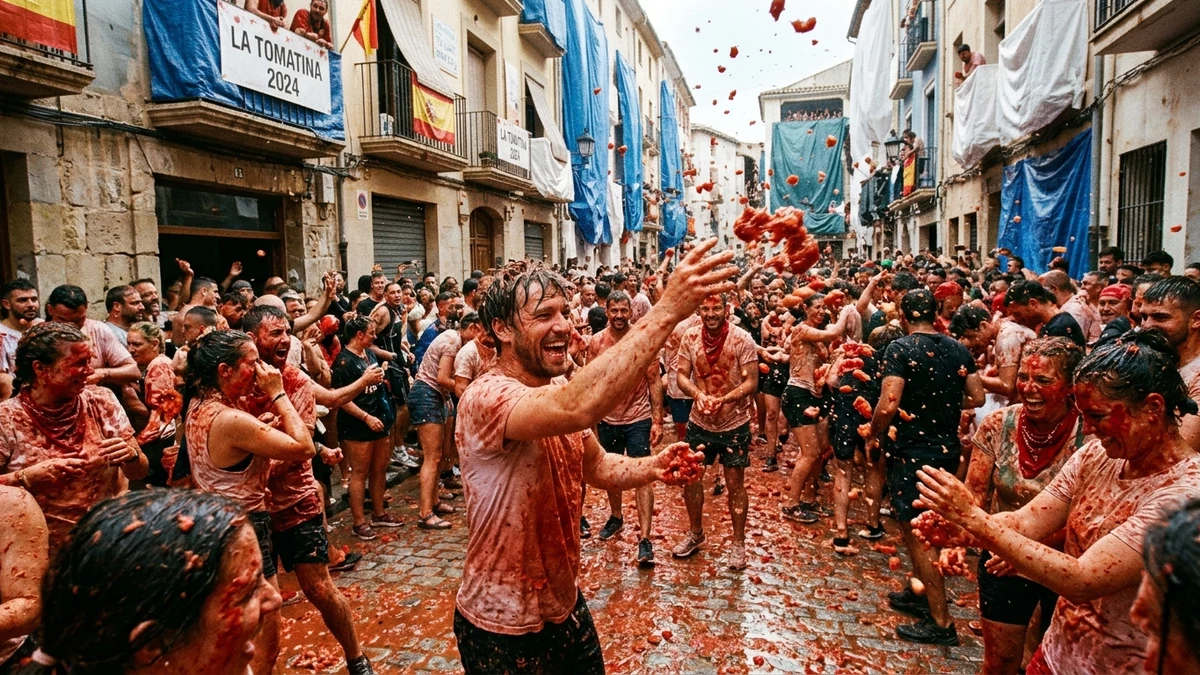
Every August, the quiet Valencian town of Buñol transforms into the epicenter of La Tomatina Spain, the world’s largest and best-known organized food fight. For roughly one hour on the last Wednesday of August, thousands of international visitors and local residents fill the narrow streets of Buñol’s historic center to throw overripe tomatoes at one another in a high-energy, municipal-run celebration.
Located roughly 40 kilometers inland from the Mediterranean city of Valencia, Buñol draws solo backpackers, couples, friend groups, and festival travelers from the United States, the United Kingdom, India, Europe, and beyond. Because the municipality caps participant numbers through an official ticketing system and enforces strict street-access controls, attending La Tomatina requires advance planning—from securing authorized entry passes to arranging pre-dawn rail or bus transfers from Valencia.
This guide covers everything first-time visitors need to plan a smooth, safe trip: how the festival works, its historical roots, how to verify upcoming dates and buy legitimate tickets, what to wear and pack, transport routes from Valencia, accommodation options, EUR budget estimates, safety rules, and realistic Spain itineraries.
Quick La Tomatina Travel Information
| Festival Detail | Verified Information & Planning Context |
|---|---|
| Official Event Name | La Tomatina de Buñol |
| Location | Buñol, Province of Valencia, Valencian Community, Spain |
| Traditional Annual Date | Last Wednesday of August (Upcoming edition exact date: awaiting official confirmation on latomatina.info) |
| Main Event Zone | Town center streets around Calle Cid, Plaza del Pueblo, and Calle San Luis |
| Typical Fight Duration | Approximately 1 hour (historically 11:00 AM – 12:00 PM; verify official edition timetable) |
| Entry Requirement | Official paid entry ticket required (capacity-controlled since 2013; verify exact release dates) |
| Nearest Major City & Airport | Valencia (~38–40 km east of Buñol) / Valencia Airport (VLC) |
| Official Festival Portal | latomatina.info & Ayuntamiento de Buñol |
Table of Contents
- What Is La Tomatina Festival?
- History and Origin of La Tomatina
- When Is La Tomatina Festival Celebrated?
- Where Is La Tomatina Celebrated?
- What Happens During La Tomatina?
- How to Buy La Tomatina Tickets
- La Tomatina Festival Rules and Regulations
- What to Wear at La Tomatina?
- What to Bring to La Tomatina?
- How to Reach La Tomatina, Buñol
- How to Travel from Valencia to Buñol
- Best Places to Stay During La Tomatina
- Estimated La Tomatina Travel Budget
- Best Time to Book Your La Tomatina Trip
- Food and Dining in Valencia and Buñol
- Best Places to Visit Near Buñol
- Suggested La Tomatina Spain Itineraries
- La Tomatina Safety Tips for Visitors
- Is La Tomatina Suitable for Families?
- Accessibility at La Tomatina
- Common Mistakes to Avoid at La Tomatina
- Frequently Asked Questions About La Tomatina
- Final Travel Tips for La Tomatina
Explore Popular Flight Corridors
Find direct vs connecting routes, airline schedules, and airport transfer tips.
What Is La Tomatina Festival?
La Tomatina is an annual municipal festival held in the town of Buñol, in Spain’s Valencia province, where ticketed participants engage in a tightly regulated, one-hour tomato fight using overripe tomatoes supplied by the town council. The event forms the centerpiece of Buñol’s week-long summer festivities honoring the town’s patron saints, San Luis Bertrán and the Virgen de los Desamparados.
Unlike music festivals or passive parades, La Tomatina is a purely participatory street event. There are no concerts during the main battle and no spectator grandstands inside the launch zone—everyone inside the perimeter is part of the action. Because tomatoes contain natural citric acid, the pulp acts as a mild disinfectant on the cobblestone streets once municipal fire trucks hose down the town center immediately after the closing signal.
Key features that make the event distinct include:
- Municipal Organization: The Ayuntamiento de Buñol (Buñol Town Hall) manages crowd capacity, truck routing, medical stations, security checkpoints, and post-event street sanitation.
- Specially Grown Tomatoes: The tomatoes used are low-cost, overripe varieties (historically sourced from Extremadura) grown specifically for the event rather than prime table produce.
- Global Draw: Designated a Fiesta of International Tourist Interest by the Spanish government in 2002, the event attracts visitors from dozens of countries each August.
History and Origin of La Tomatina
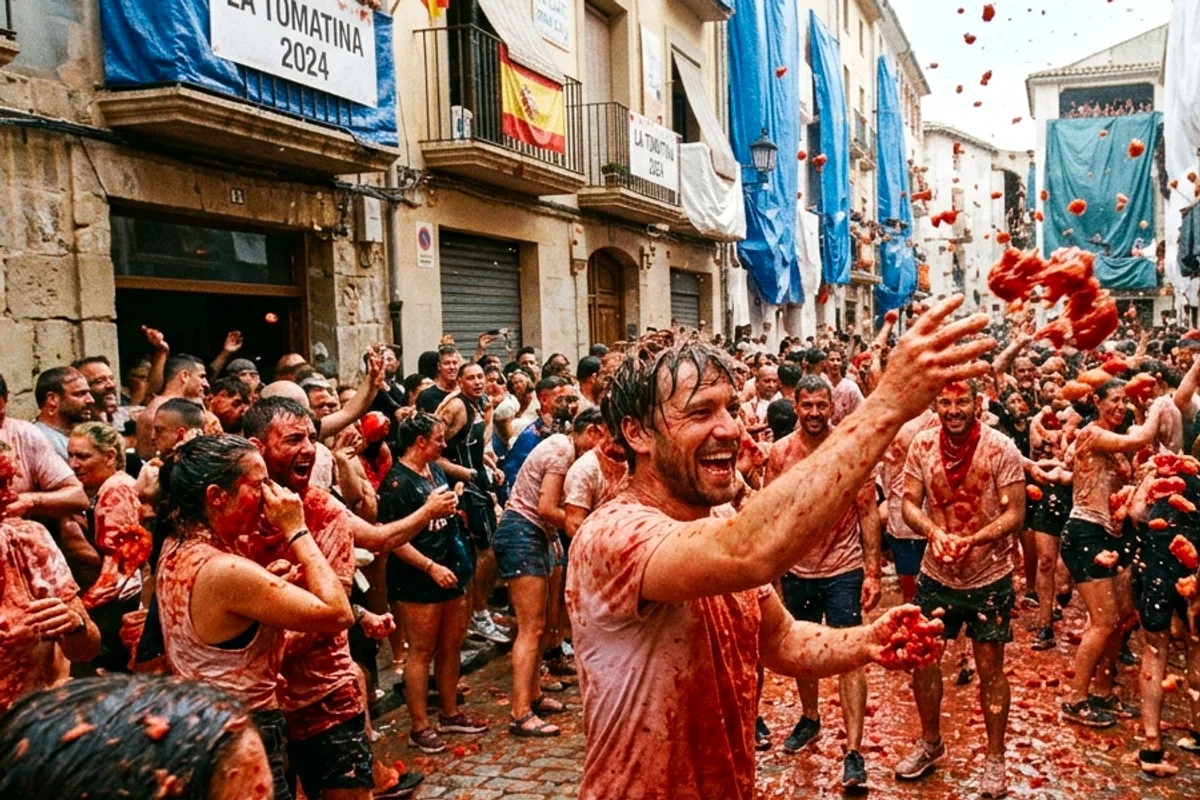
According to historical accounts preserved by Buñol Town Hall and Spain’s Official Tourism Portal, La Tomatina originated in August 1945 during a traditional Gigantes y Cabezudos (giants and big-heads) parade in Buñol’s Plaza del Pueblo.
While local oral histories offer slightly different accounts of the exact spark—some describe young spectators jostling to join the parade and knocking over a participant, while others recount a scuffle breaking out near a neighborhood vegetable stall—historical records agree that young people grabbed tomatoes from a nearby produce stand and began throwing them at one another until local police intervened to break up the melee.
- Early Bans and Persistence (1946–1957): The following year, local youths returned on the same Wednesday in August bringing their own tomatoes from home. Municipal authorities repeatedly banned the gathering during the early 1950s. In 1957, residents staged a mock "burial of the tomato" funeral procession carrying a giant tomato in a coffin accompanied by a marching band—a humorous protest that led the town council to officially authorize the festival.
- International Recognition and Capacity Controls (1980s–Present): From the 1980s onward, television coverage and international travel media turned La Tomatina into a global bucket-list event. As crowds swelled past 40,000 people in streets designed for a town of roughly 10,000 residents, Buñol introduced mandatory entry tickets and official capacity limits in 2013 to protect participant safety and preserve the event’s atmosphere.
When Is La Tomatina Festival Celebrated?
La Tomatina is traditionally held every year on the last Wednesday of August.
- Upcoming Edition Status: Exact official dates, ticket release windows, and daily schedules for the upcoming edition are awaiting official confirmation on latomatina.info and bunyol.es. Always verify the official edition date before purchasing non-refundable flights or lodging.
- Typical Festival Day Schedule (Historical Arrangement):
- 08:00 – 09:30 AM: Security checkpoints open and wristband/ticket exchange desks operate for arriving participants.
- 10:00 AM: Pre-event crowd gathering and the traditional Palo Jabón (greased pole climb) if organized for that edition.
- 11:00 AM: First signal shot fires; tomato trucks enter the perimeter and the main tomato fight begins.
- 12:00 PM: Second signal shot fires; all tomato throwing must stop immediately, and municipal cleaning crews begin hosing down the streets.
- Recommended Arrival Time: Plan to arrive in Buñol at least 2 to 3 hours before the scheduled 11:00 AM start (typically between 07:30 AM and 08:30 AM) to clear ticket/wristband verification, store bags if needed, and walk into the central event zone before access gates reach crowd capacity.
- Best Time to Plan Your Trip: Late August is peak summer across eastern Spain, bringing warm, sunny Mediterranean weather. Building a 3- to 5-day stay around Valencia allows you to combine La Tomatina with coastal sightseeing and regional dining without rushing transport connections.
Planning Travel Logistics?
Use FareWander tools to calculate flight times, luggage rules, and visa requirements.
Where Is La Tomatina Celebrated?
La Tomatina takes place in Buñol (valencian: Bunyol), an inland town in the Hoya de Buñol comarca of the Province of Valencia, Spain, situated approximately 38 to 40 kilometers (24–25 miles) west of Valencia city.
- Main Festival Area: The action is concentrated in Buñol’s historic town center, primarily along Calle Cid, Plaza del Pueblo, and Calle San Luis. These narrow, sloped streets lined with multi-story residential buildings form the enclosed tomato-throwing corridor.
- Local Geography: Surrounded by foothills, orchards, and the Buñol River gorge, the town sits along the A-3 highway corridor linking Valencia with Madrid.
- Access Points: On festival morning, Buñol Town Hall establishes perimeter pedestrian checkpoints around the town center. Only visitors wearing official event wristbands are permitted past the outer security cordons into the main tomato zone.
What Happens During La Tomatina?
While specific entertainment and staging details are confirmed each year by Buñol Town Hall, the typical festival morning follows a well-established sequence:
- Arrival and Wristband Verification: Visitors arriving by train, bus, or car walk toward the town center, presenting their official ticket vouchers and government photo ID at municipal checkpoints to receive a physical entry wristband.
- Pre-Event Atmosphere: Residents on upper balconies drape protective plastic sheeting over building facades and often pour buckets of cold water down onto the cheering crowd below as temperatures climb.
- Palo Jabón (Greased Pole Challenge): Historically staged around 10:00 AM in Plaza del Pueblo, volunteers attempt to climb a tall, soap-greased wooden pole to reach a cured ham (jamón) tied at the top. (Note: Whether the Palo Jabón takes place in a given edition depends on the official annual program.)
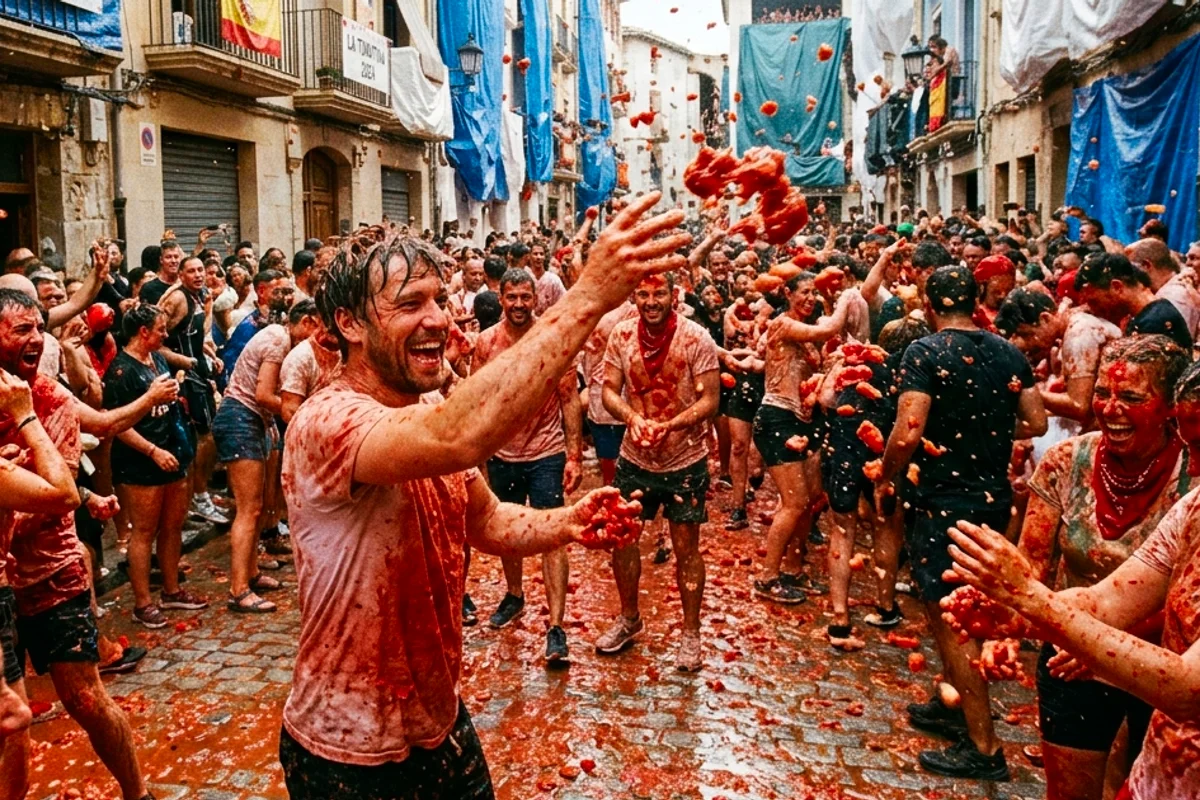
- Tomato Truck Arrival: Around 11:00 AM, a starter signal announces the arrival of flat-bed municipal dump trucks loaded with tons of overripe tomatoes. Staff riding in the truck beds shovel tomatoes into the crowd while trucks tip their beds along the route.
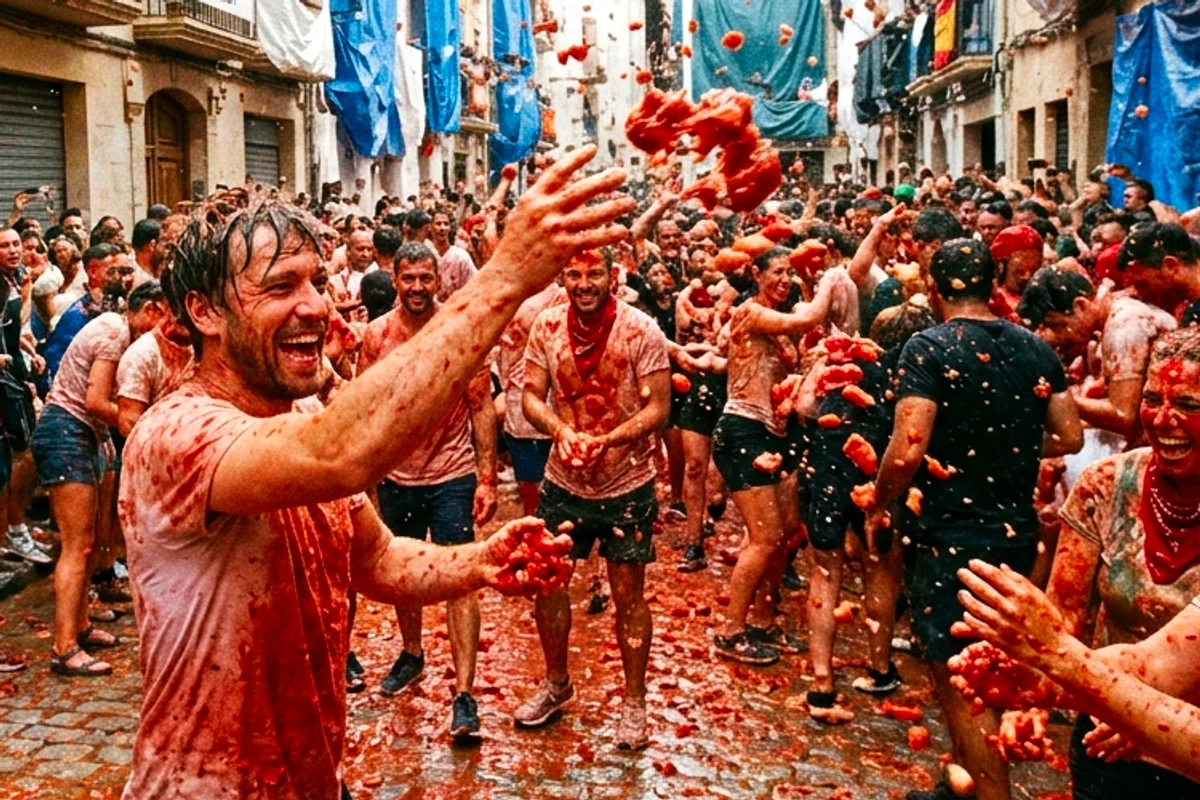
- The Main Tomato Fight: For approximately 60 minutes, participants squash tomatoes in their hands and hurl pulp across the packed streets. Within minutes, the cobblestones are ankle-deep in red tomato juice.
- Official End Signal and Cleanup: At 12:00 PM sharp, a second signal shot marks the end of the battle. Throwing tomatoes after this signal is strictly prohibited. Fire engines and municipal sanitation trucks enter immediately to wash down the streets, while participants head toward public shower zones, the river area, or designated tour-bus wash points to rinse off.
How to Buy La Tomatina Tickets
Since 2013, entry to the main La Tomatina zone in Buñol has been strictly ticketed and capacity-controlled. You cannot simply walk into the tomato-throwing streets without an official pass.
- Official Ticket Portal: Purchase general entry tickets directly through the official municipal ticketing platform at latomatina.info (operated in coordination with Buñol Town Hall).
- Ticket Categories:
- General Entry Ticket: Grants wristband access to the official tomato-throwing zone on festival morning.
- Official Travel & Bus Packages: Authorized tour partners listed via latomatina.info bundle general entry tickets with round-trip coach transfers from Valencia (and sometimes Madrid or Barcelona), lockers, and post-event shower facilities.
- Truck Ride / VIP Experiences: Occasionally offered in limited quantities through official partners—verify exact availability and rules on latomatina.info when sales open.
- Pricing & Availability: Official ticket prices and exact participant capacity for the upcoming edition are awaiting official publication. Historically, basic general admission tickets sold directly by the municipality have been modestly priced compared to bundled tour packages, and official allocations routinely sell out weeks or months ahead of August.
- Ticket Confirmation & Wristband Exchange: Buyers receive an electronic voucher upon purchase, which must be presented alongside a valid passport or national ID card at designated exchange points in Buñol on festival morning (or at authorized pre-event pickup points in Valencia, if announced) to collect your physical wristband.
- Beware of Unauthorized Resellers: Never purchase tickets from unverified social media sellers, street touts, or unauthorized scalping sites. Municipal checkpoints scan barcodes and verify IDs against official purchaser records; duplicate or invalid vouchers will be denied entry.
- Cancellation and Refund Policies: Official La Tomatina tickets are traditionally non-refundable and non-transferable once issued, except in the event of official municipal cancellation. Review the exact terms of sale on latomatina.info before completing checkout.
La Tomatina Festival Rules and Regulations
To prevent injuries in dense crowds, Buñol Town Hall enforces strict safety regulations (latomatina.info). Security staff inspect participants at entry gates, and violations can result in immediate removal from the event zone:
- Squash Every Tomato Before Throwing: Never throw a whole, hard tomato—crushing it in your hand first prevents blunt-force bruises or eye injuries.
- Do Not Bring Prohibited Objects: Glass bottles, cans, hard containers, backpacks, large bags, selfie sticks, rigid camera tripods, umbrellas, and any sharp or dangerous objects are strictly forbidden inside the event perimeter.
- Do Not Rip or Tear Clothing: Tearing off your own shirt or other participants' T-shirts is prohibited by municipal rules.
- Keep a Safe Distance from Tomato Trucks: Step back immediately when municipal trucks move through the narrow streets; never attempt to climb onto moving vehicles.
- Stop Throwing Immediately at the Closing Signal: Once the 12:00 PM end signal sounds, throwing any remaining tomatoes is forbidden so sanitation crews and emergency vehicles can enter safely.
- Follow Event Staff and Police Instructions: Obey directions from Policía Local, Guardia Civil, Red Cross volunteers, and municipal stewards at all times.
- Respect Local Residents and Property: Do not climb residential balconies, block doorways, or throw tomatoes at residents or emergency personnel outside the active zone.
(Verify any updated rules or age-verification requirements published for the upcoming edition on latomatina.info prior to arrival.)
What to Wear at La Tomatina?
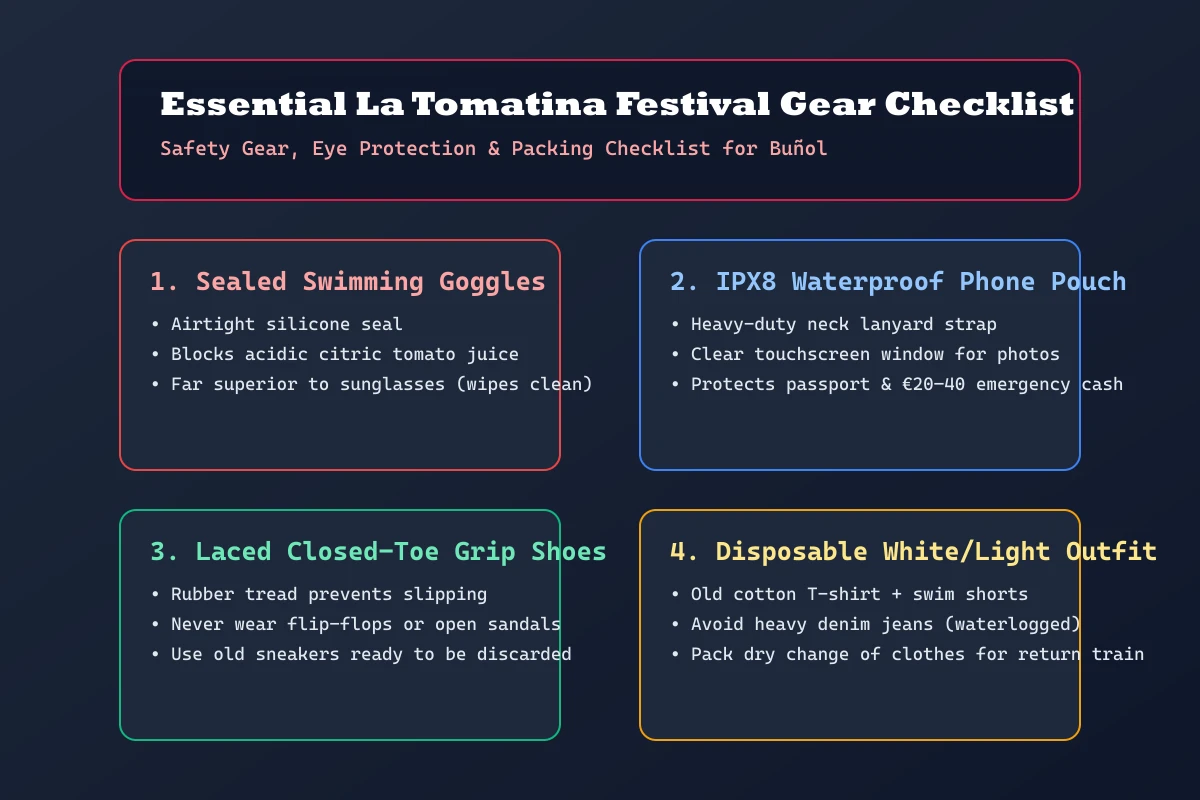
Every item of clothing you wear into the tomato zone will be soaked in acidic tomato pulp and likely discarded afterward. Dress purely for safety, traction, and easy disposal:
- Old White or Light-Colored Cotton T-Shirt: A simple T-shirt you are prepared to throw away afterward (avoid sleeveless tank tops if you want light shoulder sun protection).
- Comfortable Swim Shorts or Old Athletic Shorts: Quick-drying swimwear or old shorts with zippered pockets work far better than heavy denim jeans, which become waterlogged and heavy.
- Closed-Toe Shoes with Strong Grip: Crucial. Wear old running shoes, water shoes, or trail sneakers that lace tightly to your feet. Never wear flip-flops, slides, or open-toed sandals—they will be ripped off in the crowd, and cobblestones become slick as ice under tomato juice.
- Sealed Swimming Goggles: Essential. Citric acid in tomato pulp stings eyes severely. Well-fitted swimming goggles allow you to wipe away pulp cleanly and see safely throughout the hour.
- Waterproof Phone Pouch (Lanyard Style): If you bring a smartphone, seal it inside a certified IPX8 waterproof pouch worn around your neck under your shirt.
- Hair Tie (For Long Hair): Tie long hair securely into a bun or braid; tomato seeds and pulp are notoriously difficult to wash out of loose hair.
- Zero Jewelry or Expensive Accessories: Leave watches, rings, necklaces, prescription glasses (unless secured with a sports strap under wide goggles), and designer sunglasses at your hotel.
What to Bring to La Tomatina?
Because backpacks and large bags are barred from the central tomato-throwing streets, travel light and arrange secure storage outside the perimeter (such as your tour coach, a pre-booked locker in Buñol, or your Valencia hotel):
- Printed or Offline Digital Ticket Voucher (stored in a waterproof sleeve or on your phone)
- Original Passport or Government Photo ID (mandatory for wristband exchange; carry in a sealed waterproof pouch or secure locker)
- Sealed Swimming Goggles (test the strap fit before arriving)
- Disposable Outfit & Closed-Toe Grip Shoes (worn into the event)
- Complete Change of Dry Clothes & Clean Sandals/Shoes (stored in a locker or tour bus for the ride back to Valencia)
- Small Microfiber Towel & Biodegradable Wet Wipes (for post-fight cleanup)
- Plastic Trash Bag (to seal wet, tomato-soaked shoes or clothes if not discarding them in municipal bins)
- Cash in Small Euro Notes/Coins (€20–€40) (card readers may not work in wet conditions or at small street stalls)
- High-SPF Water-Resistant Sunscreen (applied before entering the queue)
- Drinking Water (Note: Hard plastic/glass bottles are prohibited inside the fight zone; hydrate thoroughly beforehand and carry water only in permitted containers outside the security cordon)
How to Reach La Tomatina, Buñol
Buñol has no commercial airport of its own; international visitors travel via Valencia (the nearest gateway) or Madrid (connected by high-speed rail to Valencia).
By Air
- Valencia Airport (VLC — Aeropuerto de Valencia-Manises): Located roughly 8 km west of Valencia city center and ~32 km east of Buñol along the A-3 motorway (AENA Valencia Airport).
- International & European Connections: VLC receives direct flights from major European hubs—including London, Paris, Frankfurt, Amsterdam, Rome, Zurich, and Madrid. Travelers flying from the USA, India, Canada, or Australia typically connect via Madrid (MAD), Barcelona (BCN), London (LHR/LGW), Paris (CDG), or Frankfurt (FRA) before taking a short connecting flight into Valencia.
- Airport to Valencia City Center: Metrovalencia Lines 3 and 5 run directly from the airport terminal to central stations (such as Xàtiva and Alameda) in roughly 20–25 minutes.
By Train
- Madrid to Valencia High-Speed Rail: Travelers landing in Madrid-Barajas (MAD) can take a Renfe AVE, Avlo, Ouigo, or Iryo high-speed train from Madrid Chamartín to Valencia Joaquín Sorolla in approximately 1 hour 50 minutes to 2 hours.
- Valencia to Buñol Commuter Train: Renfe Cercanías Line C-3 connects Valencia with Buñol station. (Note: During major infrastructure upgrades or festival days, Renfe occasionally operates rail-replacement buses or special festival timetables—verify exact schedules on renfe.com closer to your travel date.)
By Bus & Official Festival Transfers
- Authorized Tour Operator Coaches: Booking an official bus transfer through partners listed on latomatina.info is often the simplest option for first-time visitors, offering direct morning drop-off near Buñol’s checkpoints and afternoon return transfers to central Valencia.
- Regional Bus Services: Regular intercity buses operate between Valencia Bus Station (Estació d'Autobusos de València) and Buñol, though festival-day road closures alter drop-off points.
By Car
- Driving Route: Buñol sits directly off the A-3 Autovía del Este highway, roughly 35–45 minutes west of central Valencia under normal traffic conditions.
- Road Closures & Parking Restrictions: On festival morning, police close Buñol’s central streets to all private vehicles. Drivers must park in designated perimeter parking zones outside town and walk into the center. Do not drive a rental car without seat covers if you plan to sit inside before showering.
How to Travel from Valencia to Buñol
Most international visitors base themselves in Valencia and make a half-day excursion to Buñol on festival morning.
| Transport Option | Approximate Distance / Context | Key Advantages | Potential Limitations | Official Verification Resource |
|---|---|---|---|---|
| Renfe Cercanías (Line C-3) | ~38–40 km from Valencia city | Economical fare; drops within walking distance of Buñol town center. | Very crowded morning trains; long return queues after 12:30 PM; verify if rail-replacement buses apply. | renfe.com |
| Official Festival Shuttle / Tour Bus | Direct from designated Valencia pickup points | Guaranteed seat; often bundled with wristband pickup, lockers, and post-fight showers. | Fixed departure and return times; higher cost than public commuter rail. | latomatina.info |
| Taxi or Private Transfer | ~35–45 min drive via A-3 (subject to festival traffic) | Door-to-door convenience for groups splitting fares. | Drivers will not allow wet/tomato-stained passengers inside vehicles without full clean clothes; surge pricing and perimeter drop-off limits apply. | Visit Valencia Transport |
| Rental Car | ~38–40 km via A-3 West | Flexible departure schedule; easy trunk storage for dry clothes. | Strict town center road closures; limited perimeter parking; risk of tomato stains on rental upholstery (incurring heavy cleaning fees). | Dirección General de Tráfico (DGT) |
Best Places to Stay During La Tomatina
Because Buñol is a small town with limited hotel and guesthouse inventory, the vast majority of visitors stay in Valencia and commute on festival morning.
Staying in Buñol vs. Staying in Valencia
- Buñol: Eliminates early-morning commuting and lets you walk straight back to a private shower after the fight. However, rooms are scarce, sell out up to a year in advance, carry steep festival premiums, and offer limited dining or nightlife compared to Valencia.
- Valencia: Offers hundreds of hotels, hostels, and apartments, direct airport metro access, beaches, world-class dining, and easy day-trip connections—at the cost of a 06:30–07:00 AM wake-up call on festival morning.
Neighborhood Comparison for La Tomatina Visitors
| Location / Neighborhood | Accommodation Styles | Transport Access to Buñol | Best Suited For |
|---|---|---|---|
| Buñol Town | Small guesthouses, rural apartments, limited local hotels | Walking distance to festival checkpoints | Travelers who book 9–12 months ahead and prioritize immediate private shower access. |
| Valencia City Centre (Extramurs / near Estació del Nord) | Mid-range hotels, boutique stays, budget hostels | Immediate walking access to Valencia rail/bus departure hubs | First-time visitors and solo travelers wanting the easiest pre-dawn transit to Buñol. |
| Valencia Old Town (Ciutat Vella / El Carmen) | Historic boutique hotels, hostels, serviced apartments | 10–15 min walk or short metro ride to departure stations | Sightseers, couples, and cultural travelers exploring plazas, markets, and tapas bars. |
| Ruzafa (Russafa) | Trendy boutique hotels, design apartments, social hostels | 10–15 min walk to Estació del Nord / central bus stops | Solo travelers, young couples, and food lovers seeking vibrant cafes and evening dining. |
| Coastal Valencia (El Cabanyal / Malvarrosa) | Beachfront hotels, vacation apartments | 20–30 min via tram/metro to central departure points | Travelers combining La Tomatina with a Mediterranean beach holiday. |
Estimated La Tomatina Travel Budget
The table below provides an indicative per-person budget in Euros (EUR) for a 3-night / 4-day trip centered on Valencia and La Tomatina. Because upcoming official ticket prices and seasonal airfares vary by departure country and booking lead time, all figures below are planning estimates rather than guaranteed quotes.
| Expense Category | Budget Traveler (EUR) | Mid-Range Traveler (EUR) | Premium Traveler (EUR) | Pricing Notes & Assumptions |
|---|---|---|---|---|
| La Tomatina Ticket (1 Day) | €15 – €25 (est. municipal base ticket) | €55 – €95 (est. ticket + official Valencia bus transfer) | €120 – €250+ (VIP/hospitality packages if offered) | Upcoming edition prices awaiting official confirmation on latomatina.info. |
| Accommodation (3 Nights, Per Person) | €110 – €180 (shared hostel dorm in Valencia) | €240 – €390 (3-star hotel/apartment, double occupancy split) | €550 – €950+ (4- to 5-star boutique/luxury hotel) | Late August is peak summer in Valencia; rates include standard Spanish VAT where applicable. |
| Local & Festival Transport (Valencia–Buñol) | €10 – €15 (commuter train/bus round-trip) | Included in bus package (or €15–€30) | €90 – €160 (private taxi/chauffeur split or rental) | Commuter fares subject to current Renfe tariffs. |
| Airport Transfers (VLC ↔ Valencia) | €8 – €12 (Metrovalencia round-trip) | €8 – €12 (Metrovalencia) or €25 (shared taxi) | €45 – €70 (private airport taxi round-trip) | Based on Metrovalencia airport zone fares. |
| Food & Drinks (4 Days) | €80 – €120 (bakery breakfasts, casual tapas, grocery snacks) | €160 – €240 (sit-down paella lunches, tapas bars, drinks) | €320 – €500+ (fine dining, wine pairings, rooftop bars) | Valencia offers strong dining value outside immediate tourist plazas. |
| Festival Gear & Disposable Clothing | €15 – €25 (goggles, waterproof pouch, thrift T-shirt) | €25 – €45 (quality swim goggles, dry bag, water shoes) | €40 – €75 (new athletic wear, polarized goggles, locker) | Buy goggles and pouches before arriving in Buñol to avoid festival-day markups. |
| Sightseeing & Miscellaneous | €20 – €40 (free walking tours, beach, churches) | €50 – €90 (City of Arts and Sciences, bike rental) | €120 – €200+ (private guided tours, Albufera boat trip) | Optional depending on your Valencia itinerary. |
| Estimated 4-Day Land Total (Excl. Flights) | €258 – €417 | €553 – €922 | €1,285 – €2,205+ | International flights extra: ~€80–€250 (Europe) or ~€550–€1,100+ (USA/India/Asia round-trip). |
Best Time to Book Your La Tomatina Trip
- Festival Tickets (Immediately Upon Official Release): Monitor latomatina.info from winter through spring. Official municipal tickets are released in batches and regularly sell out well before August.
- Accommodation (6 to 9 Months Ahead): Reserve refundable hotels or apartments in Valencia early. August coincides with both La Tomatina and Spain’s domestic summer holiday peak, pushing central Valencia occupancy close to capacity.
- International & European Flights (4 to 7 Months Ahead): Book flights into Valencia (VLC) or Madrid (MAD) once your festival date is confirmed, opting for flexible fare classes if your travel plans are still finalizing.
- Public Transport & High-Speed Rail (1 to 3 Months Ahead): Renfe long-distance tickets from Madrid or Barcelona to Valencia typically open 60 to 90 days in advance; local commuter tickets are purchased closer to travel.
Food and Dining in Valencia and Buñol
Valencia is the birthplace of Spain’s most famous rice dish, making culinary exploration a highlight of any La Tomatina trip:
- Paella Valenciana: Traditional Valencian paella is cooked over wood fire in a wide shallow pan using short-grain bomba or senia rice, saffron, chicken, rabbit, green beans (ferraúra), and white lima beans (garrofó)—traditionally eaten at lunchtime rather than late at night.
- Horchata y Fartons: Cool off in the August heat with horchata de chufa (a sweet, chilled drink made from tiger nuts) served alongside fartons (soft, sugar-glazed pastries for dipping) at historic horchaterías in central Valencia.
- Tapas & Coastal Seafood: Sample patatas bravas, esgarraet (roasted red pepper and salted cod salad), clóchinas (Valencian mussels), and agua de Valencia (a local cocktail blending cava, fresh Valencian orange juice, vodka, and gin).
- Post-Festival Dining Tip: On festival day in Buñol, street vendors near the perimeter sell cold drinks, bocadillos (crusty Spanish sandwiches), and grilled snacks once you have rinsed off and changed into dry clothes.
Best Places to Visit Near Buñol
Extend your festival trip with easy sightseeing around Buñol and Valencia:
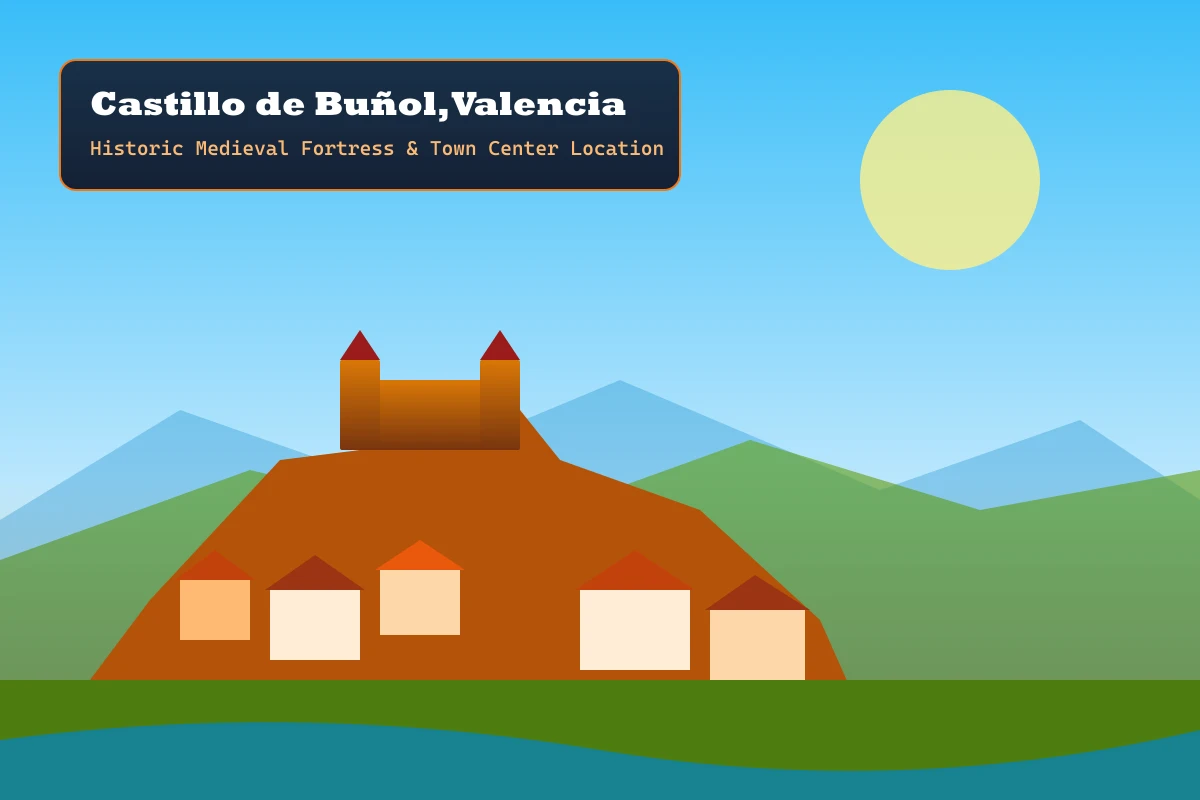
- Buñol Castle (Castillo de Buñol): Perched on a rocky crag overlooking the town center, this 11th- to 13th-century medieval fortress features two walled enclosures, a keep, and an archaeological museum—ideal for an afternoon visit the day before or after La Tomatina.
- Valencia Old Town (Ciutat Vella): Explore the Gothic Valencia Cathedral, climb the Miguelete bell tower, admire the UNESCO-listed La Lonja de la Seda (Silk Exchange), and browse fresh produce stalls at Mercado Central (Central Market).
- City of Arts and Sciences (Ciudad de las Artes y las Ciencias): Santiago Calatrava’s futuristic cultural complex set in the drained Turia riverbed, housing the Oceanogràfic aquarium, Hemisfèric cinema, and interactive Science Museum.
- Malvarrosa & Patacona Beaches: Wide, sandy Mediterranean beaches minutes from central Valencia by tram—ideal for relaxing the day after the tomato fight.
- Albufera Natural Park: Located ~10 km south of Valencia, this freshwater lagoon and rice-growing wetland offers sunset boat rides and traditional lakeside paella restaurants in El Palmar.

Suggested La Tomatina Spain Itineraries
1-Day La Tomatina Express Itinerary (From Valencia)
- 06:30 AM: Wake up in Valencia, eat a light breakfast, and dress in disposable clothes, closed-toe grip shoes, and goggles; pack dry clothes and a towel in a daypack.
- 07:15 AM: Board your pre-booked official festival shuttle bus or commuter train from Valencia to Buñol.
- 08:15 AM: Arrive in Buñol, present your voucher and passport/ID to collect your official wristband, and store your dry clothes bag in a designated locker or tour bus.
- 09:30 AM: Enter the town center security cordon and soak up the pre-event atmosphere along Calle Cid or Plaza del Pueblo.
- 11:00 AM – 12:00 PM: Participate in the main La Tomatina tomato fight.
- 12:00 PM – 01:30 PM: Exit the street zone when the closing signal sounds, rinse off at public showers or wash stations, retrieve your dry clothes, and grab a bocadillo and cold drink.
- 02:00 PM – 03:30 PM: Return to Valencia by shuttle bus or train for a late afternoon rest and tapas dinner.
2-Day Valencia and La Tomatina Itinerary
- Day 1 (Arrival & Historic Valencia): Arrive at Valencia Airport (VLC), check into your central hotel, and explore Valencia Cathedral, Mercado Central, and Plaza de la Virgen. Pick up swimming goggles and a waterproof phone pouch if needed, eat an early dinner, and prepare your festival outfit.
- Day 2 (La Tomatina & Evening Celebration): Travel to Buñol early for La Tomatina (07:15 AM – 02:30 PM). Return to Valencia for a thorough hot shower, late afternoon rest, and an evening stroll through Ruzafa or Turia Gardens.
3-Day Spain Festival & Coastal Trip
- Day 1 (Valencia Old Town & Paella): Arrive in Valencia, enjoy an authentic lunchtime Paella Valenciana, tour La Lonja de la Seda and Mercado Central, and turn in early ahead of festival morning.
- Day 2 (La Tomatina in Buñol): Morning trip to Buñol for La Tomatina; afternoon recovery in Valencia followed by sunset drinks and tapas in El Carmen.
- Day 3 (Modern Valencia & Mediterranean Beach): Spend the morning at the City of Arts and Sciences, followed by an afternoon relaxing on Malvarrosa Beach or taking a sunset boat tour on the Albufera lagoon before onward travel.
La Tomatina Safety Tips for Visitors
While La Tomatina is a festive, welcoming community event, the combination of dense crowds, slippery streets, and hot August weather requires practical caution:
- Protect Your Eyes at All Times: Fresh tomato pulp is acidic and contains tiny seeds that irritate eyes. Wear snug swimming goggles throughout the fight and keep a clean corner of a cloth tucked inside a waterproof pouch to wipe your lenses.
- Watch Your Footing on Wet Cobblestones: Streets become coated in slick tomato skin and juice. Walk deliberately with bent knees, avoid running, and wear laced closed-toe shoes with rubber tread.
- Hydrate Before and After: August temperatures in inland Valencia frequently exceed 30°C (86°F). Drink plenty of water and electrolytes before entering the crowd and immediately after exiting, as intense physical movement in dense crowds causes rapid dehydration.
- Manage Crowd Density: The narrow streets around Calle Cid become tightly packed, especially near incoming tomato trucks. If the center of the crowd feels overwhelming, move steadily toward side streets or lower-density edges of the route. Do not attend if you are unwell, injured, or uncomfortable in dense, jostling crowds.
- Use the Buddy System & Set a Meeting Point: Mobile reception can become congested during peak hours. Agree on a clear post-fight landmark outside the security cordon (such as Buñol train station or your tour bus parking lot) in case your group separates.
- Locate Red Cross Medical Posts: Municipal medical tents and Red Cross (Cruz Roja) responders are stationed just outside the main street corridor—seek assistance immediately if you experience dizziness, heat exhaustion, cuts, or eye irritation.
Is La Tomatina Suitable for Families?
The main La Tomatina fight is generally not recommended for young children due to intense crowd compression, heavy moving trucks, and slippery footing.
- Official Age Restrictions: Buñol Town Hall enforces minimum age rules for entry into the main adult event zone (historically restricted to participants aged 18 and over, or specific accompanied youth rules—verify exact age limits for the upcoming edition on latomatina.info before booking).
- La Tomatina Infantil (Children's Edition): In recent years, Buñol has organized a separate, scaled-down Tomatina Infantil for young children (typically ages 4–14) on the Saturday preceding the main festival. Confirm whether the children's edition is scheduled on bunyol.es.
- Family Alternatives in Valencia: Families visiting Valencia in late August can enjoy the Oceanogràfic aquarium, Gulliver Park in the Turia Gardens, Bioparc Valencia, and calm sandy beaches at Malvarrosa while adults take turns attending the festival.
Accessibility at La Tomatina
Because La Tomatina takes place in a historic town center with narrow cobblestone streets, steep inclines, dense standing crowds, and slick surfaces, navigating inside the main tomato-throwing corridor presents significant physical barriers for wheelchair users and visitors with limited mobility.
- Accessible Transport: Renfe and Metrovalencia provide accessible train and station facilities across major Valencia routes—verify step-free access on specific Buñol commuter services in advance.
- Municipal Assistance: Visitors with disabilities or specific accessibility requirements should contact Buñol Town Hall or the official festival organizers via latomatina.info well ahead of the event to inquire about accessible viewing areas or support services.
Common Mistakes to Avoid at La Tomatina
- Booking Accommodation Too Late: Waiting until July or August leaves only overpriced or distant rooms in Valencia; book refundable lodging 6–9 months ahead.
- Buying Tickets from Unofficial Resellers: Third-party scalpers risk voided barcodes at municipal checkpoints; buy exclusively via latomatina.info or authorized partners.
- Wearing Expensive or Brand-New Clothing: Tomato acid and stains permanently ruin fabrics; wear disposable clothes.
- Wearing Flip-Flops or Sandals: Open footwear slips off in the crowd and offers zero traction on wet cobblestones; wear laced closed-toe sneakers or water shoes.
- Ignoring Official Rules (Especially Whole Tomatoes & Backpacks): Throwing un-squashed tomatoes injures people, and backpacks are turned away at security gates.
- Bringing Unprotected Phones or Cameras: Tomato juice destroys unsealed charging ports and lenses; use a certified IPX8 waterproof pouch.
- Failing to Arrange Return Transport & Dry Clothes: Public buses and taxis will not board tomato-covered passengers; pack a dry change of clothes and pre-plan your train or shuttle return.
- Underestimating Crowd Density: Positioning yourself right beside incoming dump trucks leads to heavy pushing; stay toward calmer sections if it is your first time.
- Skipping Sun Protection & Pre-Event Hydration: Standing outdoors in late-August Spanish heat for two hours before 11:00 AM causes sunburn and dehydration without water-resistant sunscreen and early hydration.
- Forgetting Eye Protection: Sunglasses fall off easily and let acidic juice drip in from above; wear snug swimming goggles instead.
Frequently Asked Questions
La Tomatina is an annual municipal festival in Buñol, Spain, where ticketed participants throw overripe tomatoes at one another in the town center streets for approximately one hour.
Final Travel Tips for La Tomatina
A memorable La Tomatina Spain experience comes down to smart advance logistics: monitor latomatina.info to secure official wristbands early, book refundable accommodation in Valencia several months before August, and confirm your morning train or shuttle transfer well ahead of festival week. On the day itself, wear laced closed-toe shoes and snug swimming goggles, squash every tomato before throwing, and keep a dry change of clothes waiting outside the perimeter. Once the streets are washed clean, take an extra day or two to enjoy Valencia’s historic plazas, Mediterranean beaches, and authentic paella.
Planning your flights and connections to Spain? Explore route options and travel planning guides across Europe on FareWander to map out your Valencia arrival and onward itinerary.